
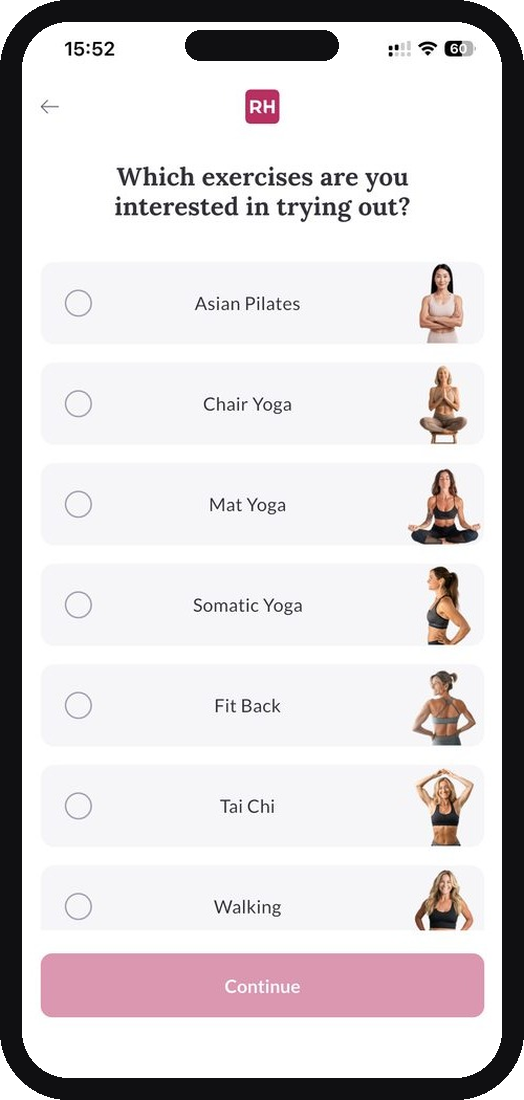
A subscription weight-loss app marketed to women over 40, with quiz-gated pricing that varies but is commonly about $20 to $40 a month, and no free trial · low-impact home workouts such as wall Pilates, chair yoga, somatic yoga and Tai Chi, plus meal plans and intermittent fasting · from Reverse Group, a European company · A mat, and optional light weights.
Researched from: the official app store listings and site (verified August 2026) · Apple App Store, Google Play, Trustpilot and the Better Business Bureau · independent expert reviews, including a registered dietitian · peer-reviewed exercise and menopause science · Not personally tested. Testing status: Data profile.
Reverse Health Data Profile 2026: Quick Answer
Data profile: research-based, not personally tested. Hands-on score pending.
Women who want short, gentle, low-impact home workouts and a simple meal plan, and who are comfortable managing a subscription carefully
You want progressive strength and bone work, genuine menopause programming, a weight-neutral approach, a free trial, or transparent pricing without billing hassle
A quiz-personalised weight-loss app for women 40+ combining low-impact workouts, meal plans, intermittent fasting and habit coaching
About 15 to 20 minutes, low-impact
Little to none: a mat, a wall or chair, and optional light dumbbells
Low, across wall Pilates, chair yoga, somatic yoga and Tai Chi
Weak. Gentle and accessible, but the menopause angle is mostly marketing, with no strength or bone work, no hormone content, and a weight-loss focus
None. On-demand workouts and a personalised daily plan
iOS and Android; no wearable, Apple Health or Google Fit sync, and no confirmed web or offline use
Quiz-gated and variable; commonly about $20 to $40/month, with short intro plans from around $7 a week. No free trial.
None; access is fully paid after the quiz, with no free trial
A 30-day money-back guarantee is advertised but reportedly hard to claim; billing and refund complaints are common, so manage the subscription carefully
Neutral on HRT; makes weight-loss claims without strong clinical backing, so treat health claims with caution
Active and frequently updated
5.2 / 10
Quick Verdict
Worth it for women over 40? Only with real caution, and there are better options.
Reverse Health earns 5.2/10 on our research-based evaluation, a below-average score for reasons that matter to this audience. The genuine positives are that its workouts are low-impact and joint-friendly, the sessions are short and beginner-friendly, and the meal plans give some structure. But it is a weight-loss app with a menopause marketing wrapper rather than genuine menopause programming: independent reviewers, including a registered dietitian, found no real menopause science, could not verify the “certified dietitian” claims, and flagged an aggressive weight-loss approach with no eating-disorder screening. It has no progressive strength or bone work, the single most important training need at midlife, and it carries a heavy record of billing, auto-renewal and refund complaints, with no free trial. Our take: if you want gentle low-impact movement there are better-value, more transparent options, and for real menopause programming a purpose-built platform is a far safer choice.
How this profile is different, and a word of caution. We have not personally completed a Reverse Health subscription. This is a research-based Data Profile built from the official pages, the app store and trust listings, independent expert reviews and the science. It is also a cautious one: Reverse Health is a weight-loss app that markets heavily to menopause, and independent reviewers, including a registered dietitian, describe its menopause angle as largely marketing, question its stated credentials, and flag aggressive weight-loss framing. It also has a heavy record of billing and cancellation complaints. We cover it because it has real search demand and does offer gentle, followable workouts, but read this as a careful, eyes-open profile. This is education, not medical advice; speak to your clinician, especially about weight, HRT or existing conditions, and if weight or food feels distressing, please reach out to a professional.
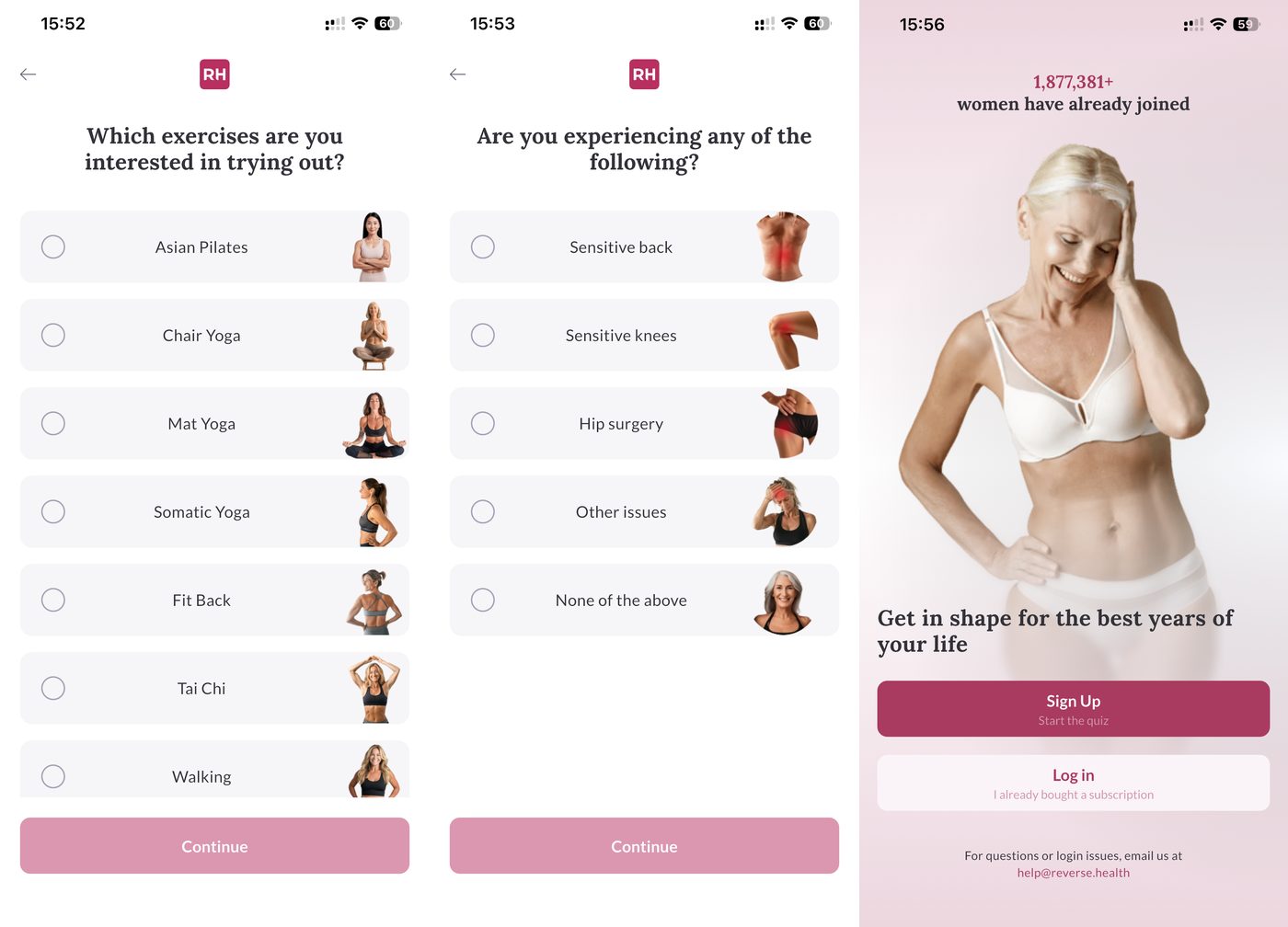
What signing up is like, and why we could not test inside. I started the sign-up myself to see how Reverse Health presents itself. It opens with a very long questionnaire, long enough that I grew tired of it, and then, before you can see anything inside, it asks you to subscribe. There is no free trial, so you pay before you can tell whether the programme suits you, what the workouts and nutrition actually are, or whether there is any dedicated menopause education addressing bone density, pelvic floor or sleep. Being unable to look before you buy is a real drawback for a menopause-marketed app aimed at women over 40, and it is why this stays a research-based profile rather than a hands-on test. Based on the questionnaire and our desk research, the dedicated menopause depth looks thin, but without access inside we cannot confirm what is there.
Is Reverse Health right for you?
Reverse Health is strongest for nutrition support (5.0 out of 10, against a 4.0 average across the 77 programmes scored) and weakest for value for money (3.0 against 6.9).
| Question | Verdict | Rating | Score |
|---|---|---|---|
| How it suits a perimenopausal body | |||
| Is Reverse Health good for pelvic floor problems?Based on pelvic floor support and low-impact design | Low, about the same as mostmost score 4.6/10 | 4.0 / 10 | |
| Is Reverse Health genuinely built for perimenopause and menopause?Based on menopause programming, hormone awareness, education and expert credibility | Low, about the same as mostmost score 3.3/10 | 2.8 / 10 | |
| Is Reverse Health good for painful joints?Based on low-impact design and recovery provision | Moderate, about the same as mostmost score 6.2/10 | 6.5 / 10 | |
| Is Reverse Health manageable when your energy is low?Based on recovery provision and mind-body support | Moderate, about the same as mostmost score 5.7/10 | 5.5 / 10 | |
| Is Reverse Health good if you are new to strength training?Based on beginner on-ramp and mind-body support | Moderate, about the same as mostmost score 6.1/10 | 6.0 / 10 | |
| Is Reverse Health good for building bone density?Based on bone loading and progressive strength | Low, and worse than mostmost score 5.1/10 | 1.5 / 10 | |
| Does Reverse Health help with nutrition?Based on midlife nutrition support | Moderate, but better than mostmost score 4.0/10 | 5.0 / 10 | |
| How it performs as a product | |||
| Can you fit Reverse Health into a busy week?Based on time efficiency | Strong, about the same as mostmost score 7.6/10 | 7.0 / 10 | |
| Is Reverse Health worth the money?Based on value for money | Low, and worse than mostmost score 6.9/10 | 3.0 / 10 | |
Jump to Section
What Reverse Health Actually Is
Reverse Health is a subscription app, from the European company Reverse Group, that markets itself hard to women over 40 and to the menopause transition. You start with a long onboarding quiz that then presents a personalised weight-loss plan, combining short, low-impact home workouts, such as wall Pilates, chair yoga, somatic yoga and Tai Chi, with meal plans, recipes, intermittent fasting and daily habit and mindset prompts. The workouts are gentle, roughly 15 to 20 minutes, and need little more than a mat, a wall or a chair. In that narrow sense it does deliver followable movement, and for a beginner or a deconditioned body the accessibility is real.
For this audience it is important to be precise about what Reverse Health is. It is, at its core, a calorie-deficit weight-loss app with a menopause marketing layer, not a menopause training or education platform. Independent reviewers, including a registered dietitian and the testing site Innerbody, concluded that the menopause framing is promotional rather than substantive, that the “personalisation” is shallow, and that there is nothing in the method that addresses a menopausal body more meaningfully than any generic diet. There is no progressive strength or bone work, no hormone or symptom content, no pelvic-floor work, and no cycle or symptom tracking. Read it as a gentle low-impact weight-loss app that uses menopause as marketing, rather than a genuine menopause solution.
Who Is Behind Reverse Health? Credibility
This is the area that most concerns us. Reverse Health is published by Reverse Group, a European company, and its marketing claims the plans are built by “certified dietitians, physiotherapists and health coaches.” However, an independent registered dietitian who investigated the app reported that she could find no registered dietitians behind it, and that the founders’ backgrounds are a “sports and exercise nutritionist,” which is an unregulated title, and a mindset and lifestyle coach. We could not independently verify any registered dietitian, physician, physiotherapist or menopause specialist attached to the programming, and there is no medical or menopause advisory board that we could confirm. The company also runs an affiliated supplement line that it upsells. For a product that makes health and weight-loss claims to a menopause audience, this gap between the credentials marketed and the credentials we could verify is a serious one, and it is the main reason we treat the health claims with caution and score credibility so low.
Content and Features
At a glance: genuinely gentle, short, low-impact workouts and a structured meal plan, wrapped in a weight-loss and intermittent-fasting approach with a menopause marketing layer. No progressive strength, no real menopause programming, weak verified credentials, and a difficult billing reputation.
| Format | On-demand, quiz-personalised daily plan of low-impact workouts, meal plans and fasting; no live classes. |
| Disciplines | Wall Pilates, chair yoga, somatic yoga, Tai Chi and body-weight moves; all low-impact. |
| Menopause / perimenopause | Marketing framing rather than programming; no hormone, symptom or education content that we could verify. |
| Prenatal and postnatal | None. |
| Pelvic floor | None. |
| Recovery and mind | Some somatic and mindset content, but thin, and set within a weight-loss and fasting frame. |
| Nutrition | Meal plans, recipes and shopping lists, but shallow tracking, and reviewers report plans that ignore stated preferences; no verified dietitian. |
| Strength | None to speak of. Low-impact only, with no progressive loading. |
| Weight and fasting | Calorie-deficit weight loss plus intermittent fasting is the central approach. |
| Tracking | Weight, water, steps and habits; a recently added calorie tracker; no cycle or menopause-symptom tracking, and no wearable sync. |
What Equipment Do You Need for Reverse Health?
Very little, which is one of its genuine conveniences. The low-impact workouts use your body weight with a wall or a chair, so a mat is really all you need, and the sessions are designed to be done in a small space. A pair of light dumbbells is optional if you want to add a little resistance. That said, because the app does not offer progressive strength training, the more useful midlife purchase is a set of adjustable dumbbells for a separate strength habit, since building muscle and bone is exactly what this app does not do.
Recommended spec examples. These picks are curated by specification and feature fit, not personally lab-tested for long-term durability. Prices are examples; verify before buying.
Exercise mat
For the low-impact Pilates, chair yoga and floor sessions.~$20 to $40
Light dumbbells
A light 1 to 5 lb pair adds gentle resistance; the app itself is largely bodyweight and cardio.from ~$9
Bottom line on equipment: a mat covers Reverse Health, but the more valuable midlife buy is a pair of adjustable dumbbells for the progressive strength work this app does not include.
How We Scored Reverse Health: the 5.2 / 10 Breakdown
Research-based scores on our 9 weighted criteria. Because this is a Data Profile rather than a hands-on test, each score carries a confidence level. Women Over 40 is our most heavily weighted menopause criterion, and its full 12-capability breakdown follows in the next section.
| Category | Weight | Score | Reasoning (confidence) |
|---|---|---|---|
| Time Efficiency | 15% | 7 | Short 15 to 20 minute low-impact sessions fit a busy schedule. (confidence: high) |
| Muscle Potential | 18% | 2 | Low-impact only, with no progressive strength or loading; minimal muscle stimulus. (confidence: high) |
| Women Over 40 Specificity | 10% | 3.7 | Gentle and accessible, but the menopause angle is marketing, with no strength, bone or hormone content; full breakdown below. (confidence: high) |
| Joint Friendliness | 12% | 8 | Genuinely low-impact and gentle on joints; a real strength. (confidence: high) |
| Recovery Compatibility | 10% | 6 | Gentle somatic yoga, chair yoga and Tai Chi are genuinely recovery-supportive. (confidence: medium) |
| Programme Structure | 12% | 6 | A quiz-personalised daily plan, challenges and meal plan give real structure, though the personalisation is shallow. (confidence: medium) |
| Value for Money | 8% | 3 | No free trial, variable and opaque pricing, and heavy billing and refund complaints. (confidence: high) |
| UX and Design | 8% | 6 | A functional, well-rated app, though no wearable sync, frequent upsells and a heavy quiz funnel. (confidence: medium) |
| Nutrition Integration | 7% | 6 | Structured meal plans and recipes are more than most apps offer, though tracking is shallow and no dietitian is verified. (confidence: medium) |
Is Reverse Health Good for Women Over 40?
In a narrow way, the movement is fine. Reverse Health’s workouts are low-impact and joint-friendly, they are short and unintimidating, and for a woman who is deconditioned or nervous about exercise, wall Pilates and chair yoga are a gentle way to start moving. The meal plans give some structure, and a subset of users do report losing weight over a few months. If all you want is a soft on-ramp to daily movement, the exercise side is not the problem.
Who it suits, and what is missing. The gaps are significant for this site, and several are cautions rather than mere limitations. First, training. Midlife guidance prioritises progressive resistance to protect muscle and bone, and Reverse Health has none: it is low-impact only, so it does almost nothing for the strength and bone density that matter most after 40. Second, the menopause claim. Independent experts found the menopause framing to be marketing rather than method, with no hormone, symptom or education content, so the very thing it sells is the thing it does not really deliver. Third, the approach. This is a weight-loss and intermittent-fasting product, not a weight-neutral one, and a registered dietitian reported that the quiz surfaced an extremely low goal weight with no eating-disorder screening, which is a real concern for a body-image-sensitive audience. Fourth, the credentials and the billing, covered above and below. It suits, at best, a beginner who wants gentle movement and is happy to manage a subscription carefully; it is a weak and, in places, worrying choice as a menopause solution.
What the wider picture shows. The most detailed independent review we found, by a registered dietitian, was a clear “hard pass,” describing the personalisation as an illusion built to sell programs and the results as likely unsustainable. Trust platforms tell a similar story: strong app-store ratings sit next to a weak Better Business Bureau customer score dominated by billing complaints. Read Reverse Health as a gentle but weight-loss-led app whose menopause promise is not matched by its substance, and steer, for real midlife training, toward a strength-capable and, ideally, menopause-built option instead.
This is the perimenopause and menopause assessment, and it is separate from the overall score. Twelve things a programme either does for a midlife body or does not, each scored out of 10 with my reasoning next to it. Together they produce a single menopause fit score, and that becomes one of the nine categories in the overall scoring below.
How Reverse Health Fits Perimenopause, Menopause & Beyond
Women Over 40 is our most important criterion, and here's the full breakdown behind it.
Reverse Health is strongest for low-impact, beginner on-ramp and recovery & deload, and weakest for bone loading, pelvic floor, progressive strength, hormone awareness, menopause programming, menopause education and expert credibility, in our menopause and midlife capability assessment for women over 40.
At a glance
| Capability | Score | Rating | Why |
|---|---|---|---|
| Right training for a midlife body | |||
| Low-impact | 7/10 | Strong | Genuinely low-impact and joint-gentle: wall Pilates, chair yoga, somatic yoga and Tai Chi. |
| Progressive strength | 2/10 | None | No progressive overload, no weights emphasis; the core midlife training need is absent. |
| Bone loading | 1/10 | None | No load-bearing or resistance work to stimulate bone density. |
| Recovery & deload | 6/10 | Some | Gentle somatic yoga, chair yoga and Tai Chi are genuinely recovery-supportive movement. |
| Built for menopause | |||
| Menopause programming | 3/10 | Minimal | Quiz tailors to the 40+ demographic and menopause stage, but the programming itself is not menopause-specific. |
| Pelvic floor | 1/10 | None | No pelvic-floor training or content. |
| Hormone awareness | 2/10 | None | Asks menopause stage at onboarding, but no cycle or symptom tracking and no hormone-based adaptation. |
| Menopause education | 3/10 | Minimal | Some menopause-framed tips and articles, but shallow and promotional rather than substantive. |
| Expert credibility | 3/10 | Minimal | Some fitness and nutrition staff, but the "certified dietitian" claim could not be verified and no clinician or menopause specialist is confirmed. |
| Whole-woman support | |||
| Mind-body support | 5/10 | Some | Somatic yoga, mindset prompts and habit coaching give a reasonable mind-body layer, though not clinically grounded. |
| Beginner on-ramp | 7/10 | Strong | Short, accessible, low-barrier sessions genuinely suit a beginner or deconditioned woman returning to movement. |
| Midlife nutrition | 5/10 | Some | Structured meal plans, recipes and shopping lists are more than most apps offer, though tracking is shallow and no dietitian is verified. |
ScaleBest-in-classStrongSomeMinimalNone
What the sources say: Research-based (not a test of the programme; the paid content sits behind a hard paywall after a long onboarding quiz), derived from the official pages, the app-store listings, independent reviews and the BBB record, plus a first-hand look at the sign-up funnel. Menopause capabilities score low because the menopause angle is marketing-led rather than structured programming.
These are evidence-informed suitability ratings, not clinical measurements. They combine exercise science with product-specific research and, where indicated, hands-on testing, alongside multi-source verification, and are approximate. Individual response varies. A starting point, not medical advice. How we score menopause fit
What the sources say: scores combine the official pages, the app store and trust listings, and independent expert reviews. Low-impact and beginner access scored acceptably because the gentle movement is real and useful. The built-for-menopause group scored very low because independent experts judge the menopause angle to be marketing, there is no strength, bone, hormone or pelvic-floor content, and the stated credentials could not be verified.
These are evidence-informed suitability ratings, not clinical measurements. They combine exercise science with published-feature analysis and multi-source verification, and are approximate. Individual response varies. A starting point, not medical advice. How we score menopause fit.
What the Research Says: Reverse Health’s Approach Checked
Reverse Health targets a real change: during the menopause transition, body composition genuinely shifts toward more central, visceral fat while lean muscle declines, a hormone-related redistribution linked to higher cardiometabolic risk.[1] So wanting to act on midlife weight and shape is entirely reasonable. The question is method, and here the evidence does not favour a low-impact, calorie-deficit, fasting-led approach as the answer. Exercise does improve body composition in postmenopausal women, reducing fat and visceral fat and building muscle, but the muscle gains come from resistance training, which Reverse Health does not provide.[2] The protective stimulus for midlife bone is progressive, higher-intensity loading, as the LIFTMOR trial showed, and gentle low-impact movement does not deliver it.[3] Low-impact work such as Tai Chi is genuinely valuable for balance and fall-risk factors, so it is not without benefit, but that is a different outcome from building muscle or bone.[4]
The bigger caution is about weight loss itself in midlife. Intermittent fasting shows some short-term metabolic effects, but the evidence is mixed and mostly low certainty, so it is not the reliable menopause fix it is marketed as.[5] More importantly, cutting calories without resistance training sacrifices muscle: a meta-analysis found that adding strength work to a calorie deficit prevented almost all of the lean-mass loss that dieting alone causes.[6] Resistance training also reliably improves strength and physical function in older women, even where muscle-mass gains are harder to achieve.[7] The upshot for a midlife body is the opposite of Reverse Health’s emphasis: protecting and building muscle with progressive strength and enough protein matters more than fast weight loss, and an approach that pushes a deficit and fasting without strength work risks losing the very muscle a midlife woman most needs to keep.
What Users Report: Verified Sentiment
Rating snapshot, and a split that matters: the app stores look positive while the trust platforms look weak, and the gap is the story. On the Apple App Store, Reverse Health holds about 4.3 stars from roughly 9,500 ratings, and on Google Play about 4.5 from around 14,500 reviews on more than 500,000 installs. But on Trustpilot it sits at about 3.8, and its Better Business Bureau customer rating is about 1.07 out of 5, with roughly 140 complaints, almost all about billing and refunds. App-store ratings are easily prompted at a happy moment and are hard to leave after you cancel, so for a purchase decision we weight the trust platforms heavily, because that is where the billing harm shows up.
Consistently praised
- Short, gentle, low-impact workouts that are easy on the joints.
- Approachable for beginners and older or deconditioned women.
- Meal plans and structure that some find motivating.
- Real weight-loss results for a subset of consistent users.
Consistently criticised
- Billing, auto-renewal and refunds: the dominant complaint, with a guarantee that is hard to claim.
- No free trial, and variable, quiz-gated pricing that surprises people.
- Aggressive marketing and constant upsells, including supplements.
- Thin content behind the marketing, and meal plans that ignore preferences.
Source and credibility note: figures were read live from the Apple App Store, Google Play, Trustpilot and the Better Business Bureau (August 2026). The pattern, inflated store ratings next to a weak Trustpilot and a very low BBB customer score, is typical of a heavy-advertising weight-loss app, and it means the store averages overstate real satisfaction, especially on billing. We use the stores for the workout experience and Trustpilot and the BBB for the commercial one. No independent verification of the “certified dietitian” claim was found; an independent registered dietitian reported the opposite.
Devices, Platforms and App
Reverse Health runs on iOS and Android, and it is a functional, frequently updated app. The practical gaps matter for this audience: there is no syncing with Apple Health, Google Fit or a wearable, which users repeatedly note, no confirmed web app for the workouts, and the experience is English only. The bigger friction is commercial rather than technical: the long quiz funnel, the variable pricing that appears only after you answer, the absence of a free trial, and the frequent in-app upsells for higher tiers and supplements. For a woman over 40 weighing this up, the app itself works, but the buying and cancelling experience is where the reported problems concentrate, so go in with your eyes open and a reminder set.
Reverse Health specifications
- Free trial
- No genuine free trial, paid quiz-to-subscription funnel (sometimes a discounted intro, not free); 30-day money-back guarantee but refunds reported hard to get
- Cancellation
- cancel anytime (app/store/email), ends at period end; can pause 1 or 3 months
- Session length
- ~5 to 25 min
- Who makes it
- Co-founded by Matt Jones, who describes himself as a sports and exercise nutritionist, and Monika, a mindset and lifestyle coach with an MBA. No named doctor or registered clinician is listed, so the menopause positioning is a brand claim rather than a medically supervised programme.
- Still maintained
- Active; iOS RH: Weight Loss for Women 40+ v2.131.0 (rel 2026-08-10), id 6464588020
- What is included
- On-demand classes: yesLive classes: noRecovery content: partlyMenopause education: partlyStructured programmes: yesMeditation: partlyNutrition guidance: yes
- Women over 40
- Pelvic floor work: noMenopause clinician involved: noInjury modifications: partlyBone-health focus: noModified progressions: partlyCycle syncing: noPrenatal options: no
- Devices and access
- Offline downloads: partlyCasting to TV: noSubtitles: noWearable sync: partly
- Support
- Clinical advisory board: noCommunity: partlySupplement upsell: no
- Last verified
- 12 August 2026
Reverse Health Price 2026: What You Actually Pay
| Plan | Cost | Includes |
|---|---|---|
| Free trial | None | There is no free trial; access is fully paid after the quiz. |
| Intro plans | From about $7 a week (1-week), with 4 and 12-week intro plans | Discounted entry pricing shown after the quiz; renews at a higher rate. |
| Standard membership | Commonly about $20 to $40/month, variable | The full app: personalised workouts, meal plans, fasting and tracking. Price varies by device, region and funnel. |
| Guarantee | 30-day money-back, advertised | Reportedly conditional and hard to claim; billing and refund complaints are common. |
Cancellation and Billing (read before you buy)
This is the part to be most careful about. Reverse Health has no free trial, and its pricing is quiz-gated and variable, so different people see different prices and some report being charged more, or on a recurring basis they did not expect. It advertises a 30-day money-back guarantee, but independent reviewers report it is conditional, and its Better Business Bureau profile is dominated by complaints about refunds being refused and subscriptions being hard to cancel. If you do try it, subscribe through the App Store or Google Play so cancellation sits in your own account settings, screenshot the price and terms you were shown, set a calendar reminder before any renewal, and keep confirmation of any cancellation. Prices were checked in August 2026 and vary; confirm at checkout.
Will You Actually Stick With It?
Short, gentle, low-impact sessions are easy to start for a beginner.
No free trial, variable pricing and a hard-to-claim guarantee make the subscription the main risk.
A weight-loss and fasting focus with no eating-disorder screening is a concern for a body-image-sensitive audience.
Low-impact only means no muscle or bone building; you must add strength work elsewhere.
Reverse Health Pros and Cons
Pros
- Genuinely low-impact, joint-friendly workouts
- Short, beginner-friendly sessions with minimal equipment
- Meal plans and a structured daily plan for those who want it
- A large, active user base and frequent app updates
Cons
- Weight-loss and fasting focus, not weight-neutral, with no eating-disorder screening
- Menopause angle is marketing rather than genuine programming
- No progressive strength or bone work, the key midlife need
- Stated credentials could not be verified; no confirmed dietitian or clinician
- Heavy billing, auto-renewal and refund complaints; no free trial
- Variable, opaque quiz-gated pricing and frequent upsells
- No wearable, Apple Health or Google Fit sync
How Reverse Health Compares to Similar Platforms
If you are deciding between low-impact options for a midlife body, this is how Reverse Health sits against the alternatives. Scores come from our independent reviews and update automatically as each is scored; Pvolve is included as the menopause-built contrast.
| Feature | Reverse Health | Pvolve | Fitness Blender | FitOn | Peloton |
|---|---|---|---|---|---|
| Our score | 5.2 / 10 (research) | 8.3 / 10 | 7.2 / 10 | 7.3 / 10 | 7.3 / 10 |
| Monthly price | ~$20 to $40/mo, variable · no trial | $24.99/mo · equipment from $199 | Free core · FB Plus ~$8.99/mo | Free tier · ~$29.99/yr Pro (verify) | ~$12.99 to $44/mo (verify) |
| Approach | Weight-loss and fasting | Functional strength, weight-neutral | Strength and low-impact | Varied classes | Studio-style classes |
| Impact level | Low | Low by design | Varies, low to high | Low to moderate | Moderate to high |
| Progressive strength | None | Yes, functional | Yes, with your own weights | Some, light weights | Yes |
| Perimenopause content | Marketing only | Best in class: Menopause Strong, pelvic floor | Dedicated 6-week program | Minimal | Some women’s-health content |
| Expert credibility | Weak, unverified | Strong, women’s-health focus | Strong: DPTs, dietitians | Good | Good |
| Free trial / billing | No trial; billing complaints | 14-day trial | Free library | Generous free tier | App tiers |
| Best suited to | Beginners wanting gentle movement, with caution | Women ~35+, perimenopause, joints | Women wanting affordable strength | Women wanting a free class library | Cycling and studio-class fans |
Competitor prices are approximate; verify on each platform’s website. Scores reflect our independent reviews. See each full review for methodology.
Reverse Health vs Pvolve: Which Is Better for Women Over 40?
This pairing is instructive because both are marketed to midlife women and both are low-impact, but they are very different in substance. Pvolve is a genuine low-impact functional-strength method with a dedicated menopause program, pelvic-floor content and a women’s-health focus, a transparent subscription and a free trial. It is built to train a midlife body, and it does the progressive, resistance-based work that protects muscle and bone.
Reverse Health is a weight-loss app with a menopause marketing layer: gentle low-impact movement and meal plans, but no progressive strength, no real menopause programming, credentials we could not verify, and a difficult billing reputation. For almost any woman over 40 choosing between them, Pvolve is the stronger and safer option, because it actually trains for strength and menopause rather than marketing to it. If budget is the constraint, a free option such as Fitness Blender gives you real strength content at no cost, which is a better use of your time than a paid weight-loss app that omits it. We would not steer a reader to Reverse Health over either.
Reverse Health FAQ
Reverse Health is a subscription weight-loss app from the European company Reverse Group, marketed to women over 40 and to menopause. After a long onboarding quiz it gives a personalised plan of short, low-impact home workouts (wall Pilates, chair yoga, somatic yoga, Tai Chi), meal plans, intermittent fasting and habit coaching. It is a calorie-deficit weight-loss app with a menopause marketing layer rather than a dedicated menopause training platform.
Pricing is quiz-gated and variable, so different people see different prices, but it is commonly about $20 to $40 a month, with short intro plans from around $7 a week that renew higher. There is no free trial. It advertises a 30-day money-back guarantee, but independent reviewers report it is conditional and hard to claim, and billing complaints are common, so confirm the price and terms at checkout.
Only in a limited way. The workouts are low-impact and beginner-friendly, which suits a gentle start, but the menopause angle is marketing rather than real programming, there is no strength or bone work, no hormone or symptom content, and the approach is weight-loss and fasting led. For genuine midlife training, a strength-capable or menopause-built option is a better and safer choice.
Treat its expert claims with caution. The app markets plans built by “certified dietitians and physiotherapists,” but an independent registered dietitian who investigated it reported finding no registered dietitians behind it, and we could not verify any dietitian, clinician or menopause specialist. It is a research-based Data Profile; we did not test it, but the credential gap is a genuine concern for a health product.
Because they measure different things. The Apple and Google ratings (about 4.3 to 4.5) reflect the workout experience and are easy to leave at a happy moment, while the Better Business Bureau customer score (about 1.07 out of 5) and Trustpilot reflect the buying and cancelling experience, which is where the complaints about billing, auto-renewal and refused refunds concentrate. For a purchase decision, the billing reputation is the more important signal.
For most women over 40, we would look elsewhere. The gentle workouts are fine, but you can get low-impact movement, and real strength, more transparently and often for free. Given the marketing-led menopause claim, the weight-loss and fasting focus, the unverified credentials and the billing complaints, it is hard to recommend over a strength-capable or menopause-built alternative. This is a research-based Data Profile; a hands-on test is still to come.
Final Verdict
Research Score: 5.2 / 10 · Hands-on Score: pending
Reverse Health lands below average among the platforms we have profiled, and the reasons are important rather than incidental. Its genuine merits are real but narrow: the workouts are low-impact and joint-friendly, the sessions are short and beginner-friendly, and the meal plans give some structure. Against that sit serious concerns for our audience: it is a weight-loss and intermittent-fasting app with a menopause marketing layer rather than genuine menopause programming, it has no progressive strength or bone work, its stated expert credentials could not be verified, its approach is weight-focused with no eating-disorder screening, and it carries a heavy record of billing, auto-renewal and refund complaints with no free trial.
Reverse Health is for, at most, a beginner who wants gentle low-impact movement and is prepared to manage the subscription very carefully. Reverse Health is not for women who want to build strength and bone, who want genuine menopause programming, or who want a weight-neutral, transparent and clinician-backed approach, who would be far better served by a strength-capable option such as Fitness Blender or a menopause-built one such as Pvolve.
Testing Status
Research profile complete (official app store and site listings, Trustpilot and the Better Business Bureau, independent expert reviews including a registered dietitian, peer-reviewed exercise and menopause science). Hands-on testing: pending. If we test it, first-person notes, real screenshots, adherence and a Hands-on Score are added to this same page. How we score and profile.
Sources and Further Reading
- Kodoth, V. et al. (2022). Adverse changes in body composition during the menopausal transition and relation to cardiovascular risk: a contemporary review. Women’s Health Reports. Available at: journals.sagepub.com. Menopause drives a shift toward central, visceral fat and declining lean mass, raising cardiometabolic risk.
- Khalafi, M. et al. (2023). The effects of exercise training on body composition in postmenopausal women: a systematic review and meta-analysis. Frontiers in Endocrinology. Available at: pmc.ncbi.nlm.nih.gov. Exercise reduced fat and visceral fat and increased muscle, with resistance training best for muscle gain.
- Watson, S.L. et al. (2018). High-intensity resistance and impact training improves bone mineral density and physical function in postmenopausal women: the LIFTMOR randomized controlled trial. Journal of Bone and Mineral Research. Available at: pubmed.ncbi.nlm.nih.gov. Heavier, high-intensity loading improved bone density; light exercise did not.
- Chen, W. et al. (2023). Tai Chi for fall prevention and balance improvement in older adults: a systematic review and meta-analysis of randomized controlled trials. Frontiers in Public Health. Available at: ncbi.nlm.nih.gov. Tai Chi reduced fall risk and improved balance, a genuine low-impact benefit, though not muscle or bone building.
- Sun, J.C. et al. (2024). Intermittent fasting and health outcomes: an umbrella review of systematic reviews and meta-analyses of randomised controlled trials. eClinicalMedicine. Available at: thelancet.com. Intermittent fasting showed some benefits, but most associations were low or very-low certainty and inconsistent.
- Sardeli, A.V. et al. (2018). Resistance training prevents muscle loss induced by caloric restriction in obese elderly individuals: a systematic review and meta-analysis. Nutrients. Available at: ncbi.nlm.nih.gov. Adding resistance training to a calorie deficit prevented almost all of the lean-mass loss that dieting alone caused.
- Zhou, Y. et al. (2025). Effects of resistance training on muscle mass, strength and physical function in older women with sarcopenia: a systematic review and meta-analysis. Frontiers in Public Health. Available at: frontiersin.org. Resistance training improved strength and physical function, while muscle-mass gains were less consistent.
This is a research-based Data Profile, not a hands-on review. Pricing and features were verified August 2026 and may have changed. Some affiliate links may be present. This site does not accept payment from platforms reviewed. Education, not medical advice; speak to your clinician, especially about weight, HRT or existing conditions. If weight or eating feels distressing, consider reaching out to a qualified professional for support.
Related Guides
What To Do Next
- → Take our 2-minute quiz for a personalised recommendation.
- → See our best workouts for perimenopause rankings.
- → Compare with our Pvolve review and see how we score every programme.