
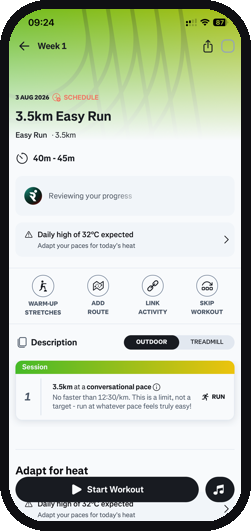
$19.99/month or $119.99/year · 7-day free trial · Personalized, adaptive running-training plans (5K to marathon, plus Couch-to-5K) · Owned by Strava · iOS and Android Researched from: official site and App Store (verified July 2026) · App Store and Google Play reviews · independent reviews · peer-reviewed menopause exercise science · Downloaded and explored hands-on; the screenshots here are our own. Testing status: Sample tested.
How we reviewed this. We downloaded Runna and spent time inside the app: we went through onboarding, explored the interface and the workout and programme library, tried sample sessions, and the screenshots here are our own. This is a hands-on look rather than a full multi-week test, so any rating that depends on long-term use is marked provisional. This is education, not medical advice; speak to your clinician, especially about HRT or existing conditions.
Runna Review 2026: Quick Answer
Quick Verdict
Worth it for women over 40? As a running coach, absolutely; as a menopause tool, no. Runna is one of the best structured running apps available, with adaptive, periodized plans that genuinely improve your running. But running is high-impact, its strength content is running-support rather than muscle and bone building, and it has no menopause programming, pelvic-floor work or menopause education.
Runna earns 5.4/10 on our hands-on evaluation. Its programme structure and design are outstanding, which is why runners love it. For this site’s audience, the honest picture is that it is a superb tool for women over 40 who already run and want to run better, not a menopause-specific programme, and its core modality is the opposite of the low-impact, joint-friendly emphasis many midlife bodies need. It does have real women’s-health content, but that content is about the menstrual cycle and pregnancy, not menopause.
Start here: if you enjoy running, use the 7-day trial and the free Couch-to-5K to see how the plans feel, and pair it with separate strength and pelvic-floor work.
Is Runna right for you?
Runna is strongest for value for money (7.0 out of 10, against a 6.9 average across the 77 programmes scored) and weakest for pelvic floor problems (2.0 against 4.6).
| Question | Verdict | Rating | Score |
|---|---|---|---|
| How it suits a perimenopausal body | |||
| Is Runna good for pelvic floor problems?Based on pelvic floor support and low-impact design | Low, and worse than mostmost score 4.6/10 | 2.0 / 10 | |
| Is Runna genuinely built for perimenopause and menopause?Based on menopause programming, hormone awareness, education and expert credibility | Low, and worse than mostmost score 3.3/10 | 2.0 / 10 | |
| Is Runna good for painful joints?Based on low-impact design and recovery provision | Low, and worse than mostmost score 6.2/10 | 4.5 / 10 | |
| Is Runna manageable when your energy is low?Based on recovery provision and mind-body support | Moderate, about the same as mostmost score 5.7/10 | 5.5 / 10 | |
| Is Runna good if you are new to strength training?Based on beginner on-ramp and mind-body support | Moderate, about the same as mostmost score 6.1/10 | 6.0 / 10 | |
| Is Runna good for building bone density?Based on bone loading and progressive strength | Low, and worse than mostmost score 5.1/10 | 3.5 / 10 | |
| Does Runna help with nutrition?Based on midlife nutrition support | Low, about the same as mostmost score 4.0/10 | 4.0 / 10 | |
| How it performs as a product | |||
| Can you fit Runna into a busy week?Based on time efficiency | Moderate, and worse than mostmost score 7.6/10 | 6.0 / 10 | |
| Is Runna worth the money?Based on value for money | Strong, about the same as mostmost score 6.9/10 | 7.0 / 10 | |
Jump to Section
What Runna Actually Is
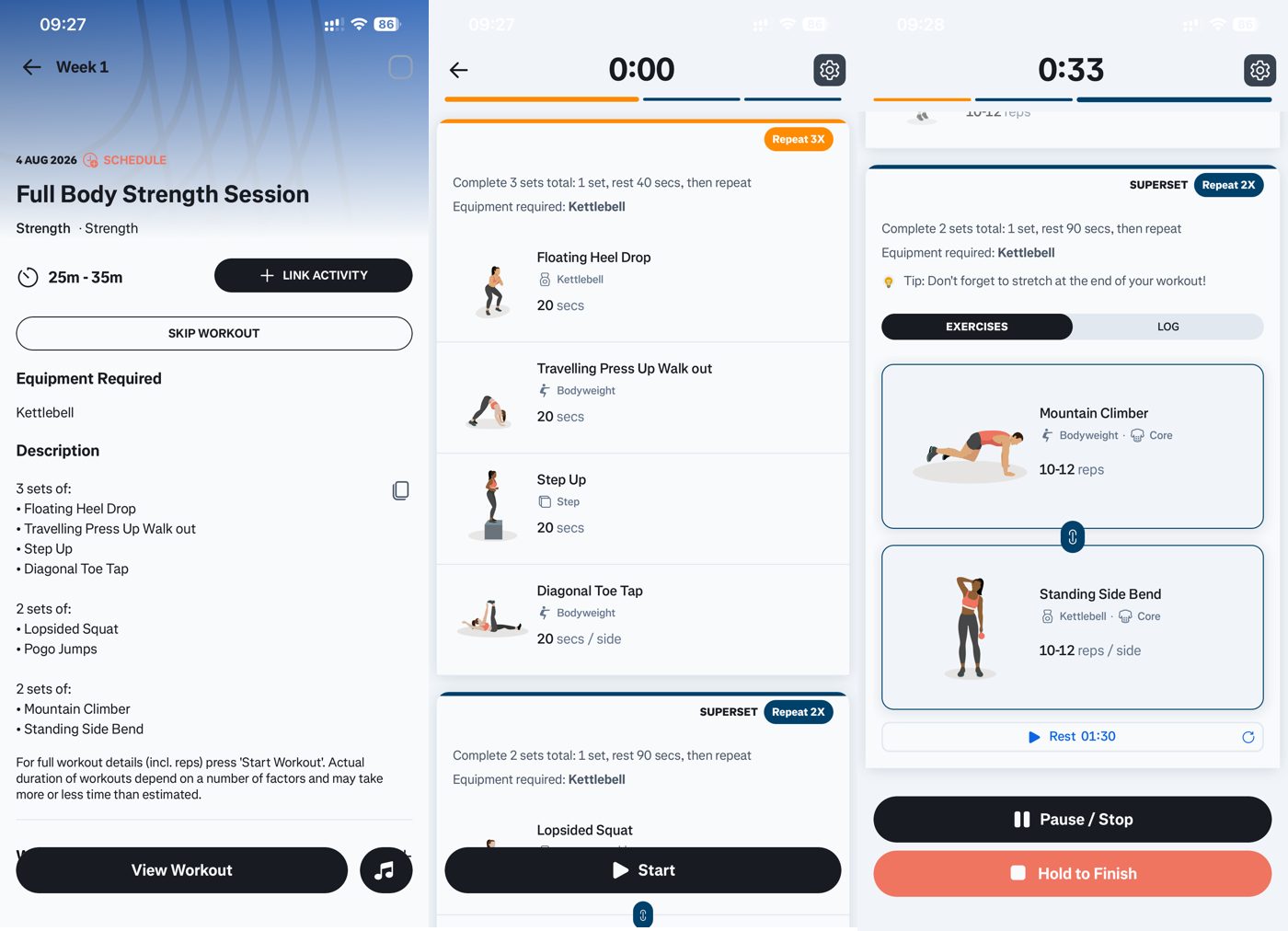
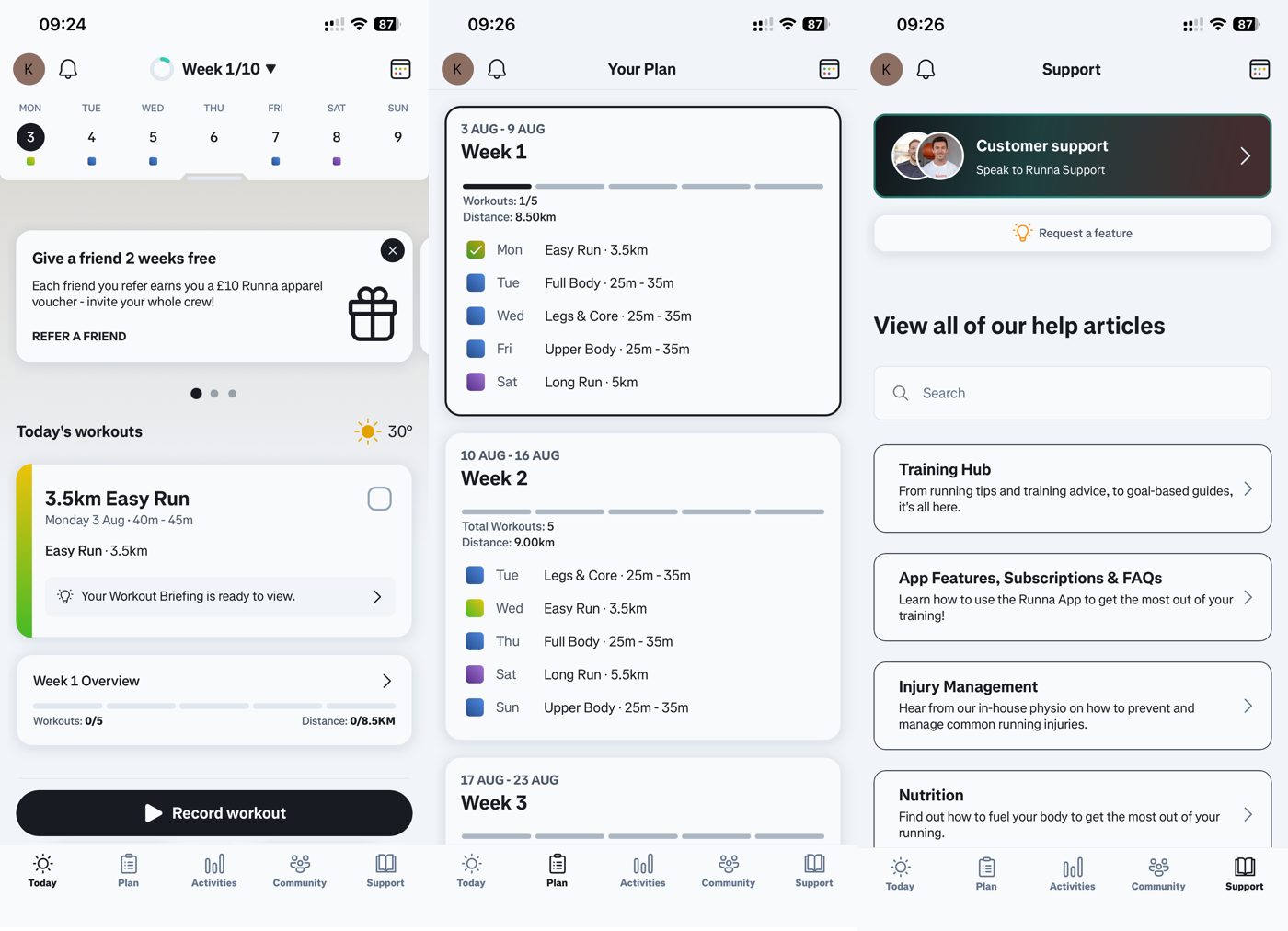
Runna is a personalized running-training app that builds adaptive, periodized plans for goals from Couch-to-5K up to marathon and ultra. You set a goal and schedule, and it creates pace-targeted sessions, interval and tempo runs, long runs and guided audio runs, adjusting as your performance changes. Founded in London by Dom Maskell and head coach Ben Parker, it was acquired by Strava in 2025 and syncs with Garmin, COROS, Apple Watch and Strava. It also offers supplementary strength, mobility and live yoga and Pilates classes to support running, but its heart is run coaching.
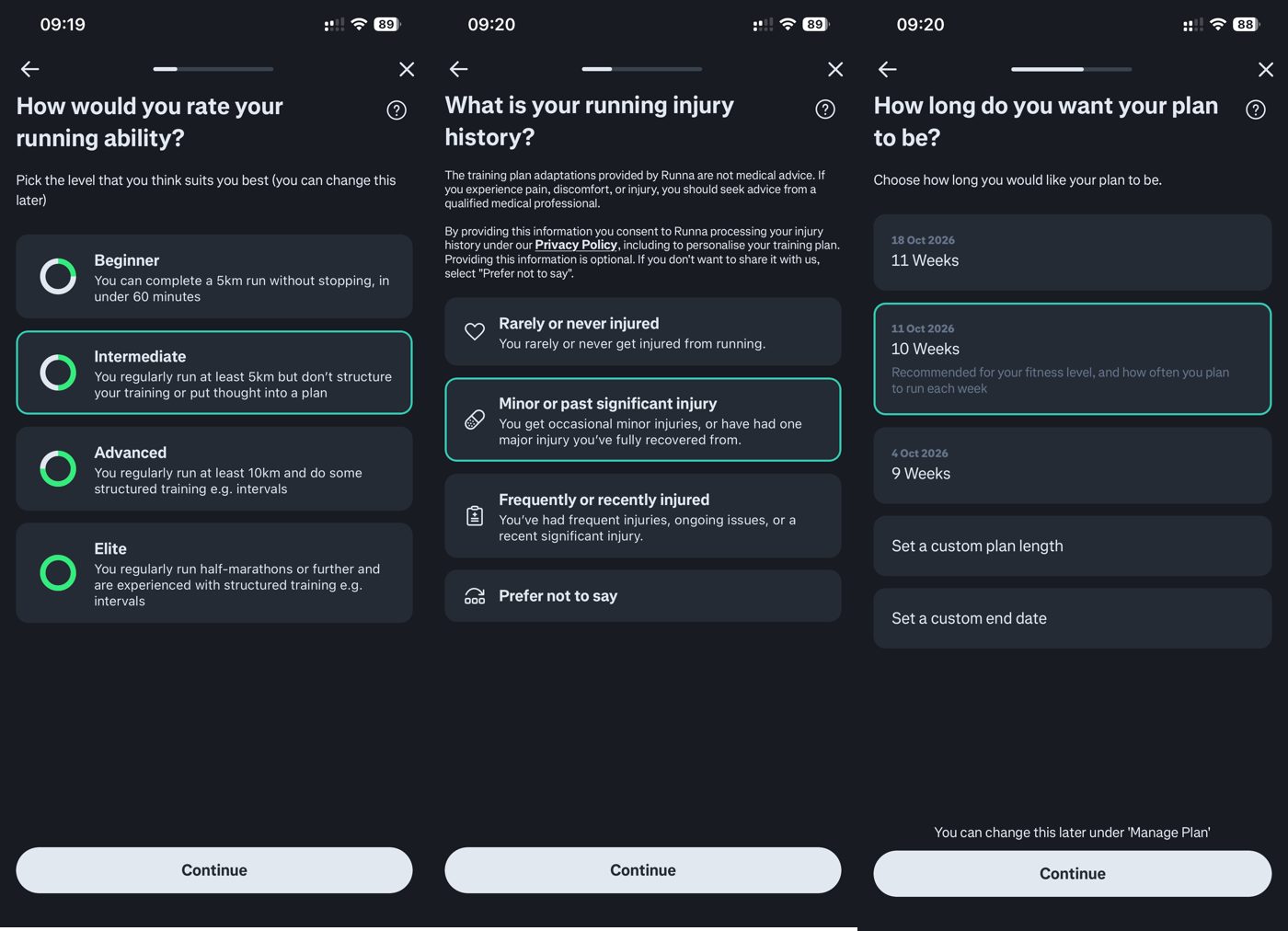
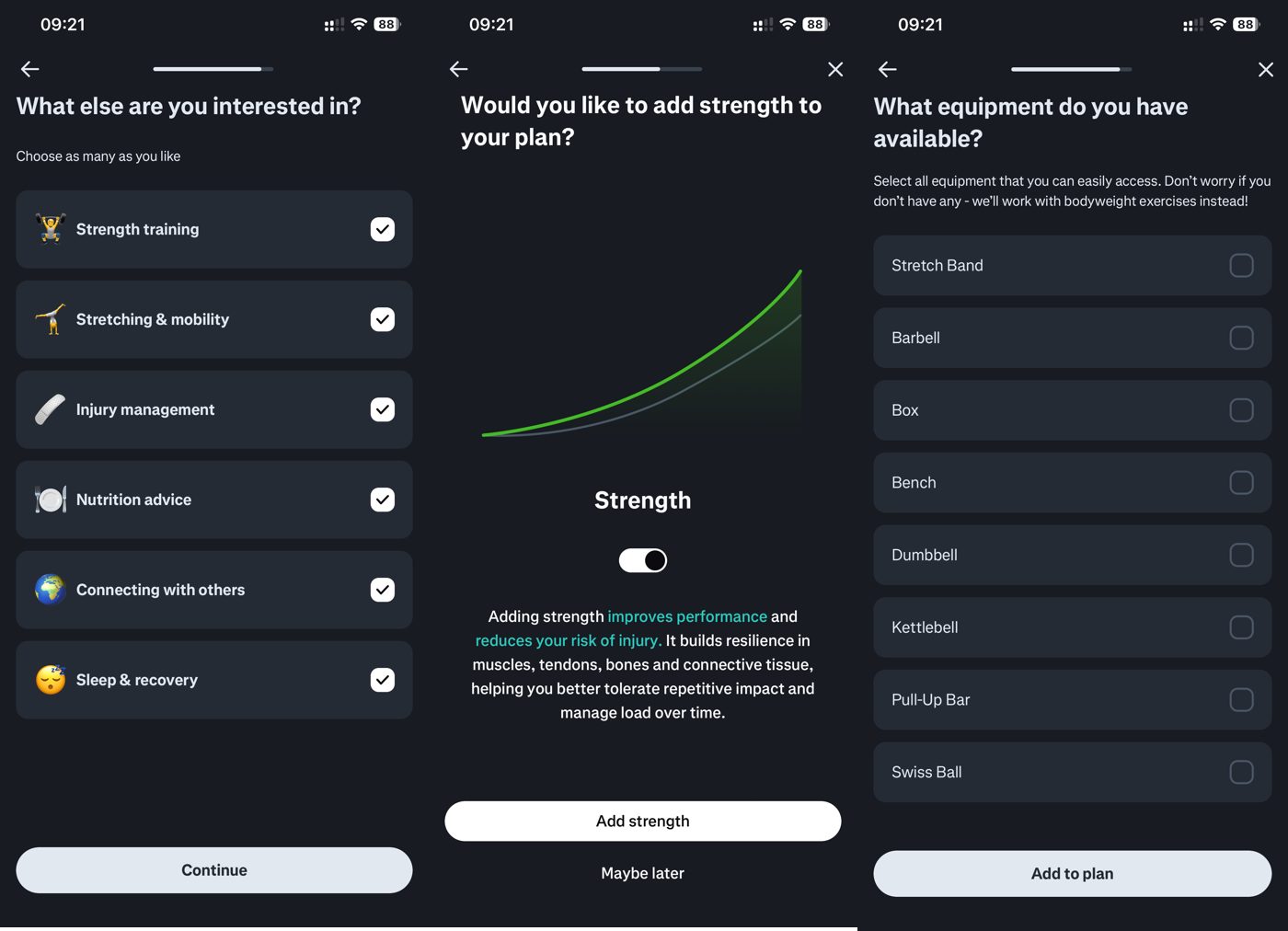
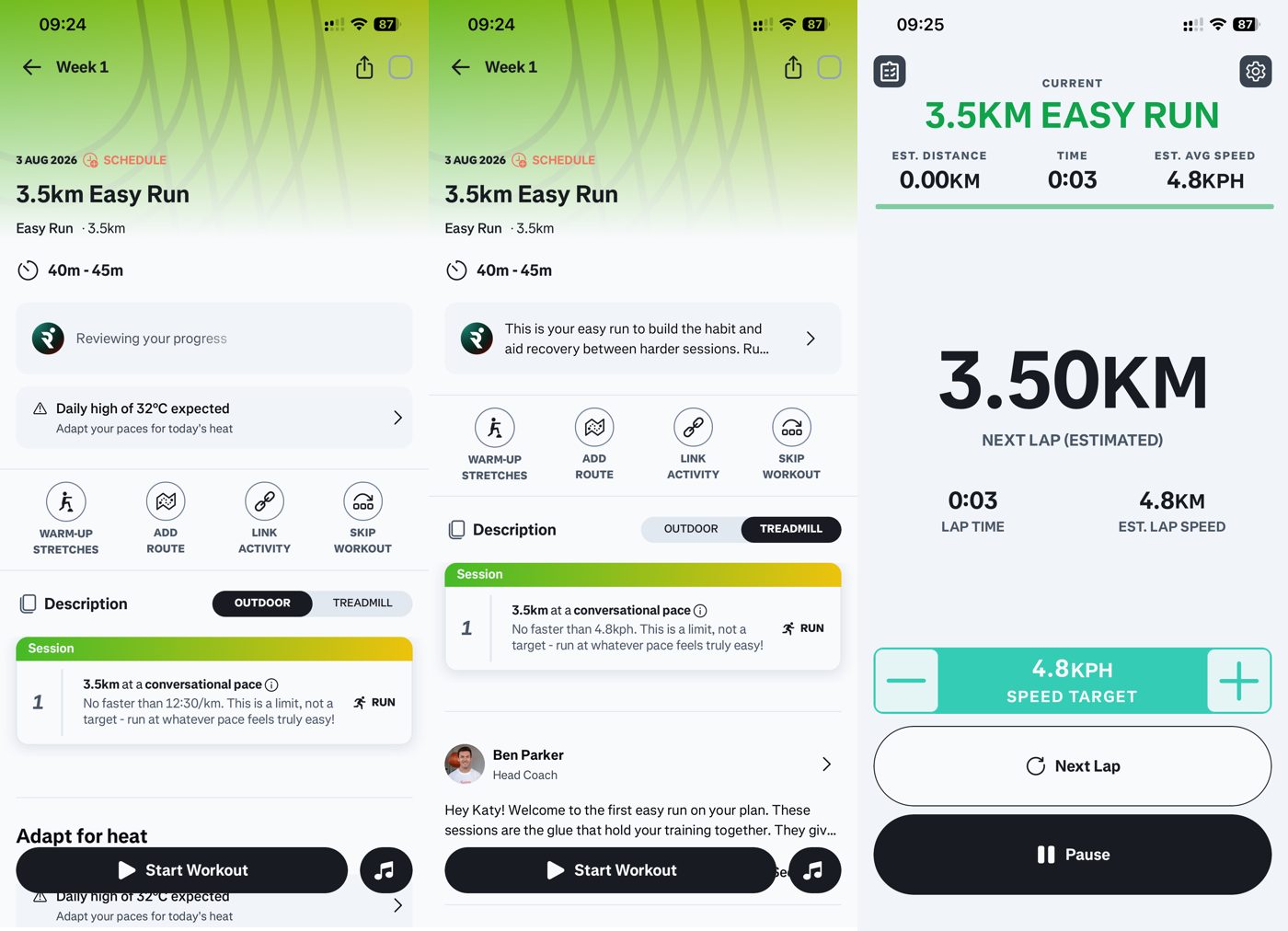
Content and Features
At a glance: best-in-class running programming and design. But high-impact by nature, with strength as a running-support add-on and no menopause-specific content.
| Format | Adaptive, periodized running plans with pace targets, guided runs and post-run insights. |
| Progression | Excellent. Periodized, adaptive, with deload and recovery blocks. |
| Strength | Running-support routines and mobility, not progressive strength for muscle and bone. |
| Impact | High. Running is high-impact; cross-training options are secondary. |
| Women’s-health content | Menstrual-cycle-and-training guidance and pregnancy or postnatal running, not menopause. |
| Menopause / pelvic / education | None specific to menopause. |
| Recovery | Deload weeks, recovery plans and easy-run guidance; fatigue tracking is a noted weak spot. |
| Nutrition | Fueling advice only; no meal plans. |
What Equipment You Need for Runna
Just running shoes and a phone. A GPS watch (Garmin, COROS or Apple Watch) makes the pace-target sessions far easier to follow but is not required. If you add the strength and mobility work, a mat and a light dumbbell pair are enough.
Recommended spec examples. These picks are curated for convenience by specification and feature fit, not personally lab-tested for long-term durability. Prices are examples; verify before buying.
Treadmill
For running Runna indoors: a cushioned deck with incline (up to 10 mph) suits pace and interval sessions and is gentler on the joints than pavement.
Optional
GPS watch or tracker
Makes pace-target sessions far easier to follow.
Optional
Starter Dumbbells (up to 10 lb)
A light adjustable pair, a great starting point
~$65 to $80
Medium Dumbbells (up to 25 lb)
For steady progression as you get stronger
~$50 to $65
Advanced Dumbbells (up to 50 lb)
For serious strength and progressive overload; grows with you
~$350 to $430
Exercise mat
For the mobility and strength sessions.
Optional
A quick heads-up: some of the buy links above are Amazon affiliate links, so if you grab something through them I may earn a small commission – at no extra cost to you. I only ever point you to kit I’d happily use myself.
Bottom line on equipment: shoes and a phone are enough to start; a GPS watch gets the most from the pace-based plans.
How We Scored Runna: the 5.4 / 10 Breakdown
Our overall score is a weighted average of nine criteria. Because this is a hands-on look rather than a full multi-week test, these reflect what we saw in the app plus published information. Women Over 40 is our most heavily weighted menopause criterion, and its full 12-capability breakdown follows in the next section.
| Category | Weight | Score | Reasoning |
|---|---|---|---|
| Time Efficiency | 15% | 6 | Schedule-adaptive, though long-run blocks are time-heavy. |
| Muscle Potential | 18% | 3 | Cardio-first; strength content only supports running. |
| Women Over 40 | 10% | 3.4 | High-impact running with no menopause features; full breakdown below. |
| Joint Friendliness | 12% | 3 | High-impact by nature, harder on midlife joints. |
| Recovery Compatibility | 10% | 6 | Deload weeks and recovery plans, but weak fatigue accounting. |
| Programme Structure | 12% | 9 | Best-in-class periodized, adaptive plans. |
| Value for Money | 8% | 7 | About $10 a month on the annual plan. |
| UX and Design | 8% | 9 | Outstanding design; an App of the Year finalist. |
| Nutrition Integration | 7% | 4 | Fueling advice only, with no meal plans. |
| Overall | 100% | 5.4 / 10 | Our Score; hands-on score pending. |
Is Runna Good for Women Over 40?
If you are a runner, Runna is excellent regardless of age: the plans are genuinely well built and adaptive. But judged as a midlife and menopause tool, it is a poor fit by design. Its core modality is high-impact running, which is harder on midlife joints and is the opposite of the low-impact emphasis many women need; its strength content is there to support running, not to build the muscle and bone that matter most after 40; and it has no menopause programming, pelvic-floor work, hormone awareness or menopause education. Running is weight-bearing and does benefit bone in the lower body, and the beginner on-ramp is strong, but this is a running app, not a menopause programme.
My hands-on look. Using Runna on the treadmill, the thing that stood out most was how planned everything is. The week is built for you, which is genuinely good for decision fatigue, but it is less suited to running your own way. You can set preferred strength days and drag sessions around the calendar, though it took some digging to find, and you can skip sessions you will not do. The bigger limit for me was the strength side: it is there to support your running, not to build muscle as the main goal, and you cannot swap an individual exercise within a session or get a modification for an old injury. With a previous meniscus injury, no alternative movements were offered, only the option to change your available equipment and let the app re-adjust. If you love running outdoors, tracking your distance and connecting with others, that community and precision is a real part of the fun. But for a perimenopausal or menopausal woman whose primary need is building muscle, a running-first app with supportive-only, non-modifiable strength does not address the main goal.
What others found too. This matches wider feedback: Runna’s own help pages confirm you cannot swap an individual exercise within a session, and independent reviewers have flagged that its pace targets can be too aggressive for newer runners, which is worth watching if you are returning to exercise.
How It Fits Perimenopause, Menopause & Beyond
Our capability breakdown of how well this program suits women across perimenopause, menopause and post-menopause. Women Over 40 is our most important criterion for this site, and this is the full breakdown behind the Women Over 40 row in the scoring table above.
This is the perimenopause and menopause assessment, and it is separate from the overall score. Twelve things a programme either does for a midlife body or does not, each scored out of 10 with my reasoning next to it. Together they produce a single menopause fit score, and that becomes one of the nine categories in the overall scoring below.
How Runna Fits Perimenopause, Menopause & Beyond
Women Over 40 is our most important criterion, and here's the full breakdown behind it.
Runna is strongest for beginner on-ramp, recovery & deload and mind-body support, and weakest for menopause programming, pelvic floor, menopause education, low-impact, progressive strength, hormone awareness, expert credibility, bone loading and midlife nutrition, in our menopause and midlife capability assessment for women over 40.
At a glance
| Capability | Score | Rating | Why |
|---|---|---|---|
| Right training for a midlife body | |||
| Low-impact | 3/10 | Minimal | |
| Progressive strength | 3/10 | Minimal | |
| Bone loading | 4/10 | Minimal | |
| Recovery & deload | 6/10 | Some | |
| Built for menopause | |||
| Menopause programming | 1/10 | None | |
| Pelvic floor | 1/10 | None | |
| Hormone awareness | 3/10 | Minimal | |
| Menopause education | 1/10 | None | |
| Expert credibility | 3/10 | Minimal | |
| Whole-woman support | |||
| Mind-body support | 5/10 | Some | |
| Beginner on-ramp | 7/10 | Strong | |
| Midlife nutrition | 4/10 | Minimal | |
ScaleBest-in-classStrongSomeMinimalNone
What the sources say: High data quality. Pricing, features, ownership (Strava), ratings and coach credentials are from primary sources cross-checked with independent reviews (TechRadar, Tom's Guide) and user discussion. The "4.9 / 76,000+" figure is Runna's own global aggregate; the US App Store store-page shows ~4.9 / ~32k. The menopause read is a verified ABSENCE: its women's-health content is menstrual-cycle/pregnancy/postnatal, with no menopause programming, education or clinical expertise.
These are evidence-informed suitability ratings, not clinical measurements. They combine exercise science with product-specific research and, where indicated, hands-on testing, alongside multi-source verification, and are approximate. Individual response varies. A starting point, not medical advice. How we score menopause fit
What the Research Says: Runna’s Claims Checked
Running is genuinely good for cardiovascular and lower-body bone health, and structured, progressive plans reduce injury risk versus unstructured training. Weight-bearing running provides an osteogenic stimulus to the hips and legs, and periodized programming like Runna’s is a sensible way to build fitness. So the running Runna delivers is real, evidence-aligned exercise.
What the science does not support is treating running alone as a midlife or menopause strategy. The strongest evidence for protecting midlife muscle and bone points to progressive resistance training with sufficient load,[1] and the best bone results use heavier, progressive loading,[2] which Runna does not provide. Reassuringly, recreational running is not linked to higher rates of hip and knee osteoarthritis in the research,[3] but high-impact running can still aggravate existing joint issues and the pelvic floor for some women, which the app does not address. Its menstrual-cycle education is aimed at menstruating women, not menopause, and official menopause guidance stresses regular strength and weight-bearing work for bone and muscle,[4] which running alone does not cover. So Runna is a strong cardio and running tool that should be paired with separate strength and pelvic-floor work, not a standalone menopause plan.
What Users Report: Verified Sentiment
Rating snapshot: Runna is very highly rated. The US App Store shows about 4.9 stars from roughly 32,000 ratings, and Runna was an App Store Awards App of the Year finalist selected by Apple’s editors; Google Play shows about 4.6 from roughly 29,000 ratings. Runna’s own site cites a global aggregate of 4.9 across 76,000-plus ratings.
Consistently praised
- Adaptive, personalized plans that produce measurable running gains.
- Clean, intuitive design; widely called one of the best-looking fitness apps.
- Schedule flexibility and strong beginner on-ramp, including free Couch-to-5K.
Consistently criticised
- Pace targets can feel too aggressive, especially for beginners.
- Weak fatigue accounting; no easy way to pause a plan for illness or injury.
- Subscription cost and running-only focus.
Source and credibility note. Ratings are high-volume and cross-checked against independent reviews (TechRadar, Tom’s Guide) and user discussion. Runna’s coaches have strong running credentials, but there is no menopause or women’s-health-over-40 clinical expertise, and its most menopause-relevant fact is a verified absence: its women’s-health library is menstrual-cycle and pregnancy, with no menopause content. Sources: App Store, Google Play, official site, independent reviews.
Runna specifications
- Free trial
- 7-day, cancel anytime
- Cancellation
- Cancel anytime
- Session length
- ~20 to 90 min (run-dependent)
- Who makes it
- Runna (UK, founded 2021); acquired by Strava, announced Apr 17 2025, closed 2025 (seller of record now Strava Inc.). Head Coach Ben Parker, certified running/triathlon coach; no clinician
- Still maintained
- Active; app v8.50.0 (rel 2026-08-11), id 1594204443, seller Strava Inc.
- What is included
- On-demand classes: yesLive classes: noRecovery content: partlyMenopause education: noStructured programmes: yesMeditation: noNutrition guidance: partly
- Women over 40
- Pelvic floor work: noMenopause clinician involved: noInjury modifications: partlyBone-health focus: partlyModified progressions: yesCycle syncing: noPrenatal options: partly
- Devices and access
- Offline downloads: partlyCasting to TV: noSubtitles: noWearable sync: yes
- Support
- Clinical advisory board: noCommunity: partlySupplement upsell: no
- Last verified
- 12 August 2026
Runna Price 2026: What You Actually Pay
Runna costs $19.99/month or $119.99/year (about $10/month), with a 7-day free trial. A limited free plan, including a free Couch-to-5K, is also available.
| Plan | Price | Notes |
|---|---|---|
| Monthly | $19.99/month | Auto-renews |
| Annual | $119.99/year | About $10/month; best value |
| Free | Limited | Includes a free Couch-to-5K plan |
Cancellation and Billing
Subscriptions auto-renew and are cancelled through your Apple or Google subscription settings. Turn off auto-renew before the 7-day trial ends and check your statement. A Strava plus Runna bundle is also offered at a higher annual price.
Runna Pros and Cons
Pros
- Best-in-class adaptive, periodized running plans
- Excellent design and user experience
- Strong beginner on-ramp, including free Couch-to-5K
- Deload and recovery blocks built in
- Good value on the annual plan
Cons
- High-impact by nature; hard on midlife joints and pelvic floor for some
- No menopause programming, pelvic-floor work or menopause education
- Strength is running-support, not progressive strength for muscle and bone
- No exercise-level modifications or injury substitutions; you can only change your equipment set and let it re-adjust
- Weak fatigue accounting; pace targets can be aggressive
- No meal plans; running-only focus
How Runna Compares
Here is how Runna stacks up against the alternatives women most often weigh it against. Scores come from our own testing; apps we have not scored yet are marked and update automatically once reviewed.
| Feature | Runna | Strava | Nike Run Club | Garmin Coach | Couch to 5K | Trenara |
|---|---|---|---|---|---|---|
| Our score | 5.4 / 10 | Not yet scored | Not yet scored | Not yet scored | Not yet scored | Not yet scored |
| Monthly price | $19.99/mo · $119.99/yr | Free; Premium $11.99/mo · $79.99/yr | Free | Free with Garmin watch | Free (NHS); Zen Labs ~$5 one-time | Free; Peak Pro ~$11/mo · ~$120/yr |
| Free trial | 7-day; free plan incl. C25K | 30-day | Free | Free | Free | 30-day (Peak Pro) |
| Best for | Personalised running plans | Run/ride tracking + social | Free guided runs + plans | Free adaptive race plans | Beginner run plan (0 to 5K) | Adaptive running plans + nutrition |
| Equipment | None (GPS/watch) | None (GPS/watch) | None (GPS) | Garmin watch required | None | None (GPS/watch) |
| Session length | Varies (run plan) | Your activity length | Varies (run) | Varies (run) | ~20 to 30 min | Varies (run) |
| Injury modifications | Some strength add-ons | None | None specific | None | None | None specific |
| Perimenopause support | None specific | None | None | None | None | None |
| Coaching style | Elite running coaches, app-guided | None (analytics) | Audio-guided runs | Adaptive plans by real coaches | Audio-guided plan | Adaptive AI running coach |
| Nutrition | Partial | None | None | None | None | Pro tier |
| Community | Yes | Yes (feed/clubs) | Yes (challenges) | Garmin Connect | No | No |
| Best suited to | Runners chasing a goal | Runners/cyclists tracking + competing | Runners wanting free coaching | Garmin owners training for a race | Total beginners starting to run | Runners wanting adaptive plans |
Runna FAQ
As a running app, yes, it is excellent at any age. But it is not a menopause tool: running is high-impact, its strength content only supports running, and it has no menopause, pelvic-floor or hormone content. Women over 40 who run will love it, ideally paired with separate strength and pelvic-floor work.
It has no menopause-specific content. Its women’s-health material covers the menstrual cycle and pregnancy, not menopause, and its high-impact focus is the opposite of the low-impact emphasis many midlife women need. For dedicated menopause programming, Pvolve or Menovation go much further.
$19.99 per month or $119.99 per year (about $10 per month), with a 7-day free trial. A limited free plan, including a free Couch-to-5K, is also available.
Partly. You can set your preferred strength days, move or skip sessions in the calendar, and add yoga, Pilates or stretch sessions. But you cannot swap an individual exercise within a session, and there are no injury modifications: Runna only lets you change your available equipment and re-adjusts around it. So if a movement bothers an old injury, there is no in-app alternative, only physio advice articles.
No. The core product is running, which is high-impact. It offers some cross-training and mobility, but if you need joint-sparing, low-impact training, a low-impact platform is a better fit.
For a woman over 40 who enjoys running and wants a genuinely excellent structured plan, yes, and the annual price is good value. It is not worth it as a menopause solution or if you want low-impact, strength-first training. This is a hands-on look (sample tested); a full multi-week test is still to come.
Runna has a limited free plan that includes a free Couch-to-5K training plan, and its paid plans start with a 7-day free trial. The full adaptive plans, guided runs and strength content require a subscription at $19.99 per month or $119.99 per year, so you can start for free but the core coaching is paid.
Yes, but it is built to support your running rather than replace dedicated strength work. Runna adds bodyweight and light-dumbbell strength and mobility sessions around your runs, and there is a beginner setting. It is not the heavier, progressive loading that best protects muscle and bone after 40, so pair it with a separate strength plan.
Runna bills through the App Store or Google Play, so you cancel or turn off auto-renew in your Apple or Google subscription settings rather than inside the app. Turn off auto-renew before your 7-day free trial ends to avoid being charged, and check your statement to confirm the cancellation went through.
Final Verdict
Our Score: 5.4 / 10 · hands-on look; long-term score provisional
Runna is one of the best running apps available, with adaptive, periodized plans and outstanding design. That earns it a fair overall score. But it is not a menopause product: it is high-impact by nature, its strength content only supports running, and it has no menopause programming, pelvic-floor work or menopause education.
Runna is for women over 40 who enjoy running and want the best structured plan for it. Runna is not for women who want low-impact, strength-first or menopause-specific training, in which case Pvolve or Menovation is the better choice.
Testing Status
Hands-on look complete (downloaded, explored, our own screenshots) (official site, App Store and Google Play, independent reviews, peer-reviewed science). Full multi-week test: pending. A trial run would confirm the plan quality, pace-target feel and cross-training depth, and move this to fully tested. How we score menopause fit.
Sources and Further Reading
- Resistance training for postmenopausal women: a 2022 systematic review and meta-analysis (PubMed). Supports progressive strength for midlife muscle and metabolic health.
- Watson, S.L. et al. (2018). LIFTMOR trial, Journal of Bone and Mineral Research. Heavier progressive loading plus impact improves bone density in postmenopausal women.
- Alentorn-Geli, E. et al. (2017). The association of recreational and competitive running with hip and knee osteoarthritis: a systematic review and meta-analysis, JOSPT (PubMed). Recreational runners had a lower occurrence of osteoarthritis than non-running controls.
- NHS, Cambridge University Hospitals. Menopause: a healthy lifestyle guide. Recommends regular strength and weight-bearing activity to protect bone and muscle through menopause.
This is a hands-on look (sample tested), not a completed multi-week review. Pricing and features were verified July 2026 and may have changed. Some affiliate links may be present. This site does not accept payment from platforms reviewed. Education, not medical advice.
Related Guides
What To Do Next
- → Take our 2-minute quiz for a personalised recommendation.
- → Compare with our Pvolve review (menopause-built low-impact strength).
- → See how we score menopause fit.