
The Latin-inspired dance-fitness phenomenon from Beto Perez, built on joyful dance cardio to Latin and international music, mostly as in-person classes led by licensed instructors, plus an app · genuinely good for cardio, mood and community, with a low-impact Zumba Gold option for older adults · but light on strength and not menopause-specific · Just supportive trainers, plus optional light weights.
Zumba Review 2026: Quick Answer
Research-based data profile, not personally tested; hands-on sections pending
Women who want fun, sociable dance cardio that lifts the mood, especially via the low-impact Zumba Gold class
Your priority is building strength, muscle and bone, or you want menopause, hormone or pelvic-floor programming
A Latin dance-fitness programme, mostly in-person classes, plus an on-demand app
About 45 to 60 minutes, at moderate intensity
Supportive trainers; Zumba Toning uses light toning sticks or weights
Moderate impact in standard classes, with low-impact Zumba Gold and Aqua Zumba options
Zumba Gold is a genuine plus: a lower-intensity, low-impact class for active older adults and beginners
Light: mostly dance cardio, with a modest bone stimulus and only a little resistance in Toning
Good for mood, cardio and community, but no menopause, hormone or pelvic-floor programming
A real strength: fun, joyful, sociable classes that keep people coming back
In-person classes worldwide, plus an app on iOS, Android and web with TV casting
In-person drop-ins commonly around $5 to $20, or included in a gym membership; the app is a separate subscription
The app has a free class-locator tier and a free trial; workouts need the paid subscription
5.4 / 10
Quick Verdict
Worth it for women over 40? For fun, sociable cardio and mood, yes, and Zumba Gold is a lovely low-impact option for midlife. But it is light on strength and not built for menopause, so for perimenopause or menopause it works best as one joyful piece of a bigger plan.
Zumba earns 5.4/10 in this research-based profile. As a way to move, it is genuinely joyful: dancing to Latin music barely feels like exercise, it gives a real cardio workout, it sharpens coordination and balance, and the class atmosphere is warm and sociable, which is exactly the kind of thing that keeps people showing up. For our audience there is a real bonus in Zumba Gold, a lower-intensity, low-impact version designed for active older adults and beginners, and Aqua Zumba in the pool is gentler still, so there are genuinely joint-friendly ways in. There is even peer-reviewed research on Zumba Gold improving physical and psychological wellbeing in postmenopausal women.
Where it is limited for our audience. Zumba is dance cardio, so it does very little for the muscle and bone that matter most at midlife: there is minimal strength, only a little resistance in Zumba Toning, and no progressive loading, so the muscle and bone benefits are small. It has no menopause, hormone or pelvic-floor programming, no nutrition, standard classes carry some impact, the choreography takes a while to pick up, and the app has drawn quality complaints. Enjoy it if you love to dance and want the mood and cardio, ideally via Zumba Gold if your joints prefer it, and pair it with dedicated strength training.
How we assessed this. This is a research-based data profile, not a hands-on test. We assessed Zumba from the official programme, its class formats including Zumba Gold, its app, pricing, independent coverage and user sentiment, and the exercise science, scored on our standard criteria. The hands-on sections are marked as pending. This is education, not medical advice; check with your clinician before starting a new programme, especially with joint, pelvic-floor or heart concerns.
Is Zumba right for you?
Zumba is strongest for value for money (7.0 out of 10, against a 6.9 average across the 77 programmes scored) and weakest for nutrition support (1.0 against 4.0).
| Question | Verdict | Rating | Score |
|---|---|---|---|
| How it suits a perimenopausal body | |||
| Is Zumba good for pelvic floor problems?Based on pelvic floor support and low-impact design | Low, about the same as mostmost score 4.6/10 | 4.0 / 10 | |
| Is Zumba genuinely built for perimenopause and menopause?Based on menopause programming, hormone awareness, education and expert credibility | Low, and worse than mostmost score 3.3/10 | 2.0 / 10 | |
| Is Zumba good for painful joints?Based on low-impact design and recovery provision | Moderate, about the same as mostmost score 6.2/10 | 6.0 / 10 | |
| Is Zumba manageable when your energy is low?Based on recovery provision and mind-body support | Moderate, about the same as mostmost score 5.7/10 | 5.0 / 10 | |
| Is Zumba good if you are new to strength training?Based on beginner on-ramp and mind-body support | Moderate, about the same as mostmost score 6.1/10 | 5.5 / 10 | |
| Is Zumba good for building bone density?Based on bone loading and progressive strength | Low, about the same as mostmost score 5.1/10 | 4.5 / 10 | |
| Does Zumba help with nutrition?Based on midlife nutrition support | Low, and worse than mostmost score 4.0/10 | 1.0 / 10 | |
| How it performs as a product | |||
| Can you fit Zumba into a busy week?Based on time efficiency | Moderate, and worse than mostmost score 7.6/10 | 6.0 / 10 | |
| Is Zumba worth the money?Based on value for money | Strong, about the same as mostmost score 6.9/10 | 7.0 / 10 | |
Jump to Section
What Zumba Actually Is
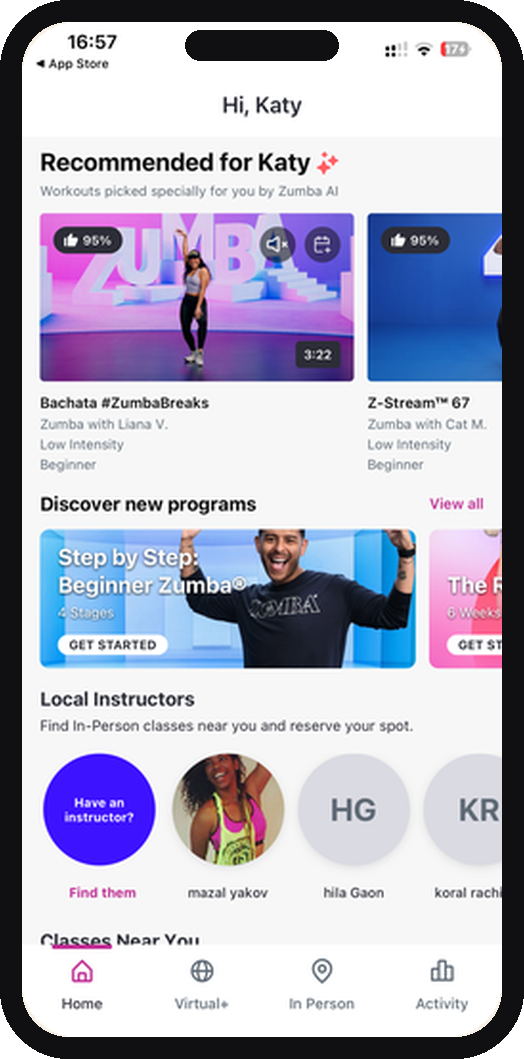
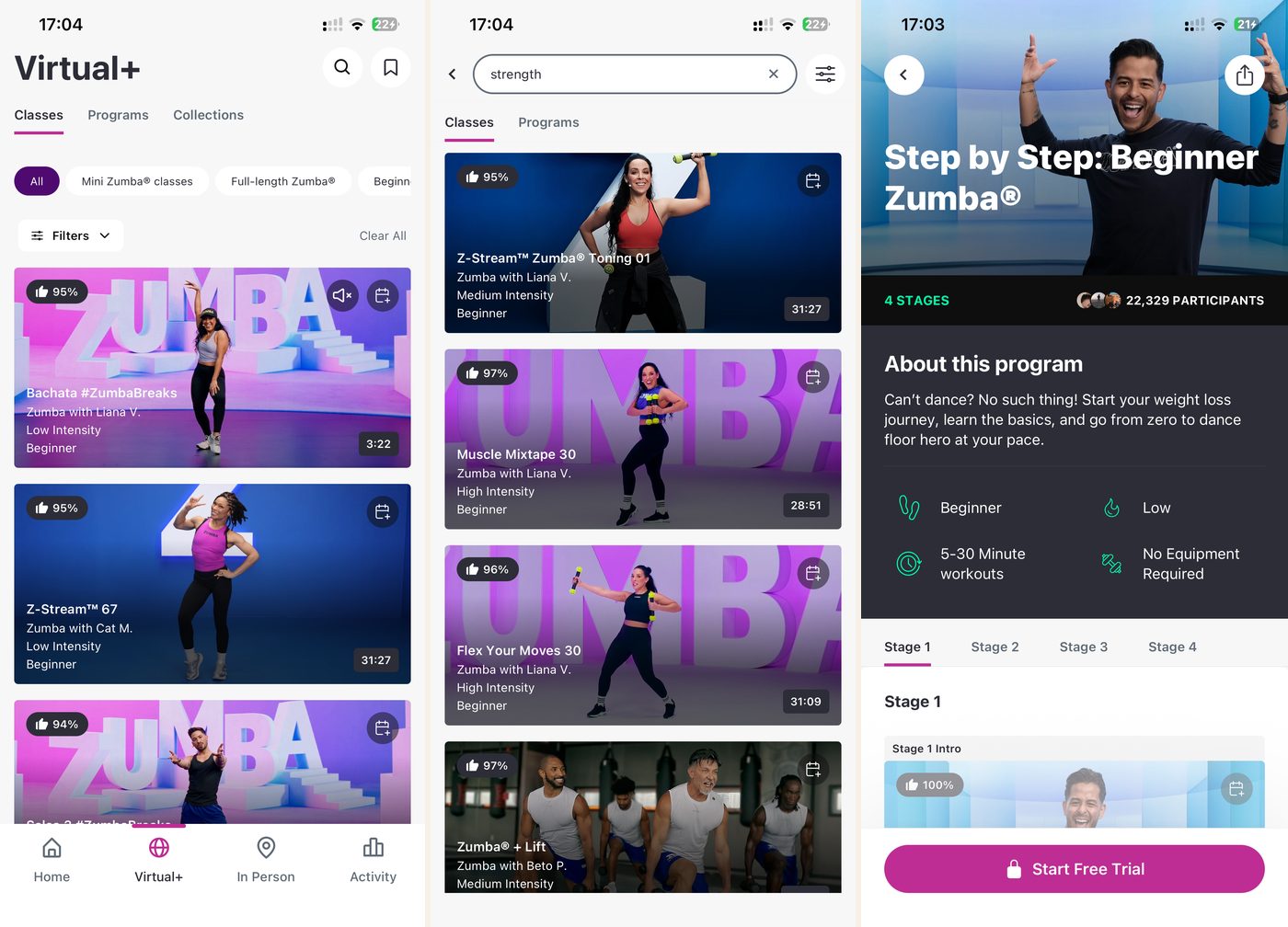
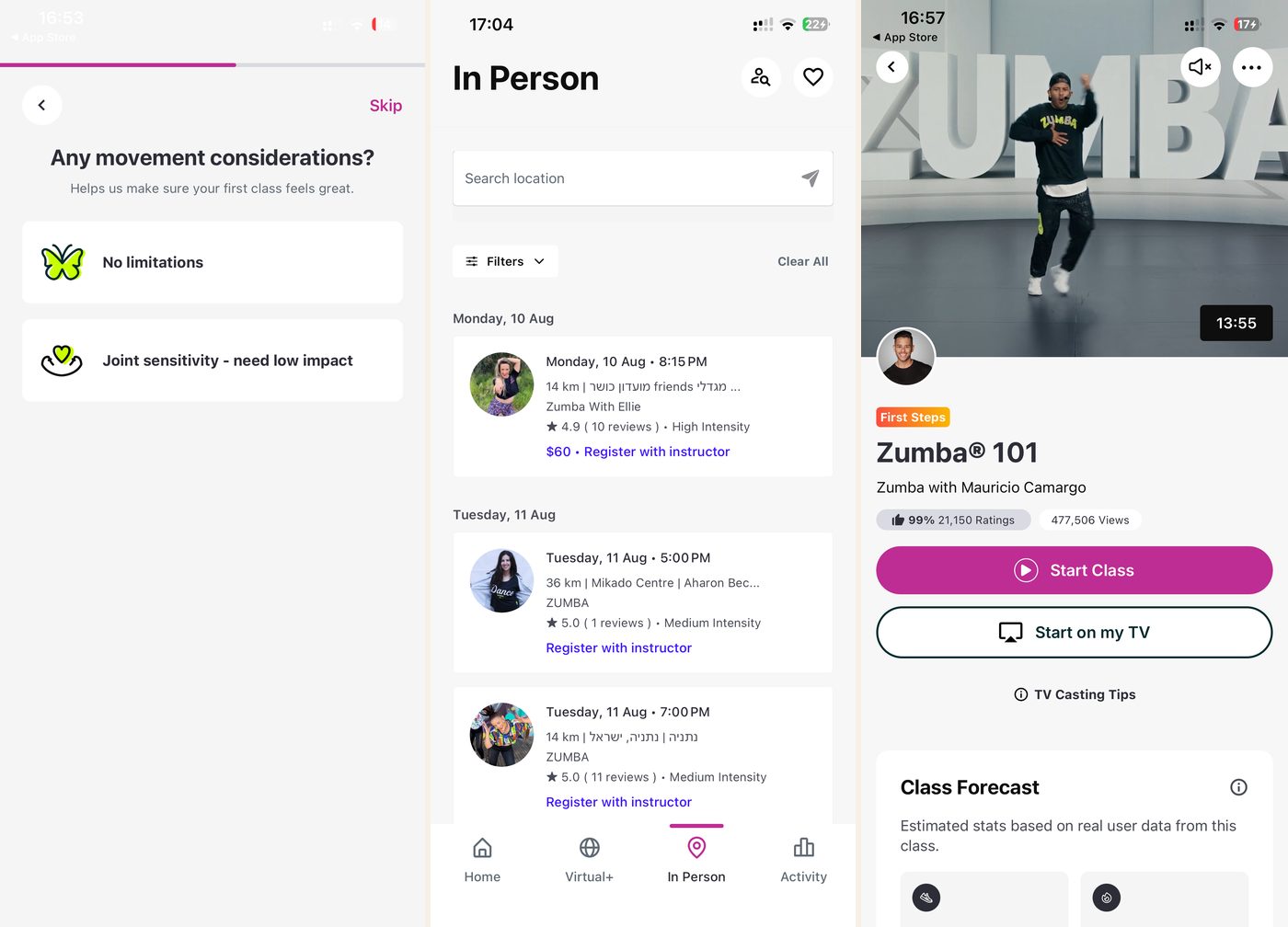
Zumba is a Latin-inspired dance-fitness programme built on dance cardio to Latin and international music, from salsa and merengue to reggaeton and cumbia. It is delivered mostly as in-person group classes led by licensed instructors, usually 45 to 60 minutes at a moderate, interval-style intensity, and there is also a polished Zumba app with on-demand classes you can stream at home, cast to a television, and filter by intensity and level, along with multi-stage beginner programmes, AI-suggested workouts and a low-impact onboarding option for joint sensitivity. Beyond the original format, there are several specialty classes, and a few matter for our audience: Zumba Gold, a lower-intensity, low-impact version designed for active older adults and beginners, Zumba Toning and app classes like Muscle Mixtape and Zumba Lift, which add light toning sticks, hand weights or kettlebells for a touch of resistance, and Aqua Zumba in a pool, which is gentler still.
For this audience it helps to be clear about what it is and is not. It is a fun, sociable, genuinely enjoyable cardio workout with real benefits for heart health, mood and coordination, and, through Zumba Gold and Aqua Zumba, real low-impact options for midlife bodies. What it is not is a strength or menopause programme: it does little for muscle and bone, there is no hormone or pelvic-floor content, and standard classes carry some impact. Read Zumba as a joyful cardio and community habit, best for the mood and movement, and paired with dedicated strength training.
Who Is Behind Zumba? Credibility
Zumba was created by Alberto, or Beto, Perez, a Colombian dancer and choreographer who improvised a class using the Latin music he had to hand, and it was commercialised in Miami in 2001 with the entrepreneurs Alberto Perlman and Alberto Aghion. It grew into a global phenomenon, cited as reaching many millions of people across around 180 countries, taught by instructors licensed through Zumba’s own training programme. Becoming a licensed instructor involves a one-day training and membership of the Zumba Instructor Network, which supplies the choreography and music, so there is a consistent brand standard behind the classes.
How to read that credibility. Zumba is a well-run, hugely popular dance-fitness brand, and a good instructor makes for a genuinely uplifting class. What it is not is a clinical or exercise-science-led programme: the instructor licence is the company’s own, awarded on completion of a short course rather than an exam or an accredited qualification, and there is no medical governance of the content. For our audience that means you can expect a fun, well-choreographed class, but not clinically designed menopause or strength programming, and the quality of any given class depends a lot on the individual instructor.
Content and Features
At a glance: joyful, sociable Latin dance cardio with real mood and cardio benefits, and genuine low-impact options in Zumba Gold and Aqua Zumba. Capped for our audience by minimal strength and bone loading, no menopause or pelvic-floor programming, no nutrition, and app quality complaints.
| Format | Mostly in-person classes led by licensed instructors, 45 to 60 minutes, plus an on-demand app. |
| Class types | Zumba, Zumba Gold for older adults and beginners, Zumba Toning with light weights, Aqua Zumba in the pool, Zumba Step and more. |
| Midlife option | A real plus: Zumba Gold is lower-intensity and low-impact, with a focus on balance, range of motion and coordination. |
| Strength and bone | Light: mostly dance cardio, with a modest weight-bearing bone stimulus and only a little resistance in Toning. |
| Impact and joints | Moderate impact in standard classes, softened by Zumba Gold and Aqua Zumba and instructor modifications. |
| Women over 40 / menopause | No menopause, hormone or pelvic-floor programming; Zumba Gold makes it age-friendly, but it is general fitness. |
| Community | A genuine differentiator: fun, joyful, welcoming classes that support adherence. |
| Nutrition | None built in. |
| Devices | In-person worldwide, plus an app on iOS, Android and web with TV casting and watch metrics. |
What Equipment Do You Need for Zumba?
Almost nothing, which is part of the appeal. For a standard class all you really need is supportive, cushioned trainers that let you pivot, since the dance involves plenty of quick direction changes. Zumba Toning classes add light toning sticks or small hand weights, and a mat is handy for any stretching at home. It is a genuinely low-barrier, come-as-you-are workout.
Because Zumba does so little for strength, the most useful thing to own for a midlife body is a set of dumbbells for the dedicated strength training we would pair alongside it, so you can build the muscle and bone that dance cardio alone will not.
Recommended spec examples. These picks are curated for convenience by specification and feature fit, not personally lab-tested for long-term durability. Prices are examples; verify before buying.
Exercise mat
For stretching and any floor work at home.Recommended
Light Dumbbells (up to 10 lb)
A light pair, in the spirit of Zumba Toning.~$65 to $80
Medium Dumbbells (up to 25 lb)
The useful add for the strength Zumba leaves out.~$50 to $65
A quick heads-up: some of the buy links above are Amazon affiliate links, so if you grab something through them I may earn a small commission, at no extra cost to you. I only ever point you to kit I would happily use myself.
Bottom line on equipment: good trainers run a Zumba class; dumbbells are the companion buy for the strength it does not cover.
How We Scored Zumba: the 5.4 / 10 Breakdown
Scores on our 9 weighted criteria, from our research-based assessment. Women Over 40 is our menopause-fit criterion, and its full 12-capability breakdown follows in the next section.
| Category | Weight | Score | Reasoning |
|---|---|---|---|
| Time Efficiency | 15% | 6 | Classes run 45 to 60 minutes at fixed times, with more flexible on-demand options in the app. |
| Muscle Potential | 18% | 4 | Mostly dance cardio, with some light toning and strength classes in the app, but no heavy progressive loading. |
| Women Over 40 Specificity | 10% | 3.6 | Zumba Gold and a low-impact onboarding make it age-friendly, but it is general fitness with no menopause programming; full breakdown below. |
| Joint Friendliness | 12% | 7 | Low-impact Zumba Gold and Aqua, plenty of low-intensity classes and a joint-sensitivity option soften the standard impact. |
| Recovery Compatibility | 10% | 6 | Moderate-intensity cardio, gentler in the Gold and low-intensity options, though no structured recovery. |
| Programme Structure | 12% | 7 | Varied formats plus multi-stage app programmes, AI recommendations and collections, though still class-led rather than progressive. |
| Value for Money | 8% | 7 | In-person classes are cheap and accessible, often included in a gym membership. |
| UX and Design | 8% | 6 | A polished app with highly rated classes, TV casting and AI recommendations, though some subscription and cancellation friction is noted. |
| Nutrition Integration | 7% | 1 | No nutrition content. |
| Total | 100% | 5.4 / 10 | Research Score. |
Is Zumba Good for Women Over 40?
For enjoyment, cardio and community, yes, and it has a genuine midlife-friendly route. Dance cardio is good for the heart, the mood and coordination and balance, all of which matter as we age, and Zumba is unusually good at not feeling like exercise, which is why so many people keep going. The standout for our audience is Zumba Gold, a lower-intensity, low-impact class designed specifically for active older adults and beginners, with a focus on balance and range of motion, and Aqua Zumba in the pool is gentler on the joints again. There is even research showing Zumba Gold improving wellbeing in postmenopausal women, so as a joyful way to stay active it is a real option.
Where it falls short, and what to pair it with. The catch is that the things a midlife body most needs to protect, muscle and bone, are barely addressed. Zumba is dance cardio with very little resistance, so it will not build meaningful strength, and while the weight-bearing dance gives a modest bone stimulus, it is nothing like the loading that best protects bone. There is no menopause, hormone or pelvic-floor programming, no nutrition, and standard classes carry impact that can bother sensitive joints or a weak pelvic floor, though Gold and Aqua help. It suits a woman who wants to enjoy moving rather than one looking for guided, strength-focused midlife training.
What the wider picture shows. Zumba is warmly regarded and genuinely fun, and its cardio, mood and community benefits are real and valuable for midlife health, with Zumba Gold making it accessible. But it is not a menopause or strength programme, so read it as a joyful cardio and community habit, ideally in the Gold format if your joints prefer it, and pair it with dedicated strength training for the muscle and bone it does not build.
How Zumba Fits Perimenopause, Menopause and Beyond
Our capability breakdown of how well Zumba suits women across perimenopause, menopause and post-menopause. Women Over 40 is our menopause-fit criterion, and this is the full breakdown behind the Women Over 40 row above.
Zumba is strongest for enjoyable cardio, mood, community and, via Zumba Gold, low-impact access; it is weakest on strength, bone loading, and any menopause, hormone or pelvic-floor programming, in our menopause and midlife capability assessment.
| At a glance | Score |
|---|---|
| Right training for a midlife body | 5.3 / 10 |
| Built for menopause | 1.8 / 10 |
| Whole-woman support | 4.0 / 10 |
This is the perimenopause and menopause assessment, and it is separate from the overall score. Twelve things a programme either does for a midlife body or does not, each scored out of 10 with my reasoning next to it. Together they produce a single menopause fit score, and that becomes one of the nine categories in the overall scoring below.
How Zumba Fits Perimenopause, Menopause & Beyond
Women Over 40 is our most important criterion, and here's the full breakdown behind it.
Zumba is strongest for low-impact, beginner on-ramp and bone loading, and weakest for pelvic floor, hormone awareness, menopause education, midlife nutrition, menopause programming, progressive strength and expert credibility, in our menopause and midlife capability assessment for women over 40.
At a glance
| Capability | Score | Rating | Why |
|---|---|---|---|
| Right training for a midlife body | |||
| Low-impact | 7/10 | Strong | Genuinely accommodating: a joint-sensitivity low-impact onboarding option, plenty of low-intensity classes, and low-impact Zumba Gold and Aqua Zumba, though standard classes still carry impact. |
| Progressive strength | 4/10 | Minimal | Primarily dance cardio, but the app adds real light-to-moderate toning and strength classes (Muscle Mixtape, Flex Your Moves, Zumba Lift, Zumba Toning), short of heavy progressive loading. |
| Bone loading | 5/10 | Some | The weight-bearing dance impact gives a modest bone stimulus, but nothing like heavier progressive loading. |
| Recovery & deload | 5/10 | Some | Moderate-intensity cardio, gentler in the Gold and low-intensity options, though no structured recovery or deload. |
| Built for menopause | |||
| Menopause programming | 2/10 | None | No menopause programming; Zumba Gold and the low-impact onboarding make it age-appropriate, but that is not menopause-specific. |
| Pelvic floor | 1/10 | None | No pelvic-floor content, and the impact in standard classes can challenge a weak pelvic floor. |
| Hormone awareness | 1/10 | None | No hormone education or programming beyond an occasional blog post. |
| Menopause education | 1/10 | None | No menopause-specific education. |
| Expert credibility | 4/10 | Minimal | Instructors are licensed through Zumba’s own short training and instructor network, a proprietary licence rather than an exam-based, clinical or exercise-science qualification. |
| Whole-woman support | |||
| Mind-body support | 5/10 | Some | A real strength: music, joy, a genuine mood lift and a warm, sociable community. |
| Beginner on-ramp | 6/10 | Some | Genuinely beginner-friendly: a Step by Step 4-stage beginner programme, a Zumba 101 first-steps class, beginner filters and Zumba Gold, though the choreography still takes time to learn. |
| Midlife nutrition | 1/10 | None | No nutrition content. |
ScaleBest-in-classStrongSomeMinimalNone
These are evidence-informed suitability ratings, not clinical measurements. They combine exercise science with product-specific research and, where indicated, hands-on testing, alongside multi-source verification, and are approximate. Individual response varies. A starting point, not medical advice. How we score menopause fit
What the sources say: scores combine the programme and its formats, independent coverage, user sentiment and the science. Zumba does well on mood, cardio, community and, through Zumba Gold and Aqua Zumba, low-impact access, which genuinely support a midlife body. It scores low on the built-for-menopause measures because there is no menopause, hormone or pelvic-floor programming and only minimal strength, so it is a joyful general workout rather than a menopause-designed plan.
These are evidence-informed suitability ratings, not clinical measurements. They combine exercise science with programme research and multi-source verification, and are approximate. Individual response varies. A starting point, not medical advice. How we score menopause fit.
What the Research Says: Zumba Checked
The benefits Zumba offers are well supported. Dance-based exercise has good evidence for wellbeing in midlife and older women: a 2025 study of a 12-week Zumba Gold programme in postmenopausal women found improvements in physical and psychological measures, which fits the mood and fitness lift people describe after class.[1] That matters because across the menopause transition body composition shifts, with fat mass rising and lean mass falling, so regular, enjoyable movement you actually keep doing is genuinely valuable.[2]
Where the limits lie. For the muscle and bone that midlife women most need to protect, the strongest stimulus comes from heavier, progressive loading: trials such as LIFTMOR show that heavy, progressive resistance and impact training improves bone density and function in postmenopausal women with low bone mass, where light exercise does not to the same degree.[3] Zumba’s dance cardio and light Toning weights do not provide that, so the sensible way to use it is as your cardio, mood and community habit, layered with a dedicated progressive-strength routine for the muscle and bone it does not build.
What Users Report: Verified Sentiment
Rating snapshot: Zumba is an iconic, warmly regarded brand, and the in-person classes are widely loved. The app itself is polished, and individual classes are rated very highly by users, often in the mid-90-percent range, though aggregated store ratings have been more mixed recently, pointing to some subscription and billing frustration rather than the class experience. We do not lean on a single headline number and treat store sentiment as directional. The strongest signal for Zumba is qualitative: people find it fun, and they keep coming back.
What users praise and criticise. The praise is consistent and warm: it is fun and joyful, it barely feels like exercise, the cardio is effective, the classes are sociable and welcoming, and Zumba Gold is genuinely appreciated by older adults. The fair criticisms are that the choreography takes time to learn, that it is light on strength despite the toning classes, that the impact in standard classes can bother sensitive joints, and that the app draws complaints mainly about its subscription and cancellation process rather than the classes themselves, which is worth knowing before you sign up. We found no wider controversies.
Consistently praised
- Genuinely fun and joyful, so people keep going.
- Effective cardio and a real mood and coordination lift.
- Warm, sociable, welcoming class community.
- Zumba Gold and Aqua Zumba give low-impact, age-friendly options.
Consistently noted
- Minimal strength, so little for muscle or bone.
- No menopause, pelvic-floor or nutrition content.
- A choreography learning curve, and some impact in standard classes.
- Subscription and cancellation friction, despite a polished app.
Source and credibility note: app ratings come from aggregators rather than a single confirmed live count, and appear to have dipped recently, so we treat app sentiment as directional and do not cite a headline figure. Sentiment is drawn from app-store reviews and independent coverage. Figures can change, so treat them as a snapshot.
Zumba specifications
- Free trial
- 14-day free trial
- Cancellation
- app cancel anytime (site or store), reverts to free tier; fees non-refundable
- Session length
- studio ~45 to 60 min; app 3/10/20/30/50 min
- Who makes it
- Founder Alberto Beto Pérez (Colombian dancer/choreographer), commercialized 2001 (with Alberto Perlman & Alberto Aghion); licensed instructors; not clinicians
- Still maintained
- Active; Zumba - Dance Fitness Workout app v4.3.0 (rel 2026-08-11), id 6447769025
- What is included
- On-demand classes: yesLive classes: yesRecovery content: partlyMenopause education: noStructured programmes: partlyMeditation: noNutrition guidance: no
- Women over 40
- Pelvic floor work: noMenopause clinician involved: noInjury modifications: partlyBone-health focus: partlyModified progressions: partlyCycle syncing: noPrenatal options: partly
- Devices and access
- Offline downloads: partlyCasting to TV: partlySubtitles: noWearable sync: no
- Support
- Clinical advisory board: noCommunity: yesSupplement upsell: no
- Last verified
- 13 August 2026
Zumba Price 2026: What You Actually Pay
| Plan | Cost | Notes |
|---|---|---|
| In-person drop-in | ~$5 to $20 a class | Varies widely by gym, studio, instructor and region; community-centre classes are often cheaper. |
| Gym membership | Often included | Many gyms include Zumba in a standard membership. |
| Zumba app free tier | $0 | Class locator and reminders; a free trial is available for the paid tier. |
| Zumba app subscription | Subscription required for workouts | Reported figures vary by source, so confirm the current price in the app. |
Cost and Cancellation
Zumba is usually inexpensive and accessible in person: drop-in classes commonly run around $5 to $20 depending on the gym, studio or community centre, and many gyms include Zumba in a standard membership, so check what you already have access to. The Zumba app has a free class-locator tier and a free trial, but the on-demand workouts require a paid subscription; reported prices vary across sources, so confirm the current figure in the app before subscribing, and note that some users report friction cancelling the app subscription. Prices were checked in 2026 and vary by location and plan.
Zumba Pros and Cons
Pros
- Genuinely fun, joyful dance cardio that people stick with
- Real benefits for heart health, mood and coordination
- Zumba Gold and Aqua Zumba give low-impact, age-friendly options
- Warm, sociable community, and cheap or included in a gym membership
- Accessible and beginner-welcoming, with no equipment needed
Cons
- Minimal strength, so little for building muscle or bone
- No menopause, hormone or pelvic-floor programming, and no nutrition
- Some impact in standard classes; choreography takes time to learn
- Instructor licence is a short course, not a clinical qualification
- Subscription and cancellation friction, despite a polished, well-rated app
How Zumba Compares
Here is how Zumba stacks up against the alternatives women most often weigh it against. Scores come from our own reviews; apps we have not scored yet are marked and update automatically once reviewed.
| Feature | Zumba | Jazzercise | The Sculpt Society | Pvolve | FitOn |
|---|---|---|---|---|---|
| Our score | 5.4 / 10 | 5.7 / 10 | 8.2 / 10 | 8.3 / 10 | 7.3 / 10 |
| Monthly price | In-person ~$5 to $20 · app sub | $24.99/mo · $239.99/yr | ~$19.99/mo | $24.99/mo · equipment from $199 | Free tier · ~$29.99/yr Pro |
| Style | Latin dance cardio | Dance cardio and light strength | Dance cardio and sculpt | Functional strength, menopause-built | Varied class library |
| Strength | Minimal, light Toning only | Light hand weights | Light | Yes, functional | Some |
| Low-impact option | Yes, Zumba Gold and Aqua | Yes, low-impact formats | Some | Yes, low-impact | Some |
| Best suited to | Women who love to dance for cardio and mood | Women wanting dance cardio with a little strength | Women wanting dance and sculpt | Women ~35+ wanting menopause-built strength | Women wanting a free library |
Zumba vs Jazzercise: Which Is Better for Women Over 40?
These two are the classic dance-fitness rivals, and they are more different than they look. Both are fun, sociable and cardio-first, but Jazzercise deliberately blends in light strength segments with hand weights alongside the dance, so it does a little more for muscle, and it has added some midlife and menopause-oriented content. Zumba is the purer dance-party experience, all Latin rhythms and choreography, with strength appearing only in the optional Toning class.
For women over 40 it comes down to what you want from it. If you are there for the joy of dancing and the mood lift, and you like the idea of a low-impact Zumba Gold class, Zumba is hard to beat for pure fun and is often cheaper or included in a gym membership. If you want that dance-cardio feel but with a bit more strength built in, Jazzercise edges it. Neither is a menopause or serious strength programme, though, so whichever you enjoy more, the same advice applies: use it for the cardio and the fun, and add dedicated progressive strength for muscle and bone.
Best Alternatives to Zumba
If you want more strength, or the menopause and pelvic-floor support Zumba does not offer, these published options pair or compare well.
Zumba FAQ
Zumba is a Latin-inspired dance-fitness programme built on dance cardio to Latin and international music, created by Beto Perez and commercialised in 2001. It is delivered mostly as in-person group classes led by licensed instructors, usually 45 to 60 minutes at moderate intensity, plus an on-demand app. Alongside the original format there are specialty classes, including Zumba Gold, a low-impact version for active older adults and beginners, Zumba Toning with light weights, and Aqua Zumba in the pool.
For fun, cardio and mood it is a strong choice, and Zumba Gold is a genuine plus: a lower-intensity, low-impact class designed for active older adults and beginners, with Aqua Zumba gentler still. The caveat is that it does very little for the muscle and bone that matter most at midlife, there is no menopause, hormone or pelvic-floor programming, and standard classes carry some impact. So enjoy it for the cardio and community, ideally in the Gold format, and pair it with dedicated strength training.
Not much. Zumba is primarily dance cardio, with only light resistance in the optional Zumba Toning class, so it does little to build muscle. The weight-bearing dance does give bone a modest stimulus, which is a small benefit, but it is far less than the heavier, progressive loading that best protects bone at midlife. For real muscle and bone gains, add a dedicated progressive-strength routine alongside Zumba.
Zumba Gold is a modified version of Zumba designed for active older adults and beginners. It uses the same Latin music and dance style but at a lower intensity and with lower-impact, modified moves, and it places extra emphasis on balance, range of motion and coordination. For women over 40, and especially those with sensitive joints or returning to exercise, Zumba Gold is a genuinely accessible, joint-friendly way to enjoy the workout, and Aqua Zumba in a pool is gentler again.
In person it is usually inexpensive: drop-in classes commonly run around $5 to $20 depending on the gym, studio or community centre, and many gyms include Zumba in a standard membership. The Zumba app has a free class-locator tier and a free trial, but the on-demand workouts require a paid subscription, and reported prices vary by source, so confirm the current figure in the app before subscribing. Some users report friction cancelling the app subscription.
For a woman who loves to dance and wants fun, sociable cardio and a mood lift, yes, and Zumba Gold makes it accessible and low-impact for midlife. It is a weaker choice if your priority is building strength, muscle and bone, or you want menopause or pelvic-floor programming, because it is dance cardio with minimal strength and no midlife-specific content. This is a research-based profile, not a hands-on test, and Zumba is best enjoyed for cardio and community, paired with dedicated strength.
Final Verdict
Research Score: 5.4 / 10 · Research-based, not personally tested
Zumba is one of the most joyful ways to move there is, and that counts for a lot: it delivers real cardio, a genuine mood and coordination lift, and a warm, sociable community, and it is unusually good at not feeling like a workout, which is why people stick with it. For our audience the real bonus is Zumba Gold, a low-impact, age-friendly version built for active older adults and beginners, with Aqua Zumba gentler still, so there are genuinely accessible ways in, backed by research showing wellbeing benefits in postmenopausal women.
Zumba is for women who love to dance and want fun, sociable cardio and a mood lift, especially through the low-impact Gold format. It is not for women whose priority is building strength, muscle and bone, or who want menopause, hormone or pelvic-floor programming, because it is dance cardio with minimal strength and no midlife-specific content, and the app has its frustrations. The best way to use it is to enjoy it for the cardio, mood and community, choose Zumba Gold or Aqua Zumba if your joints prefer them, and add a dedicated progressive-strength routine for the muscle and bone it does not build. As a research-based profile this is our considered assessment rather than a hands-on test.
Assessment Status
Research-based data profile: this profile is based on the official programme, its class formats and app, pricing, independent coverage, user sentiment and the exercise science, scored on our standard criteria. It has not yet been personally tested; the hands-on sections are pending. How we score and test.
Sources and Further Reading
- Delextrat, A. et al. (2025). Physical and psychological benefits of a 12-week Zumba Gold exercise intervention in postmenopausal sedentary women from low socioeconomic status. Healthcare, 13(17), 2250. DOI 10.3390/healthcare13172250. Available at: pubmed.ncbi.nlm.nih.gov. A 12-week Zumba Gold programme improved physical and psychological measures in postmenopausal women.
- Greendale, G.A. et al. (2019). Changes in body composition and weight during the menopause transition. JCI Insight (Study of Women’s Health Across the Nation). Available at: pubmed.ncbi.nlm.nih.gov. The rate of fat-mass gain roughly doubled while lean mass declined across the menopause transition.
- Watson, S.L. et al. (2018). High-intensity resistance and impact training improves bone mineral density and physical function in postmenopausal women with low bone mass: the LIFTMOR randomized controlled trial. Journal of Bone and Mineral Research, 33(2), 211 to 220. DOI 10.1002/jbmr.3284. Available at: pubmed.ncbi.nlm.nih.gov. Heavier, progressive resistance and impact training improved bone density and function; light exercise did not to the same degree.
This is a research-based data profile, not a hands-on test. Pricing and features were verified in 2026 and may have changed, and pricing varies by location and plan. Some affiliate links may be present. This site does not accept payment from platforms reviewed. Education, not medical advice; check with your clinician before starting a new programme, especially with joint, pelvic-floor or heart concerns.
Related Guides
What To Do Next
- → Take our 2-minute quiz for a personalised recommendation.
- → See our best workouts for perimenopause rankings.
- → Compare with our Jazzercise review and see how we score every programme.