
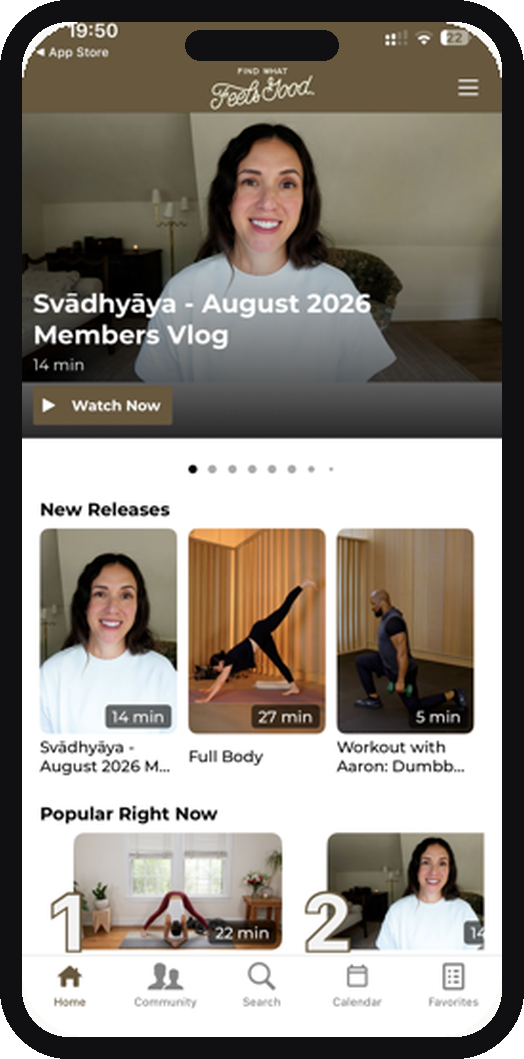
Find What Feels Good (FWFG) is the membership app from Yoga With Adriene (Adriene Mishler), free at its core on YouTube and about $12.99/month or $129.99/year for the membership, with a 7-day trial · far more than yoga: a big, calming library of yoga, Pilates, meditation, breathwork, sound baths and a light strength and conditioning “Train” section, plus a small menopause collection · gentle, low-impact, beginner-friendly and mindful · sessions from about 5 to 60 minutes · a mat is all you need · Optional block and strap.
What this review is. This is a sample-tested review: I signed up for the one-week Find What Feels Good trial and practised across the app, rather than a full 30-day test, so the score is a hands-on look with a full test still to come. One correction from actually using it: Find What Feels Good is broader than the “yoga only” label the free channel suggests. Inside the membership there is Pilates, meditation, breathwork, sound baths, a “Train” section of light strength and conditioning workouts, some nutrition, and a genuine menopause and perimenopause collection. It is still a calm, low-impact, mind-body app at heart, and it is still not a progressive-strength or bone-building system, but it does more for a midlife woman than the yoga label implies. This is education, not medical advice; speak to your clinician, especially about HRT or existing conditions.
Find What Feels Good (Yoga With Adriene) Review 2026: Quick Answer
Sample-tested: a one-week Find What Feels Good membership trial. Full 30-day test still to come.
Women who want gentle, calming, low-impact movement and mind-body support at home, for stress, mobility, back care, sleep and a softer nervous system, from a warm and trusted teacher
Your main priority is building muscle or bone with progressive strength; the strength here is light, so you will need a dedicated strength system alongside it
A huge free Yoga With Adriene YouTube channel plus the Find What Feels Good membership app, which adds Pilates, meditation, breathwork, sound baths, light strength and a menopause collection
About 5 to 60 minutes, with lots of short options and multi-day journeys and challenges
A mat, plus an optional block and strap; light dumbbells if you use the Train section
Low, by design; gentle and joint-friendly
Better than expected for calm and self-care: a real menopause and perimenopause collection, plus pelvic-floor, back and joint sessions. But it is focused on stress and acceptance, not muscle loss or bone density
On-demand, with occasional live classes for members, challenges, and a new annual journey each January
YouTube on any device or TV; the FWFG app on iOS, Android, Apple TV, Roku and Fire TV, and the web, with offline downloads for members
Free on YouTube; the Find What Feels Good membership is about $12.99/month or $129.99/year
The whole YouTube library is free; the membership has a 7-day trial
Cancel the membership anytime through your account or the App Store; the free YouTube channel needs no account
Neutral and supportive; gentle, mindful movement with no medical or menopause claims
Active, with new videos, annual journeys, challenges and regular membership updates
6.8 / 10
Quick Verdict
Worth it for women over 40? Yes as gentle, calming, low-impact movement and self-care, with a strength system added alongside.
Find What Feels Good earns 6.8/10 after a one-week hands-on trial. Using it was a genuine pleasure: it is a beautiful, calming app, the library is huge and varied, and it is one of the most welcoming places to move at home, from a teacher millions of women trust. For a midlife body it does the calm, mobility, back-care and stress side beautifully, and I was pleasantly surprised to find real pelvic-floor, joint and menopause sessions, plus meditation, breathwork and sound baths that make low-intensity and stressful days genuinely easier. The limit is the one that matters most for our audience: the strength here is light. There is a “Train” section and some Pilates, but no heavy, progressive loading, so on its own it will not rebuild the muscle and bone a midlife body loses. Our take: use Find What Feels Good as the calming, mind-body foundation of your week, and pair it with a dedicated progressive-strength routine for muscle and bone.
Is Find What Feels Good right for you?
Find What Feels Good is strongest for training on low energy (9.0 out of 10, against a 5.7 average across the 77 programmes scored) and weakest for building bone density (3.5 against 5.1).
| Question | Verdict | Rating | Score |
|---|---|---|---|
| How it suits a perimenopausal body | |||
| Is Find What Feels Good good for pelvic floor problems?Based on pelvic floor support and low-impact design | Strong, and better than mostmost score 4.6/10 | 7.0 / 10 | |
| Is Find What Feels Good genuinely built for perimenopause and menopause?Based on menopause programming, hormone awareness, education and expert credibility | Low, about the same as mostmost score 3.3/10 | 4.0 / 10 | |
| Is Find What Feels Good good for painful joints?Based on low-impact design and recovery provision | Strong, and better than mostmost score 6.2/10 | 9.0 / 10 | |
| Is Find What Feels Good manageable when your energy is low?Based on recovery provision and mind-body support | Strong, and better than mostmost score 5.7/10 | 9.0 / 10 | |
| Is Find What Feels Good good if you are new to strength training?Based on beginner on-ramp and mind-body support | Strong, and better than mostmost score 6.1/10 | 9.0 / 10 | |
| Is Find What Feels Good good for building bone density?Based on bone loading and progressive strength | Low, and worse than mostmost score 5.1/10 | 3.5 / 10 | |
| Does Find What Feels Good help with nutrition?Based on midlife nutrition support | Low, and worse than mostmost score 4.0/10 | 3.0 / 10 | |
| How it performs as a product | |||
| Can you fit Find What Feels Good into a busy week?Based on time efficiency | Strong, about the same as mostmost score 7.6/10 | 8.0 / 10 | |
| Is Find What Feels Good worth the money?Based on value for money | Strong, and better than mostmost score 6.9/10 | 8.0 / 10 | |
Jump to Section
Who Is Behind It
Content and Features
Equipment You Need
Full Scoring
Good for Women Over 40?
Menopause and Midlife Fit
What the Research Says
What Users Report
Devices and Access
Pricing 2026
Will You Stick With It?
Pros and Cons
How It Compares
vs Down Dog
Best Alternatives
FAQ
Verdict
Testing Status
Sources
What Find What Feels Good Actually Is
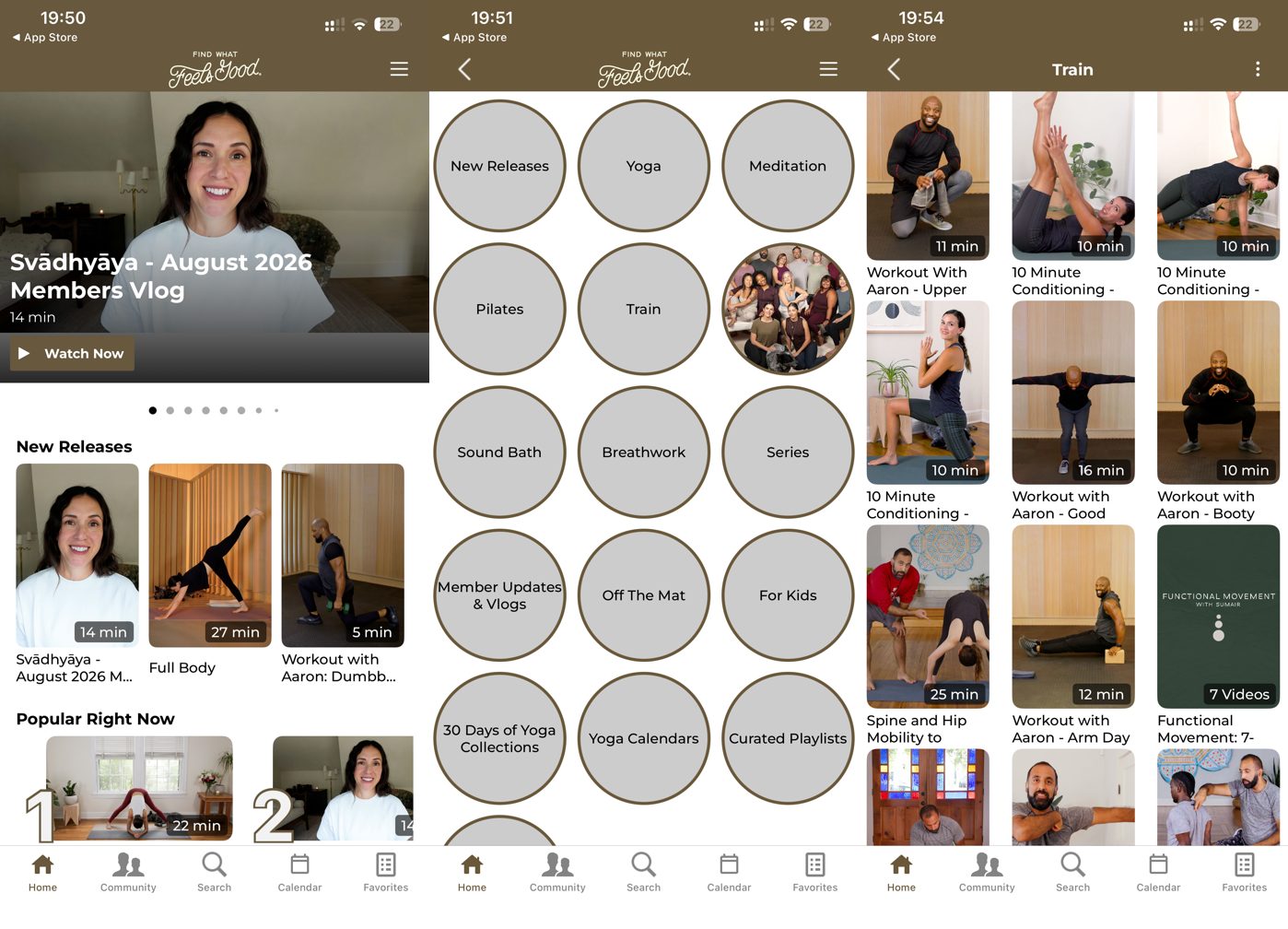
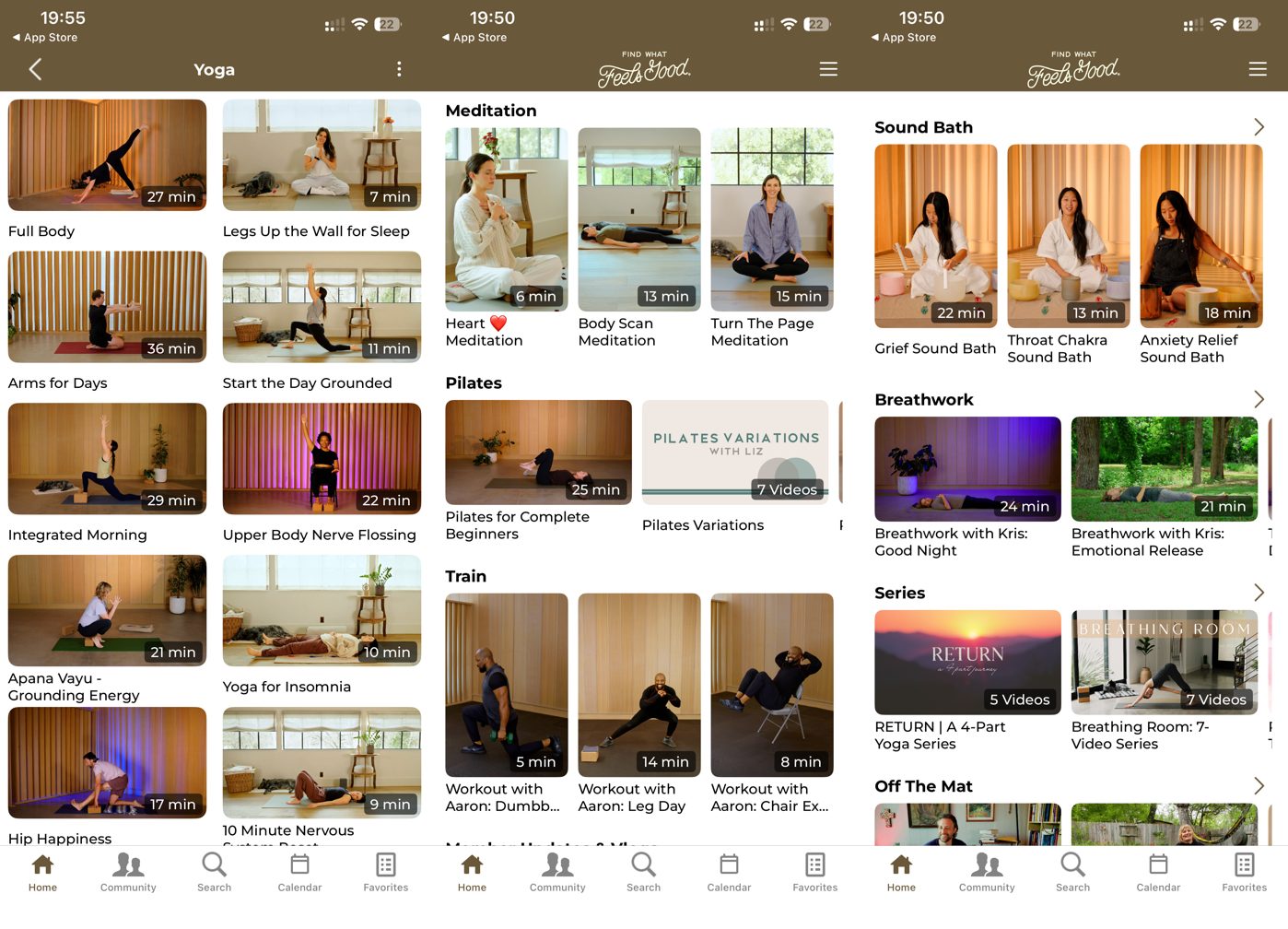
Find What Feels Good (often shortened to FWFG) is the membership app built around Yoga With Adriene, the free YouTube channel from Adriene Mishler, a yoga teacher in Austin, Texas, and one of the biggest yoga followings in the world with more than 13 million subscribers and over 750 free classes. The free channel is where most people meet her: gentle, beginner-friendly, mindful home yoga with a “find what feels good” philosophy, plus the famous annual New Year journey that millions practise along with. The paid Find What Feels Good membership, which co-founder Chris Sharpe helped build, adds ad-free streaming and a much broader library on top of the yoga: Pilates, meditation, breathwork, sound baths, a “Train” section of light strength and conditioning workouts with other teachers, monthly calendars, challenges, offline downloads and a members community.
Testing the membership changed how I would describe it. On the free channel, “yoga only” is fair. Inside the app it is broader: a calming, low-impact, mind-body wellness library that happens to be led by a yoga brand. For a woman over 40 that breadth matters, because alongside the yoga there are genuine pelvic-floor, strong-back and joint-health sessions, some nutrition, and a real menopause and perimenopause collection. What it still is not is a progressive-strength or bone-building system: the Train section and the Pilates are light and largely bodyweight, without the heavier, progressive loading a midlife body needs to rebuild muscle and bone. Read Find What Feels Good as an excellent calming, mobility and self-care foundation to pair with dedicated strength work, rather than a complete midlife programme on its own.
Who Is Behind Find What Feels Good? Credibility
The face and founder is Adriene Mishler, a certified yoga teacher in Austin, Texas, who built one of the world’s largest and most trusted yoga followings, with around 13.5 million YouTube subscribers and more than 750 free classes, alongside her business partner Chris Sharpe. Her credibility is genuine and rooted in warmth, authenticity, consistency and accessibility: she is widely regarded as the friendliest on-ramp to yoga, and she commands unusually high audience trust and loyalty, especially among women. The membership also brings in a small faculty of other teachers for the Pilates, strength, breathwork and menopause sessions, which broadens the expertise beyond one person.
What the brand is not is clinical: Adriene is not a physician, physiotherapist, dietitian or menopause specialist, and there is no medical or menopause advisory board behind the content.
For a midlife audience that means high trust and safety for gentle movement and mindfulness, and lower authority on menopause-specific medical or hormone claims. Read the team as a beloved, trustworthy movement brand, rather than a source of clinical menopause guidance.
Content and Features
At a glance: a huge, calming library that is broader than yoga once you are inside the membership, best-in-class for accessibility, mindfulness and low-impact movement, with a genuine menopause and self-care collection. The strength content is light, and there is no heavy progressive loading, so muscle and bone still need a separate system.
| Format | On-demand, teacher-led sessions on YouTube and in the FWFG app, plus challenges, monthly calendars and occasional live classes for members. |
| Disciplines | Yoga (vinyasa, hatha, gentle, restorative, yin), Pilates, meditation, breathwork, sound baths, and a light “Train” strength and conditioning section. |
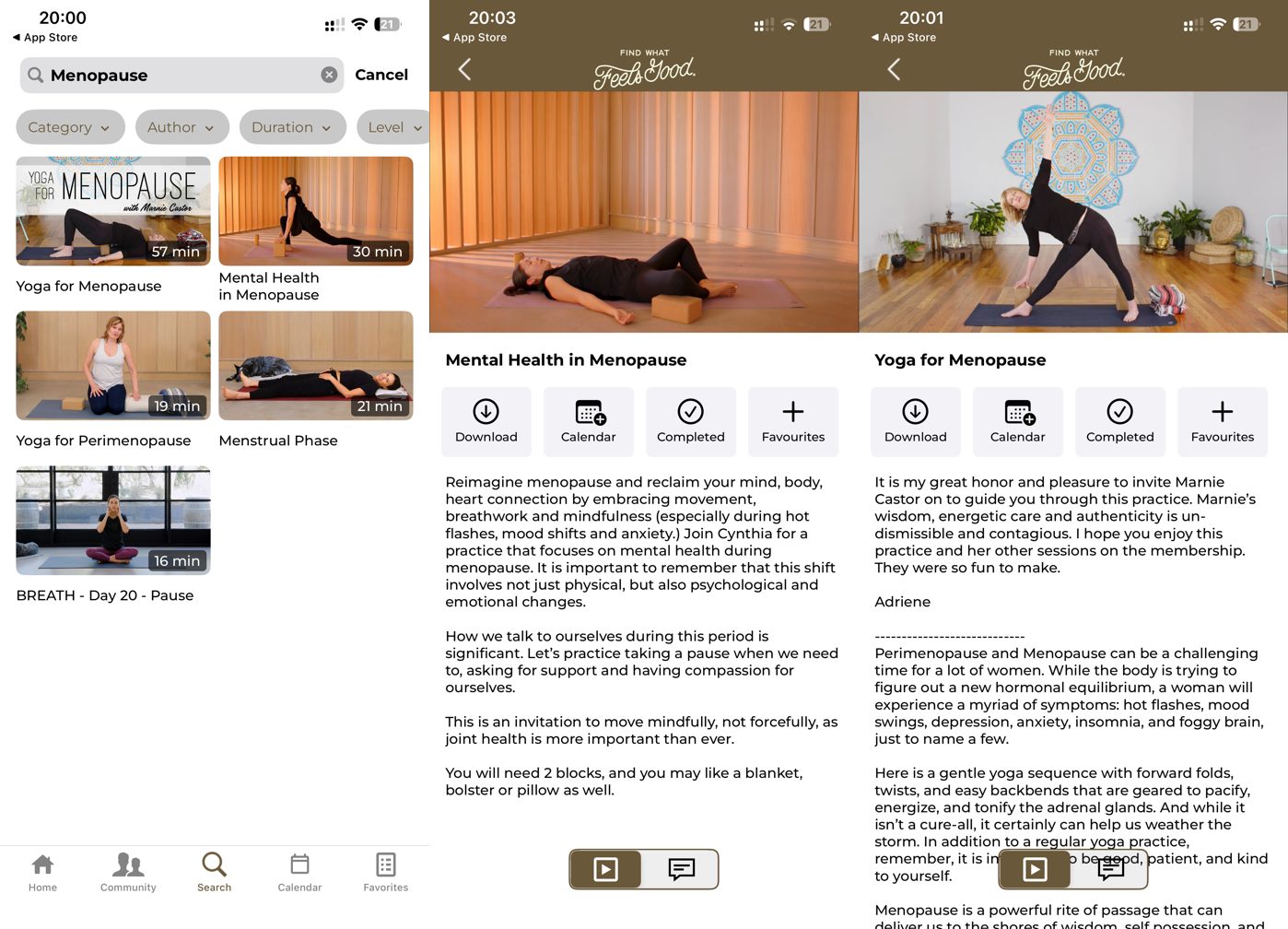
| Menopause / perimenopause | A real collection: Yoga for Menopause, Mental Health in Menopause, Yoga for Perimenopause, Menstrual Phase and more. Focused on stress, mood, sleep and acceptance rather than muscle, bone or hormone therapy. |
| Pelvic floor, back and joints | Dedicated sessions exist for pelvic floor, strong back and joint health, which suit a midlife body well. |
| Recovery and mind | Best-in-class. Restorative yoga, guided meditation, breathwork and sound baths, with a calming, mindful tone throughout. |
| Nutrition | Some nutrition content is present, but it is light and not a structured plan. |
| Strength | Light. A “Train” section of bodyweight and light-dumbbell conditioning plus Pilates, but no heavy or progressive loading; not a muscle or bone builder on its own. |
| Structure and discovery | Annual 30-day journeys, themed challenges, curated collections, monthly calendars, and a Netflix-style “Popular Right Now” ranking that genuinely helps with decision fatigue. |
| Community | An enormous free YouTube community and a members community in Find What Feels Good. |
What Equipment Do You Need for Find What Feels Good?
Very little, which is part of the appeal. A mat is all you really need for the yoga, Pilates, meditation and breathwork, and a pair of blocks and a strap make poses more accessible, which helps a midlife body easing back into flexibility work. If you use the “Train” section, a pair of light dumbbells is useful, though the loading stays gentle. To add the muscle and bone work this app does not fully provide, a set of adjustable dumbbells for a separate progressive-strength habit is the more valuable midlife buy.
Recommended spec examples. These picks are curated by specification and feature fit, not personally lab-tested for long-term durability. Prices are examples; verify before buying.
Exercise mat
~$20 to $40
The one essential. Needed for every yoga, Pilates, floor and mobility session; a half-inch mat is kinder to knees, hips and spine.
Yoga blocks
~$15 a pair
Optional but helps. Brings the floor closer so poses stay accessible for a midlife body; buy two.
Light adjustable dumbbells
~$70 to $80
For the Train section. Adds the progressive resistance this app does not fully cover; adjustable to about 20 lb.
Bottom line on equipment: a mat and blocks cover almost everything in Find What Feels Good; add adjustable dumbbells for a separate progressive-strength habit, since the app’s strength stays light.
How We Scored Find What Feels Good: the 6.8 / 10 Breakdown
Hands-on scores on our 9 weighted criteria, from a one-week membership trial. Women Over 40 is our most heavily weighted menopause criterion, and its full 12-capability breakdown follows in the next section.
| Category | Weight | Score | Reasoning (confidence) |
|---|---|---|---|
| Time Efficiency | 15% | 8 | A deep range of 5 to 60 minute sessions makes it easy to fit into a busy day. (confidence: high) |
| Muscle Potential | 18% | 4 | The Train section and Pilates add light strength, but there is no heavy or progressive loading, so the muscle stimulus is modest. (confidence: high) |
| Women Over 40 Specificity | 10% | 5.6 | Real menopause, pelvic-floor, back and joint content and superb calm, but light on the strength and bone side; full breakdown below. (confidence: high) |
| Joint Friendliness | 12% | 9 | Gentle, low-impact movement with dedicated joint and back sessions; among the most joint-friendly apps there is. (confidence: high) |
| Recovery Compatibility | 10% | 9 | Restorative yoga, meditation, breathwork and sound baths make it an outstanding recovery and stress-reset tool. (confidence: high) |
| Programme Structure | 12% | 7 | Journeys, challenges, collections, calendars and a Netflix-style ranking give real structure and ease decision fatigue. (confidence: high) |
| Value for Money | 8% | 8 | A huge free core, plus an inexpensive, content-rich ad-free membership; excellent value. (confidence: high) |
| UX and Design | 8% | 8 | A genuinely pleasant, calming, well-organised app with helpful discovery; a small number of app bugs are reported. (confidence: high) |
| Nutrition Integration | 7% | 3 | Some nutrition content is present, but it is light and not a structured plan. (confidence: medium) |
| Total | 100% | 6.8 / 10 | Hands-on Score, from a one-week sample test. |
Is Find What Feels Good Good for Women Over 40?
For gentle, mindful movement and self-care, yes, and after a week in the app I would happily recommend it as part of a midlife routine. It is low-impact and joint-friendly, warm and non-intimidating, and its restorative classes, meditation, breathwork and sound baths genuinely help on stressful or low-energy days, which matter when stress sensitivity and sleep disruption rise in perimenopause. The library of specific-need sessions, from back care to pelvic floor to the menopause collection, means there is almost always something that meets you where you are, and the annual journeys and challenges build a real habit.
What I found using it. I signed up for the one-week trial and was welcomed into a genuinely lovely app: the colours and design are calm and aligned with the better yoga and Pilates apps, and there is a big library of yoga and Pilates. I am not normally a yoga person, but on low-intensity or stressful days these calming sessions were really helpful, and I loved the “Popular Right Now” feature that ranks workouts visually like Netflix, which cut the decision fatigue. The app is full of meditation, breathwork and relaxation, it is great for beginners because there is so much guidance, there is some nutrition, and I was positively surprised to find sessions on pelvic floor, strong back and joint health. There are even a few menopause and perimenopause programs, though these are very much about stress management, mood and feeling less alone, rather than muscle loss or bone density. The “Mental Health in Menopause” session in particular is about relaxation, acceptance and self-compassion, and it was a highlight.
Who it suits, and what I missed. It suits a woman who wants calm, low-impact movement, mobility and self-care she can trust and stick with. What I missed is real strength: there is a light Train section and Pilates, but nothing that progressively loads muscle and bone, and at our age we are actively losing muscle and need to build it. On its own, yoga and light movement will not do that, so this app needs a proper strength system alongside it. For that, see our low-impact strength guide or a purpose-built option like Pvolve.
What others found too. A devoted, largely female following describes the brand the same way I experienced it: accessible, calming and genuinely beloved, with a teacher people trust and return to for years. The recurring caveats match mine, that some find the yoga chatty and that stronger practitioners can outgrow it, and that the membership app occasionally has bugs.
What the wider picture shows. Older and midlife women in particular praise the gentleness, the joint-friendliness and the stress relief, and reviewers echo the warmth and trust. The recurring caveats are that some find her chatty, that stronger practitioners can outgrow the yoga, and that the paid app is occasionally buggy next to the free channel. Read Find What Feels Good as a superb gentle, mindful, self-care foundation for a woman over 40, best paired with a dedicated strength habit for the muscle and bone it does not build.
This is the perimenopause and menopause assessment, and it is separate from the overall score. Twelve things a programme either does for a midlife body or does not, each scored out of 10 with my reasoning next to it. Together they produce a single menopause fit score, and that becomes one of the nine categories in the overall scoring below.
How Find What Feels Good Fits Perimenopause, Menopause & Beyond
Women Over 40 is our most important criterion, and here's the full breakdown behind it.
Find What Feels Good is strongest for low-impact, recovery & deload, mind-body support and beginner on-ramp, and weakest for bone loading, hormone awareness, midlife nutrition, progressive strength, menopause education and expert credibility, in our menopause and midlife capability assessment for women over 40.
At a glance
| Capability | Score | Rating | Why |
|---|---|---|---|
| Right training for a midlife body | |||
| Low-impact | 9/10 | Best-in-class | Gentle yoga, Pilates and mobility are inherently low-impact and among the most joint-gentle movement there is. |
| Progressive strength | 4/10 | Minimal | The Train section and Pilates add light strength, but there is no heavy or progressive loading, so muscle gains are limited. |
| Bone loading | 3/10 | Minimal | Light dumbbell and bodyweight work offers little of the high-magnitude loading bone density needs. |
| Recovery & deload | 9/10 | Best-in-class | Restorative yoga, meditation, breathwork and sound baths make it an outstanding recovery and nervous-system reset. |
| Built for menopause | |||
| Menopause programming | 5/10 | Some | A genuine collection (Yoga for Menopause, Mental Health in Menopause, Yoga for Perimenopause, Menstrual Phase), focused on stress and calm rather than strength or hormones. |
| Pelvic floor | 5/10 | Some | Dedicated pelvic-floor sessions exist and are a genuine plus for a midlife body. |
| Hormone awareness | 3/10 | Minimal | Menstrual-phase and menopause content touch the theme, but there is no structured hormone or phase-based programming. |
| Menopause education | 4/10 | Minimal | The menopause sessions offer supportive framing and self-compassion, but not structured clinical education. |
| Expert credibility | 4/10 | Minimal | Trusted teachers and a small faculty, but not clinicians or menopause specialists, and no medical advisory board. |
| Whole-woman support | |||
| Mind-body support | 9/10 | Best-in-class | Mindfulness, breathwork and sound baths are the heart of the brand; a genuine standout for calm and stress. |
| Beginner on-ramp | 9/10 | Best-in-class | Famously the most approachable movement online, warm and heavily guided; a superb place to start. |
| Midlife nutrition | 3/10 | Minimal | Some nutrition content is present, but it is light and not a structured plan. |
ScaleBest-in-classStrongSomeMinimalNone
These are evidence-informed suitability ratings, not clinical measurements. They combine exercise science with product-specific research and, where indicated, hands-on testing, alongside multi-source verification, and are approximate. Individual response varies. A starting point, not medical advice. How we score menopause fit
What the sources say: scores combine a one-week hands-on trial with the app and channel pages, the app listings and reviews. Low-impact, mind-body support, beginner access, recovery and the menopause and pelvic-floor collections scored well because they are genuine, verifiable strengths and a real match for a midlife nervous system. The built-for-menopause group is held to Some because the menopause content is stress and calm focused, and there is no strength, bone, hormone or clinical programming.
These are evidence-informed suitability ratings, not clinical measurements. They combine exercise science with hands-on and feature analysis, and are approximate. Individual response varies. A starting point, not medical advice. How we score menopause fit.
What the Research Says: Find What Feels Good’s Approach Checked
Find What Feels Good’s gentle, mindful approach is well matched to some midlife needs, with one clear limit. Yoga has real, if modest, benefits for menopausal women: a systematic review and meta-analysis of 13 trials found yoga reduced menopausal symptoms, most consistently the psychological ones, though the evidence was rated low to moderate quality, so we frame it as helpful for wellbeing rather than a treatment for hot flashes.[1] Mindfulness-based practices, which the app emphasises, improved menopausal quality of life and reduced stress, though evidence for specific symptoms was mixed.[2] In older adults, yoga improves balance, lower-limb strength and flexibility, which are fall-risk factors, though the evidence does not show it prevents actual falls, so we do not claim that.[3] It can genuinely help everyday aches, too: a Cochrane review found yoga gave small to moderate short-term improvements in back function and pain, comparable to other exercise, which matters given how much back-care content the app offers.[4] On sleep, be cautious: a meta-analysis found yoga improved sleep in women overall while the peri and postmenopausal subgroup showed no significant benefit.[5]
The caveat that matters most, and the one that backs my own reservation, is muscle and bone. At midlife women lose muscle and bone, and the biggest gains come from progressive resistance and heavier loading, not gentle or light movement. A meta-analysis of postmenopausal women found that exercise improves body composition, with resistance training the most effective for building muscle.[6] In the LIFTMOR trial, high-intensity resistance and impact training improved bone density and function in postmenopausal women, whereas light exercise did not, and reviews confirm that bone responds to higher mechanical loads.[7][8] Find What Feels Good’s Train section and Pilates are light and largely bodyweight, so they provide little of that stimulus. This is why the app is best read as the calming, mobility and self-care side of a midlife routine, paired with a dedicated progressive-strength habit for the muscle and bone it cannot build on its own.
What Users Report: Verified Sentiment
Rating snapshot: the real signal here is reach, and it is enormous and warm. The free YouTube channel has around 13.5 million subscribers and is the most-followed yoga channel there is, with a devoted, largely female audience. On the membership side, the Find What Feels Good app rates about 4.9 stars on the Apple App Store from a few thousand ratings, while on Google Play it sits a little lower at about 4.4 to 4.5, where app bugs are the main complaint rather than the content. There is no genuine Trustpilot profile, so we do not publish one. My week in the app matched that picture: the content and calm are the strength, and the app itself is pleasant, with only minor friction. We read the huge free following as the trustworthy signal, and treat the app-store split as a software-quality story.
Consistently praised
- Free and accessible, with no equipment and nothing to intimidate a beginner.
- Adriene’s warmth and authenticity, which keep people coming back.
- Gentle, calming and mindful, good for stress, sleep, anxiety and back care.
- The annual journeys and challenges build a genuine, lasting habit.
Consistently criticised
- Light on real, progressive strength for muscle and bone.
- Some find her too chatty, wanting more flow and less talk.
- Stronger practitioners can find the yoga repetitive or not challenging.
- The paid membership app has recurring bug complaints, especially on Android.
Source and credibility note: figures were read from the YouTube channel and the app listings (August 2026) and cross-checked against a one-week hands-on trial. The free following is the strongest, hardest-to-fake signal; the Apple 4.9 skews to committed members, and the Google Play 4.4 to 4.5 reflects app-build bugs more than content, so we report them separately rather than blend them. No genuine Trustpilot profile exists.
Devices, Platforms and Access
Find What Feels Good is as easy to reach as anything gets. The free channel is on YouTube, so it plays on any phone, tablet, computer or smart TV, and casts easily to a screen. The paid membership adds apps for iOS, Android, Apple TV, Roku and Fire TV, plus the web, with offline downloads and cross-device syncing, and it works with an Apple Watch. In my week on iOS the app was smooth and pleasant, though the membership app, which is powered by a third-party platform, draws recurring bug complaints elsewhere, especially on Android, with reports of playback and download issues after updates. For a woman over 40 who mostly wants to roll out a mat and follow a calming class on her phone or television, the experience could hardly be simpler.
Find What Feels Good specifications
- Free trial
- 7-day free trial
- Cancellation
- cancel anytime via store; auto-renews unless cancelled ≥24h before; no partial refund
- Session length
- ~10 to 60+ min
- Who makes it
- Adriene Mishler, a Yoga Alliance certified Hatha yoga teacher based in Austin, Texas, who also works as an actor and writer. She is not a clinician or personal trainer.
- Still maintained
- Active; FWFG app iOS v15.0.10 (rel 2026-06-03), id 1050813703
- What is included
- On-demand classes: yesLive classes: noRecovery content: yesMenopause education: partlyStructured programmes: yesMeditation: yesNutrition guidance: no
- Women over 40
- Pelvic floor work: partlyMenopause clinician involved: noInjury modifications: yesBone-health focus: noModified progressions: partlyCycle syncing: noPrenatal options: yes
- Devices and access
- Offline downloads: partlyCasting to TV: yesSubtitles: partlyWearable sync: no
- Support
- Clinical advisory board: noCommunity: yesSupplement upsell: no
- Last verified
- 12 August 2026
Find What Feels Good Price 2026: What You Actually Pay
| Plan | Cost | Includes |
|---|---|---|
| Free (YouTube) | $0 | The full library of 750-plus Yoga With Adriene classes and the annual journeys, ad-supported, with no account needed. |
| FWFG membership monthly | About $12.99/month | Ad-free streaming, exclusive classes, Pilates, meditation, breathwork, sound baths, the Train section, the menopause collection, curated programs, calendars, offline downloads and community. |
| FWFG membership yearly | About $129.99/year | The same, at a lower monthly rate, with a 7-day free trial for new members. |
Cost and Cancellation
The value here is unusually good, because the core is genuinely free on YouTube, so you can practise for years without paying at all. The optional Find What Feels Good membership is inexpensive at about $12.99 a month or $129.99 a year, with a 7-day free trial for new members, and it adds an ad-free experience, the broader library and offline downloads. You can cancel anytime through your account dashboard, or via the App Store if you subscribed there, with access continuing to the end of the billing period; there are no refunds for an unused portion. If you are only sampling it, set a reminder before the trial ends. Prices were checked in August 2026; confirm the current figure at checkout.
Will You Actually Stick With It?
On paper this is one of the easiest apps to stick with: it is warm, gentle and free to begin, so the usual barriers of intimidation, soreness and cost barely apply. The one real adherence risk is the opposite one, that it is so calming it is easy to coast, so you still need to add progressive strength elsewhere to protect muscle and bone.
The warmest, most beginner-friendly movement there is, and free to start, so it is very easy to begin.
Gentle and calming by design, so it rarely leaves you needing to recover.
The core is free, so cost is almost never the reason you stop.
Light strength only means you must add progressive resistance elsewhere for muscle and bone.
Find What Feels Good Pros and Cons
Pros
- Genuinely free at its core, with a huge library and no equipment
- Best-in-class gentle, low-impact, joint-friendly movement
- Best-in-class mindfulness, breathwork and sound baths for stress and sleep
- A real menopause and perimenopause collection, plus pelvic-floor, back and joint sessions
- Warm, trusted, non-intimidating teacher, loved by millions
- Lovely, calming app design with Netflix-style discovery that eases decision fatigue
- An inexpensive, ad-free membership with offline downloads and challenges
Cons
- Strength is light, with no heavy or progressive loading for muscle and bone
- You will need a separate strength system for the top midlife priority
- The menopause content is stress and calm focused, not hormone or clinical
- Nutrition is light and not a structured plan
- Some find her chatty, and stronger practitioners can outgrow the yoga
- The paid membership app draws bug complaints, especially on Android
- Not a clinician or menopause specialist, and no medical advisory
How Find What Feels Good Compares to Similar Platforms
If you are deciding between gentle, at-home options, this is how Find What Feels Good sits against the alternatives. Scores come from our independent reviews and update automatically as each is scored; Pvolve is included as the menopause-built contrast.
| Feature | Find What Feels Good | Down Dog | FitOn | Peloton | Pvolve |
|---|---|---|---|---|---|
| Our score | 6.8 / 10 (hands-on) | 6.0 / 10 | 7.3 / 10 | 7.3 / 10 | 8.3 / 10 |
| Monthly price | Free · membership ~$12.99/mo | $12.99/mo · ~$99.99/yr | Free tier · ~$29.99/yr Pro (verify) | ~$12.99 to $44/mo (verify) | $24.99/mo · equipment from $199 |
| Free option | Entire YouTube library free | Brief trial (card required) | Generous free tier | App tiers | 14-day trial (card required) |
| Best for | Gentle, free, mindful movement and self-care | Flexible, generative yoga practice | Free, varied at-home workouts | Studio-style cycling and classes | Low-impact functional strength, menopause, joints |
| Impact level | Low | Low (yoga); high in the HIIT app | Low to moderate | Moderate to high | Low by design |
| Progressive strength | Light only | Bodyweight and light weights | Some, light weights | Yes | Yes, functional |
| Perimenopause content | Real calm-focused collection | None | Minimal | Some women’s-health content | Best in class: Menopause Strong, pelvic floor |
| Mind-body content | Best in class | Strong | Good | Good | Some |
| Best suited to | Women wanting calm, free, low-impact movement | Women wanting a customisable yoga practice | Women wanting a free class library | Cycling and studio-class fans | Women ~35+, perimenopause, joint issues |
Competitor prices are approximate; verify on each platform’s website. Scores reflect our independent reviews. See each full review for methodology.
Find What Feels Good vs Down Dog: Which Is Better for Women Over 40?
This is the closest pairing for a woman who mainly wants calming yoga at home, and they take opposite approaches. Down Dog generates a fresh, non-repeating class each time from your settings, so it feels like a customisable, do-it-yourself yoga studio, and it spans several practice types under one app. It suits a woman who wants variety and control and does not mind a more app-like, less personal experience.
Find What Feels Good is the opposite in the best way: real, warm human teachers, a huge free library, and a calming, mindful style that people bond with and stick to for years, now broadened with Pilates, breathwork, sound baths and a menopause collection. It is the better pick if you want to be taught by teachers you trust, if free matters, and if calm, self-care and back care are your goals. Neither is a heavy-strength or bone-building tool. For a warm, free, teacher-led practice with real breadth, Find What Feels Good; for a customisable, generative one, Down Dog; and for genuine menopause programming and the progressive strength a midlife body needs, a purpose-built option such as Pvolve goes further than either.
If Find What Feels Good Is Not Right for You: Best Alternatives
Find What Feels Good’s one real weakness for our audience is progressive strength. If that is your priority, or you want more menopause-specific programming, these published options map to the gaps.
Find What Feels Good FAQ
Find What Feels Good (FWFG) is the membership app built around Yoga With Adriene, the free YouTube channel from Adriene Mishler. The free channel is gentle, beginner-friendly yoga; the paid membership adds ad-free streaming and a broader library of Pilates, meditation, breathwork, sound baths, a light strength and conditioning “Train” section, a menopause collection, monthly calendars, challenges, offline downloads and a community. It is about $12.99 a month or $129.99 a year, with a 7-day trial.
They are two sides of the same brand. Yoga With Adriene is the free YouTube channel, and Find What Feels Good is the paid membership app. The channel is yoga; the app is broader, adding Pilates, meditation, breathwork, sound baths, light strength and a menopause collection. You can use the free channel forever without paying, or subscribe to the app for the ad-free, expanded library.
For gentle, mindful movement and self-care, yes: it is low-impact, joint-friendly, calming and largely free, and it has a real menopause and perimenopause collection plus pelvic-floor, back and joint sessions. But the strength content is light, so it does little for the muscle and bone a midlife body needs. Use it for calm and mobility, and pair it with a dedicated progressive-strength routine.
Only lightly. There is a “Train” section and Pilates, but no heavy or progressive loading, and the evidence is clear that building muscle and bone in midlife needs heavier, progressive resistance. Treat Find What Feels Good as excellent for flexibility, mobility, back care and calm, and add a separate progressive-strength routine, with dumbbells, for the muscle and bone it does not build.
No. The free Yoga With Adriene YouTube channel is the main event and needs no payment or account. The Find What Feels Good membership is optional, and it is worth it if you want the broader library, an ad-free experience, offline downloads, or the menopause and Pilates content. Note the app draws occasional bug complaints, especially on Android.
For a woman who wants gentle, mindful, joint-friendly movement and self-care from a warm, trusted teacher, largely free, Find What Feels Good is one of the best things on the internet, and after a hands-on week I would happily recommend it as part of a routine. It is a weaker single choice if your priority is building strength or bone, since the strength is light. This is a sample-tested review; a full 30-day test is still to come.
Final Verdict
Hands-on Score: 6.8 / 10 · Sample-tested (one-week trial)
Find What Feels Good is one of the most accessible and beloved movement resources anywhere, and after a week in it I understand why. It is best-in-class for low-impact movement, mindfulness and beginner access, it is largely free, and it is led by teachers millions of women trust. For stress, sleep, mobility, back care and a calmer nervous system it is a lovely fit for a midlife body, and I was genuinely surprised by the depth of its menopause, pelvic-floor and joint content. The one moderating factor for our audience is the one that matters most: the strength is light, so on its own it does little for the progressive muscle and bone loading that protect a midlife body.
Find What Feels Good is for women who want gentle, free, mindful movement and self-care they can trust and stick with, for calm, mobility and back care. Find What Feels Good is not for women whose single priority is building muscle and bone, who should pair it with a dedicated strength habit and, for menopause-specific programming, a purpose-built option such as Pvolve.
Testing Status
Sample-tested. This review is based on a one-week Find What Feels Good membership trial on iOS (August 2026), plus the free channel, the app listings, independent reviews and peer-reviewed science. A full 30-day test, with adherence and progression over time, would move it to Fully tested and may refine the score. Screenshots are my own. How we score and test.
Sources and Further Reading
- Cramer, H., Peng, W., Lauche, R. (2018). Yoga for menopausal symptoms: a systematic review and meta-analysis. Maturitas. Available at: pubmed.ncbi.nlm.nih.gov. Yoga reduced menopausal symptoms, most consistently psychological ones; evidence was rated low to moderate quality.
- Chen, T.L. et al. (2021). Effectiveness of mindfulness-based interventions on quality of life and menopausal symptoms in menopausal women: a meta-analysis. Journal of Psychosomatic Research. Available at: sciencedirect.com. Mindfulness-based interventions improved quality of life and reduced stress in menopausal women, with mixed evidence for specific symptoms.
- Sivaramakrishnan, D. et al. (2019). The effects of yoga compared to active and inactive controls on physical function and health-related quality of life in older adults: a systematic review and meta-analysis. International Journal of Behavioral Nutrition and Physical Activity. Available at: pmc.ncbi.nlm.nih.gov. Yoga improved balance, lower-limb strength and flexibility (fall-risk factors), not actual falls.
- Wieland, L.S. et al. (2017). Yoga treatment for chronic non-specific low back pain. Cochrane Database of Systematic Reviews. Available at: cochranelibrary.com. Yoga gave small to moderate short-term improvements in back function and pain, comparable to other exercise.
- Wang, W.L. et al. (2020). The effect of yoga on sleep quality and insomnia in women with sleep problems: a systematic review and meta-analysis. BMC Psychiatry. Available at: pmc.ncbi.nlm.nih.gov. Yoga improved sleep in women overall, but the peri and postmenopausal subgroup showed no significant benefit.
- Khalafi, M. et al. (2023). The effects of exercise training on body composition in postmenopausal women: a systematic review and meta-analysis. Frontiers in Endocrinology. Available at: pmc.ncbi.nlm.nih.gov. Exercise improved body composition in postmenopausal women, with resistance training the most effective for building muscle.
- Watson, S.L. et al. (2018). High-intensity resistance and impact training improves bone mineral density and physical function in postmenopausal women: the LIFTMOR randomized controlled trial. Journal of Bone and Mineral Research. Available at: pubmed.ncbi.nlm.nih.gov. Heavier, high-intensity loading improved bone density; light exercise did not.
- Kumar, S. et al. (2025). Exercise for postmenopausal bone health: can we raise the bar? Current Osteoporosis Reports. Available at: pmc.ncbi.nlm.nih.gov. Bone responds to high-magnitude loading; low-load movement like gentle yoga is not a bone-loading intervention.
This is a sample-tested review based on a one-week trial, not a full 30-day test. Pricing and features were verified August 2026 and may have changed. Some affiliate links may be present. This site does not accept payment from platforms reviewed. Education, not medical advice; speak to your clinician, especially about HRT or existing conditions.
Related Guides
What To Do Next
- → Take our 2-minute quiz for a personalised recommendation.
- → See our best workouts for perimenopause rankings.
- → Compare with our Down Dog review and see how we score every programme.