Peloton scores higher overall, 7.3 against 6.9, and is the stronger platform for nutrition guidance and perimenopause-specific programming. Apple Fitness+ is the better pick if what you need most is a structured programme.
- Score 7.3 vs 6.9
- Yes free trial on both
- Both tested hands-on
Quick answer: Peloton is the better overall platform for women over 40 managing perimenopause symptoms because of its dedicated Menopause Health Collection (56 classes organised into a 7-day framework, developed with Respin Health) and the way instructors cue modifications inside every class. Apple Fitness+ is the better choice for women who want the lowest monthly price, short stackable sessions, and a modifier on screen in every workout.
The two platforms
Same nine weighted categories, two different women. Here is who each one is built for.
Peloton
WinnerLeads this comparison on nutrition guidance and perimenopause-specific programming, scoring 2 against 0 on Nutrition Integration.
- Low impact
- 20 to 45 min
- None for app
Choose Peloton if you:
- Are managing perimenopause or menopause symptoms and want training built around this life stage
- Need live class accountability to stay consistent
- Train across multiple devices, including Android or web browser
- Want variety across 15+ workout types in one subscription
- Have joint history and want lower-impact options across more workout types
Apple Fitness+
Runner-upLeads this comparison on a structured programme, scoring 7.5 against 6.5 on Programme Structure.
- High impact
- 5 to 45 min
- Dumbbells, resistance
Choose Apple Fitness+ if you:
- Want sessions of 10 to 30 minutes that stack together into a complete workout
- Already use Apple devices (iPhone, iPad, Apple TV)
- Want the lowest monthly price ($9.99 vs Peloton App Plus at $28.99)
- Want family sharing across one subscription (up to five household members)
- Are a beginner who wants very clear technique explanations and a visible modifier
Inside Apple Fitness+ and Peloton
Bottom line in 30 seconds
- Peloton wins overall (7.3 vs 6.9) on the strength of the dedicated Menopause Health Collection, instructor modification quality inside every class, and live class accountability. Worth the higher price if perimenopause programming matters to you.
- Apple Fitness+ wins on time efficiency and price. Every session is 10 to 30 minutes and designed to stack. A 20-minute strength block plus a 10-minute cooldown gives you a complete session in 30 minutes, warm-up and cool-down built in.
- The price gap is real. Apple Fitness+ is $9.99/month or $79.99/year ($79.99 saves about $40/year). Peloton App One is $15.99/month, App Plus is $28.99/month, with no annual plan at any tier. Family sharing on Apple Fitness+ widens the gap for households.
The closest direct comparison is Apple Fitness+ vs Peloton App One. Peloton App One at $15.99/month covers the Menopause Health Collection, all strength, yoga, pilates, barre and live non-cycling classes. Apple Fitness+ at $9.99/month covers the full Apple Fitness+ library. Both work without proprietary hardware. The Peloton App Plus tier at $28.99/month adds unlimited cycling and treadmill content plus Peloton Strength+ free, which only matters if you would actually use those.
Both platforms have the same nutrition gap. Neither Apple Fitness+ nor Peloton includes any nutrition content. No meal plans, no recipes, no macro tools, no calorie tracking. For women over 40 where nutrition is a primary lever for body composition, this is a real gap on both platforms. If nutrition support matters, BODi includes the Portion Fix container system as part of the subscription and scores 9 / 10 on this category.
Quick yes/no comparison
The machine-readable version. Simple yes/no answers for the most common decision questions. The nuanced version is below.
| Feature | Apple Fitness+ | Peloton |
|---|---|---|
| Dedicated perimenopause/menopause programme | No | Yes (56 classes in a 7-day framework) |
| Live classes | No | Yes (with leaderboard) |
| Android app | No | Yes |
| Web browser support | No | Yes (most content; programmes app-only) |
| Annual plan option | Yes ($79.99/year) | No |
| Family sharing | Yes (up to 5 members) | No |
| On-screen modifier in every session | Yes | No (modifications cued by instructor verbally) |
| Real-time heart rate metrics on screen | Yes (Apple Watch required) | Yes (cadence monitor pairing) |
| Built-in nutrition guidance | No | No |
| Direct line to orthopedic specialist (HSS) | No | Yes (members can book via HSS direct number) |
| Free trial | Yes (1 month, or 3 with new Apple device) | Yes (30 days) |
| Outdoor walking/running classes with GPS | Limited | Yes |
At-a-glance comparison
The nuanced version. Use the yes/no table above if you just want answers; this one gives you the context.
| Feature | Apple Fitness+ | Peloton App |
|---|---|---|
| Her Daily Fit score | 6.9 / 10 | 7.3 / 10 |
| Monthly price (US) | $9.99/month | $15.99/month (App One) / $28.99/month (App Plus) |
| Monthly price (UK) | £9.99/month | £12.99/month (App One) / £28.99/month (App Plus) |
| Annual plan | $79.99/year (saves about $40/year) | None at any tier |
| Free trial | 1 month standard, 3 months with new Apple device | 30 days |
| Ecosystem | iPhone, iPad, Apple TV only | iOS, Android, web, Apple TV, Roku, Fire TV |
| Session length | 5 to 45 min, designed to stack | 5 to 90 min, full range |
| Live classes | None | Yes, with leaderboard |
| Perimenopause content | None labelled | Dedicated Menopause Health Collection (56 classes, 7-day framework) |
| Modification quality | Three trainers on screen with a dedicated modifier showing lower-impact alternatives in every session | Instructor cues modifications inside the class itself, no separate modifier track |
| Equipment required | Dumbbells, bands, mat (optional) | None for app library; dumbbells useful |
| Family sharing | Included via Apple Family (up to 5) | Not available |
| Clinical partnerships | None | Hospital for Special Surgery (ACL recovery, orthopedic care); Respin Health (menopause) |
| Women Over 40 Specificity* | 4.3 / 10 | 6 / 10 |
*Women Over 40 Specificity is a scored category in the Her Daily Fit methodology, weighted 15%. It assesses perimenopause and menopause programme depth, clinical credibility, specialist content breadth, symptom-aware workout design, and the quality of modifications for women in this life stage.
Her Daily Fit scoring breakdown
| Category | Weight | Apple Fitness+ | Peloton | Winner |
|---|---|---|---|---|
| Time Efficiency | 15% | 9 | 9 | Tied (both 9) |
| Muscle Potential | 15% | 7.5 | 7.5 | Tied (both 7.5) |
| Women Over 40 Specificity | 15% | 4.3 | 6 | Peloton |
| Joint Friendliness | 12% | 8 | 9 | Peloton |
| Recovery Compatibility | 10% | 7 | 8.5 | Peloton |
| Programme Structure | 10% | 7.5 | 6.5 | Apple Fitness+ |
| Value for Money | 8% | 7 | 7 | Apple Fitness+ |
| UX and Design | 8% | 7.5 | 7.8 | Peloton |
| Nutrition Integration | 7% | 0 | 2 | Tied (both very low) |
| Overall (weighted) | 100% | 6.9 / 10 | 7.3 / 10 | Peloton |
The pattern in this scoring is straightforward. Peloton wins on the high-weight categories that matter most for women managing perimenopause: Women Over 40 Specificity, Joint Friendliness, and Recovery Compatibility. Apple Fitness+ wins on the categories that matter most for women optimising around a busy schedule and a tight budget: Programme Structure within its short-cycle format, Value for Money, and the time-efficiency tie. The overall gap reflects the weighting of the perimenopause-relevant categories, which collectively make up 37% of the scoring rubric.
Time efficiency (Apple Fitness+ 9 vs Peloton 9: tied)
Apple Fitness+ and Peloton both reach the top of this scoring category, for different structural reasons. Apple Fitness+ wins on stacking design; Peloton wins on library breadth at any duration.
Why Apple Fitness+ feels more time-efficient day to day
Every session on Apple Fitness+ runs 10 to 30 minutes and the platform is built around stacking shorter blocks. A 20-minute strength session followed by a 10-minute mindful cooldown is the default unit, and warm-up and cool-down are baked into the runtime so you do not have to bolt them on.
Working full-time with two school-aged children, fitting in a 20-minute workout was genuinely achievable in a way that a 45 to 60-minute commitment every day was not. The stacking model is the single biggest reason I kept coming back to Apple Fitness+ during five weeks of daily testing. Strength typically runs 10, 20 or 30 minutes. HIIT (high-intensity interval training, where you alternate short bursts of hard effort with rest) is 10 to 20. Dance is around 20. Pilates is 10 to 20. Mindful cooldowns are 5 or 10.
How Peloton matches the duration without the stacking design
Peloton offers genuine 20-minute options across most workout types: cycling, strength, yoga, barre, pilates, stretching. Peloton IQ (a feature that builds custom workouts based on the time you have available and the muscle groups you want to target) removes the daily decision of what to do. The on-demand library is large enough that filtering to under 30 minutes returns a meaningful selection across every modality.
The structural difference is that Apple Fitness+’s stacking is explicit. The app suggests the next block, queues it automatically, and the warm-up and cool-down are inside the session. On Peloton you choose your second class manually. For schedules built around school runs and work blocks, that integration matters more than absolute class count.
Muscle potential (Apple Fitness+ 7.5 vs Peloton 7.5: tied)
Both platforms reach the same muscle potential score, with the same structural ceiling for slightly different reasons.
What progressive overload means and why it matters after 40
Progressive overload is the principle of gradually adding load over time. In practice this looks like going from 4kg dumbbells to 5kg, then 6kg, then 7.5kg over a few weeks. Or doing one more repetition at the same weight than you managed last week. Or slowing the lowering phase of a movement to make it harder without changing the weight.
This matters more after 40 because oestrogen decline accelerates loss of muscle and bone, and resistance training (any training where you push against load: dumbbells, bands, or your own bodyweight) is the strongest intervention against that decline. Maltais 2009 documents the trajectory, and a 2022 systematic review and meta-analysis on resistance training for postmenopausal women confirms training improves functional capacity and reduces symptoms. The catch is that resistance training only keeps working if the load gets harder over time. Doing the same 4kg shoulder press for a year stops producing change after the first few weeks.
Where Apple Fitness+ delivers
Apple Fitness+ delivers genuine progressive overload inside its 3 Weeks of Strength programme. During my five weeks of testing, I went from 4kg/6kg dumbbells in week 1 with Sam, slowed the tempo and increased the load in week 2 with Kyle, then bumped to 5kg/7.5kg by week 3 with explosiveness added on some movements. The structured 3-week programmes are the part of the platform that produced visible toning for me.
The ceiling is the 3-week cycle. There is no long-term plan that progresses over multiple months in stages (what trainers call “periodisation”). For self-directed users this is fine. For women who want a coach to tell them what comes next, it leaves a gap.
Where Peloton goes harder
Peloton’s strength library is broader and the dumbbell sessions reach harder than the short 10-30 minute Apple Fitness+ format allows. With a single pair of 7.5kg dumbbells in my Peloton testing, some classes pushed hard enough that I was working at my limit by the end. That is not a complaint. It confirms the content is genuinely effective with basic equipment.
The shared weakness
Neither platform prompts you to increase weights. You set the weight; nobody on either app tells you it is time to go heavier. If muscle retention is your primary goal after 40, both platforms work but you will need to track and progress your weights yourself. BODi’s LIIFT4 or Caroline Girvan’s CGX deliver this as a guided system; Apple Fitness+ and Peloton do not.
Women over 40 specificity (Apple Fitness+ 4.3 vs Peloton 6: Peloton wins by the biggest margin in this comparison)
Peloton wins this category decisively because it has a dedicated Menopause Health Collection built around the physical changes of perimenopause, while Apple Fitness+ has none.
What is actually in Peloton’s Menopause Health Collection
The collection was revamped to a 7-day framework with 56 classes organised so each day has a specific training focus. Modalities include cycling, strength, running and walking. Recent additions include Weighted Vest Strength and Jump Training classes, which target bone density specifically. The collection is the product of Peloton’s partnership with Respin Health, the holistic menopause care platform founded by Halle Berry, which also includes a research study on how exercise affects menopause symptoms.
What “designed around perimenopause” means in practice is three things:
- Sustainable intensity. Hard enough to build fitness, not so hard that it spikes cortisol (the stress hormone your body produces under load) in a way that worsens perimenopause symptoms.
- Load-bearing without joint overload. You need to put load through your bones to keep them strong. High-impact jumping is harder on knee, hip and ankle joints once oestrogen drops, which Watt 2018 documents in detail for musculoskeletal pain across the menopause transition.
- Pacing that doesn’t tank you for the next 48 hours. Recovery slows in perimenopause. Sessions need to fit into a sustainable weekly rhythm.
In my Peloton testing, these sessions sat appropriately in my training week without leaving me either undertrained or wrecked the next day. That balance is harder to get right than it sounds. Peloton’s separate partnership with the Hospital for Special Surgery (a well-known US orthopedic hospital) adds further clinical credibility through the Road to Recovery: ACL programme and a direct phone line members can use to book appointments with HSS orthopedic specialists.
Why Apple Fitness+ has nothing here
Apple Fitness+ has no perimenopause or menopause content, no hormonal education, no symptom-aware programming. The “Workouts for Older Adults” category I asked my mum (68) to test was both too basic and incorrectly targeted. Most women aged 40 to 55 are not “older adults”. They are active women dealing with specific hormonal changes that affect how they should train.
The platform has the content to serve this audience well. The strength programmes, the modifier system, the recovery library all suit perimenopause. It just has not built the structure around it.
What this means for your decision
If perimenopause symptoms (joint aches, sleep disruption, fatigue patterns, mood changes) are shaping how you train, Peloton is the stronger choice by a clear margin. For women researching perimenopause weight loss or low-cortisol training, Peloton’s Menopause Health Collection is currently the strongest dedicated content of any mainstream fitness platform I have tested in fifteen years.
Joint friendliness (Apple Fitness+ 8 vs Peloton 9: Peloton wins)
Peloton wins on joint friendliness because of the lower-impact breadth of the Menopause Health Collection, but Apple Fitness+ is genuinely strong on a per-session basis thanks to the on-screen modifier in every class.
Why this matters more after 40
As oestrogen drops in perimenopause, tendons and ligaments (the bands of tissue that connect muscle to bone and bone to bone) lose some elasticity and become more prone to injury. Research by Watt 2018 reviews the increased frequency of musculoskeletal pain and arthritis around menopause and the role of oestrogen deficiency in predisposing women to these conditions. This is not a reason to stop training. It is a reason to be more deliberate about how you load joints.
Peloton’s joint-safety advantage
I have a meniscus injury (a tear in the cartilage cushion inside the knee) from years ago, which means joint load matters to me more than it did a decade ago. Using Peloton with that history, I navigated the daily schedule across strength, yoga, barre, pilates and the Menopause Health Collection without needing to assess each class for impact level before pressing play. The instructors cue modifications inside the flow of the class rather than relegating them to a separate on-screen modifier you have to find.
Apple Fitness+’s per-session reliability
Apple Fitness+ has a different system that works well. Every class has three trainers on screen: a lead coach who explains and demonstrates, one trainer following at full intensity, and one consistently showing modifications throughout (lower pace, less impact, easier on joints). With my meniscus history I followed every strength and Pilates session without knee pain by watching the third trainer. After testing platforms where modifications are an afterthought or mentioned once and forgotten, the consistency stood out.
Why Peloton still edges ahead
Apple Fitness+’s HIIT can still be high-impact even with the modifier showing alternatives. Peloton’s Menopause Health Collection is engineered to avoid high-impact loading entirely, which is the right starting point for women managing hormonal change rather than a workaround during it. Combined with the HSS direct-consultation line that launched in March 2026 (Peloton members can call to book appointments with HSS orthopedic specialists), Peloton is currently the most clinically integrated mainstream fitness platform for joint health.
Recovery compatibility (Apple Fitness+ 7 vs Peloton 8.5: Peloton wins narrowly)
Peloton wins recovery on breadth. Yoga, meditation and stretching sessions are well-developed parts of the platform, and the Menopause Health Collection includes restorative content designed specifically around the higher recovery needs of perimenopausal women. Rest and recovery are treated as core training components rather than optional extras.
Apple Fitness+’s recovery library is functional and includes meditation, mindful cooldown, yoga and gentle walking. I used the 5 to 10 minute cooldowns almost daily after strength sessions during testing. It does not reach the depth of Peloton’s Menopause Collection restorative content, but for anyone outside the perimenopause-aware programming need, both are adequate.
Programme structure (Apple Fitness+ 7.5 vs Peloton 6.5: Apple Fitness+ wins narrowly)
Apple Fitness+ wins on programme structure within its short-cycle format. Peloton’s structure is library-shaped rather than programme-shaped, with the live schedule as the structural lifeline.
Apple Fitness+’s short-cycle strength
Apple Fitness+ has a solid programme catalogue: Strength Basics in 3 Weeks, 3 Weeks of Strength, 3 Perfect Weeks of Pilates, plus build-your-own custom plans. The 3-week cycles are good for commitment because they have a defined start and end. They are short enough that finishing feels achievable and long enough that progression is real. The weakness is what happens at the end of three weeks. You choose your own continuation with no guided multi-month arc and no progress tracking beyond completed sessions.
Peloton’s live schedule advantage
Peloton’s app structure is a library you navigate, not a programme you follow. Peloton IQ helps by assembling custom workouts based on your time and target muscle groups, but using it well requires intentional engagement with the platform’s features.
The live schedule is the real structural advantage Apple Fitness+ does not have at all. A fixed weekly cadence of live classes with real participants and a leaderboard creates a commitment psychology that on-demand recordings cannot replicate. If you know from experience that you skip a recorded workout but you show up for a scheduled class, that is worth paying for.
Why both platforms can still cause dropout
For users who don’t engage with Peloton IQ or the live schedule, the typical trajectory is strong initial engagement followed by declining consistency around week 6 to 8 once the library novelty exhausts itself. Apple Fitness+’s 3-week cycles can hit the same wall when the cycle ends and you have to choose the next thing. Both platforms reward users who commit to a structure. Neither imposes one.
Value for money and pricing (Apple Fitness+ 7 vs Peloton 7: Apple Fitness+ wins)
Apple Fitness+ is the clear value winner on price. Peloton charges roughly twice as much for App Plus and offers no annual plan at any tier. Neither platform includes nutrition guidance.
| Plan | Apple Fitness+ | Peloton App One | Peloton App Plus |
|---|---|---|---|
| Monthly cost (US) | $9.99/month | $15.99/month | $28.99/month |
| Monthly cost (UK) | £9.99/month | £12.99/month | £28.99/month |
| Annual plan | $79.99/year (saves about $40/year) | No annual plan | No annual plan |
| Effective annual cost | $79.99/year | $191.88/year (12 × $15.99) | $347.88/year (12 × $28.99) |
| Family sharing | Yes (up to 5 household members) | No | No |
| Free trial | 1 month standard (3 with new Apple device) | 30 days | 30 days |
What you get for each price
Apple Fitness+ at $9.99/month covers the entire library: 12+ activity types, all 3-week programmes, the modifier in every session, family sharing across up to five Apple Family members. It is also bundled in Apple One Premier at $37.95/month (£36.95/month UK) along with iCloud+, Music, TV+ and Arcade.
Peloton App One at $15.99/month covers the Menopause Health Collection, all strength, yoga, pilates, barre, and live non-cycling classes. Cycling and treadmill content is capped at three classes per month on this tier. App Plus at $28.99/month adds unlimited cycling and treadmill content plus Peloton Strength+ free (which on its own is $9.99/month).
The cancellation flag
Apple Fitness+ cancels straightforwardly through Apple ID settings on any Apple device. The Peloton cancel link was not functional during my testing, which I tested more than once with the same result. Use Peloton app settings then account then membership, or contact Peloton support directly. Set a calendar reminder before day 30 of the free trial.
A closer look at Apple Fitness+
UX and design (Apple Fitness+ 7.5 vs Peloton 7.8: Peloton edges ahead)
Both platforms are well-designed. The differences are in ecosystem coverage and where each one has rough edges.
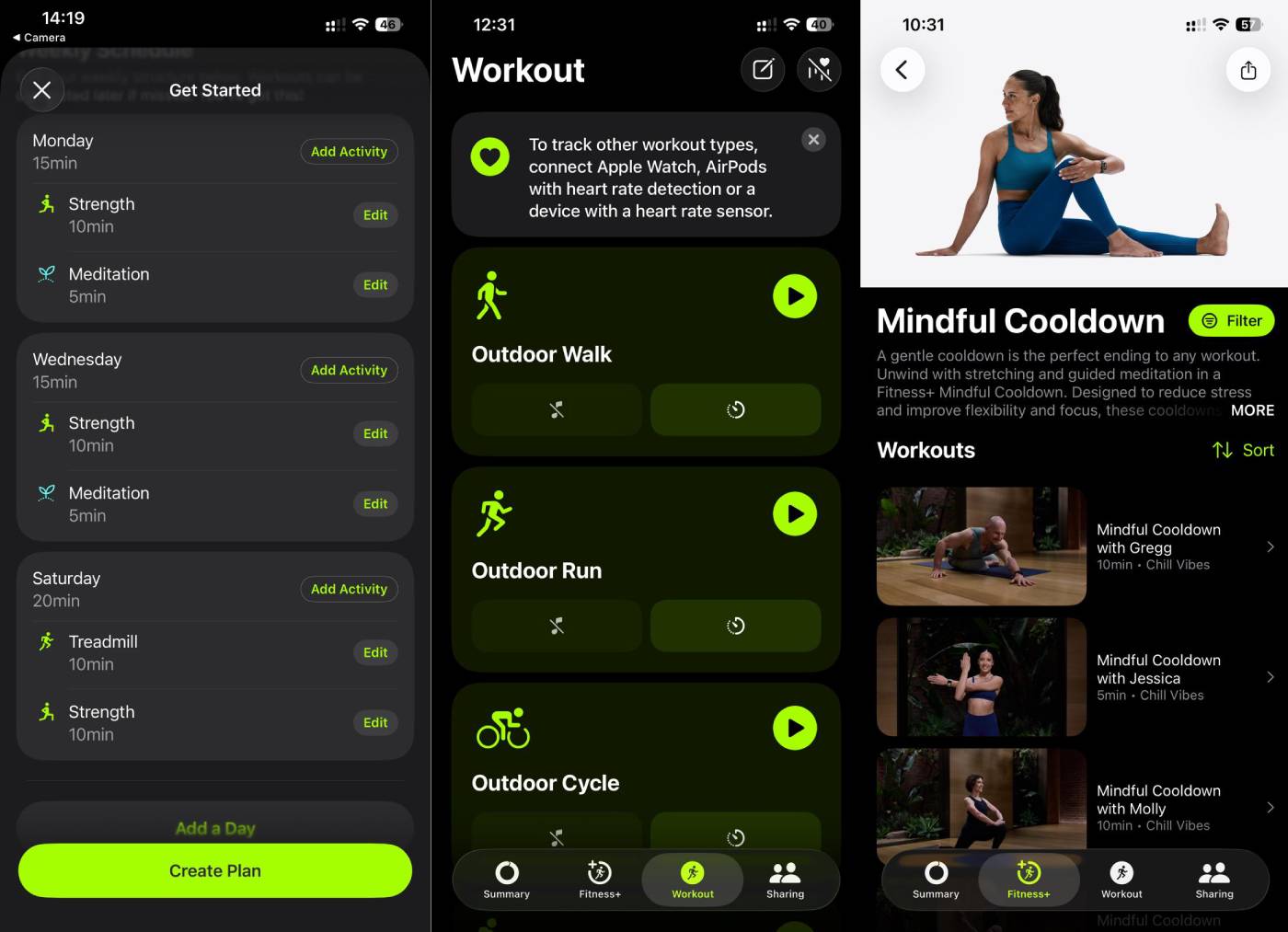
Apple Fitness+ is locked to the Apple ecosystem. iPhone, iPad, Apple TV. No Android app, no web app, no Mac app. If you live inside Apple, the integration is seamless. If you do not, you cannot use it at all. During my testing I experienced intermittent screen blackouts when projecting from iPhone to TV, requiring a session restart. Filtering across activity types is also inconsistent, which made the library harder to browse than it should have been.
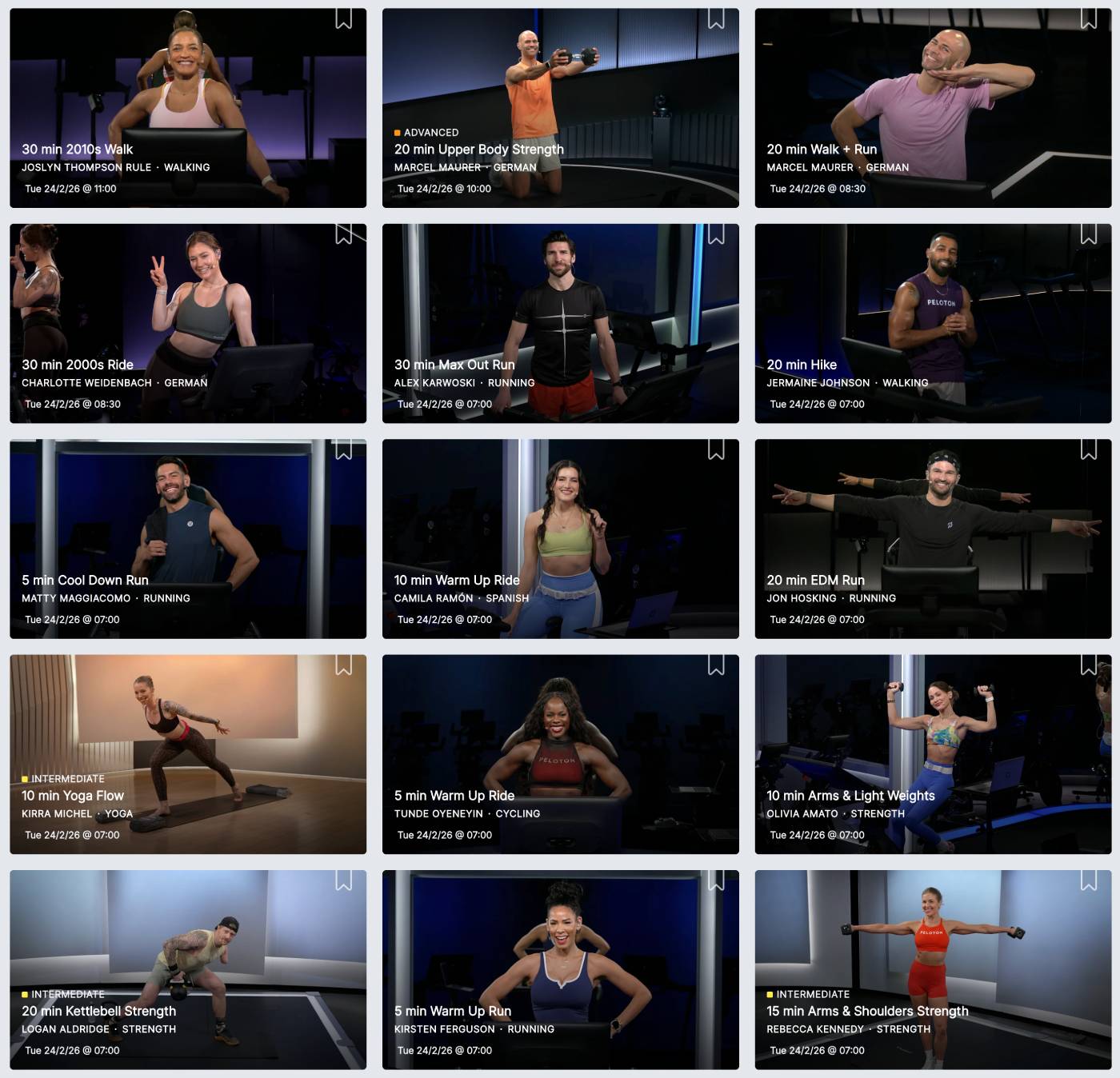
Peloton’s app is available on iOS, Android, web browser, Apple TV, Roku and Fire TV. The flexibility is real and the live class interface is well-built. The weakness is the cancel link being non-functional during my testing, and the programmes being app-only rather than available in the web browser. For desktop-primary users that is a genuine usability gap.
A closer look at Peloton
Nutrition integration (Apple Fitness+ 0 vs Peloton 2: both very low)
Neither platform includes nutrition content. No meal plans, no recipe library, no macro tools, no calorie tracking. This is the largest shared weakness in the comparison.
For women over 40 where nutrition is a primary lever for body composition (the ratio of fat to muscle in your body), this matters more than at any other life stage. The shared absence on both platforms means the choice between them does not turn on nutrition. If nutrition support is important to you, look at BODi, which includes the Portion Fix container system as part of the subscription and scores 9 / 10.
Who wins for…
Quick answers for specific situations. Each one resolves the question in the heading.
Who wins for perimenopause programming
Peloton. The Menopause Health Collection (56 classes, 7-day framework, developed with Respin Health) is currently the strongest dedicated perimenopause content of any mainstream platform I have tested. Apple Fitness+ has no perimenopause-labelled content at all.
Who wins for joint issues or a meniscus injury
Peloton on breadth, Apple Fitness+ on per-session reliability. Peloton’s Menopause Health Collection avoids high-impact entirely and the HSS partnership adds clinical depth. Apple Fitness+’s on-screen modifier in every session is genuinely consistent and works well for individual classes.
Who wins for time-efficient training under 30 minutes
Apple Fitness+. The stacking model (20-minute strength plus 10-minute cooldown equals a complete session in 30 minutes) is the strongest time-efficiency design I have tested. For women fitting training around school runs and full-time work, this is the practical answer.
Who wins for the lowest monthly price
Apple Fitness+. $9.99/month versus $15.99/month for Peloton App One and $28.99/month for App Plus. Family sharing across up to five household members widens the gap further.
Who wins for live class accountability
Peloton. No other platform at this price point delivers live classes as well. Apple Fitness+ has none at all.
Who wins for beginners
Apple Fitness+. Strength Basics in 3 Weeks is one of the cleanest beginner strength programmes I have tested. The three-trainer format means beginners always have a lower-intensity visual reference on screen. Peloton’s breadth can feel overwhelming for new users unless they engage with Peloton IQ or the live schedule.
Who wins for women on Android
Peloton by default. Apple Fitness+ requires an iPhone, iPad or Apple TV. There is no Android app and no web app.
Who wins for fat loss after 40
Neither is built for this directly because neither includes nutrition guidance. Fat loss is driven primarily by what you eat. In my Apple Fitness+ testing the 3 Weeks of Strength programme produced a net loss of 0.5kg over five weeks alongside visible toning, after coming back from a month of inactivity. Peloton’s breadth supports a varied training week which helps body composition, but neither platform will change what is on your plate. If fat loss is the primary goal, pair either platform with a separate nutrition approach.
Who wins for women over 50
Peloton selectively. The Menopause Health Collection extends to symptoms many women over 50 are navigating, including bone density (the Weighted Vest Strength and Jump Training classes specifically target this), joint stability, mood and sleep. The yoga and strength content is genuinely good. Apple Fitness+’s “Workouts for Older Adults” category I had my mum (68) test was too basic and incorrectly targeted; she switched to the regular Workouts for Beginners library with light weights and got a better workout.
Who wins for women on a tight schedule with school-aged children
Apple Fitness+. The 10 to 30 minute stacking format is genuinely designed for this constraint. I tested this exact constraint over five weeks and the platform delivered.
Who wins for value per household
Apple Fitness+. Family sharing means one subscription for everyone on your Apple Family plan, up to five members. Peloton does not offer family sharing.
Who wins if you hate long workouts
Apple Fitness+ decisively. Most sessions are under 30 minutes and the platform is designed around that constraint. If a 45-minute commitment is the reason you skip workouts, this is the platform built around that problem.
Who wins for clinical credibility
Peloton. The Hospital for Special Surgery partnership (announced October 2025) added the Road to Recovery: ACL programme led by Jess Sims, and from March 2026 Peloton members can call a direct line to book appointments with HSS orthopedic specialists. The Respin Health menopause partnership adds a research dimension Apple Fitness+ does not have.
Screenshots from our full reviews
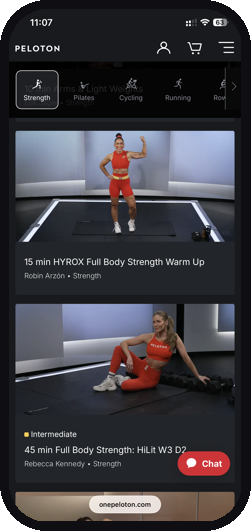
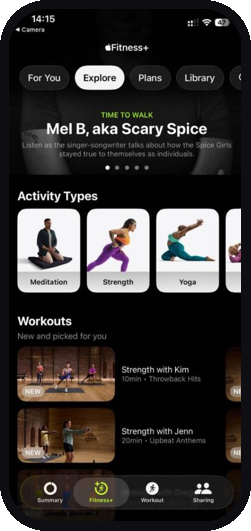
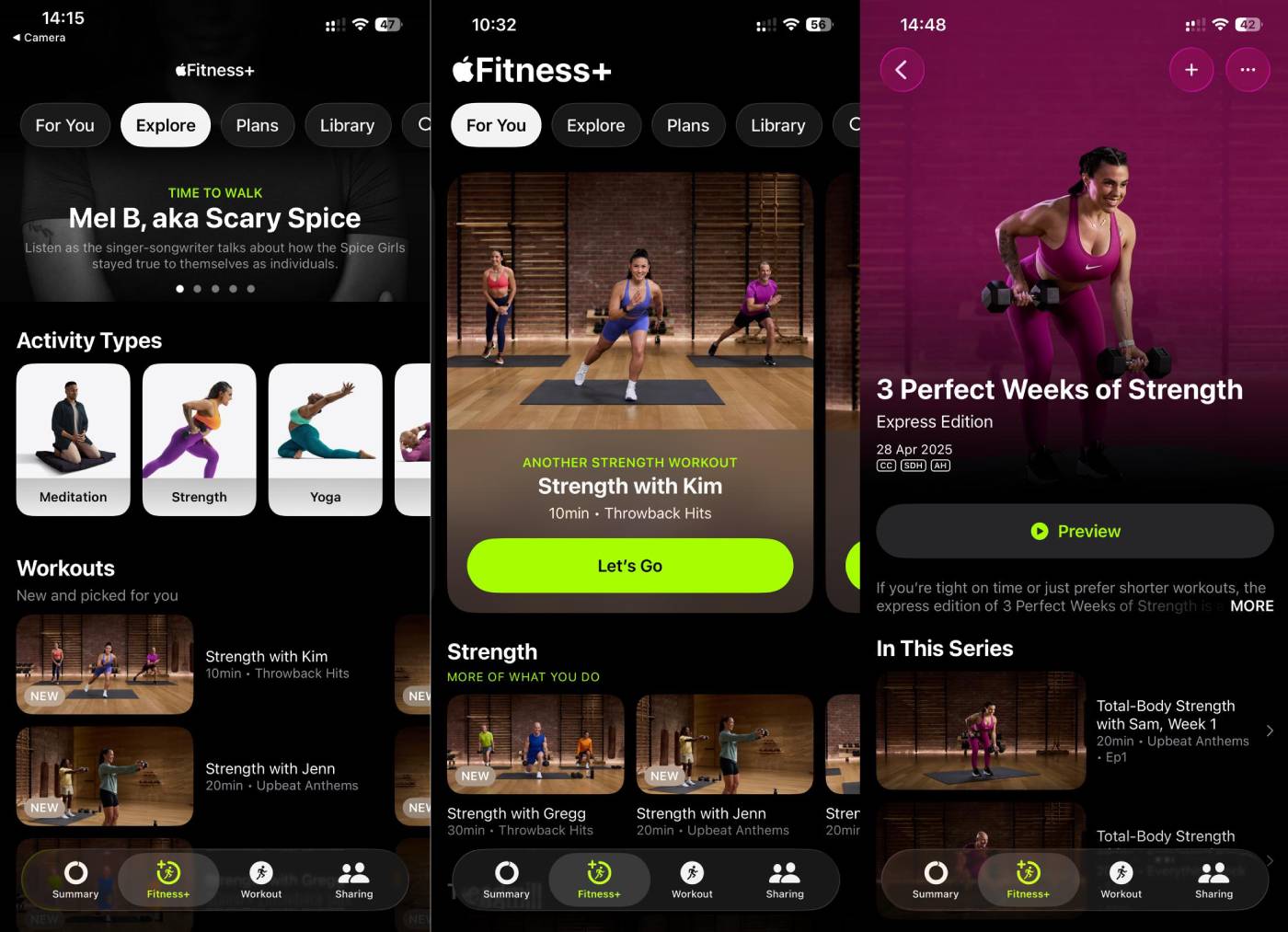
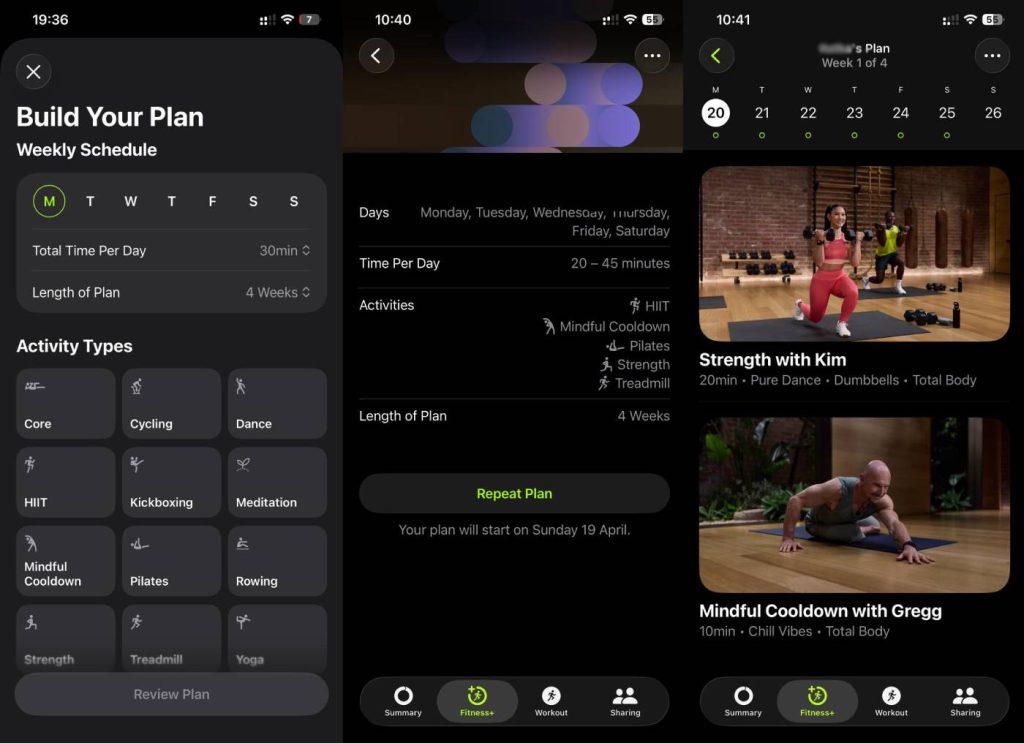
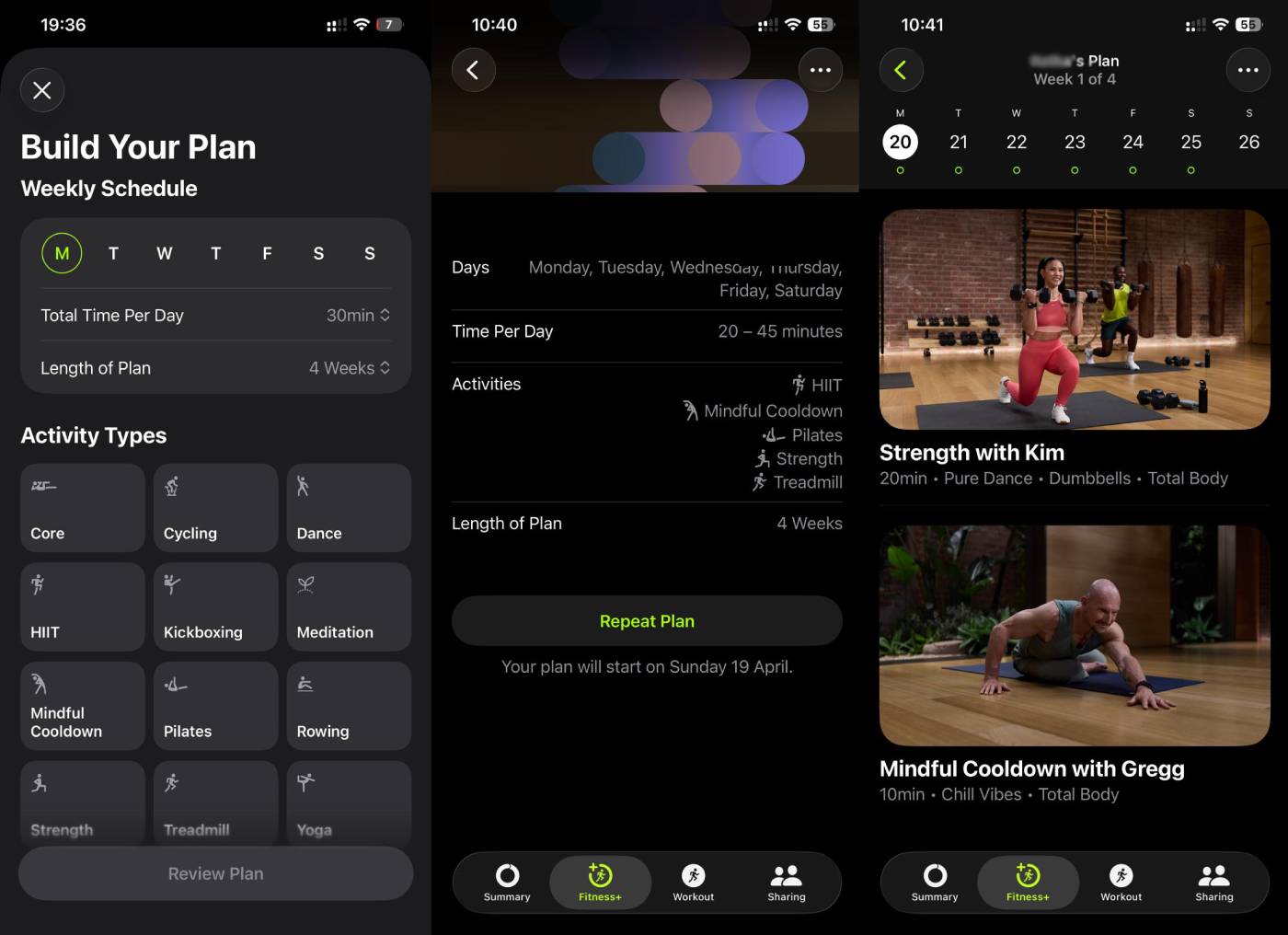
More screenshots: Apple Fitness+
See the full Apple Fitness+ review for methodology and pricing.
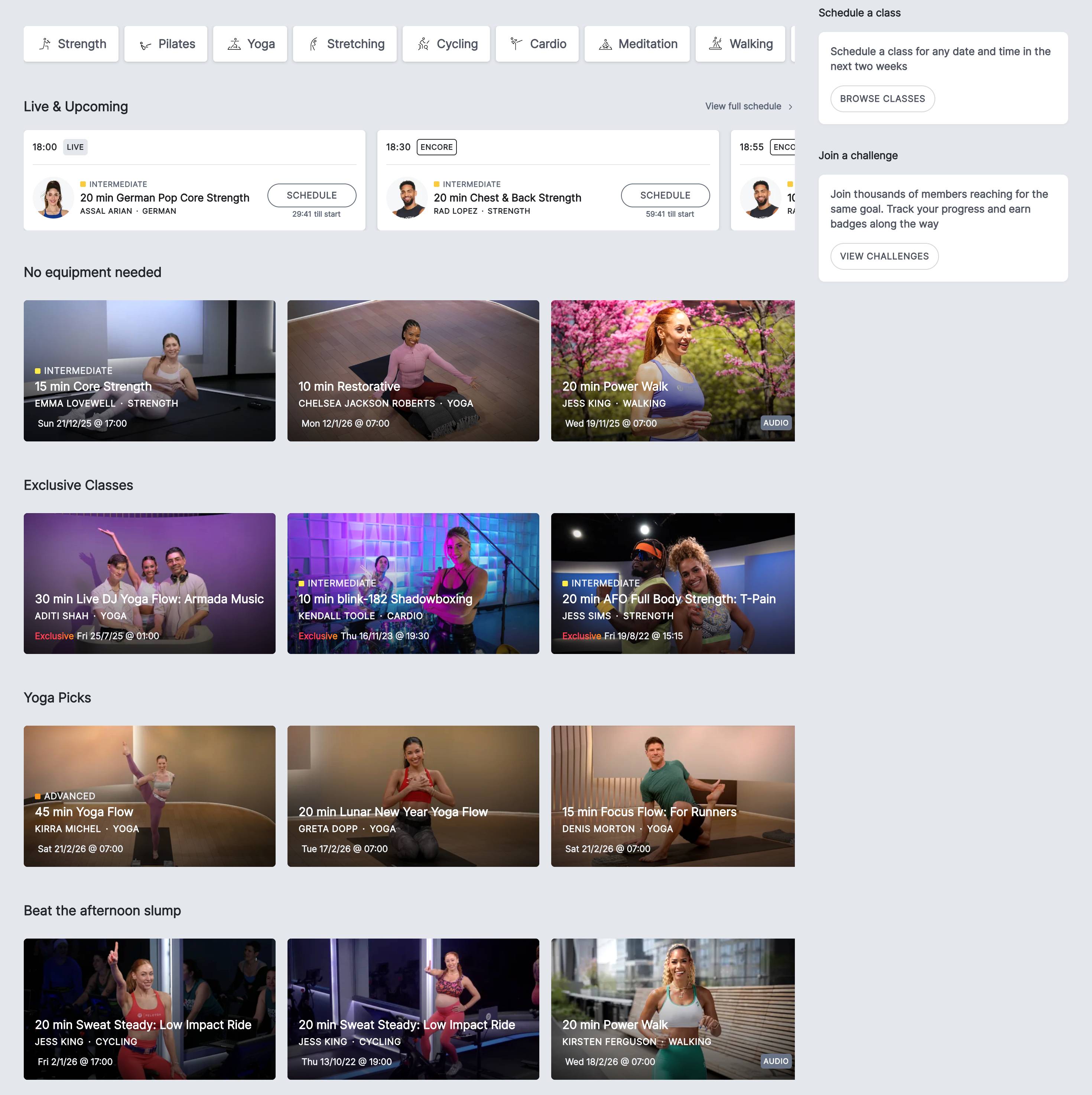
More screenshots: Peloton
See the full Peloton review for methodology and pricing.
Decision tree: which one should you actually pick?
Short answers to short questions. Use this to short-circuit the decision.
- Managing perimenopause or menopause symptoms? Choose Peloton. The Menopause Health Collection is the reason.
- Own an Apple Watch and want short stackable sessions? Choose Apple Fitness+. The metrics layer plus the time-efficiency design.
- Budget caps at around $10/month? Choose Apple Fitness+. Apple One Premier bundles it further if you already pay for iCloud, Music or TV+.
- Will only train if a live class is on the schedule? Choose Peloton. No other platform at this price delivers live as well.
- On Android or train primarily via web browser? Choose Peloton. Apple Fitness+ is Apple-ecosystem only.
- Have an active meniscus, knee or hip issue? Either works. Peloton wins on Menopause Health Collection breadth. Apple Fitness+ wins on per-session modifier consistency. Cross-test with both free trials before committing.
- Want progressive barbell strength? Neither platform is the right choice. See Caroline Girvan CGX or your gym.
- A true beginner? Apple Fitness+’s Strength Basics in 3 Weeks is the cleaner on-ramp.
- Want family sharing across the household? Apple Fitness+.
- Want clinical orthopedic support alongside training? Peloton, via the HSS direct consultation line.
What I did not test
For trust, here is what falls outside my direct experience on this comparison.
- Peloton hardware. I tested app-only, with no Peloton bike, treadmill or rower. The Peloton hardware experience adds performance metrics (resistance, output, cadence) and a different visual context.
- Apple Watch integration with Apple Fitness+. I tested without an Apple Watch, projected from iPhone to TV and computer monitor. Apple Watch adds real-time heart rate, calorie tracking, Activity Rings during the workout and the Burn Bar comparing your effort to others. If you own the watch, Apple Fitness+’s value strengthens significantly compared to what I experienced.
- Long-term adherence beyond five weeks for Apple Fitness+. My testing covered an intensive five-week window of daily use. Whether the stacking model remains motivating across six months or twelve is not something I can answer from my own data.
- Programmes I did not run. I did not test every programme in either library. My Apple Fitness+ testing covered 3 Weeks of Strength, Strength Basics (sampled), Pilates with bands, dance with Jhon and treadmill walking. My Peloton testing covered strength, yoga, walking and the Menopause Health Collection.
- The HSS direct consultation line. I have not used the orthopedic specialist booking service. It launched in March 2026 and is available to Peloton members in the US.
- The Peloton x Respin Health research study (P.R.E.S.S.). The partnership is documented but I did not participate in the study.
Personal testing and observations
Apple Fitness+ testing
I am a woman in my mid-forties, currently in perimenopause, working full-time with two children and training daily. I tested Apple Fitness+ over five weeks of structured daily use on iPhone, projected to TV and computer monitor. No Apple Watch. I built my own four-week custom plan and ran the 3 Weeks of Strength programme. I sampled dance classes, Pilates with bands and ankle weights, and treadmill walking. I asked my mum (68) to test the Workouts for Older Adults category for an honest second perspective.
Coming back from a month of inactivity (two weeks of holidays with mostly walking, then a week of being ill, then the family getting sick), I dropped my dumbbells from 9kg to 4kg/6kg in week 1. By week 3 I was back to 5kg/7.5kg with explosiveness added on some movements. My weight went up by 1kg in the first week. This is normal: when resistance training creates micro-tears in muscle fibres, your body holds onto extra water around the damaged tissue while it repairs, and the storage form of carbohydrate (glycogen) in newly-worked muscles binds with water, adding 0.5 to 1.5kg temporarily. By the end of five weeks the scale was down by a net 0.5kg overall and I was visibly more toned.
The standout was the modifier system. With my meniscus history I followed every strength and Pilates session without knee pain by watching the third trainer. The dance classes (Latin Grooves with Jhon) made 20 minutes disappear in a way HIIT never does for me. The gap was guidance. There was nothing labelled or structured for perimenopause, no hormonal education, no symptom-aware programming.
Peloton testing
I tested Peloton with no Peloton hardware at all. Single pair of 7.5kg dumbbells, my own non-Peloton treadmill, phone projected to TV. Across strength, yoga, walking and the Menopause Health Collection.
The Menopause Health Collection was the most compelling dedicated perimenopause content I encountered across the comparison series. Twenty-minute sessions including low-impact ride (cycling without standing or jumping in the saddle), hike (incline walking on a treadmill or outside), endurance, bodyweight strength and kettlebell. Built around the specific physical changes of this life stage rather than relabelling standard yoga or strength sessions as menopause-friendly. The modification cues built into the main class delivery were notably better than most platforms I have tested. Mid-session I could adapt without breaking my flow.
Weaknesses were real. Peloton does not guide progressive overload (you choose your own weights and nobody prompts you to increase them). The cancel link was non-functional during my testing, which I tested more than once. At $28.99/month for App Plus the price is a significant premium over Apple Fitness+ for comparable structured content.
Who should choose which
Choose Apple Fitness+ if:
You want short, time-efficient sessions designed to stack. You already use Apple devices and would benefit from family sharing across the household. You value the $9.99/month price and the $79.99 annual plan saving roughly $40 a year. You are a beginner who would benefit from the three-trainer format with a visible modifier in every session. You want clinical-grade production quality at the lowest price in this segment.
Choose Peloton if:
You are managing perimenopause or menopause symptoms and want a platform built around this life stage. The Menopause Health Collection’s 56 classes in a 7-day framework, developed with Respin Health, is the strongest dedicated content available on any general-audience fitness platform I have reviewed. You need live class accountability to stay consistent. You train across multiple devices including Android, web browser or non-Apple TV. You want the clinical credibility of the Hospital for Special Surgery partnership, including the direct consultation line for orthopedic specialist appointments.
Which is better for women over 50?
For women over 50, Peloton is the stronger pick by a clear margin. The Menopause Health Collection extends naturally into post-menopause concerns including bone density, joint stability, mood and metabolic health. The Weighted Vest Strength and Jump Training classes specifically target bone density, which becomes a primary training goal after 50. The Hospital for Special Surgery partnership adds orthopedic depth that no other mainstream fitness platform offers.
Apple Fitness+’s “Workouts for Older Adults” category was the weakest part of the platform for this audience in my mum’s testing. Most women in their 50s are not “older adults” in the way Apple has framed this category. The general Apple Fitness+ library does include yoga, walking, strength and Pilates content that suits over-50 training. It just is not labelled or grouped to make it findable.
If joint protection, bone density work, and clinical credibility matter, Peloton wins for over-50. If short stackable sessions and the lowest price matter, Apple Fitness+ still works.
Frequently asked questions
Is Apple Fitness+ or Peloton better for women over 40?
Peloton is the stronger choice for women over 40 managing perimenopause or menopause symptoms because of its dedicated Menopause Health Collection (56 classes in a 7-day framework, developed with Respin Health). Apple Fitness+ wins for women over 40 who want short, time-efficient sessions and own Apple devices. The choice comes down to whether perimenopause-specific programming or time-efficient stacked sessions matter more to you.
Is Apple Fitness+ or Peloton cheaper?
Apple Fitness+ is significantly cheaper. $9.99/month or $79.99/year (£9.99/month or £79.99/year UK), with family sharing across up to five household members included. Peloton offers no annual plan at any tier: App One is $15.99/month, App Plus is $28.99/month, and All-Access at $49.99/month requires Peloton hardware. Apple Fitness+ is roughly half the price of Peloton App Plus, and family sharing widens the gap further for households.
Does Peloton have a menopause programme?
Yes. The Peloton Menopause Health Collection contains 56 classes organised into a 7-day framework, developed with Respin Health (the holistic menopause platform founded by Halle Berry). Modalities include cycling, strength, running and walking, with recent additions like Weighted Vest Strength and Jump Training targeting bone density. It is accessible on Peloton App One ($15.99/month) without Peloton hardware.
Does Apple Fitness+ work without an Apple Watch?
Yes. Apple removed the Apple Watch requirement on 24 October 2022 with iOS 16.1. You can subscribe and use Apple Fitness+ on iPhone, iPad and Apple TV without a watch. The watch is still required for real-time heart rate metrics, the Burn Bar comparing your effort to others, and Activity Ring tracking during workouts.
Which has better workouts for perimenopause?
Peloton, decisively. The Menopause Health Collection is currently the strongest dedicated perimenopause content of any mainstream platform I have tested. Apple Fitness+ has no perimenopause-labelled content at all.
Can I cancel Apple Fitness+ or Peloton easily?
Apple Fitness+ cancellation is straightforward through Apple ID settings on any Apple device. The Peloton standard cancel link was non-functional during my testing. Use Peloton app settings then account then membership, or contact Peloton support directly. Set a calendar reminder before day 30 of the free trial.
Is Apple Fitness+ better for beginners than Peloton?
Apple Fitness+ is marginally better for true beginners. The Strength Basics in 3 Weeks programme has detailed technique explanations and the three-trainer format puts a lower-intensity visual reference on screen for every class. Peloton’s breadth can feel overwhelming for new users unless they engage with Peloton IQ or the live schedule.
Do Apple Fitness+ or Peloton include nutrition guidance?
Neither platform includes nutrition content. No meal plans, recipes, macro tools or nutrition education on either subscription. For women over 40 where nutrition is a primary lever for body composition, this is a real gap on both. BODi includes the Portion Fix container system as part of the subscription.
Can I use Peloton on Android?
Yes. Peloton has a full Android app, iOS app, web browser support, plus Apple TV, Roku and Fire TV. Apple Fitness+ is locked to Apple devices only (iPhone, iPad, Apple TV) with no Android or web option.
What is the Peloton x Hospital for Special Surgery partnership?
Peloton and the Hospital for Special Surgery (HSS) announced a partnership in October 2025 to co-develop science-backed content for joint and muscle pain, injuries and orthopedic conditions. The Road to Recovery: ACL programme is a 4-phase post-ACL surgery recovery plan led by Jess Sims. From March 2026, Peloton members can call a direct line to book appointments with HSS orthopedic specialists.
Research citations
- Maltais ML, Desroches J, Dionne IJ. Changes in muscle mass and strength after menopause. Journal of Musculoskeletal and Neuronal Interactions. 2009;9(4):186-197. PubMed.
- Watt FE. Musculoskeletal pain and menopause. Post Reproductive Health. 2018;24(1):34-43. doi: 10.1177/2053369118757537. SAGE.
- Resistance training for postmenopausal women: systematic review and meta-analysis. 2022. PubMed.
- Ainsworth BE et al. 2011 Compendium of Physical Activities: a second update of codes and MET values. Medicine and Science in Sports and Exercise. 2011;43(8):1575-1581. PubMed.
- Peloton Interactive and Hospital for Special Surgery. First-of-its-Kind Collaboration to Redefine Injury Prevention and Recovery Education. October 2025. Press release.
- Peloton Interactive and Respin Health. First-of-Its-Kind Research Partnership to Study the Impact of Exercise on Menopause Symptoms. 2025. Press release.
- Apple Inc. Apple Fitness+ available to iPhone users in 21 countries starting October 24. 2022. Apple Newsroom.
About this review
Reviewed by Katy Cole. Apple Fitness+ tested personally across five weeks of structured daily use on iPhone projected to TV (no Apple Watch). Peloton tested personally without Peloton hardware (App One tier) across strength, yoga, walking and the Menopause Health Collection, using a single pair of 7.5kg dumbbells and a non-Peloton treadmill. Prices verified against apple.com/apple-fitness-plus and onepeloton.com in May 2026.
Katy is the lead reviewer at Her Daily Fit. Fifteen years personally testing online fitness platforms. Mid-forties, currently in perimenopause, UK-based. Every claim on this page is either personally tested or attributed to peer-reviewed research. See how we score every programme using 9 weighted criteria.
Medical disclaimer: The content on this page is for informational purposes only and is not medical advice. Consult your GP or a healthcare provider before beginning a new exercise programme, particularly if you are managing perimenopause, menopause, or any existing health condition or injury.
Compared with
Where these brands appear in our “Best for” rankings