
Why does a defined workout challenge work for women over 40?
Structure beats motivation for almost everyone, and structure beats it most for women in midlife. A defined challenge (start date, end date, daily prescription, measurable outcome) removes the cognitive load of choosing what to do each day, gives you a finishable goal rather than an open-ended “get fitter” project, and produces the consistency required for the underlying training to actually work. For women juggling perimenopausal sleep disruption, family demands, work intensity and the general overload of midlife, the “decision-free” quality of a structured challenge is itself a feature.
The behavioural research on goal-setting and structured programmes is consistent. Locke and Latham’s goal-setting theory, developed over 30+ years and reviewed in American Psychologist in 2002, shows that specific, time-bound goals produce significantly better performance and adherence than vague intentions. A 30-day Iron Series with a daily calendar is, structurally, the kind of goal Locke and Latham describe. An open-ended “train more” intention is not.
The training science supports the same conclusion from a different angle. Schoenfeld and colleagues (2016) on dose-response for resistance training showed that the volume and intensity of resistance work matters; consistent execution over time matters more than perfect individual sessions. A structured challenge that you complete in full beats an ad-hoc training plan that you partially execute. The challenge supplies the structure that makes consistent execution possible.
The midlife-specific case for challenges is stronger still. Women in perimenopause often describe a particular pattern of fitness frustration: programmes that worked at 30 stop working at 45. Energy is lower, recovery is slower, body composition shifts in ways that traditional cardio-heavy or HIIT-led training does not reverse. A challenge built specifically for this life stage (Pvolve’s 4-week Menopause Strong, The Sculpt Society’s 4-week Midlife Movement, Burn360’s 21-Day Metabolic Reset) re-calibrates the training to the body that is actually showing up.
What a challenge cannot do is guarantee permanent change. The published evidence on weight loss maintenance (notably the National Weight Control Registry) makes this clear: short-term interventions produce short-term results, and the long-term outcomes depend on what happens after the challenge ends. The pragmatic operating point is to treat a challenge as the launch protocol for a longer-term practice, not as a complete solution. Run the challenge, then continue training (often less intensely, but consistently) for the years that follow.
The five challenges in this guide are the ones I have personally tested. They differ in length (21 days to 7 weeks), modality (dumbbell strength, multi-planar resistance, Pilates-strength hybrid, dance-cardio sculpt), price (free YouTube to $39.95 one-time to $24.99/month subscription) and target audience (general fitness over 40, perimenopause-specific, postnatal-returning). The ranking reflects my judgment of which challenge delivers the best combination of structure, evidence-based programming and midlife-aware design.
How should women over 40 evaluate a workout challenge?
Look at progressive structure, time commitment realism, equipment requirements, modification quality and what happens after the challenge ends. The challenge market is wide and the depth of programming behind “30-day” or “6-week” framing varies dramatically. The challenges that work for women over 40 are the ones that respect the realities of midlife training and that sequence the work intelligently across the duration.
Progressive structure is the first filter. A good challenge gets harder across its duration: heavier weights, more complex movement, decreased rest, or progressively longer sessions. A challenge that does the same thing every day for 30 days is missing the progression that drives adaptation. Caroline Girvan’s Iron Series builds across weeks, with heavier compound work and longer finishers in the later sessions. Burn360 explicitly asks you to increase dumbbell weight as you progress through the 21 days. Both are doing the right thing.
Time commitment realism is the second filter. A 30-day challenge that requires 60 minutes of training six days per week is unrealistic for most working women over 40. A 30-day challenge that runs 20-30 minute sessions four or five days per week is achievable. The challenges in this guide all sit in the realistic range; many marketed challenges do not.
Equipment requirements are the third silent filter. A challenge that requires a Reformer, a barbell with plates, kettlebells in three weights and a treadmill is functionally inaccessible to most women at home. A challenge that works with two pairs of dumbbells and a mat is genuinely accessible. The five challenges in this guide all work with dumbbells and minimal additional kit; Pvolve uses bands and ankle weights instead of (or alongside) dumbbells.
Modification quality is the fourth filter and the one most relevant to midlife. Women over 40 commonly bring some history: knee, hip, lower back, shoulder, pelvic floor. A challenge that flags modifications proactively (low-impact swaps, no-kneeling alternatives, reduced range of motion for joint sensitivity) protects you from the small re-injuries that derail completion. The Sculpt Society’s no-kneeling filter and Pvolve’s low-impact-throughout design are the clearest examples in this guide.
What happens after the challenge ends is the fifth filter, and the one most challenges handle poorly.
Marketing-led challenges (the ones built primarily to drive subscription sign-ups) end abruptly, leaving you to figure out what to do next. The challenges built inside platforms with structured continuation paths (Caroline Girvan’s CGX has the Iron Series followed by EPIC, FUEL and longer-form programmes; The Sculpt Society has the Midlife Movement Programme followed by ongoing midlife and strength content; Pvolve has Menopause Strong followed by Knee Stability and the broader library) treat the challenge as a launch, not a destination.
What should women over 40 prioritise in a workout challenge?
Five priorities matter most: realistic time commitment, progressive loading, joint-friendly programming, measurable outcomes and a credible continuation path. Each addresses a documented stumbling block in challenge completion at this life stage. The challenges that handle them well are the ones with the highest completion rates and the strongest long-term outcomes.
Realistic time commitment. Sessions of 20-45 minutes four or five days per week sit in the right realism window. Daily 60-minute sessions sit outside it for most women. The Burn360 21-Day Reset uses 20-25 minute sessions; Caroline Girvan’s Iron Series uses 30-50 minute sessions; The Sculpt Society and Pvolve Menopause Strong both use 30-45 minute sessions. All four sit in the achievable range.
Progressive loading. The challenge should ask you to do more across its duration. Burn360 explicitly asks you to increase dumbbell weight by approximately 0.5kg per round of the 21-Day Reset. Caroline Girvan’s Iron Series builds across weeks with heavier compound work and longer finishers. The Sculpt Society’s Midlife Movement and Pvolve’s Menopause Strong both sequence weeks with increasing complexity and load. Progressive loading is what produces the adaptation the Schoenfeld 2016 dose-response research supports.
Joint-friendly programming. The challenges that flag modifications proactively (no-kneeling filters, low-impact swaps, reduced range of motion for joint sensitivity) protect long-term completion. The Sculpt Society and Pvolve both build joint-friendliness into the default; Caroline Girvan’s programmes include some modifications but assume a baseline of joint capability.
Measurable outcomes. The challenges that ask you to measure something (dumbbell weight, body composition, waist circumference, rep counts) produce stronger motivation than challenges that ask you to “feel better”. Burn360 builds explicit measurement into the protocol (start dumbbell weight, finish dumbbell weight, waist and hip circumference, total weight). Fit With Coco asks for waist measurement and weight at start and end of the 7-week Full Body Express. Measurable outcomes anchor the challenge in something objective.
Credible continuation path. The challenge should have a clear next step. Caroline Girvan’s YouTube has Iron Series followed by countless other named programmes; CGX adds structured calendar follow-ons. The Sculpt Society has the broader midlife and strength library. Pvolve has the wider Menopause Strong + Knee Stability + general library structure. Burn360 explicitly recommends running the 21-Day Reset multiple times with increasing weights. Fit With Coco has follow-on programmes after Full Body Express.
A 21-day challenge you can run from anywhere
Three sessions a week, three weeks, dumbbells only. Written so it works whether you subscribe to anything on this page or not, and structured with rest days rather than a streak.
| Week | Session A | Session B | Session C |
|---|---|---|---|
| 1 | Goblet squat, row, glute bridge. 3 x 10 | Split squat, overhead press, dead bug. 3 x 8 each side | Hinge, floor press, side plank. 3 x 10 |
| 2 | Same, 3 x 12 | Same, 3 x 10 | Same, 3 x 12 |
| 3 | Heavier dumbbells, back to 3 x 10 | Heavier, 3 x 8 | Heavier, 3 x 10 |
Rest at least a day between sessions. Walk on the days between if you want to, and take a full day off each week without negotiating it.
The only rule that matters: the last two repetitions of every set should be genuinely hard. If they are not, the weight is too light, and no amount of extra days will compensate.
On day 22, run it again with heavier dumbbells. That is the part almost every challenge omits, and it is where the results actually come from.
Which workout challenges score highest?
Five platforms run a genuine, time-bound challenge rather than a library you are left to organise yourself. The Sculpt Society ranks first, followed by FORM, Burn360, Kira Stokes Fit and Caroline Girvan.
The uncomfortable thing about challenges, said plainly: the format is built on streaks, and streaks are the opposite of what recovery capacity in midlife needs. A 30-day everyday challenge asks you to train through the days your body is telling you not to. The five below are ranked partly on how well they survive that objection, and the ones that schedule rest days deliberately rank higher than the ones that count consecutive days.
How do the best workout challenges compare?
| Rank | Platform | The challenge | Meno fit 70% | Ease of use 30% | Review score * | Length | Cost |
|---|---|---|---|---|---|---|---|
| 1 | The Sculpt SocietyFully tested | 4-week Midlife Movement Programme | 6.6 | 8.5 | 8.2 | 15 to 35 min | $24.99/mo |
| 2 | FORMFully tested | Quarterly challenges plus 7 to 30 day programmes | 4.8 | 9 | 7.6 | 20 to 30 min | $28/mo or $180/yr |
| 3 | Burn360Fully tested | 21-Day Metabolic Reset, one-off purchase | 5.1 | 7 | 7.9 | 20 to 25 min | $39.95 once |
| 4 | Kira Stokes FitData profile | Stoked Series and curated challenges | 3.9 | 8 | 6.6 | 10 to 60 min | $19.99/mo |
| 5 | Caroline GirvanFully tested | EPIC and Iron series, free on YouTube | 3.7 | 7 | 7.6 | 30 to 50 min | Free; app $12.99/mo |
* Review score is the platform’s overall rating across all nine criteria we score, the number on its review page. The rank comes from how well the challenge suits women over 40, weighted 70%, blended with ease of use, weighted 30%. Caroline Girvan carries the second-highest review score here and ranks last, because her programmes are excellent and demanding in a way that suits a trained lifter more than someone starting a challenge to get going again.
Pvolve was removed from this page. It is our top-ranked programme elsewhere and it is not a challenge product: it runs continuous programming rather than a time-bound challenge. Listing it here was ranking a good platform on the wrong question. Its review is here, and it leads our resistance band and perimenopause app lists.
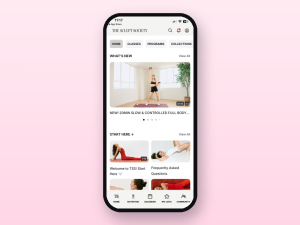
The Sculpt Society: a four-week block designed for midlife, not a streak
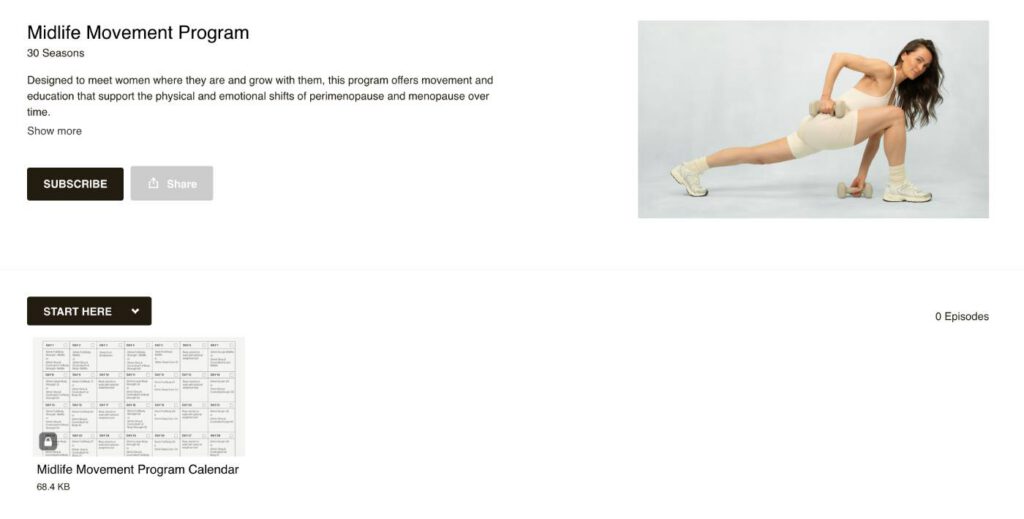
The Midlife Movement Programme is the only challenge here built for this life stage from the start
The Sculpt Society runs a doctor-backed four-week Midlife Movement Programme added in 2026, alongside seasonal challenges for annual members. Crucially it is a four-week structure with rest built in, not a consecutive-day streak.
Tested by Katy Cole, four weeks: I used between 11 lb and 19 lb depending on the movement, and by the end of the block I had moved from 17 lb to 19 lb on exercises where I started conservatively. Measurable progress inside a month, from a platform people dismiss as “just dance”.
Why it ranks first: it is the only challenge here where finishing does not depend on training on days you should not. The dance-cardio format also means you are more likely to reach day 28 than with a programme you have to force yourself into.
The honest limitation: loading stays light overall, so the bone and maximal strength ceiling is low. Finish the block, then progress somewhere heavier.
What the four weeks look like: a mix of dance cardio and sculpt sessions of 15 to 35 minutes, four or five days a week, with the schedule set for you. Use light dumbbells from the start rather than adding them in week three, and increase them the moment the last two repetitions stop being hard.
Cost: $24.99 a month web, or $229.99 a year. Seven-day trial.
FORM: short challenges you can actually finish
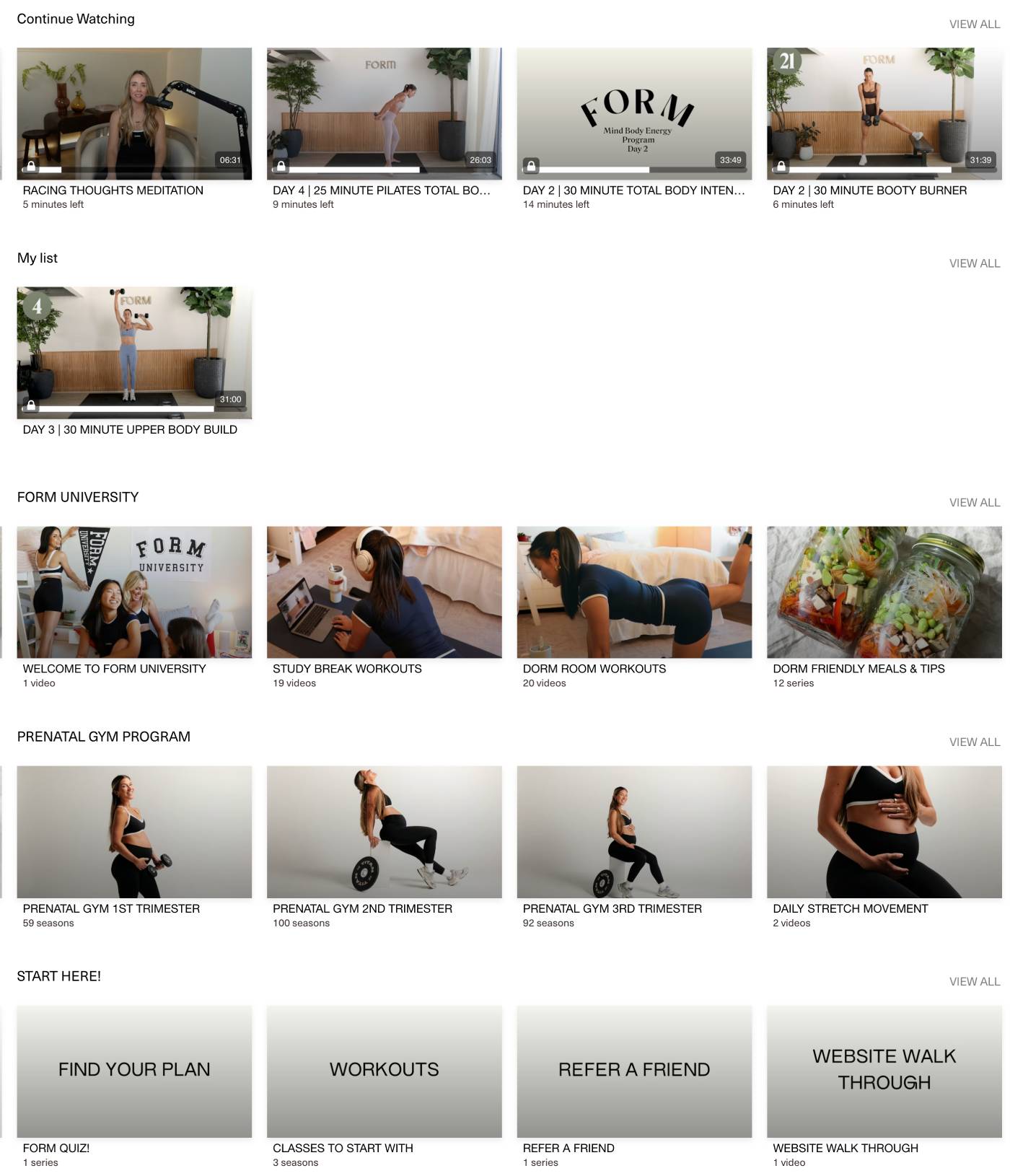
Quarterly challenges plus 7 to 30 day programmes, with an explicit anti-burnout position
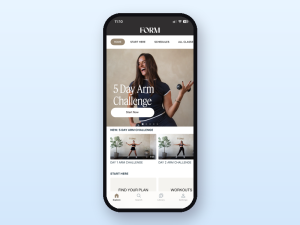
FORM runs quarterly challenges and a rolling set of 7 to 30 day programmes, including short formats like a five-day arm challenge. The anti-burnout ethos is genuine rather than marketing, which matters more on a challenge page than anywhere else on this site.
Tested by Katy Cole: FORM is the platform I have spent the most time with. The short challenges are the useful thing here: a five-day block is short enough that you finish it, and finishing one is what makes you start another.
What to run first: pick a 7-day programme rather than a 30-day one. The completion rate on a week is far higher, and three finished weeks beats one abandoned month.
The honest limitation: no menopause content at all, and loading is light. Check pricing before you subscribe: the site is $180 a year while Apple in-app is $144.99, a channel discrepancy that has persisted.
What a week looks like: four sessions of 20 to 30 minutes from whichever programme you have picked, with the mindfulness content on the days between rather than a fifth workout. If a quarterly challenge is running when you join, that is the one to take, because the cohort effect is real.
Cost: $28 a month or $180 a year on the site. Seven-day full-access trial.
Burn360: the only one you buy once, and the shortest
A 21-day metabolic reset at 20 to 25 minutes a session, for a single $39.95 payment
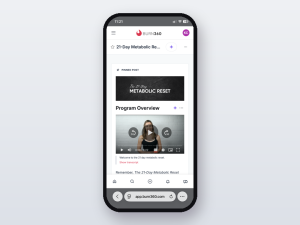
Burn360 is the purest challenge product here: one 21-day programme, bought once, no subscription. Sessions are 20 to 25 minutes of compound dumbbell work, which makes it the most time-efficient programme we have tested.
Tested by Katy Cole, three full rounds: I completed the 21-day reset three times, increasing my weights by about half a kilogram each round. Running it repeatedly is what turned it from a challenge into actual progression, which is not how the product is sold but is how it works best.
Why the pricing model matters here: a one-off $39.95 with a 90-day money-back guarantee removes the thing that makes challenges expensive, which is a subscription you keep paying for after you stop.
The honest limitation: moderate impact, no menopause programming, and once you have run it three times you have exhausted it. There is no trial, though the guarantee covers you.
What the 21 days look like: three or four sessions a week of 20 to 25 minutes, compound dumbbell work, with rest days between. Write down the weights you use in round one, because the whole value of the programme is beating them in round two.
Cost: $39.95 once for lifetime access. No subscription.
Kira Stokes Fit: the most challenge-led library here
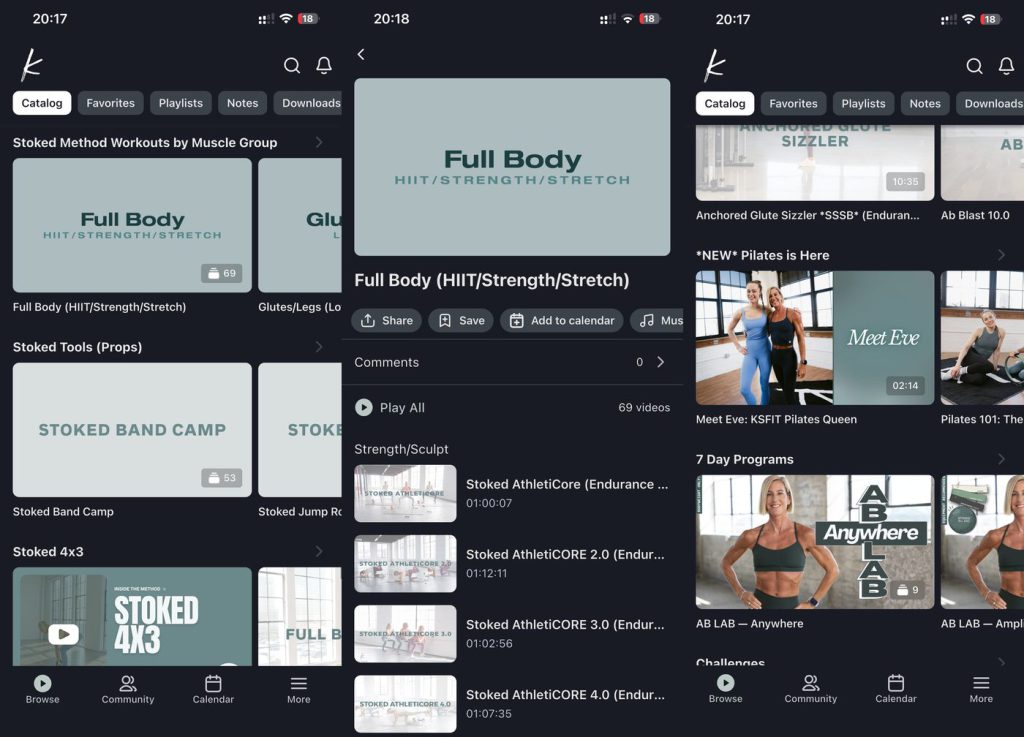
The Stoked Series and curated challenges from a respected trainer, at a mid-range price
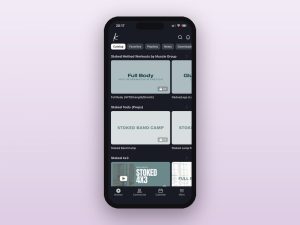
Kira Stokes Fit organises its whole library around challenges and curated schedules rather than leaving you to browse, with good coaching and nutrition guidance alongside.
This is a data profile, not a tested review. We have not run a Kira Stokes challenge first hand, so there is no personal testing note here. What the published information shows is a polished strength and HIIT app with challenges, curated schedules and Fuel School nutrition. What we cannot verify without testing is how the challenge progression feels across a full block.
The honest limitation: the default programming is moderate impact and HIIT-leaning, and there is no menopause or pelvic floor content. It ranks fourth on midlife fit, not on quality of coaching.
What a week looks like: follow a curated schedule rather than assembling your own, and choose the strength-led blocks over the HIIT-led ones if you are here for midlife suitability. Sessions run 10 to 60 minutes, so the short ones cover a bad week.
Cost: $19.99 a month or $219.99 a year. Seven-day trial, not charged until it ends.
Caroline Girvan: the hardest, the best value, and the wrong place to start
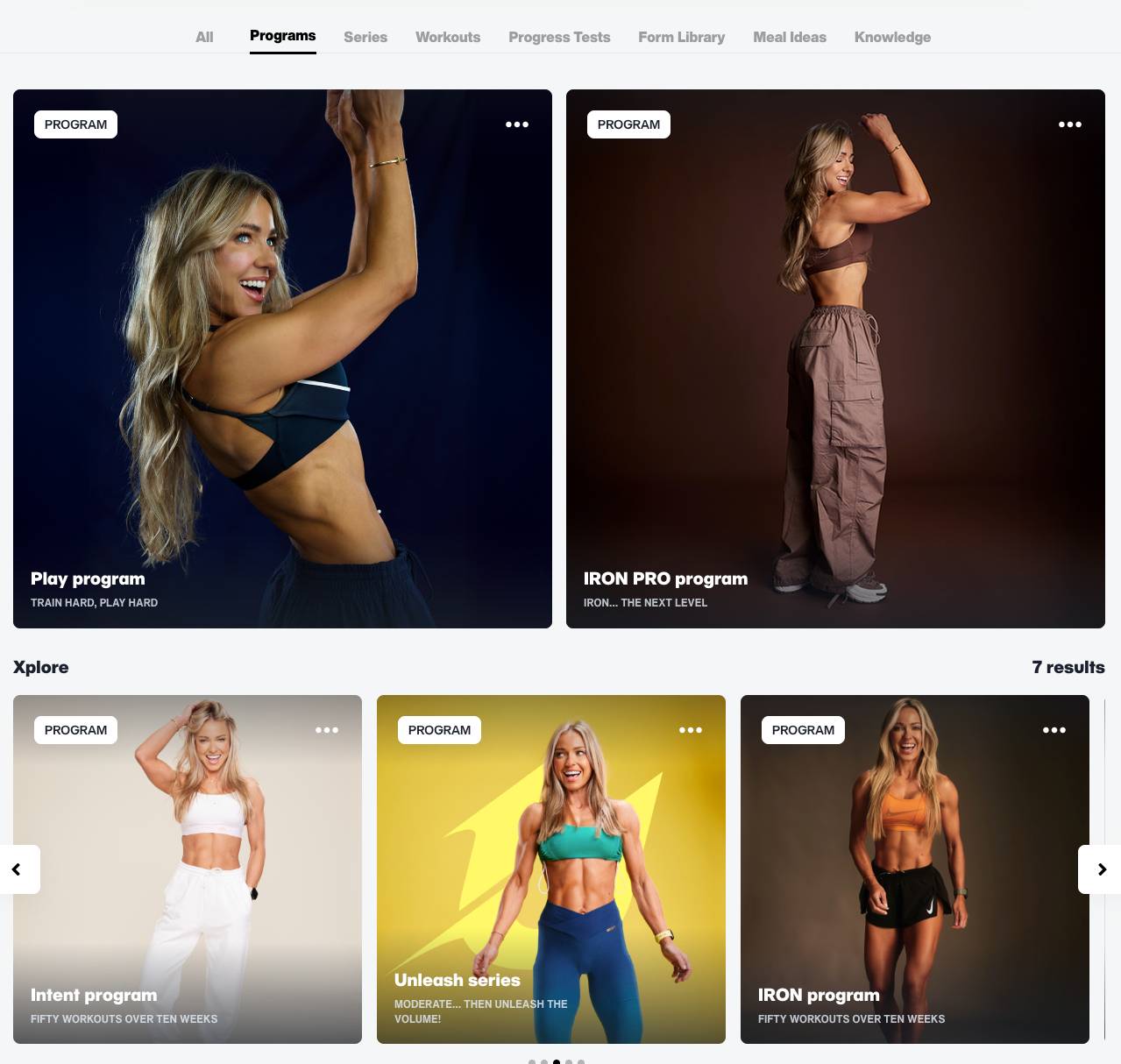
EPIC and Iron are free, structured, genuinely progressive, and demanding
Caroline Girvan‘s named YouTube series are the most effective home strength programmes we have tested for visible muscle tone, with progressive overload built into the structure and hundreds of workouts free.
Tested by Katy Cole: the results are real and so is the demand. Sessions run 30 to 50 minutes and the cumulative fatigue across a week builds noticeably if you are lifting weights that genuinely challenge you.
Why it ranks last despite the second-highest review score: this is a challenge for someone already training, not someone starting again. If you are looking for a challenge because you have stopped, starting with EPIC is how people end up quitting in week two and concluding the problem is them. Come here after a shorter block, not instead of one.
What a week looks like: four or five sessions of 30 to 50 minutes, following one named series in order rather than picking workouts at random. The programmes are built as blocks and lose most of their value if you cherry-pick.
Cost: free on YouTube. The app is $12.99 a month or $99.99 a year, with a 14-day trial.
Which workout challenge is right for you?
If you are starting again after a gap, FORM and a 7-day programme. Finish one week before committing to a month.
If you want a challenge designed for midlife specifically, The Sculpt Society and the four-week Midlife Movement Programme.
If you do not want another subscription, Burn360 at $39.95 once, and run it three times rather than once.
If you want structure without deciding anything yourself, Kira Stokes Fit and its curated schedules.
If you already train and want to be pushed, Caroline Girvan, free on YouTube.
Why most workout challenges are badly designed for women over 40
The challenge format has one mechanism, the streak, and the streak is the part that does not suit midlife. This is worth understanding before you start one, because the reason challenges fail is usually the design rather than the person.
- Consecutive-day counting punishes recovery. A 30-day everyday challenge asks you to train on the day after a bad night’s sleep, which is exactly the day to do less. Recovery capacity falls in perimenopause, so the format fights the physiology.
- All-or-nothing framing wastes a good fortnight. Miss day 12 of 30 and the streak logic says you failed. You did twelve sessions, which is more than most months.
- Most challenges are cardio-heavy. The thing that actually protects muscle and bone in midlife is progressive resistance training, and a challenge built on daily HIIT gives you fatigue instead.
- Thirty days is too short to change much and too long to sustain at intensity. Strength adaptation shows up over eight to twelve weeks. A month is enough to build a habit, which is the honest thing to promise.
- Nothing tells you what to do on day 31. The most common outcome of a completed challenge is stopping, because the structure ends and nothing replaces it.
So use a challenge for what it is genuinely good at: getting you started again, proving to yourself that you will show up, and establishing a schedule. Then convert it into ongoing progressive training, which is where results actually come from.
How to run a challenge so it works
- Pick a week, not a month, if you have stopped. Completion rates on 7-day blocks are far higher, and finishing is the point.
- Build rest days in from the start, whatever the challenge says. Three or four sessions a week that you complete beats seven that you abandon on day nine.
- Count sessions, not consecutive days. “Twenty sessions this month” survives a bad week; “thirty days straight” does not.
- Make at least two sessions a week resistance training that gets measurably harder, even inside a cardio-led challenge.
- Decide day 31 before you start day 1. Which programme follows this one? Booking that in advance is what stops a challenge becoming a one-off.
- Repeat the same challenge rather than hunting a new one. Running Burn360’s 21 days three times with heavier dumbbells each round is progressive training. Running three different challenges once each is not.
How long should your challenge be?
Match the length to where you are starting from, not to what sounds impressive.
- If you have not trained in months: 7 days. The goal is finishing something, not changing anything. FORM’s short programmes are built for exactly this.
- If you train occasionally and want a schedule: 21 days. Long enough to establish a rhythm, short enough that the end is visible from the start. Burn360’s reset is the cleanest example.
- If you train consistently and want progress: 4 weeks and then repeat it. The Sculpt Society’s Midlife Movement Programme, run twice with heavier weights the second time, is a genuinely progressive eight weeks.
- If you want a body composition change: 12 weeks, and stop calling it a challenge. That is a training block. Challenges are how you get to the start line of one.
Nothing on this page is medical advice. If you have a diagnosed joint condition, a recent injury or a pelvic floor issue, check with your doctor or a physiotherapist before starting any challenge, and be particularly careful with formats that ask you to train daily.
How did we rank these five?
The qualifier is a real, time-bound challenge, not a library with programmes in it. Almost every platform we review has multi-week content, so we kept only those running a named challenge you start and finish. That removed Pvolve, which is our top pick elsewhere and runs continuous programming rather than challenges.
The ranking is midlife fit, weighted 70%, blended with ease of use at 30%, which is the same model we use across the site. Having a challenge is the entry ticket, so ranking on it again would restate the gate.
Five programmes qualify, and five is the whole list. We do not pad to a round number. If more platforms ran genuine midlife-appropriate challenges we would list them.
Four of the five I have tested myself. Kira Stokes Fit is a data profile built from published information and carries no first-hand testing claim.
We buy our own subscriptions. Some links on this page earn a commission, which never affects a score or a position.
How to maximise challenge completion and what to do afterwards
Three things drive challenge completion in midlife: realistic frequency, environmental setup and accountability structure. The published research on behaviour change in adults (notably Lally and colleagues 2010 on habit formation in European Journal of Social Psychology) suggests that habits form over 18-254 days depending on complexity, with the median around 66 days. A 30-day challenge sits inside that window; a 4-7 week challenge sits at the lower end. Completion of the challenge matters because it is the bridge from intention to habit.
Realistic frequency is the first lever. Four or five sessions per week is the right operating point for most working women over 40. Daily sessions are unrealistic given perimenopausal sleep patterns and life demands; three sessions per week is below the volume that produces meaningful adaptation. Picking a challenge whose frequency matches your actual schedule is the most important pre-commitment decision.
Environmental setup is the second lever. Where you train, when you train, and what equipment is set up before you start all affect completion. Dumbbells out and visible, mat already on the floor, app or YouTube tab already loaded: these small frictions reduce the willpower cost of starting. Women who train at 5am report higher completion rates than women who plan to train “sometime in the evening”; the morning slot is protected from the day’s overrun.
Accountability structure is the third lever. Tell someone you are doing the challenge; post your progress somewhere visible (private journal, family chat, social media); join the platform’s community if there is one. Caroline Girvan’s community on Reddit and Instagram is one of the most active fitness communities anywhere; The Sculpt Society and Pvolve both have in-app community features. External accountability is one of the most-replicated findings in the behaviour change literature.
What you do after the challenge ends matters more than what happens during it. The published research on weight loss maintenance (notably the National Weight Control Registry) shows that short-term interventions produce short-term results; long-term outcomes depend on what comes next.
The best continuation paths in this guide: Caroline Girvan’s CGX (Iron Series followed by EPIC, FUEL, IRON), The Sculpt Society (Midlife Movement followed by the broader strength library), Pvolve (Menopause Strong followed by Knee Stability and ongoing menopause content), Burn360 (rerun the 21-Day Reset with heavier weights). Treat the challenge as the launch protocol for a longer-term practice, not as a complete solution.
What does the evidence say about challenges and adherence?
The strongest argument for a challenge is behavioural, not physiological. Nothing about 21 or 30 days is special to the body; what is special is that a defined end point makes people start.
What a challenge genuinely delivers is a decision made once instead of daily. The main reason people stop training is not effort, it is the accumulated cost of deciding each morning whether today is a training day. A challenge removes that decision for its duration, which is why completion rates are higher than for open-ended plans.
What it cannot deliver is adaptation. Strength and muscle change over eight to twelve weeks of progressive loading. Schoenfeld and colleagues found low and high loads both build muscle when sets are taken close to failure, and the operative word is progressive: the load has to keep rising. Three weeks at a fixed weight builds a habit, not a physique, and any challenge promising otherwise is overselling.
For midlife specifically, the bone question is the one challenges answer worst. Martyn-St James and Carroll found that combining impact with high-magnitude resistance work reduced postmenopausal bone loss. Almost no popular challenge programmes that, because high-magnitude loading does not suit a format designed for daily participation by beginners.
And the body composition backdrop matters. Greendale and colleagues documented loss of lean mass and gain in fat mass across the menopause transition. That is a slow process and it needs a slow answer. A challenge is a reasonable way to begin one and a poor substitute for it.
So the honest promise for a challenge at this life stage is: it will get you started, it will prove you show up, and it will give you a schedule. Everything that follows is what actually changes your body.
Where is the evidence still evolving on workout challenges and women in midlife?
Three open questions matter most. First, whether challenge completion produces durable behaviour change or whether most completers revert to pre-challenge patterns within months. Second, whether the social and community components of a challenge contribute meaningfully to outcomes beyond the training itself. Third, whether shorter (21-day) or longer (8-12 week) formats produce better long-term adherence.
On durability, the consumer research and the National Weight Control Registry data together suggest that most short-term interventions do not produce durable change unless they are followed by sustained practice. The challenges with credible continuation paths (Caroline Girvan’s ongoing content, Pvolve’s broader library, The Sculpt Society’s wider midlife programming) are structurally better positioned to produce durable change than standalone challenges that end abruptly.
On community contribution, the available evidence (mostly correlational rather than causal) suggests that challenges with active community components produce higher completion rates and stronger long-term engagement than identical training without community. Caroline Girvan’s Reddit and Instagram communities, The Sculpt Society’s in-app community, and Pvolve’s member community all appear to contribute to outcomes. The mechanism is plausibly social: belonging to a group of completers reinforces identity and increases the cost of dropping out.
On duration, the published behaviour change literature is mixed. Shorter challenges (21-30 days) produce higher completion rates because the commitment ask is smaller; longer challenges (8-12 weeks) sit closer to the habit-formation window the Lally research identifies. The pragmatic position: shorter challenges work as habit-launch protocols when followed by sustained practice; longer challenges work as habit-formation protocols when the duration is realistic for the participant.
If I were running a 12-month training plan built around challenges, knowing the published research, I would suggest this sequence. Month 1: Burn360 21-Day Reset with starting dumbbell weights and measurements. Months 2-3: Caroline Girvan’s Iron Series followed by Strong on YouTube, free. Month 4: The Sculpt Society 4-Week Midlife Movement (for the Pilates and recovery integration).
Months 5-6: Caroline Girvan’s EPIC programme on CGX (longer-form follow-on). Month 7: Pvolve Menopause Strong (for the multi-planar and pelvic floor work).
Months 8-12: Self-directed training drawing from the platforms that worked best for me, with one re-run of Burn360 to retest measurements against the year-one baseline. Total cost across the year: $39.95 (Burn360 one-time) + 4 months of CGX at $12.99/month + 2 months of Sculpt Society at $24.99/month + 1 month of Pvolve at $24.99/month + free Caroline Girvan YouTube content = roughly $200 across the year, less than $20/month equivalent for clinically-curated, structurally varied training.
Frequently Asked Questions
The Sculpt Society’s four-week Midlife Movement Programme is our top pick, because it is the only challenge here designed for this life stage and built around a four-week block with rest built in rather than a consecutive-day streak. If you have stopped training entirely, start with a 7-day FORM programme instead, because completion rates on a week are far higher than on a month. Burn360’s 21-Day Metabolic Reset is the most defined challenge format, with explicit measurement of waist, hip, weight and dumbbell load, at $39.95 one-time. Pvolve’s Menopause Strong is the most clinically curated. Fit With Coco’s 7-week Full Body Express is the Pilates and strength hybrid option. Caroline Girvan’s Iron Series is the strongest free option, a 30-day dumbbell programme on YouTube that is structurally progressive across the weeks, though it ranks lowest here on midlife fit, which is what this page ranks on.
21 days to 7 weeks is the practical range. The published behaviour change literature (Lally 2010) suggests habit formation takes 18-254 days, with the median around 66 days. A 21-day challenge sits inside that window as a habit-launch protocol; a 4-7 week challenge sits closer to the habit-formation duration. Shorter challenges (Burn360 21-Day Reset) have higher completion rates because the commitment ask is smaller; longer challenges (Fit With Coco’s 7-week Full Body Express) produce more cumulative training adaptation. For women new to structured training, start with a 21-day or 4-week challenge and progress to longer formats once the habit is established.
Yes, with the right challenge. The challenges built specifically for perimenopause (Pvolve Menopause Strong, The Sculpt Society Midlife Movement) are calibrated for the energy, joint and recovery patterns that midlife women bring. They use moderate intensity rather than HIIT, low-impact rather than high-impact, and short-to-moderate session lengths rather than long sessions. Avoid challenges that demand daily high-intensity work, long fasted-cardio sessions or unmanaged cortisol-spiking patterns; these compound perimenopausal symptoms for many women. The five challenges in this guide are all suitable for women in perimenopause; the two specifically designed for it (Pvolve Menopause Strong, Sculpt Society Midlife Movement) are the strongest fit for women with active symptoms.
Caroline Girvan’s Iron Series on YouTube is free. The 30-day dumbbell programme requires only a pair of dumbbells, a mat and the ability to follow a calendar. Sessions run 30-50 minutes, four-to-five days per week. The production values are professional, the cueing is precise and the progression across the 30 days is real. Burn360’s 21-Day Metabolic Reset is the cheapest paid challenge at $39.95 one-time for lifetime access, with explicit measurement protocol and a 90-day money-back guarantee. Both are structurally serious options at the budget end.
Most women who start a challenge do not complete it in full, and that is fine. The published research on behaviour change shows that partial completion of a structured programme still produces meaningful change relative to no structured programme at all. If you miss a session, do the next one rather than ‘making up’ the missed one. If you fall behind, stay where you are in the calendar rather than skipping ahead to catch up. If you genuinely cannot complete the challenge for legitimate reasons (illness, injury, family demands), pause, recover and restart from where you stopped rather than starting again from day one. Completion matters, but partial completion still produces results.
Two or three challenges per year is a realistic operating point. Most challenges are 21 days to 7 weeks, which means a year accommodates 4-6 challenges if you wanted to back-to-back them, but that pattern is unsustainable for most women. The right approach is to use challenges as launch protocols and follow each one with 6-10 weeks of more flexible, less structured training before starting the next one. A practical 12-month cycle might be: Burn360 21-Day Reset in January, free training and Caroline Girvan content through spring, The Sculpt Society 4-Week Midlife Movement in autumn, Pvolve Menopause Strong in late autumn or winter. Three structured challenges per year delivers the habit-launching benefits without the burnout of continuous high-structure training.
Usually no. Most workout challenges include a nutrition component, and the quality varies dramatically. Light-touch protein-focused guidance (Fit With Coco, Sculpt Society) is generally reasonable; aggressive caloric restriction or elimination diets paired with high-intensity training is not recommended for women in perimenopause. The Nedeltcheva 2010 research showed that caloric restriction during sleep deficit shifts weight loss from fat to lean mass, which is the opposite of what most midlife women want. The cautious operating point is to eat protein-forward, real-food meals (100-130g of protein per day for women over 40), keep alcohol moderate, prioritise sleep, and treat the challenge nutrition guidance as light suggestion rather than prescription.
Continue training, ideally with a credible follow-on path. The published research on weight loss maintenance and behaviour change is consistent: short-term interventions produce short-term results unless followed by sustained practice. The best follow-on paths from the five challenges in this guide: after Caroline Girvan’s Iron Series, run her Strong programme or upgrade to CGX for structured continuation; after Burn360 21-Day Reset, rerun the Reset with heavier weights or rotate with free Caroline Girvan content; after The Sculpt Society Midlife Movement, continue with the platform’s broader midlife and strength library; after Pvolve Menopause Strong, run Knee Stability or stay in the ongoing Menopause Strong content; after Fit With Coco Full Body Express, continue with Fit With Coco’s follow-on programmes. Treat the challenge as a launch, not a destination.
The format works against you more than it works for you. Consecutive-day counting asks you to train on the days recovery capacity says not to, all-or-nothing framing means one missed day reads as failure, and most challenges are cardio-heavy when what protects muscle and bone is progressive resistance training. Count sessions rather than consecutive days, build rest in, and decide what follows before you start.
Decide that before you begin, because the most common outcome of a completed challenge is stopping. The best option is usually to repeat the same challenge with heavier weights rather than hunting a new one: running Burn360’s 21 days three times with heavier dumbbells each round is progressive training, while running three different challenges once each is not.
Caroline Girvan’s EPIC and Iron series are free on YouTube, structured and genuinely progressive. They are also demanding, with 30 to 50 minute sessions, so they suit someone already training rather than someone starting again. If you are restarting, a shorter block first will serve you better.