



What is functional fitness and why does it matter for women over 40?
Functional fitness is training that improves your capacity to perform the movements of daily life: carrying, lifting, climbing stairs, getting up from the floor, reaching overhead, twisting, stepping sideways. The training emphasises movements that translate to real-world tasks rather than isolated muscle work that only matters in the gym. For women over 40, functional fitness sits at the intersection of strength preservation, fall prevention and the everyday capacity that determines independence and quality of life across the decades ahead.
The case for functional training in midlife rests on the documented changes that arrive at this life stage. Skeletal muscle mass decreases approximately 1-2% per year after age 30 (the Cruz-Jentoft sarcopenia consensus sets out the framework). Balance and proprioception decline gradually. Reaction time slows. The stabiliser muscles that prevent falls (hip abductors, external rotators, deep core) are particularly susceptible to disuse. Functional training that loads these specific muscles produces adaptation that translates directly to functional capacity.
The fall prevention evidence is meaningful. A 2019 Cochrane review on exercise for preventing falls in older people (Sherrington et al.) identified multi-component training combining strength, balance and functional movement as the most effective intervention. The effect sizes are modest but the practical importance is high: falls in midlife and beyond are a leading cause of disability and lost independence. Functional training in your 40s and 50s builds the stabiliser strength that prevents falls in your 60s and 70s.
The movement-pattern argument is the technical heart of functional fitness. Schoenfeld 2017 and the broader resistance training literature support the principle of specificity: training adapts you to the exact patterns you train. Squats make you better at squatting. Curls make your biceps stronger. Functional fitness applies this principle to real-world tasks: training that incorporates rotation, lateral movement, single-leg balance, hip hinging and carrying patterns produces adaptation that transfers to daily life in a way that machine-based isolation training does not.
The pelvic floor and core integration is the practical strength. Functional movements load the core through the demands of stability rather than the demands of crunch-style isolation. The deep core (transverse abdominis, multifidus, pelvic floor, diaphragm) is what stabilises the spine and pelvis through complex movement. For women in midlife and beyond who carry pelvic floor or low back history, functional training cued correctly delivers the deep core work the body actually needs.
What functional fitness does not do as well as dedicated heavy resistance training is maximum load for bone density adaptation. The Watson 2018 LIFTMOR trial required high-intensity progressive resistance training (heavy barbell squat, deadlift, overhead press at 80-85% of one-rep-max) to produce bone density gains in postmenopausal women. Functional training at moderate loads sits below this threshold. The pragmatic operating point: functional training for daily capacity, plus heavier compound strength training one or two days per week for the bone density-supporting loading.
The five platforms in this guide are the ones I have personally tested that deliver structured functional training. Pvolve has built its entire methodology around functional fitness; Evlo Fitness brings DPT-designed targeted resistance with explicit load-to-joint-stress accounting; BODi, Caroline Girvan and EvolveYou integrate functional movements into broader strength-and-conditioning frameworks at three different price points and equipment requirements.
How should women over 40 evaluate a functional fitness app?
Look at movement variety, instructor anatomical depth, modification quality, programme structure and balance integration. The functional fitness market is wide and the depth of programming behind the “functional” label varies dramatically. A platform that puts a squat and a lunge in a circuit and calls it functional is using the marketing word without the methodology behind it.
Movement variety comes first. A genuine functional fitness programme loads movement through multiple planes: sagittal (forward-backward), frontal (side-to-side), transverse (rotational).
It includes single-leg work for balance and asymmetry correction, carrying patterns for grip and core, and combination movements that integrate hip-trunk-shoulder coordination. Pvolve’s methodology spans all of these planes deliberately; Caroline Girvan’s programmes include unilateral and compound work; BODi’s 4 Weeks for Every Body emphasises functional movement patterns; Evlo’s programming targets each muscle through movements selected for the load-to-joint-stress ratio; EvolveYou’s gym programmes load the compound barbell and machine work that the published evidence supports.
Instructor anatomical depth matters more for functional training than for many other modalities. The cueing has to address rotation, deep core engagement, hip-trunk coordination and stabiliser activation in ways that conventional fitness cueing often does not. Pvolve’s instructors are trained on the platform’s methodology, which includes detailed cueing on multi-planar mechanics. Evlo’s anatomical depth is the strongest in the tested set on a per-exercise basis: Dr Shannon Ritchey holds a Doctor of Physical Therapy and the cueing reflects that clinical training directly. BODi varies by trainer.
Modification quality is the third filter. Functional fitness movements (rotational chops, lateral lunges, single-leg deadlifts) can stress joints if executed without sufficient stability. The platforms that flag modifications proactively (Pvolve’s low-impact-throughout design, BODi’s modifier tracks in some programmes, Evlo’s joint-stress-aware exercise selection) protect women with joint history. Programmes that assume perfect single-leg balance and full hip mobility may exclude women whose joint history makes those assumptions wrong.
Programme structure separates platforms that take functional training seriously from those that do not. A good functional programme sequences progressions across weeks: foundational stability, then single-plane loading, then multi-plane combinations, then complex coordination. Pvolve’s Menopause Strong does this across 4 weeks. Evlo’s Foundations and Build pathway moves women through clear stage progression with explicit upper-and-lower-body splits. Caroline Girvan’s longer programmes (EPIC, FUEL, IRON) include progressive complexity. BODi’s 4 Weeks for Every Body progresses through functional patterns systematically. EvolveYou’s gym programmes apply phase-based periodisation.
Balance integration is the fifth filter and the one most relevant for fall prevention. Single-leg work, unstable surface training (where appropriate), and coordination challenges should feature in any genuinely functional programme. Pvolve includes balance work deliberately. Evlo includes unilateral lower-body work inside the Build programme. EvolveYou’s functional accessory work covers single-leg variations. Programmes that ignore balance training are missing a core functional fitness component.
What should women over 40 prioritise in a functional fitness app?
Five priorities matter most: multi-planar movement, balance and stability work, integrated core training, joint-friendly defaults and a credible continuation path. Each addresses a documented stumbling block for women bringing midlife considerations to a functional practice.
Multi-planar movement. Movements that load the body in rotation (chops, woodchops, twisting lunges), in the frontal plane (lateral lunges, side planks, banded clamshells) and combined with rotation. Pvolve’s methodology is built around this; other platforms integrate it less systematically.
Balance and stability work. Single-leg variations, unilateral loading, slow-tempo work that demands stability. The Cochrane 2019 review on falls prevention identified balance training as a key component of multi-component falls prevention. Functional programmes that include balance work deliberately produce the fall prevention benefit the research supports.
Integrated core training. Deep core engagement (transverse abdominis, pelvic floor, diaphragm) integrated into movement rather than treated as a separate crunch-style section. Pvolve’s Menopause Strong cues this throughout; Evlo’s Foundations programme loads the deep core through stability demands rather than crunch isolation; BODi’s programmes vary. The integration matters because real-world tasks demand integrated core function, not isolated abdominal work.
Joint-friendly defaults. Movements modified for knee, hip and wrist history; low-impact alternatives to high-impact functional patterns; range of motion adapted to individual capacity. Pvolve’s low-impact-throughout design, Evlo’s DPT-curated exercise selection based on load-to-joint-stress ratio, and BODi’s 4 Weeks for Every Body all lean joint-friendly.
Credible continuation path. The platform should offer ongoing functional training beyond the initial programme. Pvolve has Knee Stability, Strong, ongoing Menopause Strong content. BODi has 140+ programmes. Evlo runs Foundations, Build (Upper and Lower) and continuation tracks with new programming added regularly. Caroline Girvan has structured progression from Ultimate Beginner through IRON. EvolveYou rotates new gym and home programmes regularly.
Which functional fitness apps score highest?
Six platforms genuinely programme functional movement for a midlife body. Pvolve ranks first, followed by Menovation, Owning Your Menopause, MUTU System, Fit With Coco and Kira Stokes Fit.
The test we applied is whether functional movement is the method or the marketing. Ten of our 105 programmes discuss functional training substantively and are not high impact.
How do the best functional fitness apps compare?
| Rank | Platform | Functional approach | Meno fit 70% | Ease of use 30% | Review score * | Length | Cost |
|---|---|---|---|---|---|---|---|
| 1 | PvolveFully tested | Functional movement is the method | 7.4 | 8.5 | 8.3 | 16 to 25 min | $24.99/mo |
| 2 | MenovationFully tested | Functional loading with education | 7.6 | 6.5 | 7.7 | 20 to 30 min | $28.99/mo |
| 3 | Owning Your MenopauseFully tested | Everyday-movement framing throughout | 7.7 | 5 | 7.3 | 20 to 30 min | £16.99/mo |
| 4 | MUTU SystemFully tested | Deep core and pelvic floor function | 6.6 | 7 | 7.1 | 12 to 30 min | About $28/mo |
| 5 | Fit With CocoFully tested | 3-2-1 strength and Pilates hybrid | 5.6 | 8 | 7.9 | 20 to 30 min | $39.95/mo |
| 6 | Kira Stokes FitData profile | Functional circuits, moderate impact | 3.9 | 8 | 6.6 | 10 to 60 min | $19.99/mo |
* Review score is the platform’s overall rating across all nine criteria we score, the number on its review page. The rank comes from how well it suits women over 40, weighted 70%, blended with ease of use, weighted 30%. Owning Your Menopause ranks third on the strength of its programming despite the weakest ease-of-use score here, which is the trade-off this blend exists to make visible.
Pvolve: functional movement as the actual method
Clinically studied, low impact, with an OBGYN advisory board and a dedicated menopause programme
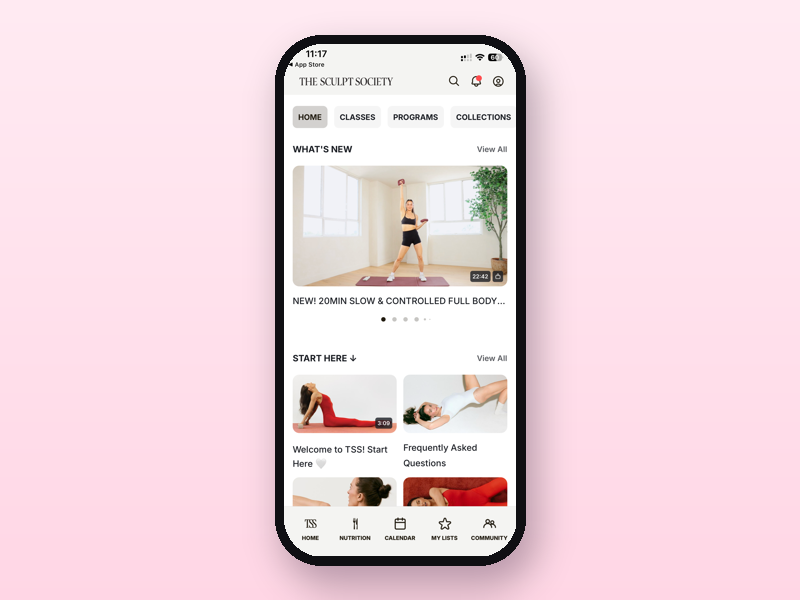
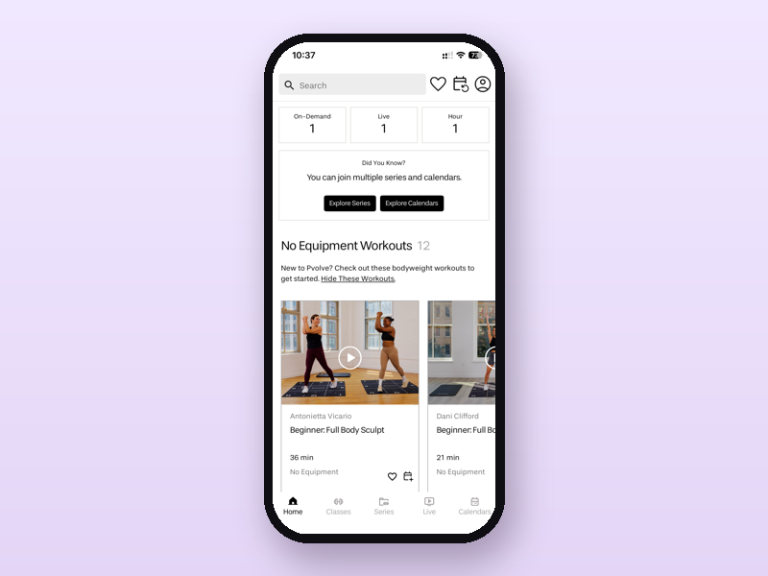
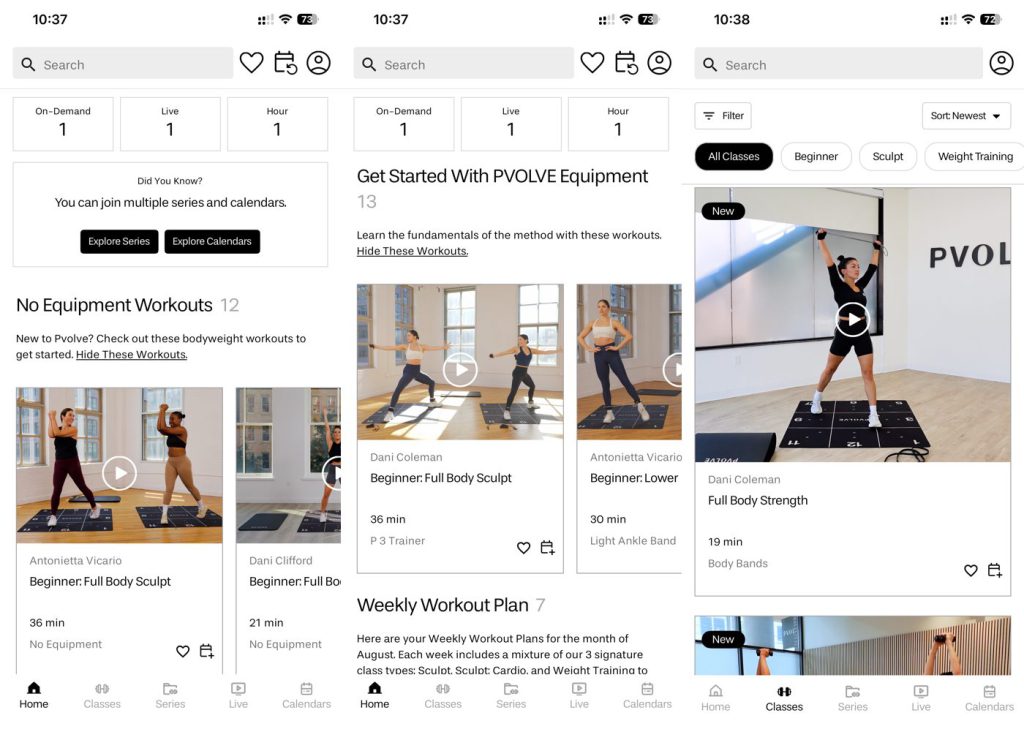
Pvolve is the one platform here where functional movement is the organising principle rather than a description applied afterwards. Sessions train patterns in multiple planes, at low impact, in 16 to 25 minutes.
Tested by Katy Cole, two months: in my 40s, in early perimenopause, with a previous knee injury, two kids and a full-time job, I am precise about what I need. Pvolve is what I landed on. The multi-planar work reaches things that straight-ahead training does not, and I noticed it most in ordinary movements rather than in the sessions.
What a week looks like: four sessions of 16 to 25 minutes following a programme. Add walking on the days between.
The honest limitation: it leans on branded equipment beyond ordinary bands, which adds real cost, and loading stays light so the bone ceiling is low.
Cost: $24.99 a month, or $224.91 a year. Fourteen-day trial, card required.
Start the 14-day free trialAffiliate link, opens pvolve.com. I earn a commission at no extra cost to you. Full disclosureMenovation: functional loading, and the best explanation of why
Real dumbbell work in movement patterns, with exceptional education alongside
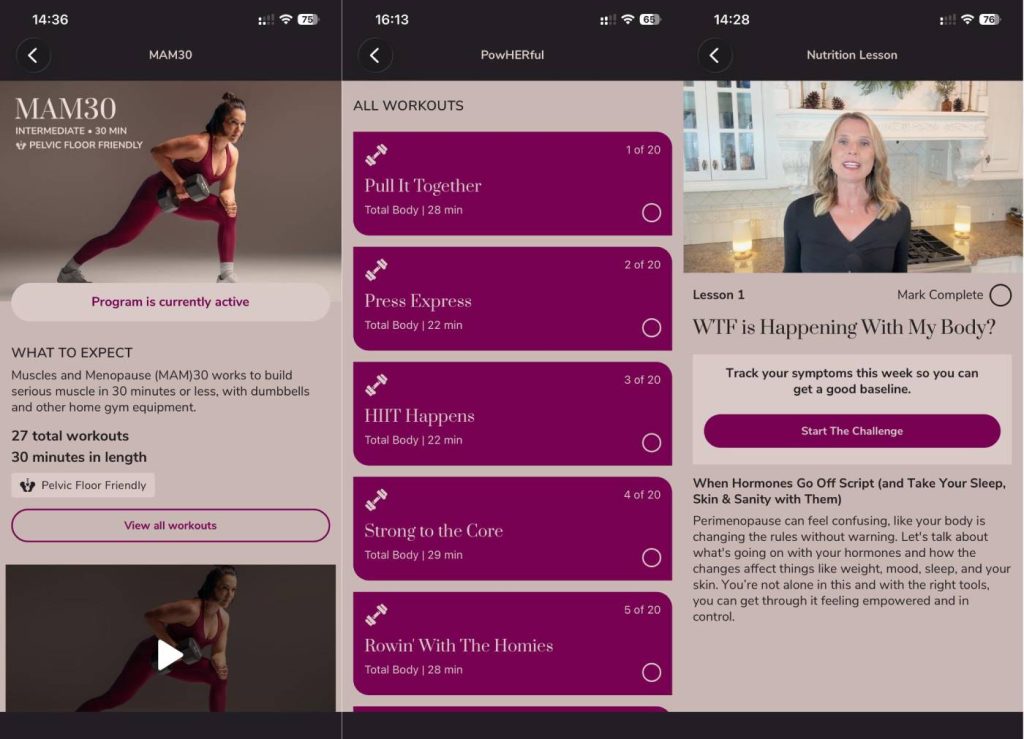
Menovation pairs functional loading with the strongest teaching on this page. For a category where the word “functional” is used loosely, understanding what you are training and why is worth a great deal.
Tested by Katy Cole: the education modules are the part I still think about. Session length is the practical win: 20 to 30 minutes is short enough to do on a bad-sleep day rather than skip.
The honest limitation: a dated interface and a library still growing. It also carries more HIIT than its position suggests, so favour the strength sessions.
Cost: $28.99 a month or $199.99 a year. Eight days free at the checkout.
Owning Your Menopause: everyday movement, inside the deepest menopause platform
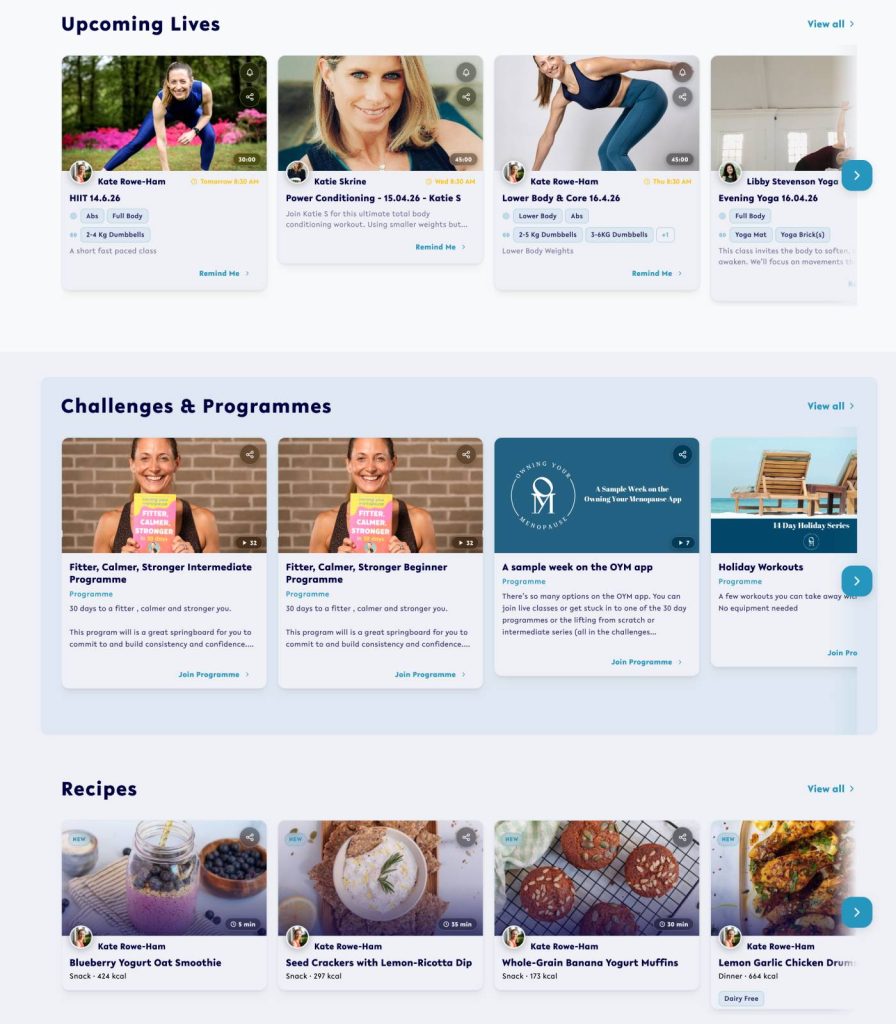
The most comprehensive menopause education we have tested, with GP access and community
Owning Your Menopause frames training around everyday capability rather than aesthetics, inside the most complete menopause platform we have assessed, including GP access and genuinely good nutrition resources.
Tested by Katy Cole, across two periods: an initial stint of several weeks post-injury, then more recently to reassess. The menopause thinking held up. The experience of using it has not moved on.
The honest limitation: ease of use is the weakest here and video production is basic. If a clunky interface is what stops you training, rank Pvolve above it for yourself.
Cost: £16.99 a month or £159.99 a year, which includes two months free. Fourteen-day trial.
MUTU System: the functional capability nobody else programmes
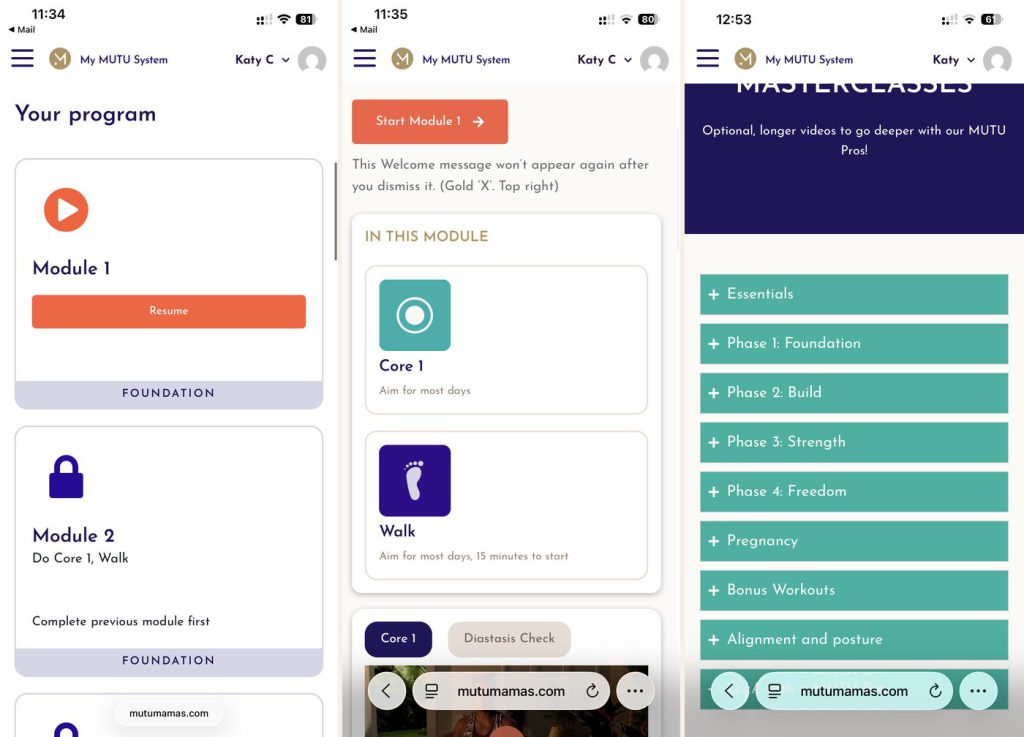
Physio-informed pelvic floor and deep core work, which is functional training in the most literal sense
MUTU System trains the thing that decides whether you can sneeze, lift and run without consequence. That is functional capability, and almost no general platform touches it.
Tested by Katy Cole: I first started MUTU after my first pregnancy, ran it again after my second, and I still use its core and pelvic floor work now, in perimenopause. My separation was about 3 cm, enough to make my belly protrude, with some leaking too.
The honest limitation: loading is light throughout, so it does very little for bone or maximal strength. Run it alongside strength work, not instead of it.
Cost: about $28 a month, or roughly $190 a year. Ten-day trial, the longest here.
Fit With Coco: functional patterns with actual loading behind them
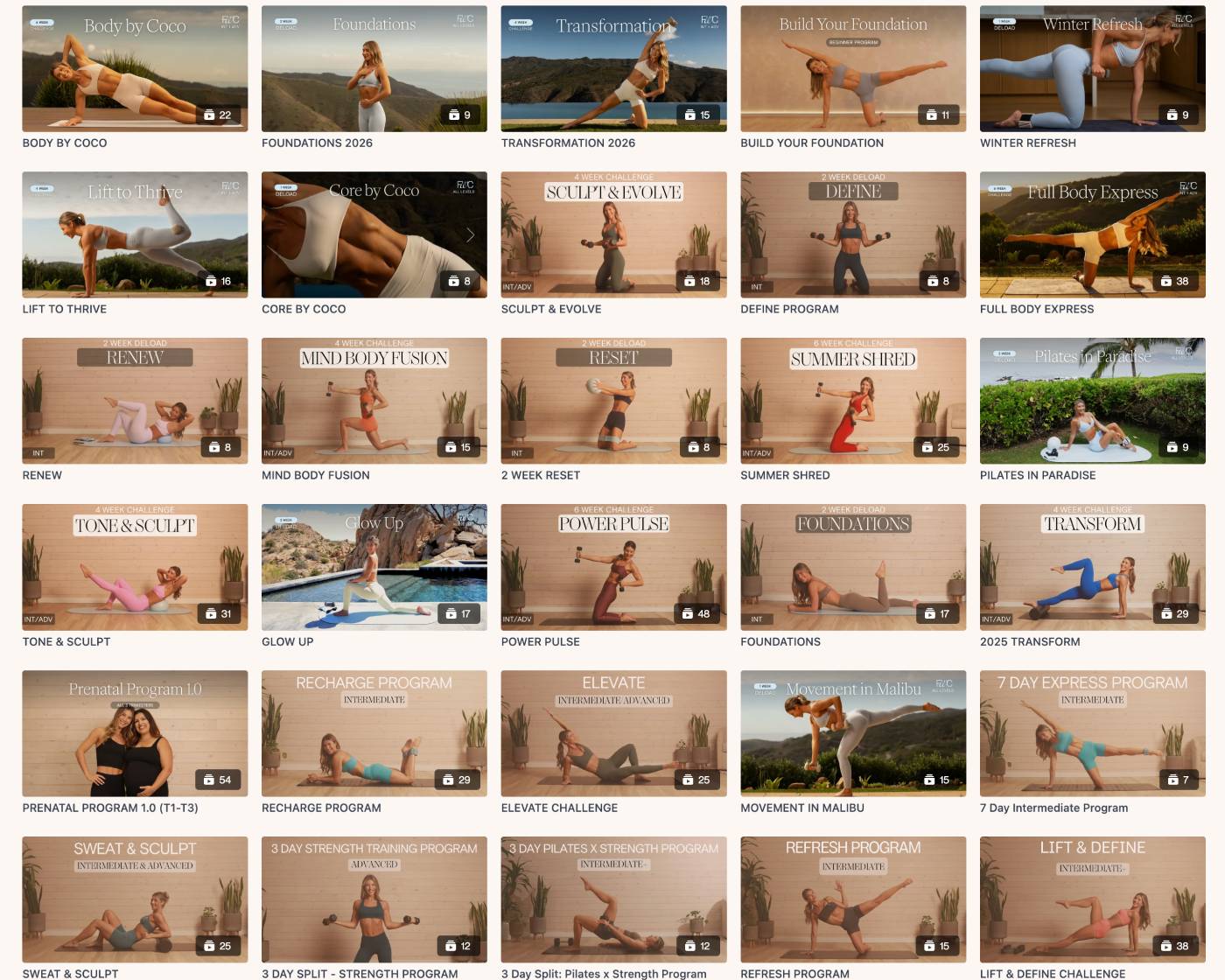
A 3-2-1 method that puts Pilates-style control alongside real strength work
Fit With Coco runs three strength sessions, two Pilates and one cardio in a structured week, which handles the usual functional-training weakness: plenty of movement quality, not enough load.
Tested by Katy Cole: I tested it on both the app and in a browser. The coaching is the standout and the results were real. The structure removes the daily decision about what to do.
The honest limitation: $39.95 a month is the most expensive subscription here.
Cost: $39.95 a month or $359.95 a year. Seven-day trial with no card required.
Kira Stokes Fit: functional circuits from a respected trainer
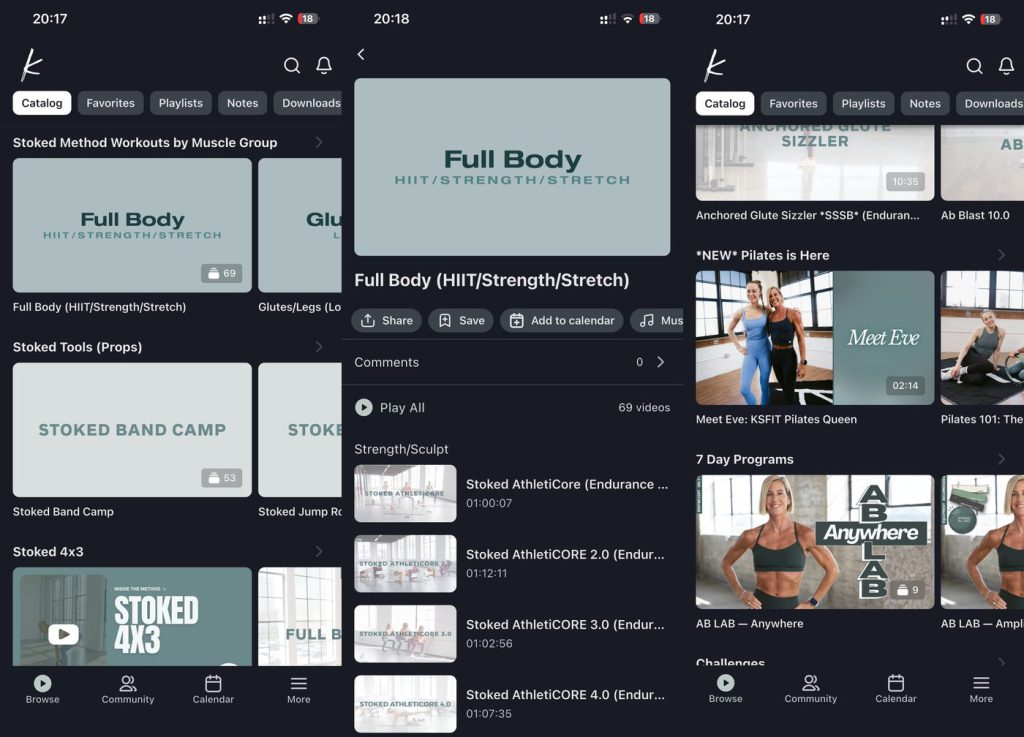
Well-coached circuit work, at a moderate-impact default
Kira Stokes Fit organises functional circuit training into curated schedules rather than a library to browse, with good coaching and nutrition guidance.
This is a data profile, not a tested review. We have not trained on it first hand, so there is no personal testing note here. The published information shows a polished strength and HIIT app with curated schedules. What we cannot verify is how the progression feels across a full block.
The honest limitation: a moderate-impact default and no menopause or pelvic floor content. It ranks sixth on midlife fit, not on coaching quality.
Cost: $19.99 a month or $219.99 a year. Seven-day trial.
Which functional fitness platform is right for you?
If your joints have started objecting and you want movement quality, Pvolve.
If you want to understand what you are training, Menovation.
If leaking or a weak deep core is the real problem, MUTU System, and its 10-day trial is the longest here.
If you want functional patterns with real load, Fit With Coco.
If you want menopause education as much as training, Owning Your Menopause.
What does “functional” actually mean?
It is the most abused word in fitness marketing, so it is worth pinning down before you pay for anything labelled with it.
Functional training means training the movement patterns daily life uses, loaded and in more than one direction: squatting to get off the floor, hinging to lift, pushing, pulling, carrying, rotating, and resisting rotation. The test is transfer. Does it make ordinary things easier?
- Multi-planar movement. Life happens sideways and rotationally, not only forwards. Most gym training is forwards only, which is why Pvolve’s multi-planar work is its genuine differentiator.
- Loaded carries. Carrying is the most functional thing you can train and the most commonly skipped. Grip strength is also one of the better predictors of healthy ageing.
- Getting up and down off the floor. A capability people lose quietly in their fifties and sixties, and one that is trainable.
- Balance and single-leg work. Falls are what turn low bone density into a fracture, so balance belongs in the plan rather than as an afterthought.
What functional training is not: unstable-surface novelty, endless core circuits, or any exercise that is hard mainly because it is awkward. Difficulty is not the same as transfer.
Does functional training work better than conventional strength training?
Not for building muscle or bone, and that is worth saying plainly on a page that recommends it.
The European consensus on sarcopenia identifies progressive resistance training as the countermeasure for age-related muscle loss, and Martyn-St James and Carroll found that impact combined with high-magnitude resistance work reduced postmenopausal bone loss. Neither finding is about movement patterns; both are about load.
What functional training does add is transfer, balance and confidence in ordinary movement, and it tends to be gentler on joints, which matters if conventional loading has become uncomfortable. Schoenfeld and colleagues found low and high loads both build muscle when sets are taken close to failure, so a functional programme that works you genuinely hard is not a soft option.
The sensible arrangement: functional work as the way you train, with enough load in it to be progressive. If a platform never gets harder, it is a movement class rather than a training programme, and that is the most common failure in this category.
How did we rank these six?
The qualifier is functional movement as the method, not the marketing. Ten programmes discuss functional training substantively and are not high impact; six made the list.
The ranking is midlife fit, weighted 70%, blended with ease of use at 30%. Being functional is the entry ticket, so ranking on it again would restate the gate.
Five of the six I have tested myself. Kira Stokes Fit is a data profile built from published information and carries no first-hand testing claim.
We buy our own subscriptions. Some links on this page earn a commission, which never affects a score or a position.
Where is the evidence still evolving on functional fitness for women over 40?
Three open questions matter most. First, whether multi-planar functional training produces measurably better fall prevention outcomes than conventional sagittal-plane resistance training. Second, whether the functional fitness label carries genuine training methodology or is mostly marketing. Third, whether functional training delivers enough loading for bone density in postmenopausal women, or whether dedicated heavy resistance training is required alongside.
On multi-planar versus conventional, the published evidence supports both. The Cochrane 2019 falls prevention review identified multi-component training (combining strength, balance and functional movement) as the most effective intervention. Whether multi-planar loading (Pvolve’s methodology) is meaningfully different from balance plus conventional resistance training is plausible but not directly tested in head-to-head trials.
On methodology versus marketing, the answer is platform-specific. Pvolve’s functional methodology is genuine and consistent across the platform. Evlo’s targeted-resistance methodology is anatomically literate and the load-to-joint-stress accounting is real rather than rhetorical. BODi’s 4 Weeks for Every Body is functional in approach but the wider library is not. Look at the programme details rather than the marketing label.
On bone density adequacy, the Watson 2018 LIFTMOR trial used heavy barbell loading at 80-85% of one-rep-max. Functional training at moderate loads sits below this threshold.
The pragmatic operating point: functional training for daily capacity and stabiliser strength, plus one or two heavier compound dumbbell or barbell sessions per week for bone density. Pvolve plus Caroline Girvan’s heavier programmes is one workable combination; BODi LIIFT4 plus 4 Weeks for Every Body is another; Evlo Build plus a heavier dumbbell day is a third; EvolveYou as the gym progression layered on top of any home functional programme is a fourth.
If I were designing a functional fitness week for a woman over 40, knowing the published research, I would suggest: three Pvolve Menopause Strong sessions per week (20-30 min, multi-planar functional with pelvic floor), one heavier compound dumbbell session per week (Caroline Girvan or BODi LIIFT4, 30-45 min for bone density loading), two 30-45 minute walking sessions per week, and one rest or active recovery day. Total weekly time: 4-5 hours.
Cost: $24.99/month Pvolve + free Caroline Girvan YouTube = $24.99/month for clinically-curated multi-planar functional plus heavy compound progression. For women whose joint history points away from heavier dumbbell work, an alternative week uses Evlo Foundations or Build three times per week with one Pvolve session for the multi-planar component and two walking sessions. For women with gym access ready to take loading further, EvolveYou’s barbell programming sits naturally alongside one or two Pvolve or Evlo sessions for the multi-planar and joint-protective work.
How does functional fitness fit with the rest of your training week?
Functional fitness is not the whole training programme; it is one of the strongest individual components and combines well with the other interventions the published research supports. The WHO physical activity guidelines call for 150-300 minutes of moderate aerobic activity per week plus two or more days of muscle-strengthening work.
Functional training delivers the strengthening side comfortably; the aerobic side comes from walking, cycling, swimming or low-impact cardio that fits around the rest of life. For an evidence-based companion to functional training, see our guide to low-impact workouts for women over 50.
The dumbbell question pairs naturally with the functional question. Conventional dumbbell strength training is the documented intervention for progressive resistance loading; functional training adds the multi-planar and balance work that conventional dumbbell training underplays. For the dumbbell side of the stack, our guide to the best dumbbell workout for women over 40 covers the progressive compound options. Pvolve plus Caroline Girvan, or Evlo Foundations plus one heavier compound dumbbell day, is the structurally complete combination.
For women newer to resistance training or working around joint history that makes dumbbell loading difficult to access, resistance bands are the bridging tool. The band-versus-dumbbell research suggests both produce comparable strength gains at moderate intensities.
For the band-led version of progressive strength, our guide to the best resistance band workout for women over 50 covers the structured options. Pvolve and Evlo both incorporate band work; for women who prefer to lead with bands, the resistance band guide is the right entry point and pairs well with one or two functional sessions a week.
The science behind functional fitness for women over 40 (deeper dive)
Three lines of evidence frame why functional training matters more in midlife and what to demand from a platform.
Sarcopenia and the muscle preservation case. The Cruz-Jentoft 2010 sarcopenia consensus sets the framework: skeletal muscle mass and function decline gradually from the 30s, accelerate after menopause and produce measurable losses of independence in later life. The intervention with the strongest published evidence is progressive resistance training. Functional resistance training (dumbbell, band or barbell loading executed through real-world movement patterns) sits inside that evidence-supported intervention. Pvolve, Evlo, BODi LIIFT4, Caroline Girvan and EvolveYou all deliver progressive resistance training inside functional movement patterns.
Falls prevention and the multi-component evidence. The 2019 Cochrane review on exercise for preventing falls identified multi-component training as the most effective intervention. The multi-component framing matters because it specifies strength plus balance plus functional movement together rather than any single modality alone. Pvolve’s methodology lines up with the multi-component evidence directly. Evlo’s unilateral and stability work covers the balance component. BODi’s 4 Weeks for Every Body and Caroline Girvan’s unilateral variations contribute the balance component inside compound dumbbell work.
Bone density and the LIFTMOR threshold. The Watson 2018 LIFTMOR trial showed that postmenopausal women on a heavy progressive resistance protocol (back squat, deadlift, overhead press at 80-85% of one-rep-max plus jumping chin-ups) produced measurable bone density gains across an 8-month period with no adverse events. The intensity threshold is the operational point: lighter functional training at moderate loads sits below the bone-loading threshold that the trial established.
For bone density adequacy, the structured solution is one or two heavier compound sessions per week alongside the functional training. Caroline Girvan’s heavier programmes (IRON, EPIC) deliver this at home; BODi LIIFT4 delivers it inside the broader BODi library; EvolveYou’s gym programmes deliver it with barbell loading.
The hormonal context and the perimenopause variable. The Menopause Society 2023 nonhormone therapy position statement identifies exercise as one of the evidence-supported non-hormonal interventions for perimenopausal symptom management. The specific mechanisms (improved sleep, mood, body composition, insulin sensitivity) all favour structured resistance training.
Functional training delivers the resistance training intervention inside the most adherence-friendly format: short sessions, low-impact defaults, modifiable intensity. The Schoenfeld 2017 specificity work reinforces the dose-response logic: it is the training you actually complete, not the training you plan, that produces adaptation. Functional fitness wins on adherence because the sessions fit inside real life.
What I learned testing five functional fitness platforms across the price spectrum
The depth of the methodology behind the “functional” label varies enormously, and the price does not always reflect the depth. Caroline Girvan’s free YouTube content delivers genuinely progressive compound functional dumbbell training that several $20+/month platforms cannot match. Pvolve at $24.99/month delivers multi-planar functional fitness as the entire methodology and earns the price through the clinical advisory and the differentiated movement system.
Evlo at $55.99/month is the highest-priced option tested and earns it through the DPT-level anatomical depth and the load-to-joint-stress accounting. BODi at $179/year is the breadth option. EvolveYou at $19.99/month is the cheapest gym-pathway option in the tested set.
The biggest practical lesson from 8 weeks on Evlo, two months on Pvolve, several months across BODi programmes, three years of Caroline Girvan and time on EvolveYou: pick the platform that matches the constraint you actually have. If your constraint is joint history, Evlo’s DPT-designed exercise selection earns the price. If your constraint is time, Pvolve’s 20-30 minute sessions plus the multi-planar methodology give you both depth and brevity.
If your constraint is budget, Caroline Girvan delivers progressive functional training for nothing. If your constraint is access (you have a gym you want to use), EvolveYou’s gym programmes give you the barbell pathway. If your constraint is needing variety inside one subscription, BODi gives you 140+ programmes.
The mistake to avoid is paying for a platform whose strength does not match your constraint. Evlo’s clinical depth is wasted if the 45-50 minute sessions mean you train twice a month instead of four times a week. EvolveYou’s gym pathway is wasted if you do not have gym access. BODi’s 140+ programmes are wasted if you bounce between programmes without finishing any. The platform that gets used is always the right pick, and that depends on your week as much as on the methodology.
Frequently Asked Questions
Functional fitness is training that improves your capacity to perform the movements of daily life: carrying, lifting, climbing stairs, getting up from the floor, reaching overhead, twisting, stepping sideways. The training emphasises movements that translate to real-world tasks rather than isolated muscle work that only matters in the gym. Functional fitness typically loads movement through multiple planes (sagittal, frontal, transverse), includes single-leg work for balance and asymmetry correction, and integrates deep core stability into compound movement. For women over 40, functional fitness builds the stabiliser strength and movement capacity that supports independence across the decades ahead.
Pvolve scored highest in our 2026 evaluation. Multi-planar functional movement is the platform's entire methodology, not an add-on. The 4-week Menopause Strong programme integrates functional training with clinical advisory board curation led by OB/GYN Dr Jessica Shepherd, with Dr Amy Hoover PT and Dr Gabrielle Lyon advising.
Yes. The 2019 Cochrane review on exercise for preventing falls in older people (Sherrington et al.) identified multi-component training (combining strength, balance and functional movement) as the most effective intervention. The mechanism is the multi-planar nature of functional training: loading hip abductors, external rotators, deep core and stabiliser muscles that conventional sagittal-plane training mostly skips. For women in their 40s and 50s, functional training builds the stabiliser strength that prevents falls in the decades ahead. The effect sizes are modest but the practical importance is high: falls in midlife and beyond are a leading cause of disability and lost independence.
For everyday capacity and stabiliser strength, broadly yes. For maximum bone density adaptation, no. The Watson 2018 LIFTMOR trial required high-intensity progressive resistance training (heavy barbell squat, deadlift, overhead press at 80-85% of one-rep-max) to produce bone density gains in postmenopausal women. Functional training at moderate loads sits below this threshold. The pragmatic operating point: functional training (Pvolve, BODi 4 Weeks for Every Body, Evlo Foundations) for daily capacity and stabiliser strength, plus one or two heavier compound dumbbell or barbell sessions per week (Caroline Girvan, BODi LIIFT4, EvolveYou) for bone density. Combine both approaches for the most complete training stimulus.
Three to five sessions per week is the typical operating point. A balanced week might include three or four 20-30 minute multi-planar functional sessions (Pvolve), one or two 30-45 minute compound dumbbell sessions (Caroline Girvan for bone density loading), and two or three 30-45 minute walking sessions. Total weekly training time: 4-5 hours. The WHO physical activity guidelines (150-300 minutes of moderate aerobic activity plus 2+ days muscle-strengthening) are met comfortably inside this structure. Daily functional training is fine for women whose preference is high-frequency low-volume work; sessions of 20-30 minutes recover quickly between days.
A pair of dumbbells, a set of resistance bands (mini loop bands plus long flat bands in light, medium and heavy tensions), ankle weights and a mat cover four of the five platforms in this guide. Pvolve specifically uses bands and ankle weights alongside dumbbells; the methodology depends on the bands for the multi-planar loading. Evlo uses dumbbells in the light-to-mid range (4-8kg covers most programming for women new to resistance training). Caroline Girvan and BODi LIIFT4 use a wider dumbbell range. EvolveYou’s strongest content is gym-based and uses barbell, dumbbells and machines. Total home equipment cost: $50-150. For women with home gym setups, a kettlebell (8-12kg) and a TRX or suspension trainer add useful options but are not required.
With the right platform and modifications, yes. Functional fitness is broadly low-impact and joint-friendly compared to high-impact HIIT or running. The platforms that flag modifications proactively (Pvolve's low-impact-throughout design, BODi's modifier tracks in some programmes, Evlo's DPT-designed exercise selection based on load-to-joint-stress ratio) protect women with knee, hip or wrist concerns. Pvolve's Knee Stability series is specifically designed for women with knee history. Evlo's whole methodology is anchored to joint protection: every exercise is chosen based on how it loads the target muscle relative to joint stress. For active joint pain or recent injury, work with a physiotherapist before starting. For chronic joint history that is well-managed, the platforms in this guide can be calibrated to suit you.
For functional capacity (real-world movement, fall prevention, stabiliser strength), the evidence supports multi-planar training as a meaningful contributor. For pure strength and hypertrophy, conventional sagittal-plane resistance training (squats, deadlifts, presses) remains the documented intervention. The pragmatic position is to combine both: multi-planar functional training (Pvolve) for the stabiliser and balance work conventional training misses, plus conventional compound strength training (Caroline Girvan, BODi LIIFT4, EvolveYou) for the maximum-load adaptation that drives bone density and muscle preservation. Head-to-head trials of multi-planar versus conventional training for functional outcomes are limited, but the combination delivers more than either approach alone.
Training the movement patterns daily life uses, loaded and in more than one direction: squatting to get off the floor, hinging to lift, pushing, pulling, carrying, rotating and resisting rotation. The test is transfer, meaning whether it makes ordinary things easier. It is not unstable-surface novelty or exercises that are hard mainly because they are awkward.
Not for muscle or bone. The European consensus on sarcopenia identifies progressive resistance training as the countermeasure for age-related muscle loss, and Martyn-St James and Carroll found bone benefit came from impact plus high-magnitude resistance. What functional training adds is transfer, balance and joint-friendliness. The best arrangement is functional patterns with enough load in them to keep getting harder.
Pvolve, which is built on functional movement rather than borrowing the term, with a clinical advisory board, low impact and 16 to 25 minute sessions. Menovation is the better choice if you want education alongside the training, and MUTU System if pelvic floor function is the actual problem.
It is one of its stronger claims. Single-leg work, multi-directional movement and loaded carries all train balance and the ability to catch yourself, and falls are what turn low bone density into a fracture. Look for a programme that includes single-leg work deliberately rather than treating balance as a warm-up.