Ladder scores higher overall, 6.9 against 5.5, and is the stronger platform for building muscle and a structured programme. BetterMe is the better pick if what you need most is joint-friendly training and nutrition guidance.
Quick answer
- Ladder 6.9 vs BetterMe 5.5
- $29.99 vs about $19.99 a month
- Muscle 9 vs 5
- Joints 7 vs 5, BetterMe
- Structure 9 vs 6
- Pelvic floor 3 vs 0
Ladder scores higher and is the better platform for the thing a midlife body needs most, which is load. It wins Muscle Potential 9 against 5, Programme Structure 9 against 6, UX and Design 9 against 6 and Value for Money 7 against 4, on a progressive strength capability of 9 out of 10 against 3, and 7 against 3 for bone loading.
BetterMe takes eight of the twelve midlife capability scores, which is the result that stops this being a simple recommendation. It wins Joint Friendliness 7 against 5 on low-impact 8 out of 10 against 5, Women Over 40 Specificity 4 against 3.6, and Nutrition Integration 6 against 5. Ladder scores zero on pelvic floor, hormone awareness and menopause education, which is as low as our scale goes.
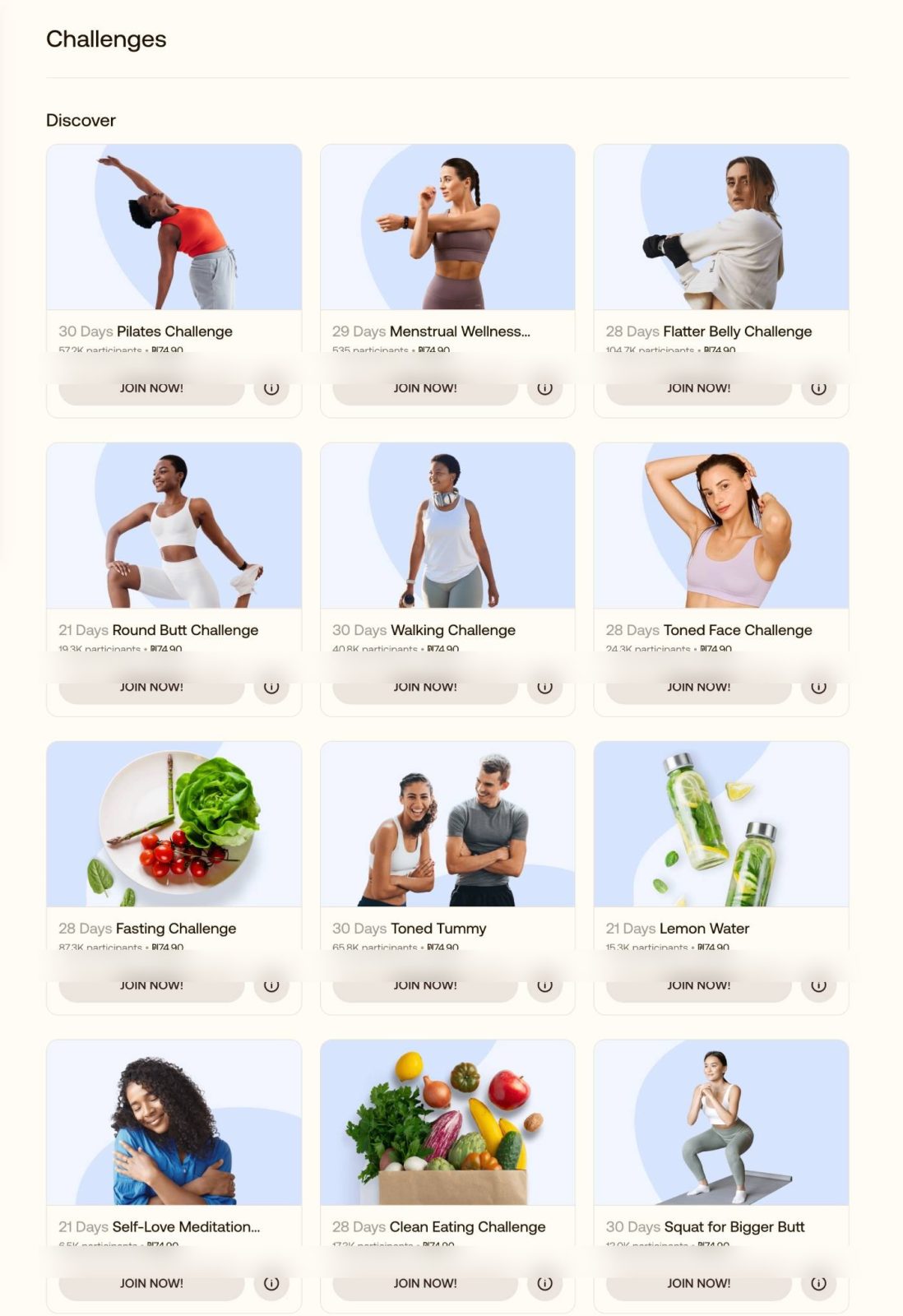
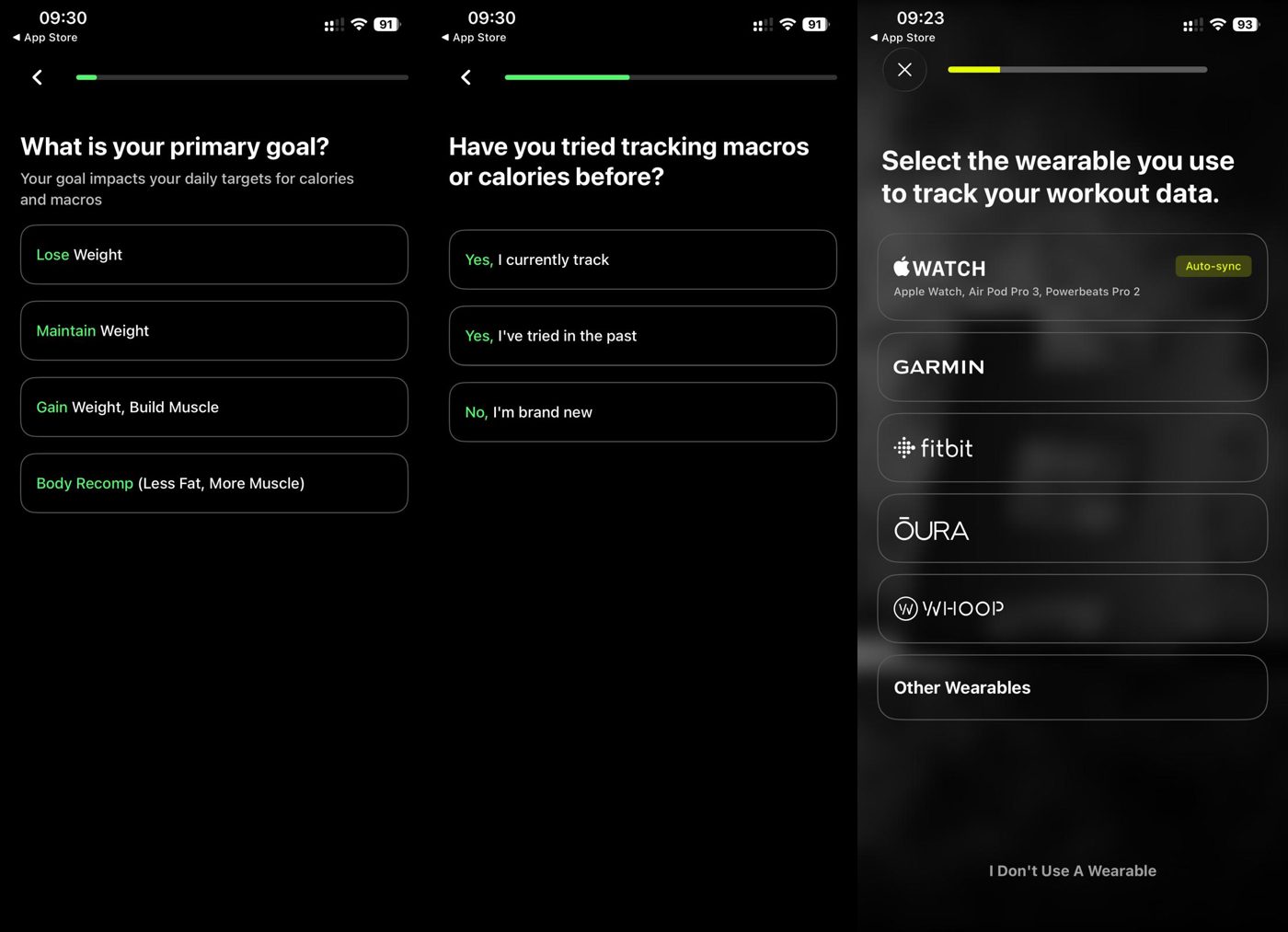
Both platforms were sample tested, and neither was run as a full multi-week programme. On each one the setup was completed and the app explored from the inside, and the methods section below lists exactly what that covered. The screenshots on both reviews are our own. That means any rating that depends on months of use is provisional on both sides, and it means the strongest claim either platform makes, that its programming works over time, is the claim we are least able to check. We say so again where it matters.
Ladder if you already know how to modify a session, your joints are steady, and you want coach-programmed progressive strength with genuine load progression. BetterMe if you are returning to training, working around a joint, or you want gentle daily movement you will actually open, and you are prepared to add loaded strength elsewhere as soon as you can. Neither one programmes anything for menopause, and one of them scores zero on three menopause capabilities.
BetterMe vs Ladder: the two platforms
Same nine weighted criteria, same twelve capability scores, and two platforms that fail a midlife body in exactly opposite directions.
BetterMe
Runner-up
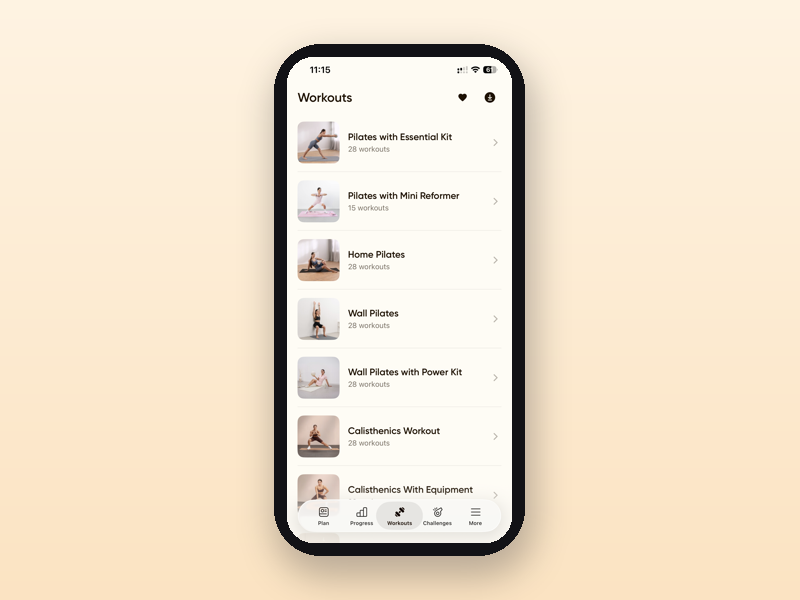
An on-demand app with more than 4,000 home workouts across Pilates, wall Pilates, chair yoga, calisthenics, strength, yoga, tai chi and walking, arranged into a plan by an onboarding quiz, alongside meal plans, calorie and habit tracking and an optional paid one-to-one coaching layer.
- 10 to 30 min
- Joints 7.0
- Low-impact 8/10
- Trial auto-converts
- Sample tested
Choose BetterMe if you:
- Are returning to training after a long gap
- Need wall Pilates, chair yoga or walking
- Want short sessions with no equipment
- Want meal plans and calorie tracking included
- Will add loaded strength somewhere else
Ladder
Winner
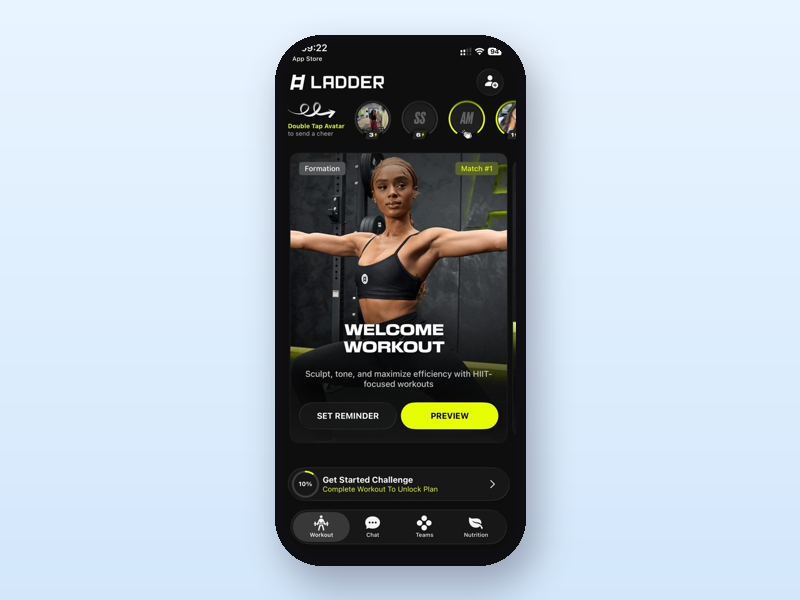
Coach-led, team-based progressive strength: a quiz matches you to a coach and a team, and each week that coach releases a new block of workouts the whole team follows together, with in-ear audio coaching, video demos and load tracking.
- 30 to 45 min
- Muscle 9.0
- Progressive strength 9/10
- 7-day trial, no card
- Sample tested
Choose Ladder if you:
- Want load that goes up week on week
- Already know how to modify a session
- Like following a coach and a team
- Want macro tracking in the same app
- Have steady joints and time for 45 minutes
How we scored this, and what each test covered
Both platforms were scored on the same nine weighted criteria and the same twelve capability scores. Muscle Potential carries 18%, Time Efficiency 15%, Joint Friendliness and Programme Structure 12% each, Women Over 40 Specificity and Recovery Compatibility 10%, Value for Money and UX and Design 8%, and Nutrition Integration 7%.
Same tester, and two tests of the same shape. Katy is a woman in her mid-40s, perimenopausal, working full-time with family commitments, and with a previous meniscus injury. On BetterMe she completed the onboarding quiz, tried a few of the Pilates workouts, worked through the workout library filters and looked at the daily plan. On Ladder she worked through the onboarding quiz, watched the coach welcome video, explored the search and filter screens and looked at the in-app macro tracking. Both are hands-on looks rather than completed programmes.
That symmetry is useful, because it means the two columns are built from the same kind of evidence. It also means the same gap sits on both sides. Ladder’s central claim is that a coach-programmed block progresses you properly over six weeks, and BetterMe’s is that a quiz-built plan keeps a beginner coming back for months. Neither claim was put to a multi-week test here, so on both sides those ratings are provisional and we flag them in the sections where they carry the most weight.
Where a criterion turns on what a platform holds, price, library breadth, whether menopause programming exists, both columns stand on firm ground. Where it turns on what months of use feel like, both are a snapshot.
Muscle and bone: the widest gap on the page, and the most important one
Ladder wins Muscle Potential, 9 against 5, with progressive strength 9 out of 10 against 3 and bone loading 7 against 3. Muscle Potential carries the heaviest weight in our model at 18%, so this single row does more to separate these two than anything else.
Ladder is built for exactly this. You are matched by quiz to a coach and a team, a new block arrives every week, and the sessions carry in-ear audio coaching, video demos and load tracking so the weight is meant to go up. Our tester had a feeling before she even logged in that this was an app for building muscle, and that held up: she only looked around rather than running a full programme, and you can see it is built for progressive strength.
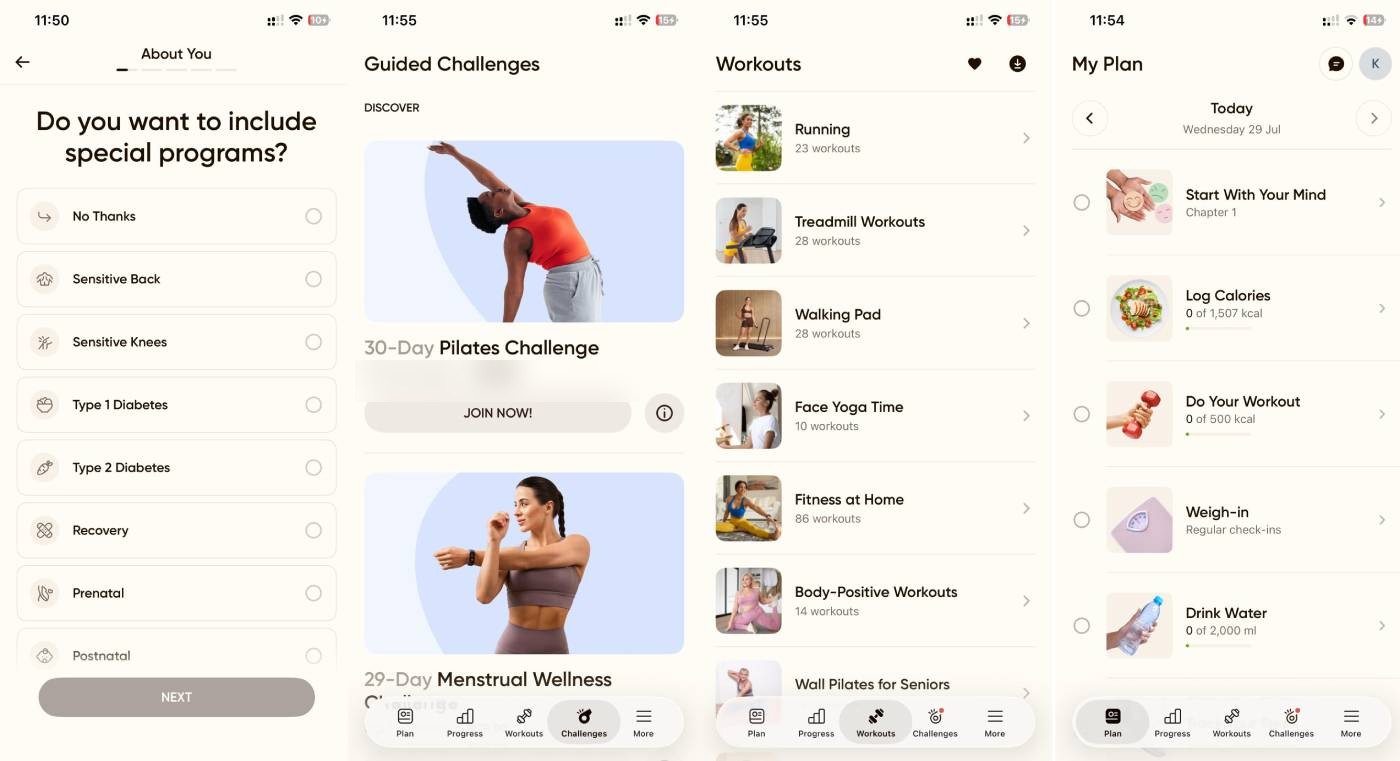
BetterMe is the opposite. Strength and calisthenics sessions exist, and the platform is mostly bodyweight and Pilates with no true progressive overload once you are past the beginner phase. She went looking for the strength content and could not find it: the filters are limited to types like yoga, wall Pilates and Pilates rather than letting her search for progressive strength, and the app leans heavily on Pilates and yoga with a weight-loss focus when what she wanted was to build and keep muscle.
The evidence is unusually clear on which of those matters after 40. Watson and colleagues found in the LIFTMOR trial that heavier, high-intensity resistance and impact training improved bone density and physical function in postmenopausal women, where light exercise did not to the same degree.2 Sá and colleagues found in a systematic review and meta-analysis that resistance training was associated with improvements in postmenopausal symptoms and functional capacity, though the authors rate the certainty of that evidence as very low to low, so we report it on that basis.1 Harvard Health puts the practical version simply: progressive strength training helps slow bone loss and can build bone, offsetting age-related decline.3
Our best workouts to build muscle after 50 ranking covers the wider field.
The wall Pilates question, and what a gentle library can and cannot do
BetterMe’s low-impact catalogue is genuinely good, and it is not a substitute for load.
Wall Pilates, chair yoga, tai chi and walking are the core of what BetterMe does well, and they are worth having: accessible, joint-gentle, short, and easy to do on a day when nothing else is going to happen. She tried a few of the Pilates sessions and found them lovely, joint friendly, relaxing and good for lowering cortisol, and she did not think they would build muscle.
That instinct matches the research. Fernandez-Rodriguez and colleagues found in a systematic review that Pilates and yoga did not meaningfully improve bone mineral density, with effects on body composition modest.4 Wall Pilates as a named modality is not separately studied, and it cannot be progressively overloaded much beyond the beginner phase, so the loading side of a midlife programme is the part BetterMe leaves undone. Our best Pilates programmes for women over 40 ranking covers platforms that put real load into this style of work.
The way to read that is not that BetterMe is useless. It is that a woman using it needs a second thing, and the second thing is the thing Ladder sells.
Joint friendliness: BetterMe wins, and this is the reason to start there
BetterMe wins, 7 against 5, with low-impact capability 8 out of 10 against 5.
The low-impact catalogue is extensive and there is an explicit low-impact filter, which is a small feature that changes how usable an app is when a knee or a hip is dictating terms. Wall Pilates needs a clear wall, chair yoga needs a sturdy chair, and neither asks anything of a joint that a walk would not.
Ladder’s core teams are loaded strength and HIIT, which is the point of the platform and also what a sore joint has to work around. It is not rigid: sessions can be swapped, the intensity dialled down and active rest days taken, and, as the review puts it, you have to know to do that. For a woman who already trains, that is a fair ask. For a woman easing back in with something that hurts, it is the difference between a platform that helps and one that has to be managed.
Neither platform has live form correction, so on both, nobody is watching how you move.
Perimenopause and menopause fit: three against zero, between two platforms that both leave it undone
BetterMe wins Women Over 40 Specificity, 4 against 3.6, and menopause programming is 3 out of 10 against 1. Neither number is a recommendation.
BetterMe markets Pilates for Menopause content with no structured programme behind it. She found one workout labelled for menopause and it was Pilates, and she could not find dedicated perimenopause or menopause programming anywhere: the app’s own special-programs opt-in list covers prenatal, postnatal, sensitive knees, sensitive back and diabetes, and has no menopause option at all. There is a basic period tracker with Apple Health sync and no menopause-symptom or hormone-phase logic, which is why hormone awareness stops at 3. Menopause education is generic article content rather than anything structured in the app.
Ladder has less than that. Pelvic floor, hormone awareness and menopause education all score zero, which is the floor of our scale, and menopause programming scores 1. There are no clinicians, pelvic-health specialists or menopause experts on the roster, and the team plans do not adapt to your individual recovery or symptoms.
Stanford Lifestyle Medicine sets out why strength training matters specifically through perimenopause, for muscle, bone and metabolic health.5 Read against that, the shape of the choice becomes clearer. Ladder does the training the guidance asks for and nothing around it. BetterMe does a little of everything around it and not the training. Neither is a menopause platform, and a woman who wants one should look at our Pvolve review instead.
Pelvic floor
BetterMe wins, 3 out of 10 against 0, on incidental Pilates core work and a pelvic-floor challenge sold as a paid add-on rather than a supervised module. Ladder has nothing at all. Three against zero is a real difference and neither is a service.
Expert credibility
Tied at 3 out of 10 each, which is low for both and low for different reasons. BetterMe Limited was founded in 2016 in Kyiv and is now headquartered in Cyprus under founder and chief executive Victoria Repa, no clinical advisory board governs the programming, and the UK Advertising Standards Authority has ruled a BetterMe advertisement misleading over a 28-day physique claim. Ladder has reputable strength coaches on its roster who are genuinely good at what they do, with no clinicians, pelvic-health specialists or menopause experts among them. She found the coaches high energy, confident and professional enough to make her want to train with them, which is a real asset and is not the same as clinical authority.
Value for money: Ladder wins, even though it costs more
Ladder wins, 7 against 4, and this is a case where the headline price is the least useful number on the page.
| Plan | BetterMe | Ladder |
|---|---|---|
| Monthly | Around $19.99 on the App Store, funnel prices vary | $29.99 |
| Annual | Variants from $19.99 to $29.99 | $179.99, about $15 a month |
| Reported renewals | Roughly $38.95 a month or $94.85 a quarter | The plan you signed up for |
| Add-ons | Paid one-to-one coaching, paid challenges, hardware | None found |
| Trial | Yes, and it auto-converts unless cancelled | 7 days, and it does not ask for a card |
| Getting out | Turn off auto-renew at least 24 hours before renewal | Standard store or account cancellation |
BetterMe’s pricing does not resolve to a single figure, because it is funnel-based and varies by entry point. What is verifiable is that the App Store monthly price is around $19.99, annual variants run from $19.99 to $29.99, and renewal charges of roughly $38.95 a month and $94.85 a quarter are widely reported, which is higher than the entry price. On top of that the challenges are separate purchases. She saw a 30-day menstrual challenge and a flatter-belly challenge that looked interesting, and they are extra purchases on top of the subscription, which she did not love.
Getting out is the part to read before you sign up. Deleting the app does not cancel a BetterMe subscription: you have to turn off auto-renew in the App Store, Google Play or your web profile at least 24 hours before renewal, and the money-back guarantee is narrow, covering web purchases only, inside 30 days, and requiring seven completed sessions with screenshots. Billing and cancellation is by far the loudest complaint theme across its review corpus.
Ladder is more expensive and simpler. It is $29.99 a month or $179.99 a year, which works out at about $15 a month on the annual plan, and the 7-day free trial does not ask for a card upfront, which removes the most common subscription trap before it can start. Our best free and budget workout apps ranking covers cheaper options that do not carry either problem.
Structure and progression: Ladder wins, and it is the best in this price band
Ladder wins, 9 against 6, and this is the second largest criterion gap on the page.
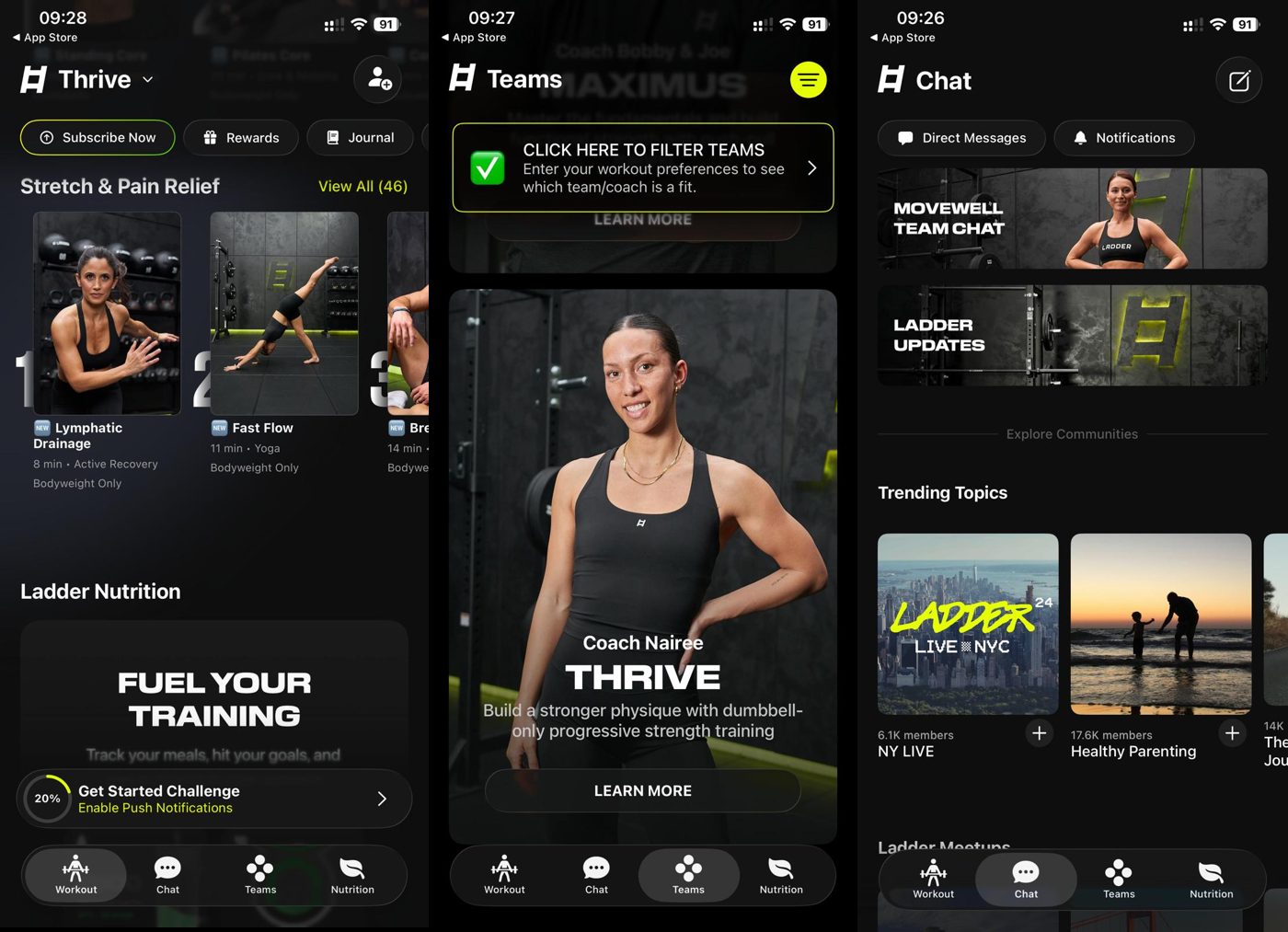
The mechanism is the team. An intake quiz puts you with a coach, that coach releases a new block of workouts each week, and everyone on the team follows it together, so the programming is done for you and the progression is built in rather than assumed. She was welcomed by a short video of a coach explaining how it works, which she liked, and then it recommended a programme based on her age and goals.
BetterMe builds a plan from the onboarding quiz and sells structured challenges as paid add-ons, which is structure of a kind. What it lacks is progression: reviewers describe the plan adaptation as limited on manual progression, there is no menopause-specific pathway, and the daily plan centres on losing weight, with calorie logging and weigh-ins front and centre rather than a training arc.
The limit on Ladder’s advantage is one we could not test, and it is worth naming here rather than burying it. The team plans are fixed: they do not adapt to your individual recovery or your symptoms. That is the trade you make for having someone else write the week.
Recovery: the tie, and both platforms lose it
Tied at 4 each, and a tie at that level is a shared failure rather than a shared strength. Recovery and deload capability runs 4 out of 10 to Ladder against 3.
BetterMe de-emphasises recovery in favour of a challenge-and-weight-loss frame. There is no structured deload, the recovery content that exists is delivered as tracking rather than as a programme, and the mindfulness material sits largely in a separate app. For a perimenopausal nervous system, an app that keeps asking for another challenge is asking in the wrong direction.
Ladder’s problem is different and just as real. Its reservation, in her words, is the intensity: the programmes she looked at could feel like a lot, with longer sessions and not much recovery between them if you follow them exactly. Ladder does allow a swap, a lower intensity setting and an active rest day, so it is not rigid. The catch is that the platform will not tell you to.
Our low-cortisol workouts for perimenopause guide covers platforms that treat this as a design problem rather than as your responsibility.
UX and design: Ladder wins, and one of BetterMe’s problems is the front door
Ladder wins, 9 against 6, and both apps are competently built.
Ladder is iOS-first and polished. The coach welcome video sets the tone, the search and filter screens sort classes by style, equipment and mood, it syncs to an Apple Watch, and macro tracking sits in the same app. There is a community chat alongside the teams, which is a genuine part of the product rather than a bolt-on.
BetterMe is broader in reach and rougher in use. It runs on iOS, iPadOS, visionOS, Android and the web, in 35 languages, and syncs with Apple Health and Apple Watch, which is more platform coverage than most. Two things hold it to 6. The first is the front door: the first hurdle is a very long onboarding quiz, and a long quiz before a price is a pattern this category should have retired. The second is the filtering, which is limited to workout types and makes finding a specific kind of training harder than it should be. No TV casting and no offline download were found on its official pages, so we mark those as not found rather than assume they exist.
What BetterMe does well inside a session is worth saying plainly, because it is the reason its beginner score is the higher of the two: the app is calm and easy to follow, with clear form explanation you can watch, so it is genuinely nice for beginners.
Nutrition: BetterMe wins narrowly, and neither has a dietitian
BetterMe wins Nutrition Integration, 6 against 5, with midlife nutrition capability 4 out of 10 against 3.
BetterMe includes more than 20 meal plans, alongside recipes and a calorie tracker, which is more content than most training apps carry. What holds it to 6 is that the plans are not personalised by a registered dietitian, reviewers describe the tracking as basic, and the whole thing sits inside a calorie-deficit frame rather than a midlife one.
Ladder lets you track macros in the same app, which she liked because for her it replaces paying separately for something like MyFitnessPal. The guidance itself is generic and there is no dietitian behind it. Nutrition carries the smallest weight in our model at 7%, so this barely moves either total. If eating is the part you want handled properly, our best workout apps with meal plans ranking covers platforms that do it better than either.
Time efficiency: Ladder wins, and BetterMe fits a smaller gap
Ladder wins, 8 against 7, which is the counter-intuitive result on this page, because Ladder’s sessions are longer.
Ladder runs roughly 30 to 45 minutes, and it earns the score because those minutes are programmed: you open the app, the session is there, and nothing is spent deciding. BetterMe runs short, roughly 10 to 30 minutes, with a deep quick-class library, which is a genuine strength when the gap in the day is small. The cost is at the other end, where a 10 minute session that never gets heavier is not going to move much after the first month.
For a woman fitting training around work and family, the practical read is that BetterMe fits more days and Ladder makes the days it fits count for more. Our 30-minute workouts for women over 40 and 20-minute workouts for perimenopause guides cover the wider field in both bands.
Equipment and space needed at home
BetterMe asks for almost nothing, Ladder assumes you have weights, and that difference is the whole comparison in miniature.
Most BetterMe sessions need nothing at all. Wall Pilates needs a clear wall, chair yoga needs a sturdy chair, and the strength sessions are better with light dumbbells. No proprietary hardware is required, although the platform does sell its own fitness tracker and smart scale, which are worth skipping.
Ladder assumes access to load, whether that is a set of dumbbells at home or a gym, because the whole model is a coach adding weight to a movement week on week. If you have neither, Ladder is the wrong purchase until you do. For either platform, adjustable dumbbells are the buy that matters, because a fixed light pair stops providing a stimulus once you adapt to it, and on BetterMe they are the only route out of the beginner phase.
Starting from scratch: BetterMe, and with a plan for leaving it
BetterMe wins beginner on-ramp, 7 out of 10 against 5, and it is the right first step for a genuine beginner.
It is explicitly beginner-first, the barrier is low, the sessions are short, most need no equipment, and the form explanation is clear enough to follow without a coach. For a woman who has not trained in years, all of that removes friction at exactly the point where friction stops people.
Ladder is not a beginner product and does not pretend to be. The coaching quality is high and the programming assumes you know how to modify, and she would point it at women who already understand how to structure their own training rather than a beginner who wants to be told exactly how much to rest.
The useful way to hold both facts at once is to treat BetterMe as a starting point with an exit plan. It is a reasonable place to begin, and her own verdict is that it can be a pleasant extra to dip into rather than something to rely on as a main app. Six to eight weeks of consistent gentle movement is a real achievement; the next step after it is load.
BetterMe pros and cons
BetterMe scores 5.5. It is strongest on joint-friendly training and weakest on suitability for women over 40.
Pros
- Joint Friendliness 7 against 5, on low-impact 8 out of 10 against 5 with an explicit low-impact filter.
- Women Over 40 Specificity 4 against 3.6, and eight of the twelve capability scores.
- Nutrition Integration 6 against 5, on more than 20 meal plans, recipes and a calorie tracker.
- Beginner on-ramp 7 out of 10 against 5.
- Pelvic floor 3 against 0, hormone awareness 3 against 0, menopause education 3 against 0.
- Very short sessions, almost no equipment, and platform coverage in 35 languages.
Cons
- Muscle Potential 5 against 9, with progressive strength 3 out of 10 and bone loading 3.
- Value for Money 4 against 7, on funnel pricing that renews higher and challenges sold as paid add-ons.
- Programme Structure 6 against 9.
- A weight-loss-first framing with a UK advertising ruling against a 28-day physique claim.
- Recovery and deload 3 out of 10.
- A very long onboarding quiz and limited filtering.
Ladder pros and cons
Ladder scores 6.9. It leads on building and keeping muscle and trails on suitability for women over 40.
Pros
- Muscle Potential 9 against 5, on progressive strength 9 out of 10 against 3 and bone loading 7 against 3, with coach-programmed load progression.
- Programme Structure 9 against 6: a coach releases a new block every week.
- UX and Design 9 against 6, with Apple Watch sync and macro tracking in the same app.
- Value for Money 7 against 4, and a 7-day trial that does not ask for a card.
- Coaches who make you want to train.
Cons
- Joint Friendliness 5 against 7, with low-impact 5 out of 10 on core teams that are loaded strength and HIIT. Pelvic floor 0 out of 10, hormone awareness 0 and menopause education 0, the lowest scores on our scale.
- Recovery and deload 4, on fixed team plans that do not adapt to your recovery or symptoms.
- Beginner on-ramp 5.
- Longer sessions at 30 to 45 minutes.
- Pricey monthly, and the macro tracking is generic with no dietitian.
Quick yes/no comparison
| Feature | BetterMe | Ladder |
|---|---|---|
| A single published price | No, funnel-based and varies by entry point | Yes |
| Free trial without a card | No, the trial auto-converts | Yes, 7 days with no card upfront |
| Coach-programmed progression | No | Yes, a new block from your coach each week |
| Real load progression | No, mostly bodyweight and Pilates | Yes, with load tracking |
| Explicit low-impact filter | Yes | No |
| Chair yoga, wall Pilates or walking | Yes, a deep library | No |
| Menopause or perimenopause programming | No, marketing content only | No |
| Pelvic floor content | Incidental, plus a paid challenge | No, none at all |
| Any hormone or cycle tracking | A basic period tracker | No |
| Nutrition guidance | Yes, meal plans, recipes and calorie tracking | Yes, macro tracking in the app |
| An in-app community | No | Yes, teams and chat |
| Paid add-ons on top of the subscription | Yes, challenges, coaching and hardware | None found |
| Apple Watch and Apple Health | Yes | Yes |
| Cast to a television | Not found on the official pages | Not assessed |
| Was it tested hands-on | Yes, a few workouts and the library | Yes, onboarding and the library |
BetterMe vs Ladder at a glance
| BetterMe | Ladder | |
|---|---|---|
| Overall score | 5.5 | 6.9 |
| How it was assessed | Sample tested, a hands-on look with a few workouts tried, with our own screenshots | Sample tested, onboarding and library explored hands-on, no full programme run |
| Cost | Around $19.99 a month on the App Store, annual variants $19.99 to $29.99 | $29.99 a month or $179.99 a year, about $15 a month |
| Trial | A free trial that auto-converts unless cancelled | 7 days, and it does not ask for a card upfront |
| Session length | Short, roughly 10 to 30 minutes | Roughly 30 to 45 minutes |
| Approach | More than 4,000 on-demand home workouts arranged by an onboarding quiz | Coach-led, team-based progressive strength with weekly blocks |
| Impact by default | Low, on wall Pilates, chair yoga, tai chi and walking | Loaded strength and HIIT, with active rest days if you take them |
| Who is behind it | BetterMe Limited, founded 2016 in Kyiv, now in Cyprus, led by Victoria Repa | Reputable strength coaches on the Ladder roster |
| Menopause content | Marketing content, no structured programme and no menopause opt-in | None |
| Equipment | Usually nothing, a wall, a chair and light dumbbells | Dumbbells or a gym, because the model is adding load |
| Known live issue | Widely reported billing and cancellation problems, and a very long onboarding quiz | Fixed team plans that do not adapt to your recovery or symptoms |
| How we assessed it | Sample tested, a few workouts tried and the library explored | Sample tested, onboarding and library explored, no full programme run |
BetterMe vs Ladder: the full scoring breakdown
Ladder wins five of the nine weighted criteria and betterme wins three, with one tied. The overall gap is 6.9 against 5.5, and it is driven almost entirely by Muscle Potential, which carries the heaviest weight in the model.
| Criterion | Weight | BetterMe | Ladder | Winner |
|---|---|---|---|---|
| Muscle Potential | 18% | 5 | 9 | Ladder |
| Time Efficiency | 15% | 7 | 8 | Ladder |
| Joint Friendliness | 12% | 7 | 5 | BetterMe |
| Programme Structure | 12% | 6 | 9 | Ladder |
| Women Over 40 Specificity | 10% | 4 | 3.6 | BetterMe |
| Recovery Compatibility | 10% | 4 | 4 | Tied |
| Value for Money | 8% | 4 | 7 | Ladder |
| UX and Design | 8% | 6 | 9 | Ladder |
| Nutrition Integration | 7% | 6 | 5 | BetterMe |
| Overall | 100% | 5.5 | 6.9 | Ladder |
The twelve capability scores
Betterme wins eight of the twelve capability scores and ladder wins three, with one tied. This is the table that complicates the overall result. The widest gaps are progressive strength, 9 out of 10 against 3, and bone loading, 7 against 3, both to Ladder, against low-impact 8 against 5 to BetterMe and three menopause capabilities where Ladder scores zero. Expert credibility is the tie, at 3 each.
| Capability | BetterMe | Ladder | Winner |
|---|---|---|---|
| Low-impact | 8 | 5 | BetterMe |
| Progressive strength | 3 | 9 | Ladder |
| Bone loading | 3 | 7 | Ladder |
| Recovery & deload | 3 | 4 | Ladder |
| Menopause programming | 3 | 1 | BetterMe |
| Pelvic floor | 3 | 0 | BetterMe |
| Hormone awareness | 3 | 0 | BetterMe |
| Menopause education | 3 | 0 | BetterMe |
| Expert credibility | 3 | 3 | Tied |
| Mind-body support | 5 | 4 | BetterMe |
| Beginner on-ramp | 7 | 5 | BetterMe |
| Midlife nutrition | 4 | 3 | BetterMe |
Who wins for…
Who wins for building muscle
Ladder, decisively. Muscle Potential 9 against 5, on coach-programmed load progression.
Who wins for bone density
Ladder. Bone loading 7 out of 10 against 3, and the loading evidence is the reason that gap matters.2
Who wins for painful joints
BetterMe. Joint Friendliness 7 against 5, on a deep low-impact catalogue with a filter to find it.
Who wins for being told what to do
Ladder. Programme Structure 9 against 6, on a coach who writes your week.
Who wins on price
Ladder, despite costing more. Value for Money 7 against 4, because the price you see is the price you pay.
Who wins for a beginner
BetterMe. Beginner on-ramp 7 out of 10 against 5, on short sessions that need no equipment.
Who wins for recovery
Neither, and it is a tie at 4. One de-emphasises rest, the other leaves it to you.
Who wins for perimenopause and menopause
Neither. Menopause programming 3 out of 10 against 1, and Ladder scores zero on three menopause capabilities.
Who wins for pelvic floor
BetterMe, on the lowest bar we have. 3 out of 10 against 0, and its support is incidental rather than designed.
Who wins for nutrition
BetterMe, and barely. 6 against 5, with no registered dietitian behind either.
Who wins on the app itself
Ladder. UX and Design 9 against 6, with the onboarding quiz the clearest difference.
Who wins for a very short window
BetterMe. Its sessions run 10 to 30 minutes against 30 to 45, so it fits days Ladder does not.
Decision tree for women over 40
Your priority is muscle and bone. Ladder, without hesitation. Nothing in this pair comes close on load.
A joint dictates what you can do. BetterMe, for the low-impact catalogue and the filter that finds it, and revisit this in a few months.
You have not trained in years. BetterMe first, then Ladder or something like it once movement is a habit again.
You already train and want someone to programme it. Ladder, and take the trial, which does not ask for a card.
You are worried about a subscription you cannot get out of. Ladder. The BetterMe billing complaints are the loudest theme in its review corpus.
You want eating handled alongside training. BetterMe, narrowly, and neither has a dietitian behind it.
You need short sessions and nothing else will fit. BetterMe, and add load whenever a longer window appears.
Perimenopause is why you are looking. Neither, and our best workouts for postmenopause ranking covers the wider field.
What we did not test
The central claim of each platform, on both sides.
On BetterMe we did not use the paid one-to-one coaching, the paid add-on challenges, the chair yoga and tai chi content, the walking sessions or the BetterMe tracker and smart scale. A completed onboarding, a few Pilates workouts and a proper look at the filters and the daily plan tell you what the library holds and how a session feels. They do not tell you whether a quiz-built plan keeps a beginner going for six months.
On Ladder we did not run a full six-week strength cycle, we did not experience the team community over time, and we did not use the Apple Watch integration or the yoga and Pilates teams. That means the thing Ladder is sold on, whether the coach’s weekly block progresses you properly, is exactly what our look could not confirm. Its progressive strength score describes the mechanism, which is documented and visible in the app, rather than a result we watched happen.
Neither platform’s handling of an injury or a symptom flare was assessed, and nothing on this page should be read as a claim about long-term results on either.
Which is better for women over 50?
Ladder, if the joints allow it
The case for loading gets stronger with age, not weaker, because muscle and bone are what a body is losing. If you are 50-plus, already training, and nothing is currently painful, Ladder does the thing the guidance actually asks for. The conditions are that you dial intensity down when you need to, take the active rest days it offers, and accept that nothing on the platform is arranged for this stage.
BetterMe, as a starting point rather than a destination
If you are coming back after a long gap, or a knee or hip is dictating terms, its low-impact catalogue is a genuinely good place to begin and one of the more accessible on-ramps in a mass-market app. Treat it as the first eight weeks rather than the plan. Our best low-impact workouts for women over 50 ranking covers gentler platforms that also load you.
What we would actually suggest
Take the Ladder trial, because it costs nothing and asks for no card, and see whether the sessions feel manageable. If they do, that is the better use of your money. If they feel like too much for where your body is now, start on the gentle end, keep going for a couple of months, and come back to the loading question with a stronger base underneath you.
Frequently asked questions
Is BetterMe or Ladder better for women over 40?
Ladder on the overall score, 6.9 against 5.5, and the answer genuinely depends on what you need. Ladder wins five of the nine weighted criteria, including Muscle Potential 9 against 5 and Programme Structure 9 against 6. BetterMe wins three and takes eight of the twelve midlife capability scores, because it is gentler and because three of Ladder’s menopause capabilities score zero. Pelvic floor, hormone awareness and menopause education are all at the floor of the scale. Read the overall number as the strength verdict and the capability count as the midlife-fit verdict, and pick the one whose gap you can live with.
Which one actually builds muscle and bone?
Ladder, 9 against 5, and it is not close. Progressive strength runs 9 out of 10 against 3, and bone loading 7 against 3. Ladder is coach-programmed progressive strength with in-ear audio coaching, video demos and load tracking, and each week the coach releases a new block for the whole team. BetterMe is mostly bodyweight and Pilates with no true progressive overload past the beginner phase. Watson and colleagues found in the LIFTMOR trial that heavier, high-intensity resistance and impact training improved bone density and physical function in postmenopausal women where light exercise did not.2
Which is gentler on the joints?
BetterMe, 7 against 5, with low-impact capability 8 out of 10 against 5, and this is its clearest strength. Wall Pilates, chair yoga, tai chi and walking make up a large and genuinely accessible low-impact catalogue, and there is an explicit low-impact filter. Ladder’s core teams are loaded strength and HIIT: you can swap sessions, dial the intensity down and take active rest days, and you have to know to do that. If a joint is currently setting your terms, BetterMe is the safer place to start.
Which is better value?
Ladder, 7 against 4, even though it costs more. Ladder is $29.99 a month or $179.99 a year, about $15 a month on the annual plan, with a 7-day free trial that does not ask for a card upfront. BetterMe’s pricing is funnel-based and varies by entry point: App Store monthly is around $19.99 and annual variants run $19.99 to $29.99, with renewals of roughly $38.95 a month or $94.85 a quarter widely reported, and the challenges are paid add-ons on top of the subscription. A lower headline price that renews higher is not a lower price.
What should I know about cancelling either one?
More about BetterMe than about Ladder. Deleting the BetterMe app does not cancel anything: you have to turn off auto-renew in the App Store, Google Play or your web profile at least 24 hours before renewal, and the money-back guarantee is narrow, web purchases only, inside 30 days, and requiring seven completed sessions with screenshots. Billing and cancellation is by far the loudest complaint theme in its review corpus. Ladder’s trial does not take a card upfront, which removes the most common trap before it starts. On either, set a calendar reminder the day you sign up.
Does either have menopause programming?
Neither has a real one, and the scores are 3 out of 10 against 1. BetterMe markets Pilates for Menopause content without a structured programme behind it, and its own special-programs opt-in list covers prenatal, postnatal, sensitive knees, sensitive back and diabetes, with no menopause option at all. On Ladder, pelvic floor, hormone awareness and menopause education all score zero, which is as low as the scale goes. BetterMe scores 3 on each of those. Three against zero is a gap between two platforms that both leave the work undone.
Which has better structure and progression?
Ladder, 9 against 6, and it is the best structure in this price band. A quiz matches you to a coach and a team, and every week that coach releases a new block of workouts the whole team follows together, so progression is programmed rather than left to you. BetterMe builds a plan from its onboarding quiz and sells challenges as paid add-ons, and progression past the beginner phase is limited. Her summary of Ladder is that you can see it is built for progressive strength.
Which is better for recovery?
Neither, and this is the one criterion they tie on, at 4 each. BetterMe de-emphasises recovery in favour of challenge-and-weight-loss framing, with no structured deload, which is why its recovery and deload capability is 3 out of 10. Ladder’s fixed team plans do not adapt to your recovery or your symptoms, and its capability score is 4. For a perimenopausal nervous system, both leave the rest days to your judgement, and on Ladder the risk is longer sessions with not much recovery between them if you follow the plan exactly.
Which suits a beginner better?
BetterMe, on a beginner on-ramp of 7 out of 10 against 5. It is explicitly beginner-first, the barrier is low, most sessions need no equipment, and she found the app calm and easy to follow, with clear form explanation you can watch. Ladder is built for someone who already trains: the coaches are excellent and the programming is real, and it assumes you know how to modify. She would point Ladder at women who already understand how to structure their own training rather than a beginner who wants to be told exactly how much to rest.
Which app is better to use?
Ladder, 9 against 6. It is a polished iOS-first app with a coach welcome video, clear search and filter screens, Apple Watch sync and in-app macro tracking. BetterMe runs on iOS, iPadOS, visionOS, Android and the web in 35 languages and syncs with Apple Health and Apple Watch, and it is held to 6 by two things: a very long onboarding quiz she did not love, and filtering limited to workout types such as yoga, wall Pilates and Pilates rather than letting you search for progressive strength. No TV casting or offline download was found on its official pages.
Which has better nutrition?
BetterMe, 6 against 5, and midlife nutrition capability is 4 out of 10 against 3. BetterMe includes more than 20 meal plans, recipes and a calorie tracker, and reviewers call the tracking basic and it is not personalised by a registered dietitian. Ladder lets you track macros inside the same app, which Katy Cole liked because it replaces paying separately for something like MyFitnessPal, and the guidance is generic with no dietitian behind it. Neither is menopause-specific and neither is a reason to choose.
Which one would you actually recommend?
It depends on which gap you can close yourself. If you already know how to modify a session and your joints are fine, take Ladder, because progressive strength is the thing a midlife body needs most and almost nothing at this price programmes it as well. If you are returning to training, carrying a joint problem, or you want gentle daily movement you will actually do, start with BetterMe, keep it as the low-impact layer, and add loaded strength as soon as you can. Neither is a menopause platform, so if that is the priority, this is the wrong pair.
Research citations
- Sá KMM, da Silva GR, Martins UK, et al. Resistance training for postmenopausal women: systematic review and meta-analysis. Menopause. 2022. PubMed. (Cited for: apparent improvements in postmenopausal symptoms and functional capacity with resistance training. Note: the authors rate the certainty of the evidence as very low to low, so we report it on that basis.)
- Watson SL, Weeks BK, Weis LJ, Harding AT, Horan SA, Beck BR. High-intensity resistance and impact training improves bone mineral density and physical function in postmenopausal women: the LIFTMOR randomized controlled trial. Journal of Bone and Mineral Research. 2018;33(2):211–220. Wiley. (Cited for: heavier, high-intensity resistance and impact training improved bone density and physical function, where light exercise did not to the same degree.)
- Harvard Health Publishing. Strength training builds more than muscles. Harvard Medical School. health.harvard.edu. (Cited for: progressive strength training helps slow bone loss and can build bone, offsetting age-related decline.)
- Fernández-Rodríguez R, Alvarez-Bueno C, Ferri-Morales A, et al. Pilates and yoga interventions on bone mineral density and body composition: a systematic review. 2021. PMC. (Cited for: Pilates and yoga did not meaningfully improve bone mineral density, with effects on body composition modest.)
- Stanford Lifestyle Medicine. Strength Training During Perimenopause. Stanford University. lifestylemedicine.stanford.edu. (Cited for: strength training through perimenopause supports muscle, bone and metabolic health.)
This page compares fitness platforms. It is not medical advice. Katy is a woman who has trained through perimenopause, not a clinician. Any training observations described are one person’s recorded experience, not an expected result or a general pattern. If you have a diagnosed condition, an injury, or symptoms that concern you, speak to a qualified healthcare professional before changing how you train.
About this comparison
Compiled by Katy Cole for Her Daily Fit. Both platforms were assessed to the same depth, a hands-on look rather than a completed multi-week run, and the methods section above sets out what each one covered. Both were scored on the same nine weighted criteria and the same twelve capability scores, and on both sides any rating that depends on months of use is provisional. Harvard Health reports that progressive strength work slows bone loss and can build bone,3 which is why Muscle Potential carries the most weight in that model and why a platform without load cannot score well on it. Prices were verified against official sources in 2026 and may differ if there has been a recent change; BetterMe’s pricing is funnel-based and varies by entry point, so the figure you are shown may not be the figure you are charged at renewal, and UK pricing is not officially published. Scores are pulled live from each programme’s own assessment. Her Daily Fit earns nothing from either platform.
Compared with
Featured in
Best free and budget workout apps
Best Pilates programmes, women over 40
Best low-impact workouts, women over 50
20-minute workouts for perimenopause
30-minute workouts, women over 40
Low-cortisol workouts for perimenopause
Best workouts for postmenopause
Best workout apps with meal plans