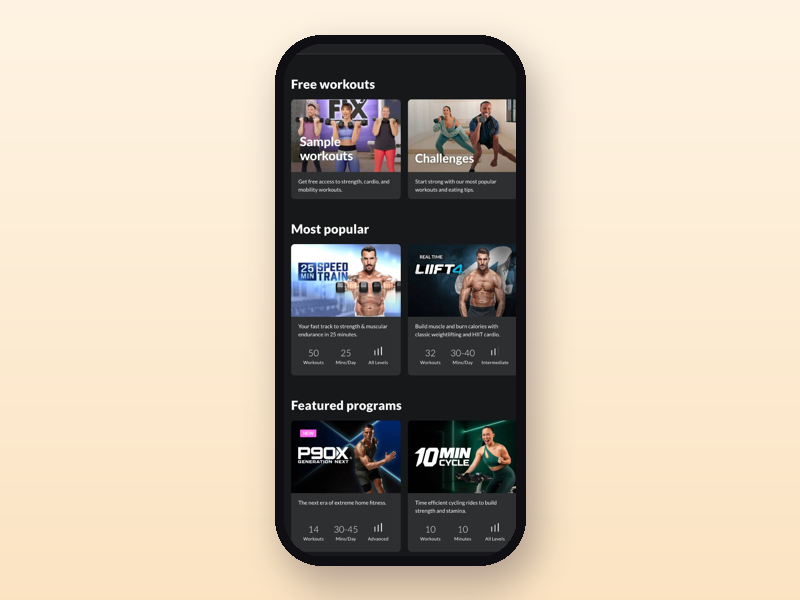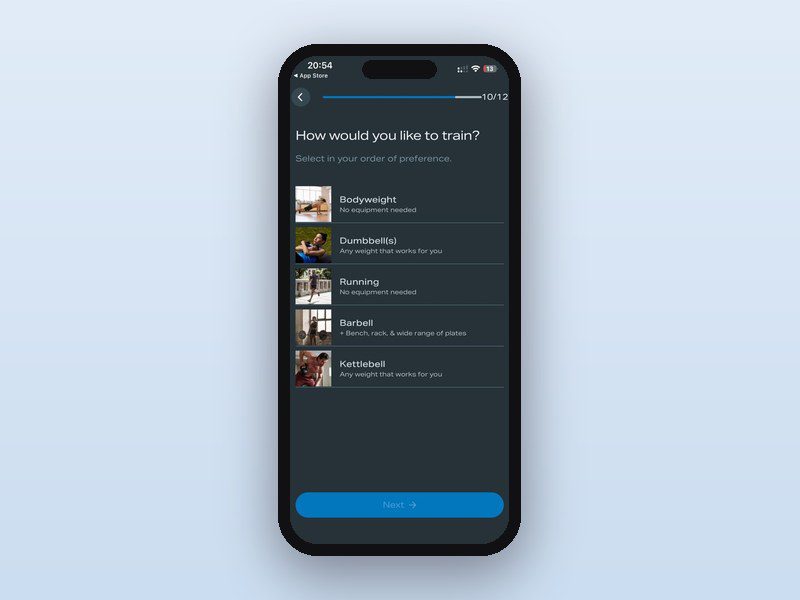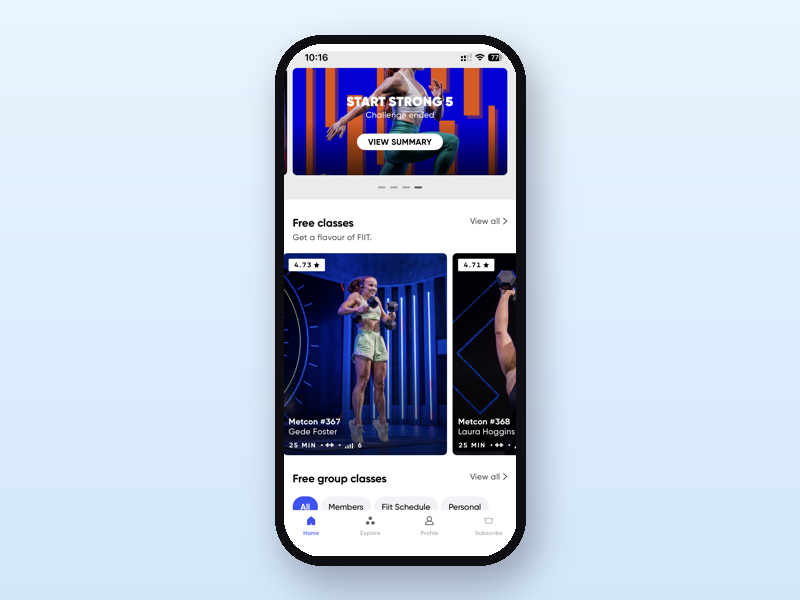
Caroline Girvan scores higher overall, 7.6 against 6.0, and is the stronger platform for building muscle and a structured programme. Sydney Cummings is the better pick if what you need most is a gentler starting point and a library that stays free.
Quick answer
- Caroline Girvan 7.6 vs Sydney Cummings 6.0
- Free on YouTube either way
- Muscle 10 vs 6
- Progressive strength 9 vs 6
- Beginner on-ramp 5 vs 3, Sydney Cummings
- Menopause programming 1 vs 1
Caroline Girvan is the stronger platform for a woman over 40 who already trains, and the reason is that her workouts are written to get heavier. She wins Muscle Potential 10 against 6, Programme Structure 9.5 against 7, Recovery Compatibility 7.5 against 6 and Value for Money 9.5 against 9. Progressive strength capability reaches 9 out of 10 against her 6, bone loading 8 against 5, and expert credibility 7 against 3.
Sydney Cummings is the easier place to begin, and on the midlife capability rows she actually wins more of them. She takes five of the twelve against three, including low-impact 5 out of 10 against 3, recovery and deload 5 against 4, beginner on-ramp 5 against 3 and midlife nutrition 3 against 1. She also wins Nutrition Integration 5 against 4. Nothing here costs anything, and a new full-length workout appears most days.
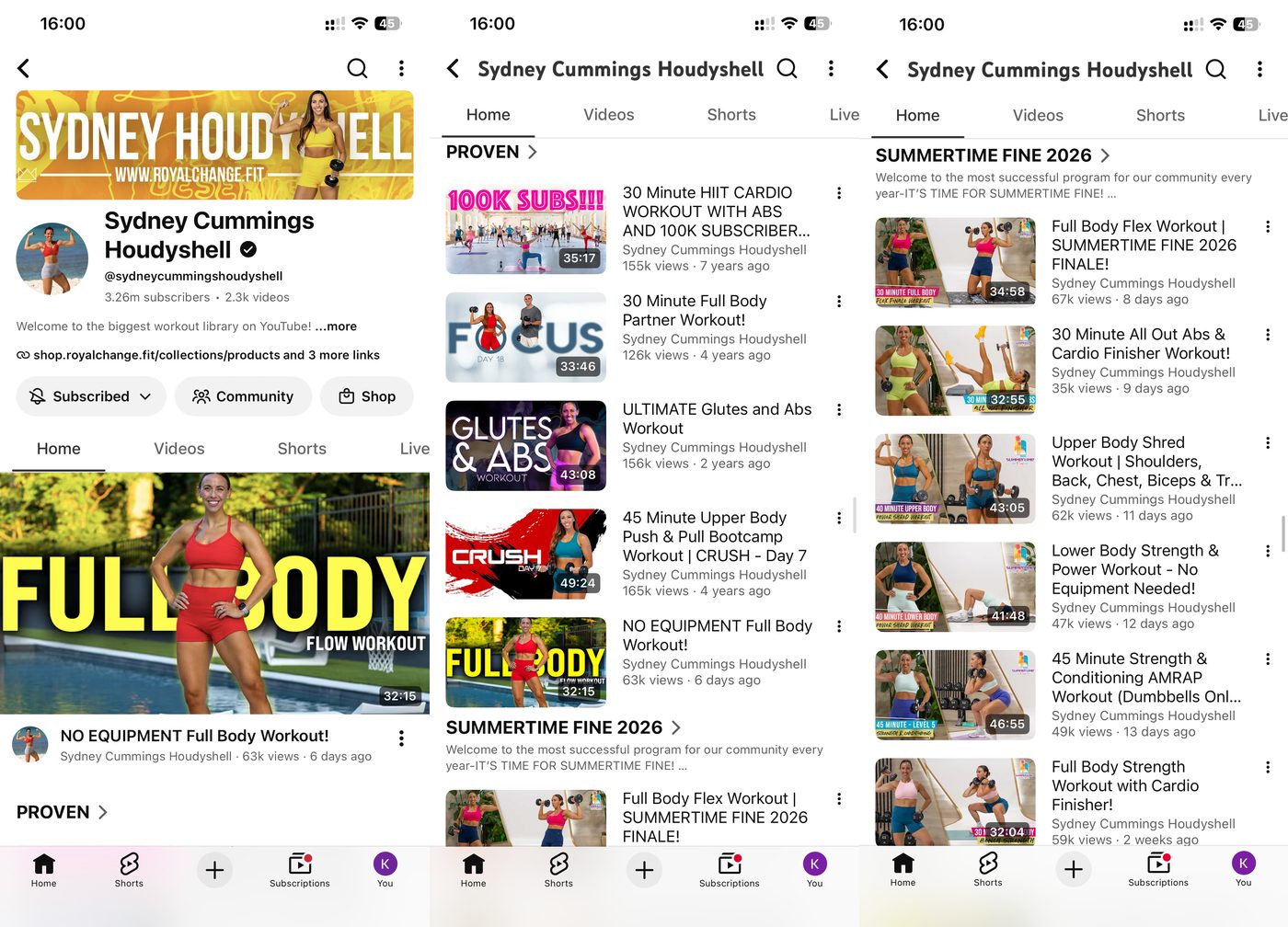
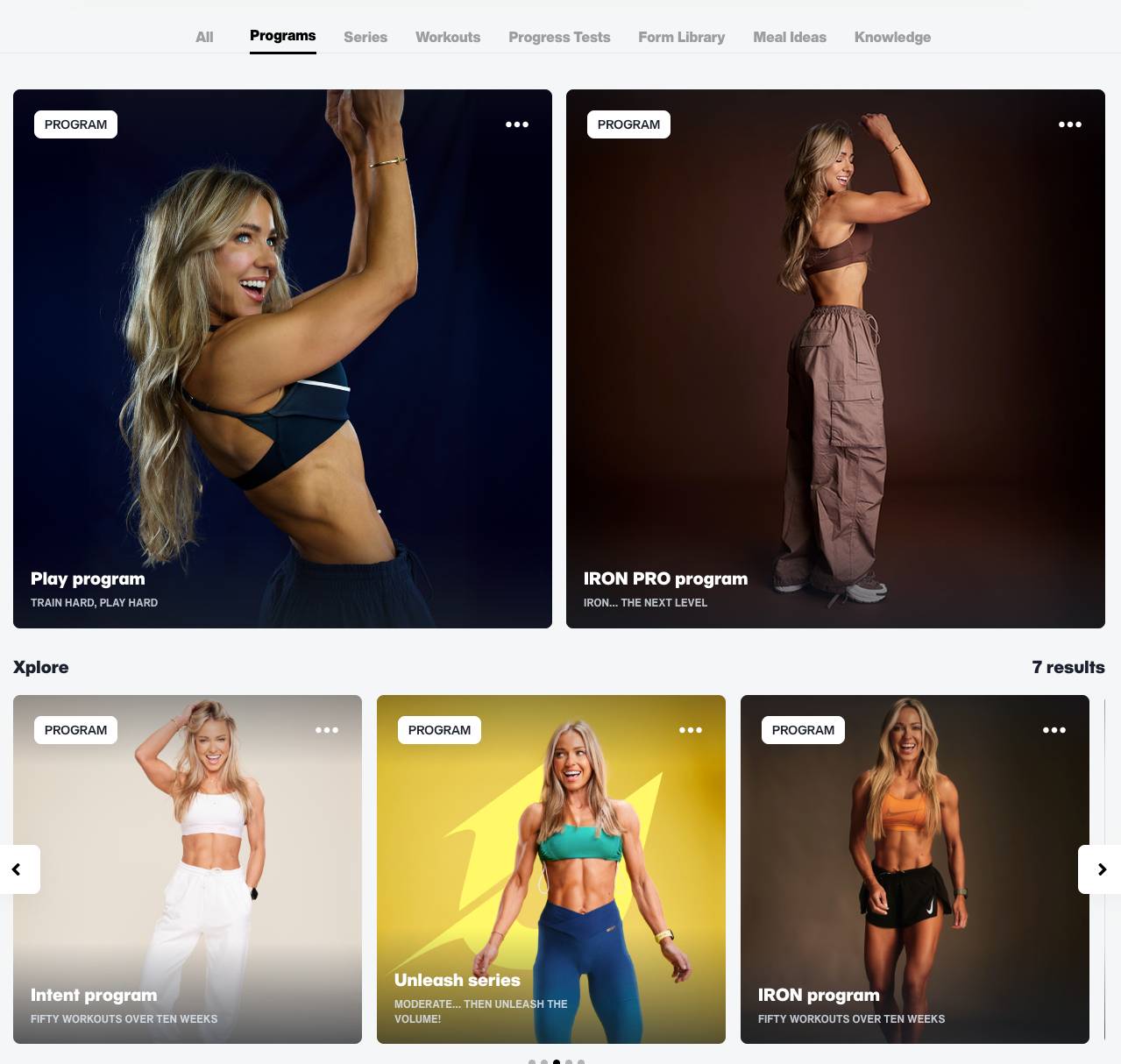
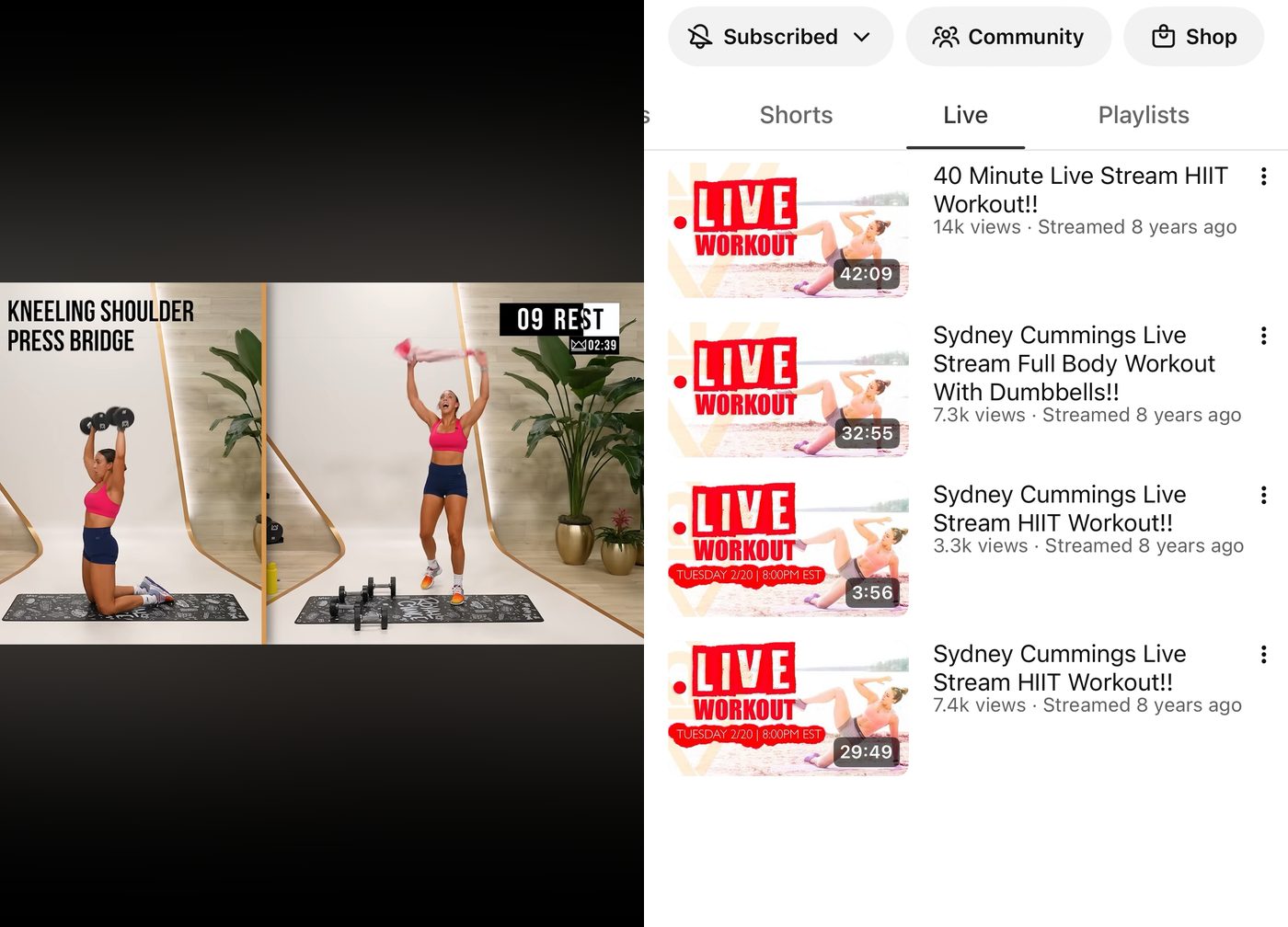
These two were not assessed to the same depth, and the gap is unusually wide. Caroline Girvan is the most heavily tested platform on this site: three years of returning to her programmes, on and off, with several completed. Sydney Cummings is a research-based data profile. No workout of hers was completed, and the assessment rests on the public YouTube channel, her published credentials, independent coverage and the exercise science. The screenshots on her review are taken from that public channel. So every Sydney Cummings score on this page describes what the library contains, not how it felt to train with, and we say so again in the sections where that limit bites.
Caroline Girvan if you want a programme that gets heavier and you can find 35 to 50 minutes five days a week. Sydney Cummings if you want a new workout waiting most mornings, a gentler default and no commitment at all. Both are free enough to try this week, and neither programmes a single thing for perimenopause or menopause, so if that is what you came for, look elsewhere first.
Sydney Cummings vs Caroline Girvan: the two platforms
Two trainers who built enormous free libraries on YouTube, and then took opposite decisions about what to do next.

Sydney Cummings
Runner-up
More than two thousand free, full-length, follow-along workouts on YouTube, mostly dumbbell strength and conditioning circuits, organised into monthly themed calendars.
- 30 to 45 min
- Value 9
- Beginner on-ramp 5/10
- Free
- Not tested
Choose Sydney Cummings if you:
- Want a new full-length workout most days
- Are rebuilding a habit rather than chasing a peak
- Want no-equipment and stretch days in the same place
- Would rather follow a monthly calendar than a programme
- Do not want to pay anything at all
Caroline Girvan
Winner
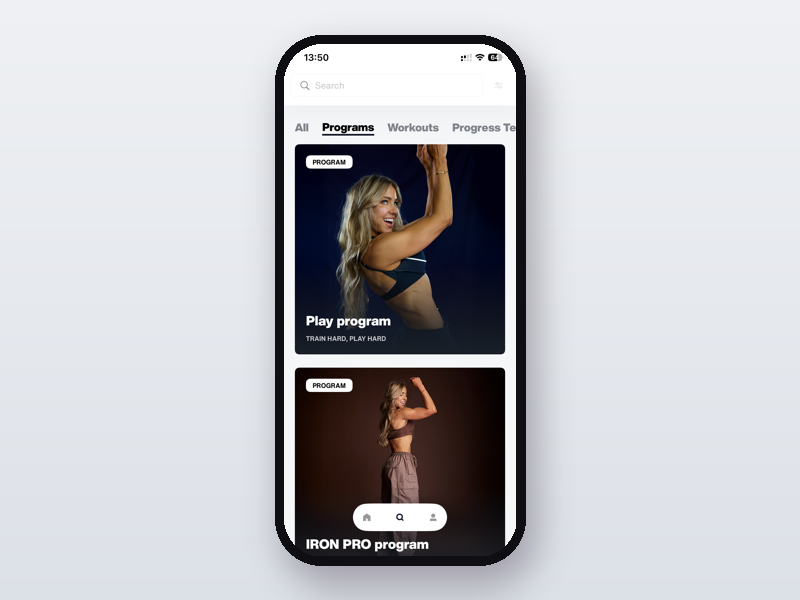
Sixteen structured dumbbell strength programmes in the CGX app, five sessions a week built on progressive overload, plus a free archive of more than 600 YouTube workouts.
- 35 to 50 min
- Muscle 10
- Progressive strength 9/10
- 14-day trial
- Fully tested
Choose Caroline Girvan if you:
- Already have a training base
- Want the weights to climb week on week
- Can commit five sessions a week
- Want lower-body work that actually shows
- Prefer a block with a beginning and an end
How we scored this, and why one column is weaker evidence
Both were scored on the same nine weighted criteria and the same twelve capability scores. Muscle Potential carries 18%, Time Efficiency 15%, Joint Friendliness and Programme Structure 12% each, Women Over 40 Specificity and Recovery Compatibility 10%, Value for Money and UX and Design 8%, and Nutrition Integration 7%.
Same tester, and the depth is lopsided. Katy is a woman in her early 40s, perimenopausal, working full-time with children, with a previous meniscus injury. On Caroline Girvan she has been training with the programmes for about three years, on and off, and keeps returning, completing the CGX Iron programme, Unleash and Max in the app after the Iron Series, EPIC Heat and EPIC Endgame on YouTube.
Sydney Cummings was not used. No workout of hers was completed, so her column is built from the public channel and its monthly calendars, her published credentials, press coverage, independent roundups and peer-reviewed science. That is a legitimate way to describe a library, and it is not the same evidence as having trained on it.
The consequence is specific. Where a criterion depends on what a session feels like at week three, the Caroline Girvan number carries years behind it and the Sydney Cummings number carries a description. Where a criterion depends on what exists, price, library size, whether pelvic-floor work is anywhere in the product, the two columns are on level ground. We flag the difference in the sections where it changes how much the number is worth.
Muscle and bone: Caroline Girvan wins, and it is the widest gap on the page
Caroline Girvan wins Muscle Potential, 10 against 6, with progressive strength capability at 9 out of 10 against 6, and bone loading at 8 against 5. Muscle Potential carries the heaviest weight in our model at 18%, so this single row does most of the work in the overall result.
The mechanism is not complicated. CGX programmes are written as blocks: five strength sessions a week, rotating lower body, upper body and full body, with the expectation that the dumbbells get heavier as the block goes on. That is progressive overload applied consistently, and it is what separates a strength programme from a collection of hard workouts. In testing, three years of returning to it produced visible change, particularly across the legs and glutes, alongside a shift from 141 lb to 134 lb while eating normally with no calorie counting and no elimination diet.
Sydney Cummings has a genuine dumbbell strength focus and a bench in most sessions, and the intent across a themed monthly block is progressive. What it is not is individualised periodisation, and a large share of the library is conditioning: circuits, HIIT, glutes and abs, cardio. Circuits build work capacity. They do not reliably build load, and load is the thing that matters here.
The evidence is specific about that distinction. Wang and colleagues found in a network meta-analysis that at least moderate-intensity resistance training was needed to improve bone density, with low-intensity loading no better than control.4 Maltais and colleagues documented the accelerated loss of muscle mass and strength through the menopause transition, which is the problem the loading is meant to solve.3 Both libraries can get you there. Only one of them is organised around making sure you do.
Our best workouts to build muscle after 50 ranking covers the platforms that treat progression as the product.
Structure: Caroline Girvan wins, and the difference is a block against a calendar
Caroline Girvan wins Programme Structure, 9.5 against 7, and this is the second-largest contributor to her lead.
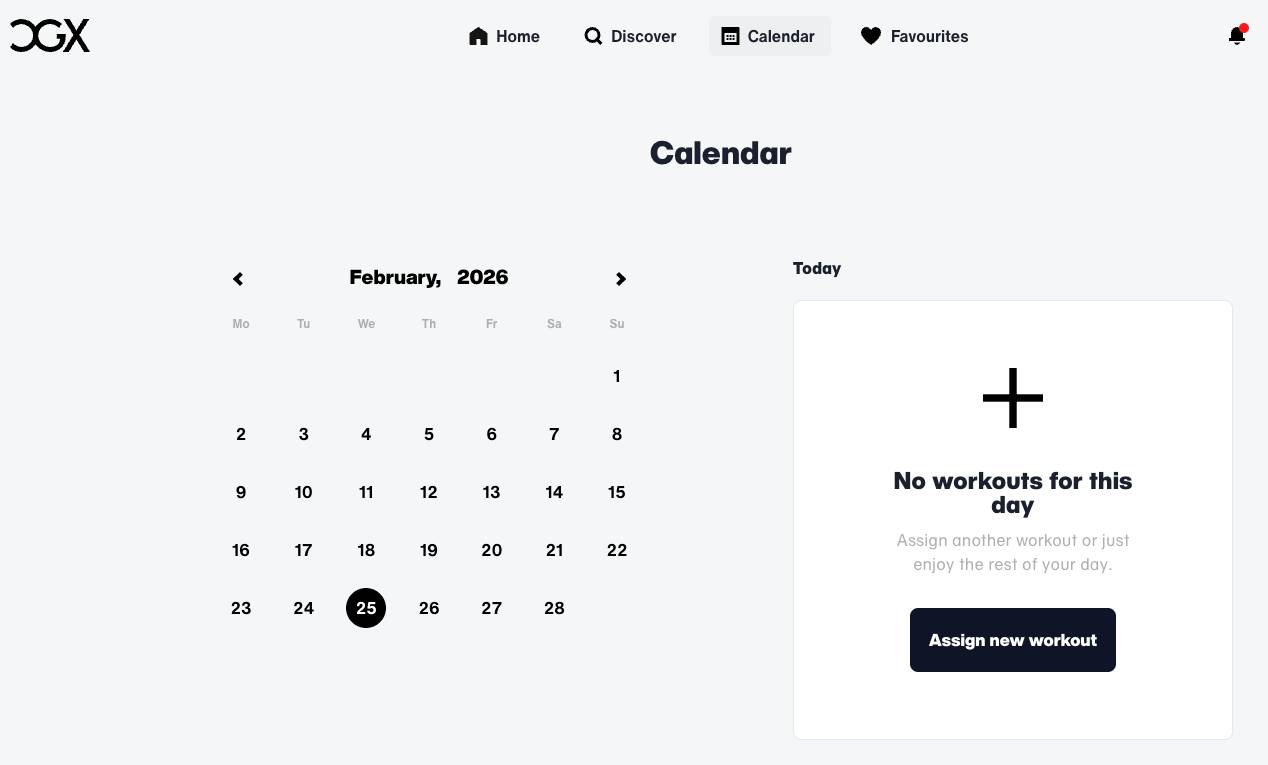
CGX carries sixteen structured programmes and series, all exclusive to the app, each with a defined length, a stated level and a sequence that goes somewhere. Every programme and standalone workout is labelled beginner, intermediate or advanced, which sounds obvious and is not: it removes the guesswork about where you are starting and where you are heading. Most sessions end with a finisher, four to six minutes of higher-intensity work on the muscles you have just trained, and the programmes assume five sessions a week with one optional HIIT or cardio day that can be swapped for a long walk.
Sydney Cummings organises rather than programmes. The monthly themed calendars, PROVEN or Summertime Fine among them, sequence the sessions and give real shape to a free resource, and they are the right way to use the channel. The limitation is that the calendar is a schedule rather than a progression: it tells you which video to open, not which weight to reach for. The library is also vast enough that without a calendar it can feel shapeless.
The trade-off is that structure has a cost. Five sessions a week at 35 to 50 minutes is a real commitment, and the review is direct about it: the session length is the one real constraint, and finding that window five days a week takes planning around work and family.
Value for money: Caroline Girvan wins, and both scores are unusually high
Caroline Girvan wins, 9.5 against 9, and these are two of the strongest Value for Money scores in our comparison set, because both give away more than most platforms sell.
| Plan | Sydney Cummings | Caroline Girvan |
|---|---|---|
| Free library | More than two thousand workouts, still growing most days | More than 600 workouts, complete but no longer added to |
| Monthly paid | Sydney Squad about $29.99 a month | CGX $12.99 a month |
| First month offer | Often about $9.99 | No reduced first month, a 14-day free trial instead |
| Annual | About $359.88 a year | $99.99 a year, about $8.33 a month |
| What the money buys | Community, weekly live sessions, calendars, meal plans, challenges | Sixteen structured programmes, new weekly workouts, recipes and articles |
| Terms | Auto-renews and is non-refundable | The trial requires a payment method upfront |
Sydney Cummings has the better free proposition by a distance, because the workouts themselves are the free product and there is no ceiling on it. Her paid tier is the odd one out: it sits well above a typical single-creator app, it adds community and accountability rather than training, and it auto-renews without refunds, so it is worth confirming the current terms on the live Royal Change page before subscribing.
Caroline Girvan has the better paid proposition, and it is not close. About $8.33 a month on the annual plan buys structured programming that most subscriptions do not attempt, and the free archive of more than 600 workouts is large enough to train on for a year before you decide. That combination, a free way to find out and a cheap way to continue, is the reason her Value for Money score is where it is. Our best free and budget workout apps ranking covers the wider free field.
Joint friendliness: Sydney Cummings edges it, and neither is a low-impact platform
Sydney Cummings takes the low-impact row, 5 out of 10 against 3, while losing Joint Friendliness itself, 6 against 7, which is worth unpicking because those two facts look contradictory and are not.
Sydney Cummings offers more ways out. Her calendars carry stretch, mobility and recovery days, plenty of sessions have no-equipment versions, modifications are shown, and the higher-impact content sits in clearly labelled HIIT sessions you can skip without leaving the channel. That is why the low-impact capability is higher.
Caroline Girvan scores higher on the criterion because heavy, controlled dumbbell work under a coach who cues technique is not the same thing as jumping, and building the muscle around a joint is protective in itself. What pulls against that is volume: high-repetition loaded work five days a week, with sessions that regularly run 45 to 60 minutes, is a lot of cumulative load. Her own review sets the boundary plainly, saying that for women new to training at this life stage, or managing joint problems, the intensity will be overwhelming.
Our best low-impact workouts for women over 50 ranking covers the field neither of these belongs to.
Recovery: Caroline Girvan wins the criterion, Sydney Cummings wins the deload row
Caroline Girvan wins Recovery Compatibility, 7.5 against 6, while recovery and deload capability runs the other way, 5 out of 10 to Sydney Cummings against 4.
The split is real. CGX rotates muscle groups across the week, lower body, upper body, full body, so you are not hammering the same tissue on consecutive days, and the library carries shorter sessions and stretching content to fill a week that has gone wrong. That is thoughtful design. What it does not include is a programmed deload, and her own account after three years is unusually candid: she cannot say with certainty whether what she experienced was appropriate training stress or whether she was overloading herself, which is exactly the kind of ambiguity a deload week is supposed to remove.
Sydney Cummings puts stretch, mobility and recovery days inside the monthly calendars, so a lighter day arrives on schedule rather than by decision. There is no menopause-specific deload structure either, and the pace across the strength and conditioning sessions is brisk.
The practical version for a perimenopausal week: on both, replacing a session with a walk when sleep has been poor is smart programming rather than failure, and neither platform will make that call for you. Our low-cortisol workouts for perimenopause guide covers the platforms that do.
Perimenopause and menopause fit: neither, and the tie is at the floor
Caroline Girvan edges Women Over 40 Specificity, 3.7 against 3.5, and all four menopause capabilities tie at 1 out of 10: programming, education, hormone awareness and pelvic floor.
That is as low as this section goes on our site, and it is not an oversight in the scoring. Neither of these is a menopause product and neither claims to be. There is no symptom guidance, no cycle or phase adaptation, no education strand and no pelvic-floor work in either library.
What separates the two by a fraction is the type of training rather than any midlife content. Heavy progressive loading is the modality the research keeps pointing to for a midlife body, and Caroline Girvan supplies more of it. Her programmes also permit the one optional weekly HIIT session to be swapped for a long walk, which happens to be a sensible adaptation for a perimenopausal week even though it was written as a scheduling note rather than as menopause programming.
Pelvic floor
A tie at 1 out of 10, and neither library contains a single session for it. Caroline Girvan’s heavy compound lower-body work, deadlifts, squats, split squats and hip thrusts, involves loading that some women will want guidance on before starting. Sydney Cummings has no pelvic-floor content either, and her library carries more no-equipment and lower-intensity alternatives to fall back on. Neither trainer offers a way to work on this, which is the whole finding.
Expert credibility
Caroline Girvan wins, 7 out of 10 against 3, and the gap is larger than the credentials alone suggest. Sydney Cummings Houdyshell holds real, relevant qualifications: NASM Certified Personal Trainer, NASM Fitness Nutrition Specialist, Women’s Fitness Specialist and stretching and mobility coach, and she was a Division I high-jumper at West Virginia University. She is Charlotte-based and runs the business, Royal Change, with her husband Dustin Houdyshell. What she does not have, and what her own profile is careful to say, is clinical or registered-dietitian standing, so hormone and medical questions belong somewhere else. Caroline Girvan scores higher on the strength of the programming record and the results it demonstrably produces, and she has no clinical or menopause credential either.
Time efficiency: Caroline Girvan wins, narrowly, and neither is quick
Caroline Girvan wins Time Efficiency, 7 against 6, and both numbers are held down by the same thing: these are full-length sessions.
Sydney Cummings runs 30 to 45 minutes for a typical full-length workout, with shorter options available if you go looking. Caroline Girvan lands between 35 and 50 minutes with the optional warm-up, and the Iron programme is the exception at about 30 minutes, which is part of why it is the recommended entry point to the app.
The reason Caroline Girvan edges it is that the time is programmed rather than browsed: you know what today is before you open anything. On a day when only 20 minutes exists, the advice from the review is to take a shorter standalone workout rather than skip, and if 20 minutes is genuinely all most days hold, a structured five-day block will be hard to follow. Our 20-minute workouts for perimenopause and 30-minute workouts for women over 40 guides cover the platforms built for that constraint.
UX and design: Caroline Girvan wins, and both have a YouTube problem
Caroline Girvan wins UX and Design, 7 against 6, because she has an actual product and Sydney Cummings has a channel.
The CGX app is available worldwide with no signup restrictions and prices in local currency, and the level labelling and personal calendar make it easy to lay a block across a week. The frustrations are specific rather than general: the app can crash if you switch to another app mid-session, Chromecast is imperfect on some Android setups, and the free YouTube archive is not integrated, so you go to YouTube separately for those programmes. Casting to a television on Android remains the main friction point, and the app has improved a good deal since it launched in 2023.
Sydney Cummings on YouTube runs on anything with a screen and casts easily, which is a real strength, and offline viewing needs YouTube Premium. What you give up is any structure the platform provides for you: navigation, tracking and progress are do-it-yourself across playlists and calendars. Her paid tier is a web member area and an online community rather than a dedicated app, which is why the UX and Design number stays where it is.
Nutrition: Sydney Cummings wins, and it is the only criterion she takes
Sydney Cummings wins Nutrition Integration, 5 against 4, with midlife nutrition capability 3 out of 10 against 1.
Her advantage is the paid tier: the Sydney Squad membership includes meal plans, and she holds a NASM Fitness Nutrition Specialist qualification, so the guidance is trainer-level and real. The free tier, which is what almost everyone will actually use, has very little nutrition in it, and there is no registered dietitian involved.
CGX includes meal ideas and recipes from Caroline Girvan, simple and budget-friendly, designed to support training rather than to replace a diet plan, alongside evidence-based articles on nutrition, recovery and fitness. That guidance has not been followed here yet, so we cannot tell you whether it works, only that it exists and reads as sensible rather than restrictive. Nutrition Integration carries the smallest weight in our model at 7%, so this criterion barely moves either total.
Equipment and space needed at home
Nearly identical, and the shopping list is short.
Caroline Girvan’s programmes have been completed with 10 lb, 15 lb and 20 lb dumbbells, a mat and a resistance and stretch band, which is genuinely all you need to start. For the more advanced programmes a heavier pair, roughly 25 to 35 lb per hand, becomes useful, and you do not need it to begin.
Sydney Cummings leans on dumbbells too, and uses a bench frequently, so a bench is worth adding if you want to follow along fully. Many of her workouts have no-equipment versions, which is a real advantage if you are starting with nothing.
On both, the purchase that changes what you get is an adjustable or laddered set of dumbbells rather than a single light pair, because you cannot add load you do not own. A mat makes the floor and stretch work bearable. Neither requires subscription hardware, a machine or a dedicated room.
Starting from scratch: Sydney Cummings, with conditions
Sydney Cummings wins beginner on-ramp, 5 out of 10 against 3, and neither of these is where a complete beginner should start.
Her library shows modifications, offers no-equipment options and includes shorter sessions, and the default pace still reflects a former Division I athlete, so a nervous beginner will need to use those modifications rather than match the video. The size of the library is its own obstacle, which is exactly what the monthly calendars exist to solve.
Caroline Girvan is harder still, and her verdict on the difficulty is not softened. The movements themselves are straightforward, and what makes the sessions demanding is being taken out of your comfort zone consistently. By the end of a leg day you may be shaking, and the day after a heavy lower-body session, walking downstairs is a genuine event. The app does carry a dedicated Ultimate Beginner programme, six weeks of 30 to 40-minute sessions building the foundational patterns, and skipping it to go straight into Iron or Unleash is the most common way people get hurt or quit.
Adherence is what actually decides this. Sá and colleagues rate the certainty of the resistance-training evidence in postmenopausal women as very low to low even while reporting apparent benefit,1 which is a reminder that the programme you keep doing beats the programme that looks better on paper.
Sydney Cummings pros and cons
Sydney Cummings scores 6.0. It is strongest on value for money and weakest on suitability for women over 40.
Pros
- Free, permanently, with more than two thousand full-length workouts and a new one most days.
- Nutrition Integration 5 against 4 and midlife nutrition 3 out of 10 against 1.
- Beginner on-ramp 5 against 3, low-impact 5 against 3, recovery and deload 5 against 4, mind-body support 4 against 3.
- Monthly calendars that give structure at no cost.
- Real credentials: NASM Certified Personal Trainer, NASM Fitness Nutrition Specialist and Women’s Fitness Specialist.
- No-equipment options throughout.
Cons
- Muscle Potential 6 against 10, with progressive strength 6 out of 10 against 9 and bone loading 5 against 8.
- Programme Structure 7 against 9.5: a calendar rather than a progression.
- Expert credibility 3 against 7.
- UX and Design 6 against 7, with tracking left entirely to you.
- A paid tier priced well above a typical creator app that auto-renews without refunds.
- And nobody here has completed one of her workouts.
Caroline Girvan pros and cons
Caroline Girvan scores 7.6. It leads on building and keeping muscle and trails on suitability for women over 40.
Pros
- Muscle Potential 10 against 6, the highest we have published, on programmes written around progressive overload.
- Programme Structure 9.5 against 7, across sixteen structured blocks with clear level labelling.
- Value for Money 9.5 against 9, at about $8.33 a month annually plus a free archive of more than 600 workouts.
- Bone loading 8 out of 10 against 5 and expert credibility 7 against 3.
- Three years of testing behind the column.
Cons
- Nutrition Integration 4 against 5, with midlife nutrition 1 out of 10.
- Beginner on-ramp 3 against 5 and low-impact 3 against 5.
- Five sessions a week at 35 to 50 minutes is a large ask.
- No programmed deload.
- Nothing for pelvic floor, hormones or menopause.
- The app can crash if you switch apps mid-session, and casting to a television on Android is still awkward.
Quick yes/no comparison
| Feature | Sydney Cummings | Caroline Girvan |
|---|---|---|
| A large free library | Yes, more than two thousand workouts | Yes, more than 600 workouts |
| Still adding new free workouts | Yes, most days | No, posting stopped in October 2022 |
| A paid app | No, a web member area and community | Yes, CGX |
| Free trial of the paid tier | Not assessed | Yes, 14 days with a payment method upfront |
| Structured multi-week programmes | Monthly calendars rather than programmes | Yes, sixteen of them |
| Explicit progressive overload | General progression across themed blocks | Yes, that is the design |
| Level labelling on every workout | Not assessed | Yes |
| No-equipment options | Yes, throughout | Limited, dumbbells are assumed |
| Menopause or perimenopause programming | No | No |
| Pelvic floor content | No | No |
| Nutrition guidance | Meal plans in the paid tier | Recipes and articles in the app |
| Programmed deload weeks | No | No |
| Works on a television | Yes, casts from YouTube | Yes, with friction on Android |
| Was it used hands-on | No, research-based only | Yes, across three years |
Sydney Cummings vs Caroline Girvan at a glance
| Sydney Cummings | Caroline Girvan | |
|---|---|---|
| Overall score | 6.0 | 7.6 |
| How it was assessed | Data profile, research-based. No workout was completed, the library was assessed from the public channel | Fully tested over three years, multiple CGX programmes completed |
| Cost | Free, with an optional membership about $29.99 a month or $359.88 a year | $12.99 a month or $99.99 a year, about $8.33 a month |
| Trial | Nothing to trial, the library is free | 14-day free trial, payment method required upfront |
| Session length | Often 30 to 45 minutes, with shorter options | 35 to 50 minutes with the optional warm-up, Iron about 30 |
| Approach | A daily free library of dumbbell strength and conditioning, in monthly calendars | Sixteen structured dumbbell strength programmes across five days a week |
| Impact by default | Mixed, with clearly labelled HIIT you can skip | Low-impact movements at high volume and heavy load |
| Who is behind it | Sydney Cummings Houdyshell, NASM certified, former Division I high-jumper | Caroline Girvan, who launched CGX in April 2023 |
| Menopause content | None | None |
| Equipment | Dumbbells and a bench, with no-equipment options | 10 lb, 15 lb and 20 lb dumbbells, a mat and a band |
| Known live issue | A vast library that feels shapeless without a calendar; a paid tier that auto-renews | Crashes when switching apps mid-session, and awkward casting on Android |
| How we assessed it | Research-based, no workout completed | Fully tested across three years, several programmes completed |
Sydney Cummings vs Caroline Girvan: the full scoring breakdown
Caroline girvan wins eight of the nine weighted criteria and sydney cummings wins one. The one that goes the other way is Nutrition Integration, the lightest criterion in the model, and the closest of the rest is Value for Money.
| Criterion | Weight | Sydney Cummings | Caroline Girvan | Winner |
|---|---|---|---|---|
| Muscle Potential | 18% | 6 | 10 | Caroline Girvan |
| Time Efficiency | 15% | 6 | 7 | Caroline Girvan |
| Joint Friendliness | 12% | 6 | 7 | Caroline Girvan |
| Programme Structure | 12% | 7 | 9.5 | Caroline Girvan |
| Women Over 40 Specificity | 10% | 3.5 | 3.7 | Caroline Girvan |
| Recovery Compatibility | 10% | 6 | 7.5 | Caroline Girvan |
| Value for Money | 8% | 9 | 9.5 | Caroline Girvan |
| UX and Design | 8% | 6 | 7 | Caroline Girvan |
| Nutrition Integration | 7% | 5 | 4 | Sydney Cummings |
| Overall | 100% | 6.0 | 7.6 | Caroline Girvan |
The twelve capability scores
Sydney cummings wins five of the twelve capability scores and caroline girvan wins three, with four tied. That reversal is the most useful thing on the page: Caroline Girvan wins the two rows that decide the overall result, progressive strength 9 out of 10 against 6 and bone loading 8 against 5, while Sydney Cummings quietly takes the rows about being able to keep going. All four menopause rows tie at 1 out of 10.
| Capability | Sydney Cummings | Caroline Girvan | Winner |
|---|---|---|---|
| Low-impact | 5 | 3 | Sydney Cummings |
| Progressive strength | 6 | 9 | Caroline Girvan |
| Bone loading | 5 | 8 | Caroline Girvan |
| Recovery & deload | 5 | 4 | Sydney Cummings |
| Menopause programming | 1 | 1 | Tied |
| Pelvic floor | 1 | 1 | Tied |
| Hormone awareness | 1 | 1 | Tied |
| Menopause education | 1 | 1 | Tied |
| Expert credibility | 3 | 7 | Caroline Girvan |
| Mind-body support | 4 | 3 | Sydney Cummings |
| Beginner on-ramp | 5 | 3 | Sydney Cummings |
| Midlife nutrition | 3 | 1 | Sydney Cummings |
Who wins for…
Who wins for building muscle
Caroline Girvan, decisively. Muscle Potential 10 against 6, on programmes designed to get heavier.
Who wins for bone density
Caroline Girvan. Bone loading 8 out of 10 against 5, and the intensity is what the evidence asks for.4
Who wins on price
Sydney Cummings for free, Caroline Girvan for paid. One never charges; the other charges about $8.33 a month annually.
Who wins for a complete beginner
Sydney Cummings. Beginner on-ramp 5 out of 10 against 3, with modifications and no-equipment options throughout.
Who wins for being told what to do
Caroline Girvan. Programme Structure 9.5 against 7: a block with a start and an end, not a schedule.
Who wins for a joint that complains
Sydney Cummings, on the low-impact row. 5 out of 10 against 3, with stretch and no-equipment days built into the calendars.
Who wins for perimenopause and menopause
Neither. Programming, education, hormone awareness and pelvic floor all tie at 1 out of 10.
Who wins for lower-body results
Caroline Girvan. Heavy compound lower-body work plus isolation finishers is what the three years of testing points to.
Who wins for a week that keeps collapsing
Sydney Cummings. A new workout most days and no programme to fall behind on.
Who wins for nutrition
Sydney Cummings, barely. 5 against 4, and the meal plans sit behind the paid tier.
Who wins for tracking and progress
Caroline Girvan. UX and Design 7 against 6, with a personal calendar instead of playlists.
Who wins on evidence
Caroline Girvan, because we have trained on it. Sydney Cummings is research-based throughout.
Decision tree for women over 40
You want visible change and you already train. Caroline Girvan, on a structured block, and buy a heavier pair of dumbbells before you start.
You are rebuilding a habit after months off. Sydney Cummings, on the current monthly calendar, and treat the HIIT days as optional.
You will not pay anything. Either. Both free libraries are large enough to train on for a year.
You need to be told exactly what to do. Caroline Girvan. This is what the app is for.
A joint sets the terms. Neither of them, and Sydney Cummings at least gives you more ways to work around it.
You have 20 minutes on most days. Sydney Cummings, on the shorter sessions, because a five-day block will not survive that week.
Perimenopause is why you are looking. Neither. Every menopause capability ties at 1 out of 10.
You want lower-body work that shows. Caroline Girvan, and give it a full block rather than a fortnight.
What we did not test
One column has years behind it and the other has none, which is the largest evidence gap on this page.
No Sydney Cummings workout was completed. The monthly themed calendars were not followed, the paid Sydney Squad membership was not bought, and the live sessions and meal plans inside it were not seen. Everything here about how her training feels comes from the research basis set out at the top, and her scores should be read as a description of the library rather than a verdict on the experience.
On Caroline Girvan the gaps are narrower and worth naming. The CGX nutrition guidance, the Ultimate Beginner programme, Iron Pro and the P.E. programme all sit outside what was completed. Three years of Iron, Unleash, Max and the earlier YouTube series tell you a great deal about how the programming behaves over time. They do not tell you how the app handles someone starting from nothing.
Neither platform’s handling of an injury or a symptom flare was assessed, and nothing on this page should be read as a claim about what will happen in your body.
Which is better for women over 50?
Caroline Girvan, only with a base
The loading is exactly what the evidence points to for muscle and bone after 50, and the demand is exactly what makes it the wrong first step. Her review draws the line clearly: for women who are already strong and experienced this is excellent, and for women new to training at this stage, or managing joint problems, hormonal fatigue or recovery concerns, the intensity will be overwhelming. The free YouTube archive lets you test the style before paying, which is worth doing.
Sydney Cummings, as the on-ramp
A free library with shown modifications, no-equipment options and scheduled stretch days is a better place to rebuild from, and the strength focus still points in the right direction. Cai and colleagues found that high-intensity interval training significantly improved cardiorespiratory fitness in middle-aged and older women,5 which is a fair defence of the HIIT sessions in her calendars for anyone who wants them. Our best workouts for postmenopause ranking covers the wider field.
What we would actually suggest
Spend a month on a Sydney Cummings calendar, keep the dumbbell days and skip whatever feels like too much, then move to a Caroline Girvan block when five sessions a week looks realistic. Both steps are free, so the only thing you risk is the time.
Frequently asked questions
Is Sydney Cummings or Caroline Girvan better for women over 40?
Caroline Girvan, 7.6 against 6.0, and the gap is built almost entirely on load. She wins Muscle Potential 10 against 6, which is the heaviest criterion in our model, Programme Structure 9.5 against 7 and Value for Money 9.5 against 9. Progressive strength capability is 9 out of 10 against 6 and bone loading is 8 against 5. Sydney Cummings wins Nutrition Integration 5 against 4 and takes five of the twelve capability rows, including beginner on-ramp 5 out of 10 against 3. Neither has any menopause programming.
Are both of them genuinely free?
Both have a large free library on YouTube, and only one of them is still adding to it. Sydney Cummings posts a new full-length workout most days and the whole library, more than two thousand sessions, is free, with an optional Sydney Squad membership at about $29.99 a month, often about $9.99 for a first month, or about $359.88 a year. Caroline Girvan stopped posting to YouTube in October 2022 after more than 600 free workouts, all of which are still up, and everything new since then sits in the CGX app at $12.99 a month or $99.99 a year, about $8.33 a month on the annual plan, behind a 14-day free trial that asks for a payment method upfront.
Which one builds more muscle?
Caroline Girvan, 10 against 6, and it is the highest Muscle Potential we have published for any platform. The reason is that her programmes are written as progressive strength blocks with dumbbells across five sessions a week, so the load is meant to climb. Sá and colleagues found in a systematic review and meta-analysis apparent improvements in postmenopausal symptoms and functional capacity from resistance training, while rating the certainty of that evidence very low to low.1 Sydney Cummings has a real dumbbell strength focus too, and her sessions are circuits and conditioning as much as strength, which is why progressive strength sits at 6 out of 10 against 9.
Which is better for bone density?
Caroline Girvan, on bone loading 8 out of 10 against 5, and the difference is intensity rather than movement choice. Wang and colleagues found in a network meta-analysis that at least moderate-intensity resistance training was needed to improve bone density, and that low-intensity loading was not superior to control.4 Watson and colleagues reached the same conclusion from the other direction in the LIFTMOR trial, where heavier resistance and impact training improved bone density and physical function in postmenopausal women.2 Programmes that push weight upward week on week fit that description better than conditioning circuits do.
Which suits a beginner better?
Sydney Cummings, on a beginner on-ramp of 5 out of 10 against 3, and neither is a soft landing. Her library carries no-equipment options, shorter sessions and shown modifications, and nothing about picking one workout off YouTube commits you to anything. Caroline Girvan is demanding by design: the movements themselves are straightforward, and what makes it hard is being taken out of your comfort zone consistently, session after session. Her app does have a dedicated Ultimate Beginner programme, six weeks of 30 to 40-minute sessions, and the review is blunt that skipping it and going straight to Iron or Unleash is where people get hurt.
Which is gentler on joints?
Sydney Cummings, 6 against 7, though the margin is small and the capability rows tell it better: low-impact is 5 out of 10 against 3. Her calendars include stretch, mobility and no-equipment days, and the impact comes from the HIIT sessions you can simply skip. Caroline Girvan is high-volume dumbbell training with significant joint loading and sessions that regularly run 45 to 60 minutes, and her own review says plainly that this suits women who are already strong rather than women managing joint problems.
Does either have menopause or perimenopause content?
No, and every menopause capability ties at 1 out of 10: programming, education, hormone awareness and pelvic floor. Neither is a menopause platform, neither has a clinician attached, and neither adapts anything to a symptom or a cycle phase. The closest either comes is practical: Caroline Girvan’s programmes allow the one optional weekly HIIT or cardio session to be replaced with a long walk, which is a sensible swap in perimenopause. That is a scheduling note rather than menopause programming.
How much did you actually test each one?
Very differently, and it is the biggest caveat on this page. Caroline Girvan is the most-tested platform on this site: three years of returning to her programmes, on and off, with several CGX blocks completed in the app and the earlier free series completed before that. Sydney Cummings was not used at all. That is a research-based data profile built from the public channel, her published credentials, independent coverage and the science, so every number in her column describes what the library contains rather than how it felt to train with.
Which is better value?
Caroline Girvan, 9.5 against 9, and both scores are high because both give away a great deal. Sydney Cummings is free and stays free, which is as low as a barrier gets, and her paid tier is priced well above a typical single-creator app while adding community rather than workouts. Caroline Girvan’s free archive is large enough to train on for a year, and CGX at about $8.33 a month on the annual plan is cheaper than most paid alternatives while delivering the progression the free archive only half-organises.
How long are the workouts?
Both ask for more time than a busy week always has. Sydney Cummings runs full-length sessions that often land at 30 to 45 minutes, with shorter options in the library. Caroline Girvan’s sessions land between 35 and 50 minutes with the optional warm-up, and the Iron programme is the short one at about 30 minutes. The session length is the one real constraint on her programmes, and on a 20-minute day the sensible move is a shorter standalone workout rather than skipping altogether.
Which has better nutrition guidance?
Sydney Cummings, 5 against 4, and neither is a reason to choose. Her paid Sydney Squad membership includes meal plans at trainer level, she holds a NASM Fitness Nutrition Specialist qualification, and the free tier has very little. CGX includes meal ideas, recipes and evidence-based articles, and that guidance has not been followed here yet, so we cannot tell you how well it works. Midlife nutrition capability is 3 out of 10 against 1, and neither has a registered dietitian involved.
Which one would you actually recommend?
Caroline Girvan if you have a training base and want visible change, because the programming is the best argument on this page and the free YouTube archive lets you find out for nothing before the app charges you. Sydney Cummings if you are rebuilding a habit, want a new workout waiting most mornings, and would rather not commit to five demanding sessions a week. A reasonable route is to start on the free Sydney Cummings calendars, then move to a structured Caroline Girvan block once five days a week feels realistic.
Research citations
- Sá KMM, da Silva GR, Martins UK, et al. Resistance training for postmenopausal women: systematic review and meta-analysis. Menopause. 2023;30(1):108–116. PubMed. (Cited for: apparent improvements in postmenopausal symptoms and functional capacity with resistance training. Note: the authors rate the certainty of the evidence as very low to low, so we report it on that basis.)
- Watson SL, Weeks BK, Weis LJ, Harding AT, Horan SA, Beck BR. High-intensity resistance and impact training improves bone mineral density and physical function in postmenopausal women with osteopenia and osteoporosis: the LIFTMOR randomized controlled trial. Journal of Bone and Mineral Research. 2018;33(2):211–220. PubMed. (Cited for: heavier resistance and impact training improved bone density and physical function in postmenopausal women.)
- Maltais ML, Desroches J, Dionne IJ. Changes in muscle mass and strength after menopause. Journal of Musculoskeletal and Neuronal Interactions. 2009;9(4):186–197. PubMed. (Cited for: accelerated loss of muscle mass and strength through the menopause transition.)
- Wang Z, Li Y, Zhong Y, et al. Comparative efficacy of different resistance training protocols on bone mineral density in postmenopausal women: a systematic review and network meta-analysis. Frontiers in Physiology. 2023. PMC. (Cited for: at least moderate-intensity resistance training was needed to improve bone density, and low-intensity loading was not superior to control.)
- Cai L, et al. Effects of high-intensity interval training on cardiopulmonary fitness and physical function in middle-aged and elderly women: a systematic review and meta-analysis. Frontiers in Physiology. 2026. PMC. (Cited for: high-intensity interval training significantly improved cardiorespiratory fitness in middle-aged and older women.)
This page compares fitness platforms. It is not medical advice. Katy is a woman who has trained through perimenopause, not a clinician. Any training observations described are one person’s recorded experience, not an expected result or a general pattern. If you have a diagnosed condition, an injury, or symptoms that concern you, speak to a qualified healthcare professional before changing how you train.
About this comparison
Compiled by Katy Cole for Her Daily Fit. The two were not assessed to the same depth. Caroline Girvan has been used across three years and several completed programmes, and the methods section above sets out which. Sydney Cummings is a research-based data profile drawn from the public YouTube channel and its monthly calendars, her published credentials, press coverage, independent roundups and peer-reviewed science, with the screenshots taken from that public channel. Both were scored on the same nine weighted criteria and the same twelve capability scores, and the Sydney Cummings column describes what the library contains rather than how it performs in use. Maltais and colleagues are the reason Muscle Potential carries the heaviest weight in that model.3 Prices were verified against official sources in 2026 and may differ if there has been a recent change; the Sydney Squad membership in particular auto-renews and is non-refundable, so confirm the current figure before subscribing. Scores are pulled live from each programme’s own assessment. Her Daily Fit earns nothing from either.
Compared with