Pure Barre scores higher overall, 6.6 against 5.3, and is the stronger platform for joint-friendly training and recovery. F45 is the better pick if what you need most is bone-loading impact and a team to train with.
Quick answer
- Pure Barre 6.6 vs F45 5.3
- $19.99 a month at home vs about $160 to $220 a month in a studio
- Joints 8 vs 4
- Low-impact 8 vs 3
- Bone loading 7 vs 5, F45
- Pelvic floor 1 vs 1
Pure Barre is the better choice for a woman over 40, and the reason is impact rather than quality. It wins Joint Friendliness 8 against 4, Recovery Compatibility 7 against 4, Value for Money 7 against 5, Time Efficiency 8 against 6 and Women Over 40 Specificity 4.5 against 3.6. Low-impact capability is 8 out of 10 against 3 and beginner on-ramp is 7 against 4.
F45 wins on load and on company, and both are real. Bone loading is 7 out of 10 against 5, the one place F45 leads a capability that matters at midlife, and Nutrition Integration is 5 against 2 because the 45-day Challenge carries meal guidance. Muscle Potential ties at 6. The team room is the thing people credit for keeping them coming back.
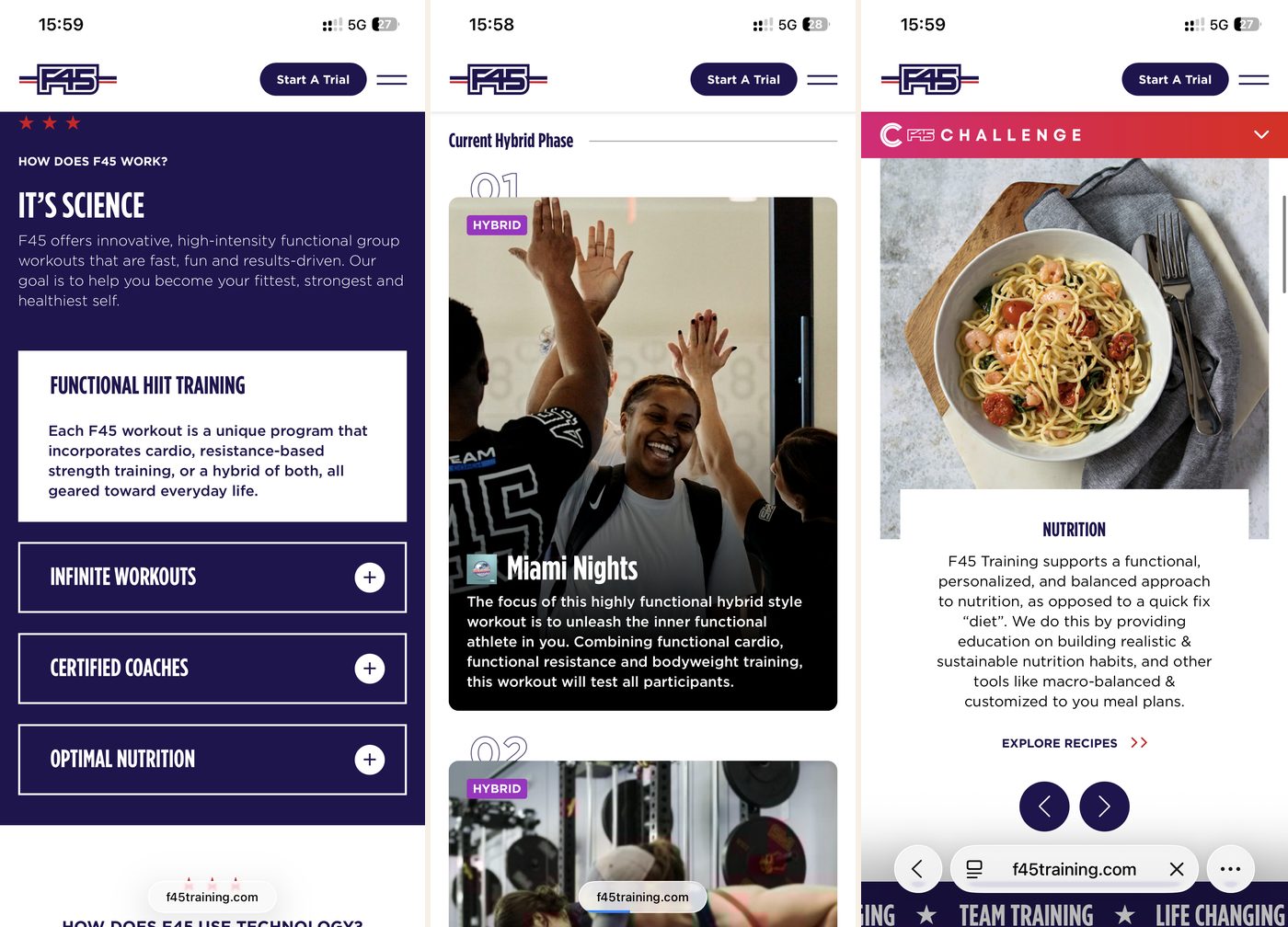
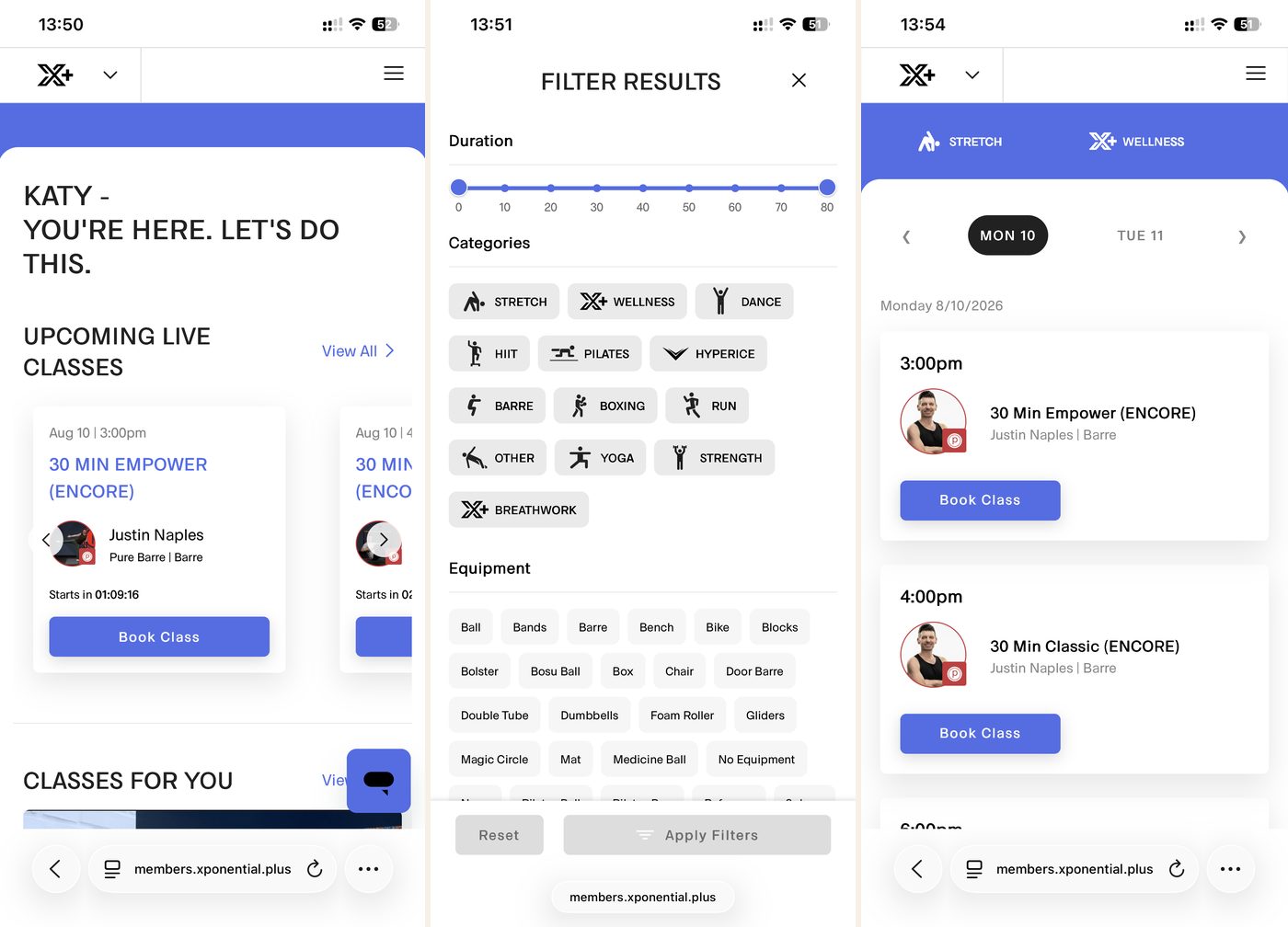
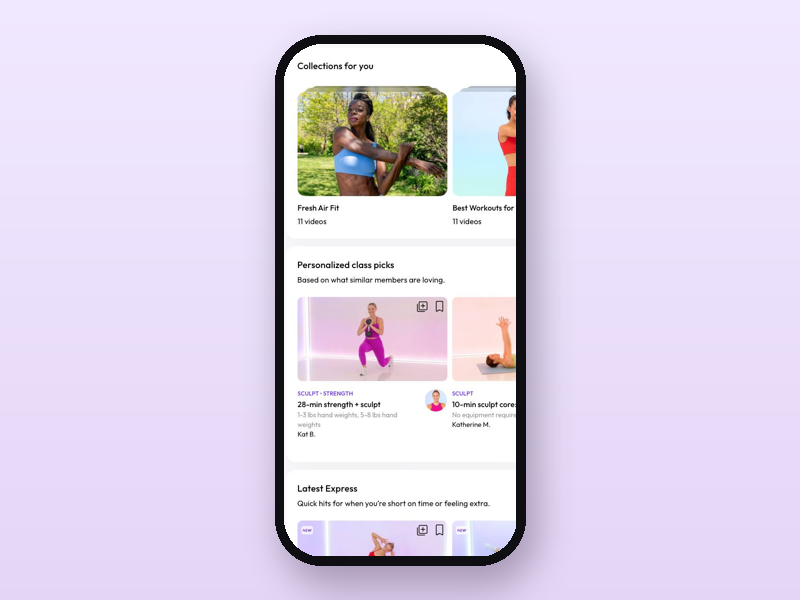
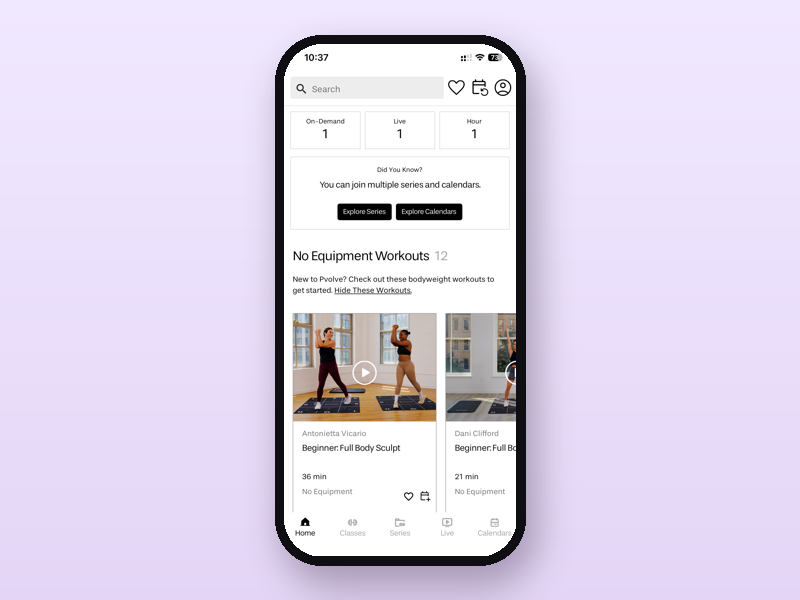
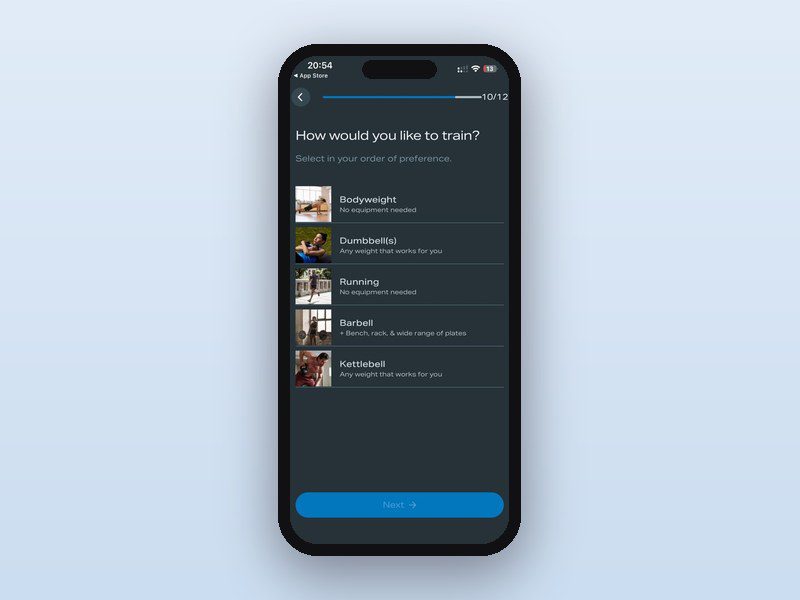
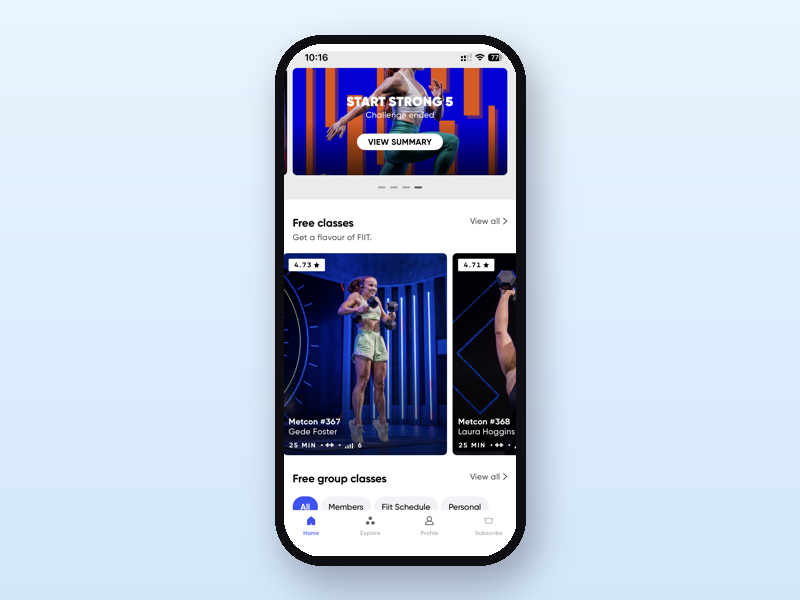
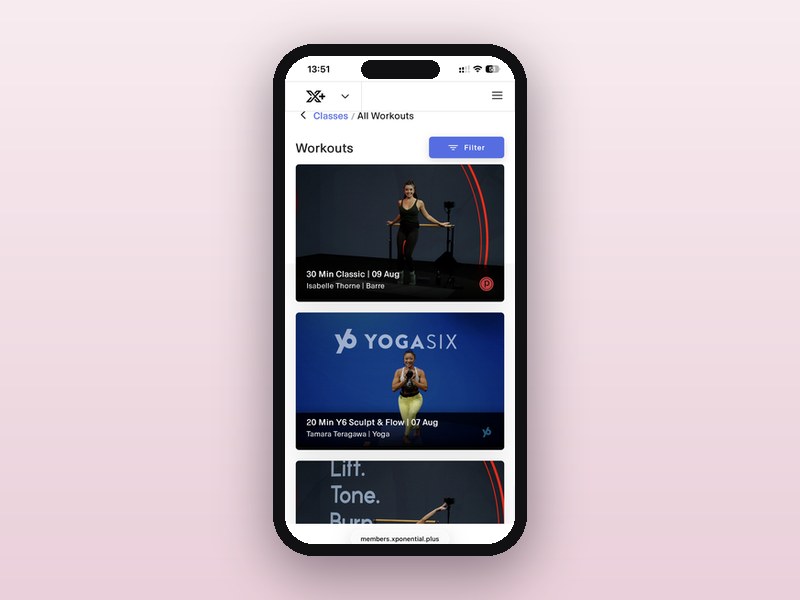
These two were not assessed to the same depth, and one of them was never used. Pure Barre was sample tested: a one-week Xponential+ trial with a couple of sessions completed and our own screenshots. F45 is a research-based data profile. No class was attended and no workout was completed on it, so its assessment rests on the official programme, its class formats, the app and the Challenge, franchise pricing, corporate filings, independent coverage, user sentiment and the exercise science. Even the images on its review come from f45training.com rather than from us. Every F45 score on this page therefore describes what the programme contains, not how it felt to train in. We repeat that limit in the sections where it bites.
Pure Barre if a joint is setting your terms, if you want to train at home for a fifth of the studio price, or if you are starting again after time away. F45 if you are already fit, want the loading and the impact, and know that the thing which keeps you turning up is a room full of other people. Neither programmes anything for perimenopause or menopause, and if that is why you are looking, neither is your answer.
F45 vs Pure Barre: the two platforms
Two franchised boutique brands, the same nine weighted criteria, and opposite answers to the question of how hard a midlife body should be hit.
F45
Runner-up
Forty-five-minute, coach-led, team-based studio circuits that rotate across cardio, resistance and hybrid formats, with movements shown on screens around the room.
- 45 min
- Bone loading 7/10
- Low-impact 3/10
- No free trial
- Not tested
Choose F45 if you:
- Are already fit and want intensity
- Want real loading and impact for bone
- Train better with other people in the room
- Want meal guidance bundled with the training
- Have a studio close enough to get to
Pure Barre
Winner
Low-impact barre from Carrie Rezabek Dorr, streamed at home through Xponential+ alongside dumbbell strength, yoga, stretch and dance, and taught in studios.
- 10 to 60 min
- Joints 8
- Low-impact 8/10
- 7-day trial
- Sample tested
Choose Pure Barre if you:
- Need training that does not jar a joint
- Want to train at home on your own clock
- Like being cued on posture in every session
- Want strength, yoga, stretch and dance in one library
- Are easing back in rather than pushing on
How we scored this, and why one column is weaker evidence
Both brands were scored on the same nine weighted criteria and the same twelve capability scores. Muscle Potential carries 18%, Time Efficiency 15%, Joint Friendliness and Programme Structure 12% each, Women Over 40 Specificity and Recovery Compatibility 10%, Value for Money and UX and Design 8%, and Nutrition Integration 7%.
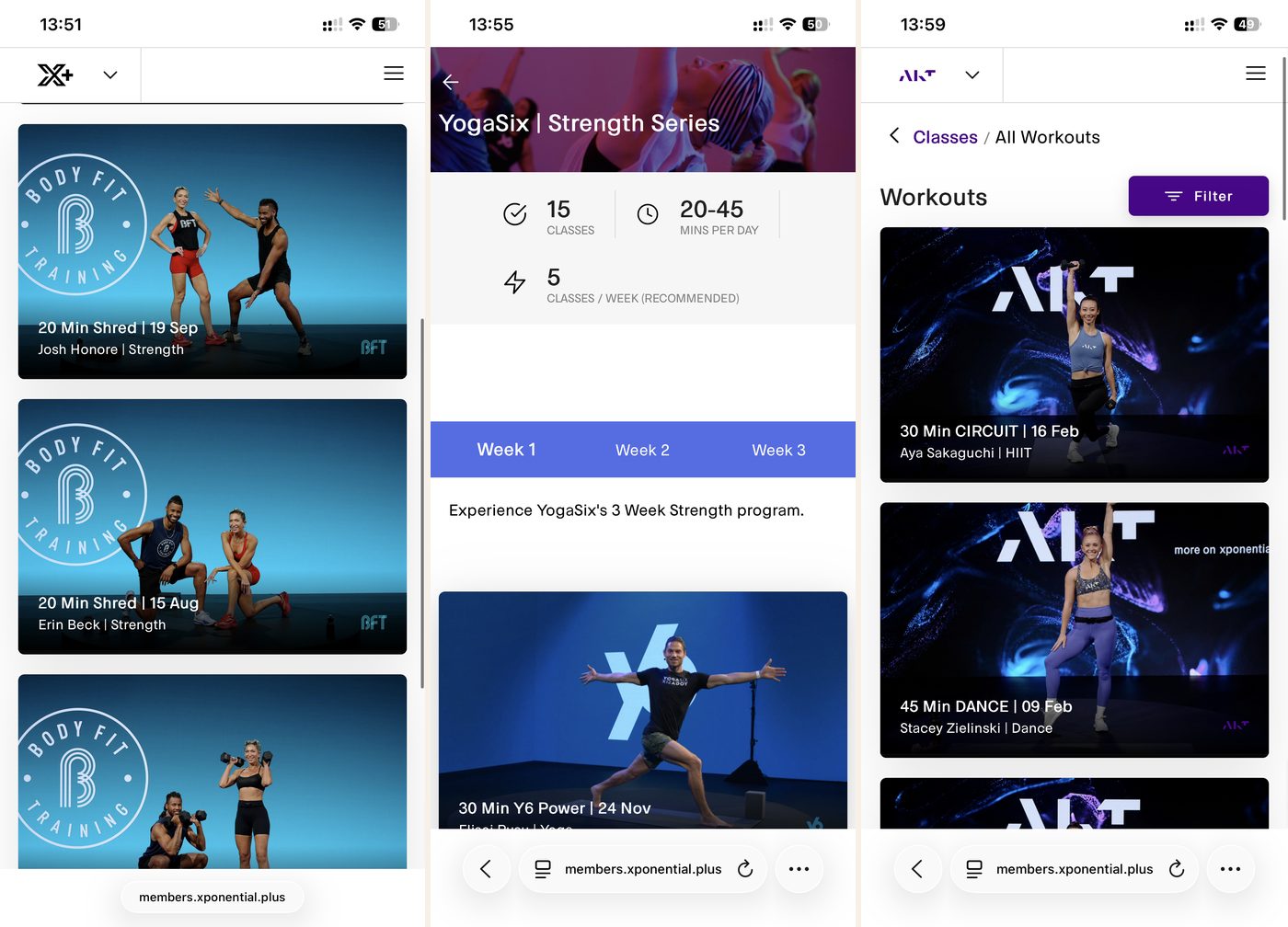
Same tester, and only one brand was used. Katy is a woman in her early 40s, perimenopausal, working full-time with children, with a previous meniscus injury. On Pure Barre she signed up for a one-week Xponential+ trial, completed a 20-minute dumbbell strength session and a dance class, and worked through the filter and library navigation.
F45 was not used. It is a studio franchise with no free trial of a membership, the at-home app is generally tied to that membership, and we do not buy a month of a boutique gym to produce a comparison. What we did instead was assess the programme itself, its three rotating class formats, the app, the LionHeart wearable and the 45-day Challenge, then build the rest from franchise pricing, exchange and legal filings, independent coverage, user sentiment and peer-reviewed science.
That asymmetry has one specific consequence and it is worth naming rather than burying. Where a criterion turns on how something feels in use, the Pure Barre number rests on sessions and the F45 number rests on what the format is documented to contain. Where a criterion turns on what exists, price, class types, whether pelvic-floor work is anywhere in the product, both columns stand on the same ground. We flag the difference in each section where it changes how much weight the number deserves.
Joint friendliness: Pure Barre wins, and this is the whole decision for many readers
Pure Barre wins, 8 against 4, with low-impact capability 8 out of 10 against 3. On a page where the overall scores are close, this is where the difference actually lives.
Pure Barre is low-impact by construction rather than by accommodation. The method is small, isometric, high-repetition movement at a ballet barre using light hand weights, a small ball, a resistance band and body weight, under the tagline Lift, Tone, Burn. There is no landing phase in a classic barre class, which is why the joint score sits where it does. The studio formats extend that logic: a free Engage intro class, Classic, Define with added dumbbells, Empower with HIIT and ankle weights, Align for flexibility and balance, and Reform, which folds Pilates patterns into barre.
F45 is the opposite by design. Its circuits are built on plyometrics, fast transitions and short rests, and the impact is not incidental, it is part of what the format is for. Coaches can offer modifications and many do, but scaling varies by studio and by coach, so the amount of protection you get depends on who is running the room that morning. That is a different proposition from a method where the low-impact quality is baked into the movement itself.
What the evidence says about the trade. Intensity is not the villain here. Cai and colleagues found in a systematic review and meta-analysis that high-intensity interval training significantly improved cardiorespiratory fitness in middle-aged and older women, while also concluding that it is insufficient on its own to comprehensively improve physical function.4 Read plainly, that supports using something like F45 as one part of a week rather than as the whole of it, which is close to what the brand’s own critics say.
Muscle and bone: tied on muscle, and F45 leads the loading
Muscle Potential ties at 6 each, and underneath that tie the capability rows disagree: bone loading is 7 out of 10 for F45 against 5, while progressive strength ties at 6.
F45 earns the bone number on merit. Its circuits use dumbbells, kettlebells, rowers and benches, the studio provides all of it, and the impact adds a loading stimulus that most low-impact programmes cannot supply. The caveat the F45 review itself makes is that the format is circuit and time-based rather than dedicated progressive overload, so the decision to go heavier week on week is yours to make and nothing in the class will make it for you.
Pure Barre has the opposite shape. Classic barre is light-load by definition, which is lovely for muscular endurance, control and balance and is a weak standalone stimulus for bone. What rescues the score is the wider library: Xponential+ carries BFT strength sessions with dumbbells and kettlebells, and the tested 20-minute dumbbell session was a solid, well-structured workout built from lunges, squats and the usual dependable moves. The strength is available; it is just not what the barre brand is selling.
The research is unusually clear about which of those matters for bone. Watson and colleagues found in the LIFTMOR trial that heavier, high-intensity resistance and impact training improved bone density and physical function in postmenopausal women, where light exercise did not to the same degree.1 Liu and Latham reached a parallel conclusion for function in a Cochrane review, reporting that progressive resistance strength training improved strength and physical function in older adults.3 Both point the same way: the load has to be real. F45 supplies it by default and Pure Barre supplies it only if you go looking in the strength classes.
Our best workouts to build muscle after 50 ranking covers the platforms that programme that progression explicitly, which neither of these does.
Value for money: Pure Barre wins, and the two are not selling the same thing
Pure Barre wins, 7 against 5, and the fair framing is that one of these is a subscription and the other is a gym membership.
| Plan | F45 | Pure Barre |
|---|---|---|
| Free trial | None of a membership, though many studios offer a free first class | 7-day free trial of Xponential+ |
| Home streaming | App generally tied to a membership, no standalone price we could verify | $19.99 a month for Pure Barre only |
| Everything included | Not applicable | $29.99 a month or about $239.99 a year for all Xponential brands |
| Studio, unlimited | About $160 to $220 a month | Often around $100 to $250 a month, set by each franchise |
| Studio, occasional | Limited plans around $139, drop-ins about $20 to $30 | Class packs and intro offers, set by each franchise |
| Common intro deal | Three classes for $30 | A free Engage intro class in studio |
At home there is no contest. Twenty dollars a month buys a multi-brand library that includes barre, dumbbell strength, yoga, stretch and dance, and a 7-day free trial lets you find out whether the coaching style suits you before any money moves. F45 has no comparable route in, which is the single biggest reason its Value for Money score sits where it does.
In a studio the picture is closer than the numbers suggest, because both are franchised and both set their own prices. F45 unlimited memberships commonly run about $160 to $220 a month with cheaper per-month rates on longer contracts, and Pure Barre studios often land around $100 to $250 a month unlimited. What you are buying in both cases is a coached room, and that is genuinely worth more to some people than any library.
Two billing cautions, one for each brand. Pure Barre’s app has a recurring cluster of complaints about billing, trials auto-charging, cancellation and unresponsive customer service, so set a reminder before the 7-day trial ends and confirm any cancellation went through. F45 memberships are contracts with a franchise, so the cancellation notice and any joining fee are set locally and are worth reading before you sign, particularly given the company’s recent instability. Our best free and budget workout apps ranking covers the cheaper field either way.
Structure and progression: Pure Barre wins, and neither builds you a week
Pure Barre wins Programme Structure, 8 against 7, and the gap is narrow because both are organised without being personalised.
F45 is a well-run system. Workouts rotate across three formats, cardio, resistance and hybrid, the branded sessions rarely repeat, the schedule is fixed and someone else has decided what today is. For a woman who does not want to think, that is a real service, and the 45-day Challenge adds a defined block with meal guidance on top. What it does not do is progress you as an individual, and it cannot, because the class in front of you was written for the room rather than for your last four weeks.
Pure Barre edges it on breadth rather than intelligence. Xponential+ carries structured multi-week series alongside the standalone classes, the studio formats give a clear ladder from Engage to Classic, Define, Empower, Align and Reform, and you filter by length, class type and equipment to build your own week. The filtering made this easy in testing, because you can narrow the library quickly and find something that fits your energy that day. That is a do-it-yourself model, and it works well if you know what you want.
So the fair summary is that neither will notice you. If you want a platform that looks at what you did last week and decides what you do this week, this is not the pair to be choosing between.
Perimenopause and menopause fit: neither, and one is marginally less absent
Pure Barre edges Women Over 40 Specificity, 4.5 against 3.6, with menopause programming 2 out of 10 against 1 and menopause education 2 against 1.
Those numbers are close to the floor for a reason. Pure Barre’s midlife content is brand-blog material rather than anything inside the app, and the sample-tested verdict was unambiguous: on the trial there was no perimenopause or menopause programming, no pelvic-floor focus and no nutrition. What earns it the extra point is that low-impact, joint-friendly movement is itself a reasonable fit for a midlife body, so the method lands in the right place even though nobody designed it for this stage.
F45 has nothing here at all. No menopause or perimenopause programming, no hormone content, no cycle awareness, no symptom guidance and no pelvic-floor work anywhere in the product, and no clinical or menopause specialisation among the people who built it. Its own review is direct about the risk profile: a high-intensity, high-volume format asks a lot of recovery at exactly the life stage when recovery is least reliable.
Greendale and colleagues documented the underlying shift, finding in the Study of Women’s Health Across the Nation that the rate of fat-mass gain roughly doubled while lean mass declined across the menopause transition.2 That is the context both brands are operating in, and neither has built anything specific in response to it.
Pelvic floor
A tie at 1 out of 10, the lowest that capability goes, and the tie hides a real difference in exposure. Pure Barre has no pelvic-floor programming, and its movements are small, controlled and non-impact, so the absence of content matters less in practice. F45 has no pelvic-floor programming either, and its default format is jumping, which the F45 profile itself describes as demanding for a weakened pelvic floor. Neither brand will help you manage this, and a pelvic-health physiotherapist will.
Expert credibility
A tie at 5 out of 10, and the two arrive there differently. Pure Barre was created by Carrie Rezabek Dorr, a dancer and choreographer with a Pilates background, and instructors complete the brand’s own teacher training, which showed in the polish and the frequency of the technique cues. F45 requires its coaches to hold an externally accredited personal-training or group-fitness certification on top of its in-house certification, which is a genuinely better baseline than a purely internal qualification. Neither has a clinician, a women’s-health specialist or a menopause advisory board.
Time efficiency: Pure Barre wins, and the reason is flexibility
Pure Barre wins, 8 against 6, and F45’s number is held down by geography rather than by the workout.
A 45-minute full-body class is an efficient thing in itself, and F45 designed the format around that claim. The cost is that it happens at a fixed time in a fixed place, so the real commitment is the class plus the journey either side of it, and a session you cannot reach is worth nothing.
Pure Barre On Demand runs from 10 to 60 minutes on your own clock, with in-studio classes at 45 to 50 minutes if you want the room. That range is what a compressed week actually needs, and it is why the score is what it is. Our 20-minute workouts for perimenopause and 30-minute workouts for women over 40 guides cover the wider field in both bands.
Recovery: Pure Barre wins, and the gap is bigger than the score
Pure Barre wins Recovery Compatibility, 7 against 4, with recovery and deload capability 7 out of 10 against 4.
Xponential+ carries stretch, yoga and breathwork alongside the barre, so a low day has somewhere to go that is still inside the subscription, and barre itself is gentle enough to sit in a week without eating into what you have left. There is no adaptive deload logic, so a rest week remains something you decide to take.
F45 is a high-volume, high-intensity format with short rests, and its own profile names the consequence: that pattern can work against recovery and sleep during perimenopause, when stress load is already stretched. The app does include recovery workouts, which helps, and the fundamental issue is that a class you attend three or four times a week at full effort is a large withdrawal from a bank that is not refilling as fast as it once did. Our low-cortisol workouts for perimenopause guide covers platforms that treat this as a design problem rather than an afterthought.
UX and design: Pure Barre wins, and one of these has no software to judge
Pure Barre wins UX and Design, 7 against 6, and the comparison is slightly unfair to both.
Pure Barre is judged as an app because that is how most people outside a studio will meet it. Xponential+ runs on iOS, Android, web, Apple TV, Fire TV and Apple Watch, with a Meta Quest option, and the production quality was the first thing that stood out on the trial: crisp video, a calm atmosphere, and instructors who talk you through the movement, the correct posture and what to watch out for. That mattered to a tester who admits she lets her form drift when she is concentrating on getting through a set. The Meta Quest option is the one flourish, and the verdict on it was measured: having tried VR training before, on Fiit, the novelty is real and it is a fun extra rather than a reason to sign up. The recurring criticisms are fair too: navigation and search are not always intuitive, and a multi-brand app is not a barre app.
F45 is judged as a room. The in-studio screens that display each movement are the interface, the app handles booking and on-demand workouts, and the LionHeart heart-rate wearable gamifies effort with points and a post-class report. All of that reads well on paper. None of it was in our hands, and the UX and Design score is the criterion where that limitation costs the most, so treat the number as a description of the feature set rather than a judgement on the experience.
Nutrition: F45 wins, and it is the only criterion it takes
F45 wins Nutrition Integration, 5 against 2, with midlife nutrition capability 5 out of 10 against 2.
The F45 Challenge is a 45-day team programme with meal guidance and wellness education attached, and running it alongside the training is more than most studio brands attempt. It is general rather than midlife-specific, there is no dietitian attached, and it is bundled with the intensity rather than sold on its own.
Pure Barre has no nutrition content in the app whatsoever, which is why its capability score sits at 2. Nutrition Integration carries the smallest weight in our model at 7%, so this win moves F45’s overall total by very little, and it is still the clearest thing F45 offers that Pure Barre does not.
Equipment and space needed at home
Pure Barre needs almost nothing and F45 barely translates.
For barre at home you need a mat, a set of light hand weights, and for classic classes a small ball and a resistance band, though plenty of sessions are equipment-free and a studio provides the props. Branch into the app’s strength classes, as the tested session did, and you will want dumbbells.
F45 in a studio needs nothing at all, because the circuit is set out for you: dumbbells, kettlebells, rowers and benches are all provided. That is a genuine convenience and it is also why the home version is a shadow of the product. To run the app’s weighted workouts you need your own dumbbells and a mat, and because the method leans on real loading, an adjustable set is the sensible buy so you can keep adding weight.
On either brand, adjustable dumbbells are the purchase that changes what you get, because a fixed light pair stops providing a stimulus once you have adapted to it. Neither requires subscription hardware, a machine or a dedicated room.
Starting from scratch: not a close call
Pure Barre wins beginner on-ramp, 7 out of 10 against 4, and this is one of the widest capability gaps on the page.
Barre is unusually forgiving as a first step. The movements are small and repeated, so there is time to learn them, the class does not depend on you catching a complicated sequence, and the coaching cues posture constantly rather than shouting pace. A studio can start you on a free Engage intro class, and at home a 7-day trial and a 10-minute session cost nothing but the ten minutes.
F45 puts a newcomer into a fast circuit next to a room of regulars, with the movements displayed on screens rather than taught from the front. Its reviewers consistently describe it as demanding rather than beginner-gentle, and note that form can slip in a quick circuit. The community is a genuine counterweight, and adherence is most of what decides whether any of this works, but there is a difference between being motivated and being taught.
F45 pros and cons
F45 scores 5.3. It is strongest on a structured programme and weakest on suitability for women over 40.
Pros
- Bone loading 7 out of 10 against 5, the one midlife capability it leads, on circuits that use dumbbells, kettlebells and real impact.
- Nutrition Integration 5 against 2, through the 45-day Challenge and its meal guidance.
- Muscle Potential tied at 6.
- Everything provided in the studio.
- Coaches hold an externally accredited certification on top of the in-house one.
- A team room that people credit for keeping them consistent.
Cons
- Joint Friendliness 4 against 8, with low-impact 3 out of 10 against 8 and no low-impact format at all.
- Recovery Compatibility 4 against 7.
- Value for Money 5 against 7, with no free trial of a membership and no verifiable home-only price.
- Beginner on-ramp 4 against 7.
- Menopause programming 1 out of 10.
- Coaching and scaling vary by franchise.
- A company that delisted from the New York Stock Exchange in 2023.
- And nobody here has trained in one.
Pure Barre pros and cons
Pure Barre scores 6.6. It leads on joint-friendly training and trails on nutrition guidance.
Pros
- Joint Friendliness 8 against 4, with low-impact 8 out of 10 against 3, on a method with no landing phase.
- Value for Money 7 against 5, at $19.99 a month with a 7-day free trial.
- Time Efficiency 8 against 6, on sessions from 10 to 60 minutes.
- Recovery Compatibility 7 against 4 and beginner on-ramp 7 against 4.
- Constant posture cueing.
- Strength, yoga, stretch and dance in the same subscription.
- And it was actually used.
Cons
- Nutrition Integration 2 against 5, with none in the app.
- Bone loading 5 out of 10 against 7, because classic barre is light-load.
- Pelvic floor 1 out of 10.
- No menopause or hormone programming and no dedicated meditation strand.
- A recurring cluster of billing, trial and cancellation complaints.
- Navigation and search that are not always intuitive, in an app that is not barre-focused.
Quick yes/no comparison
| Feature | F45 | Pure Barre |
|---|---|---|
| Free trial you can use at home | No | Yes, 7 days |
| A home-only price | No, the app is tied to a membership | Yes, $19.99 a month |
| Low-impact by default | No | Yes |
| Jumping and plyometrics | Yes, by design | No, not in barre |
| Real external load included | Yes, dumbbells and kettlebells | Yes, in the wider strength classes |
| A plan built for you | No, a rotating class schedule | No, you build your own week |
| Menopause or perimenopause programming | No | No |
| Pelvic floor content | No | No |
| Nutrition guidance | Yes, in the 45-day Challenge | No |
| Yoga, stretch and dance in the same subscription | No | Yes |
| Heart-rate wearable | Yes, LionHeart | Not assessed |
| VR option | No | Yes, on Meta Quest |
| Studio classes | Yes, that is the product | Yes, alongside the app |
| Was it used hands-on | No, research-based only | Yes, two sessions on a one-week trial |
F45 vs Pure Barre at a glance
| F45 | Pure Barre | |
|---|---|---|
| Overall score | 5.3 | 6.6 |
| How it was assessed | Data profile, research-based. No class was attended and no workout was completed | Sample tested on a one-week Xponential+ trial, two sessions completed |
| Cost | About $160 to $220 a month unlimited, around $139 limited, drop-ins about $20 to $30 | $19.99 a month, or $29.99 a month and about $239.99 a year for all brands |
| Trial | No free trial of a membership, many studios offer a free first class | 7-day free trial |
| Session length | 45 minutes in the studio | 10 to 60 minutes on demand, 45 to 50 minutes in studio |
| Approach | Coach-led team circuits rotating across cardio, resistance and hybrid | Small isometric barre movement, plus a multi-brand library |
| Impact by default | High, plyometric, with short rests | Low, with no landing phase in classic barre |
| Who is behind it | Rob Deutsch, Sydney, early 2010s; coaches externally accredited plus in-house | Carrie Rezabek Dorr, 2001; owned by Xponential Fitness since 2018 |
| Menopause content | None | None in the app, brand-blog material only |
| Equipment | Provided in the studio, dumbbells and a mat for the app | A mat and light weights, a ball and a band for classic barre, dumbbells for strength |
| Known live issue | Franchise-variable scaling, a 2023 delisting from the New York Stock Exchange | Billing, trial and cancellation complaints, and search that is not always intuitive |
| How we assessed it | Research-based, no class attended, no workout completed | Sample tested on a one-week trial, two sessions completed |
F45 vs Pure Barre: the full scoring breakdown
Pure barre wins seven of the nine weighted criteria and f45 wins one, with one tied. The one F45 takes is Nutrition Integration, the lightest criterion in the model, and the one they share is Muscle Potential.
| Criterion | Weight | F45 | Pure Barre | Winner |
|---|---|---|---|---|
| Muscle Potential | 18% | 6 | 6 | Tied |
| Time Efficiency | 15% | 6 | 8 | Pure Barre |
| Joint Friendliness | 12% | 4 | 8 | Pure Barre |
| Programme Structure | 12% | 7 | 8 | Pure Barre |
| Women Over 40 Specificity | 10% | 3.6 | 4.5 | Pure Barre |
| Recovery Compatibility | 10% | 4 | 7 | Pure Barre |
| Value for Money | 8% | 5 | 7 | Pure Barre |
| UX and Design | 8% | 6 | 7 | Pure Barre |
| Nutrition Integration | 7% | 5 | 2 | F45 |
| Overall | 100% | 5.3 | 6.6 | Pure Barre |
The twelve capability scores
Pure barre wins seven of the twelve capability scores and f45 wins two, with three tied. The widest gap is low-impact, 8 out of 10 against 3, and the most interesting reversal is bone loading, 7 against 5 to F45. Pelvic floor ties at 1 out of 10 and menopause programming is 2 against 1, which together say that neither brand is built for this life stage.
| Capability | F45 | Pure Barre | Winner |
|---|---|---|---|
| Low-impact | 3 | 8 | Pure Barre |
| Progressive strength | 6 | 6 | Tied |
| Bone loading | 7 | 5 | F45 |
| Recovery & deload | 4 | 7 | Pure Barre |
| Menopause programming | 1 | 2 | Pure Barre |
| Pelvic floor | 1 | 1 | Tied |
| Hormone awareness | 1 | 2 | Pure Barre |
| Menopause education | 1 | 2 | Pure Barre |
| Expert credibility | 5 | 5 | Tied |
| Mind-body support | 4 | 5 | Pure Barre |
| Beginner on-ramp | 4 | 7 | Pure Barre |
| Midlife nutrition | 5 | 2 | F45 |
Who wins for…
Who wins for painful joints
Pure Barre, and it is not close. Joint Friendliness 8 against 4, low-impact 8 out of 10 against 3.
Who wins on price at home
Pure Barre. $19.99 a month with a 7-day trial, against a membership you cannot buy by the month for home use.
Who wins for bone density
F45. Bone loading 7 out of 10 against 5, on circuits that combine external load with impact.1
Who wins for building muscle
A tie at 6. F45 loads you by default, Pure Barre loads you only if you choose the strength classes.
Who wins for perimenopause and menopause
Neither. Menopause programming is 2 out of 10 against 1, which is a choice between very little and nothing.
Who wins for pelvic floor
Neither, at 1 out of 10 each. Pure Barre is the lower-exposure option because it does not ask you to jump.
Who wins for a beginner
Pure Barre. Beginner on-ramp 7 out of 10 against 4, plus a free intro class in studio and a free week at home.
Who wins for a busy week
Pure Barre. Time Efficiency 8 against 6, because 10 minutes at home beats 45 you have to travel to.
Who wins for nutrition
F45. 5 against 2, through the 45-day Challenge, and it is general rather than midlife-specific.
Who wins for company you train with
F45. The team room is the differentiator, and it is the thing people credit for keeping them coming back.
Who wins for training at home
Pure Barre. A full home product against an app that exists mainly as a membership extra.
Who wins on evidence
Pure Barre, because we used it. F45 has no free trial of a membership, so its column is research-based throughout.
Decision tree for women over 40
A joint dictates what you can do. Pure Barre, for Joint Friendliness 8 against 4 and a method with nothing to land from.
You want to train at home. Pure Barre. F45 has an app, and the product is the room.
Bone density is the goal you would name first. F45, for the loading and the impact, provided your joints and your pelvic floor are up to it.
You are starting again after time away. Pure Barre, on the free intro class or the 7-day trial, and add dumbbell sessions when you are ready.
You only train when other people are expecting you. F45. This is the argument for it and it is a good one.
Your budget is the binding constraint. Pure Barre at $19.99 a month, or a Pure Barre class pack if you want the studio occasionally.
Perimenopause is why you are looking. Neither. Menopause programming is 2 out of 10 and 1 out of 10.
You want to be coached on your form. Pure Barre, where the instructor talks through the posture in every session.
What we did not test
One column of this page was never used, and the other rests on a week.
Nobody from Her Daily Fit has attended an F45 studio class, run its on-demand app workouts, worn the LionHeart wearable or done the 45-day F45 Challenge. Everything on this page about how F45 trains comes from the research basis set out at the top. Its scores describe what the format contains, and the images on its review come from f45training.com rather than from us.
On Pure Barre, the trial did not cover classic barre classes, VR sessions or in-studio classes, which means the brand’s signature format is the one part of it we cannot describe from use. Two sessions and a thorough browse tell you how the app feels and how well the coaching cues land. They do not tell you how a body responds to eight weeks of barre.
Neither brand’s handling of an injury or a symptom flare was assessed, and nothing here should be read as a claim about long-term results on either.
Which is better for women over 50?
Pure Barre, more clearly than at 40
Every argument in its favour strengthens with age. Low impact matters more when a knee is deciding your week, the constant posture cueing is worth more when you are learning a movement pattern again rather than for the first time, and a 7-day trial lets you find out for nothing. The route to muscle and bone is still there, in the dumbbell strength classes, and it is a decision you have to make rather than one the app makes for you. Our best low-impact workouts for women over 50 and best workouts for postmenopause rankings cover the wider field.
F45, only with conditions
If you are already strong, already conditioned and confident in your joints, the loading and impact are a better bone stimulus than barre supplies on its own, and that is worth something real. The conditions are that you talk to the coach about modifications before your first class rather than during it, that you do not train at full effort four days a week, and that you accept the scaling will vary depending on who is running the session. That is a lot to manage in a format you cannot try cheaply.
What we would actually suggest
Take the Pure Barre trial first, because it costs nothing to find out, and build a week of barre plus two dumbbell strength sessions from the same library. If after a couple of months you find that what is missing is other people, look for a studio and consider whether it needs to be a jumping one. Our best Pilates programmes for women over 40 ranking covers the neighbouring low-impact options.
Frequently asked questions
Is F45 or Pure Barre better for women over 40?
Pure Barre, 6.6 against 5.3, and the margin comes almost entirely from how the two treat a midlife body rather than from the quality of the training. Pure Barre wins Joint Friendliness 8 against 4, Recovery Compatibility 7 against 4, Value for Money 7 against 5 and Women Over 40 Specificity 4.5 against 3.6. F45 wins Nutrition Integration 5 against 2 and leads bone loading 7 out of 10 against 5. Neither brand programmes anything for perimenopause or menopause.
Which one is gentler on joints?
Pure Barre, 8 against 4, and this is the widest gap on the page. Low-impact capability is 8 out of 10 against 3. Barre is built on small, isometric, high-repetition movements at a ballet barre, so there is no landing and no jumping in the classic format. F45 is high-impact and plyometric by default, with fast circuits and short rests, and while coaches offer modifications, scaling varies by studio and by coach. If a knee or a hip is setting your terms, this is the whole decision.
Does F45 build more bone than barre?
On the capability scores, yes: bone loading is 7 out of 10 for F45 against 5 for Pure Barre, and it is F45’s single best number anywhere in this comparison. Its circuits use dumbbells, kettlebells and real impact, which is the combination the bone evidence points to, and the LIFTMOR trial is the reference point for it.1 Classic barre is light-load by design, so on Pure Barre the loading has to come from the dumbbell strength classes in the wider app or from your own lifting.
Which is cheaper?
Pure Barre at home, decisively, and the two are closer in a studio. Pure Barre On Demand streams through Xponential+ at $19.99 a month for Pure Barre alone, or $29.99 a month and about $239.99 a year for every Xponential brand, with a 7-day free trial. F45 has no home-only price we could verify: the app is generally tied to a membership, and membership is set by each franchise, with unlimited plans commonly about $160 to $220 a month, limited plans around $139, drop-ins about $20 to $30 and a common intro of three classes for $30. Pure Barre studios are franchised too, often around $100 to $250 a month unlimited, so in a studio the gap narrows.
Can you do either one at home?
Pure Barre yes, F45 only partly, and that difference does most of the work in the Value for Money score. Pure Barre On Demand is a full home product streamed through Xponential+ on iOS, Android, web, Apple TV, Fire TV and Apple Watch, with a Meta Quest option, and it carries barre, dumbbell strength, yoga, stretch and dance from the wider Xponential family. F45 does have an app with on-demand bodyweight, weighted and recovery workouts, but the product is the room: the team, the coach and the screens around the circuit. Take those away and you have removed the reason most people pay for it.
Does either have menopause or perimenopause content?
No, and this is the clearest finding on the page. Menopause programming is 2 out of 10 for Pure Barre against 1 for F45, which is the difference between a brand blog that mentions midlife and nothing at all. Pelvic floor ties at 1 out of 10 for both, the lowest score that capability can carry. Neither brand has hormone-phase adaptation, symptom guidance or a clinician attached. If perimenopause is the reason you are looking, this pair is the wrong shelf and you should start with a platform built for it.
Which suits a beginner better?
Pure Barre, on a beginner on-ramp of 7 out of 10 against 4. Barre movements are small and repeated, the coaching cues posture constantly, and a studio can start you on a free Engage intro class. F45 puts a newcomer into a fast circuit alongside a room of regulars, with the movements shown on screens rather than taught, and reviewers consistently describe it as demanding rather than beginner-gentle. F45’s community is a real asset for sticking at something, but it is not the same thing as being taught how to move.
How much did you actually test each one?
Unequally, and it matters more here than on most pages. Pure Barre was sample tested on a one-week Xponential+ trial with a couple of sessions completed. F45 was not tested at all: no class was attended and no workout was completed, so it is a research-based data profile built from the official programme, its class formats, the app and the Challenge, franchise pricing, corporate filings, independent coverage, user sentiment and the science. The images on the F45 review come from f45training.com rather than from us, which is another reason to read that column as a description rather than a verdict.
Is F45 safe for a weak pelvic floor?
We are not going to tell you what your body will do, and the structural facts are worth knowing. F45 is built on plyometrics, fast circuits and short rests, and neither brand offers any pelvic-floor programming at all, which is why both score 1 out of 10 on that capability. The F45 profile names this directly: the format can be a lot for midlife joints and a weak pelvic floor, and coaches scale inconsistently. If this is a live concern, neither brand will help you manage it, so take the question to a pelvic-health physiotherapist before you choose between a jumping class and a barre class.
Which is better for a busy week?
Pure Barre, 8 against 6, though the reason is flexibility rather than speed. F45 is 45 minutes in the studio, which is efficient in itself, but it is 45 minutes at a time the studio sets, plus the travel each way. Pure Barre On Demand runs from 10 to 60 minutes whenever you open it, and studio classes run 45 to 50 minutes. For a woman fitting training around work and children, a 20-minute session at seven in the morning beats a better 45-minute session she cannot get to.
Which has nutrition guidance?
F45, 5 against 2, and it is the only criterion F45 wins. The F45 Challenge is a 45-day team programme with real meal guidance and wellness education attached, which is more than a workout app usually offers, and it is general rather than midlife-specific. Pure Barre has no nutrition content in the app at all, which is why midlife nutrition capability is 5 out of 10 against 2. Nutrition Integration carries the smallest weight in our model at 7%, so this wins F45 a criterion without moving the overall picture.
Which would you actually recommend?
Pure Barre for most women reading this, because it is gentler, cheaper at home, easier to start and easier to keep doing, and because you can steer the wider Xponential+ library toward dumbbell strength on the days you want load. F45 is worth considering if you are already fit, your joints and pelvic floor are robust, you want the bone-loading stimulus, and the thing that keeps you training is other people in the room. Read the franchise terms before you sign either one, because both are franchised businesses and both have a billing reputation worth checking.
Research citations
- Watson SL, Weeks BK, Weis LJ, Harding AT, Horan SA, Beck BR. High-intensity resistance and impact training improves bone mineral density and physical function in postmenopausal women with osteopenia and osteoporosis: the LIFTMOR randomized controlled trial. Journal of Bone and Mineral Research. 2018;33(2):211–220. PubMed. (Cited for: heavier, high-intensity resistance and impact training improved bone density and physical function in postmenopausal women, where light exercise did not to the same degree.)
- Greendale GA, Sternfeld B, Huang M, et al. Changes in body composition and weight during the menopause transition. JCI Insight. 2019;4(5):e124865. Study of Women’s Health Across the Nation. PubMed. (Cited for: the rate of fat-mass gain roughly doubled while lean mass declined across the menopause transition.)
- Liu CJ, Latham NK. Progressive resistance strength training for improving physical function in older adults. Cochrane Database of Systematic Reviews. 2009;(3):CD002759. PubMed. (Cited for: progressive resistance strength training improved strength and physical function in older adults.)
- Cai L, et al. Effects of high-intensity interval training on cardiopulmonary fitness and physical function in middle-aged and elderly women: a systematic review and meta-analysis. Frontiers in Physiology. 2026. PMC. (Cited for: high-intensity interval training significantly improved cardiorespiratory fitness in middle-aged and older women, while remaining insufficient on its own to comprehensively improve physical function.)
This page compares fitness platforms. It is not medical advice. Katy is a woman who has trained through perimenopause, not a clinician. Any training observations described are one person’s recorded experience, not an expected result or a general pattern. If you have a diagnosed condition, an injury, or symptoms that concern you, speak to a qualified healthcare professional before changing how you train.
About this comparison
Compiled by Katy Cole for Her Daily Fit. The two brands were not assessed to the same depth, and the difference is structural rather than a matter of effort. Pure Barre was sample tested on a one-week Xponential+ trial, and the methods section above lists what those sessions covered. F45 sells studio memberships rather than trials, so it is a research-based data profile drawn from the official programme and its class formats, the app, the wearable and the Challenge, franchise pricing, exchange and legal filings, independent coverage, user sentiment and peer-reviewed science. Both were scored on the same nine weighted criteria and the same twelve capability scores, and the F45 column describes what the format contains rather than how it performs in use. Liu and Latham’s review is the reason Muscle Potential carries the heaviest weight in that model.3 Prices were verified against official sources in 2026 and may differ if there has been a recent change; both brands are franchised, so studio pricing is set locally and varies widely. Scores are pulled live from each programme’s own assessment. Her Daily Fit earns nothing from either brand.
Compared with
Featured in