
Freemium, with a Pro membership from about $12.99/month (Silver) or $19.99/month (Gold), and discounted annual plans that rotate by promotion · a 7-day free trial · one of the oldest yoga apps, a large pre-recorded library of yoga, Pilates, chair yoga, Tai Chi and meditation with guided programs and a 28-day SmartCoach plan · levels from beginner to advanced · from Daily Yoga Culture Technology Co., founded 2012 · A mat, and optional blocks or a strap.
Researched from: official site and app store listings (verified August 2026) · Apple App Store, Google Play and Trustpilot · a walk through the app’s onboarding and library (screenshots our own) · independent reviews · peer-reviewed exercise and menopause science · Not workout-tested (no free trial). Testing status: Data profile.
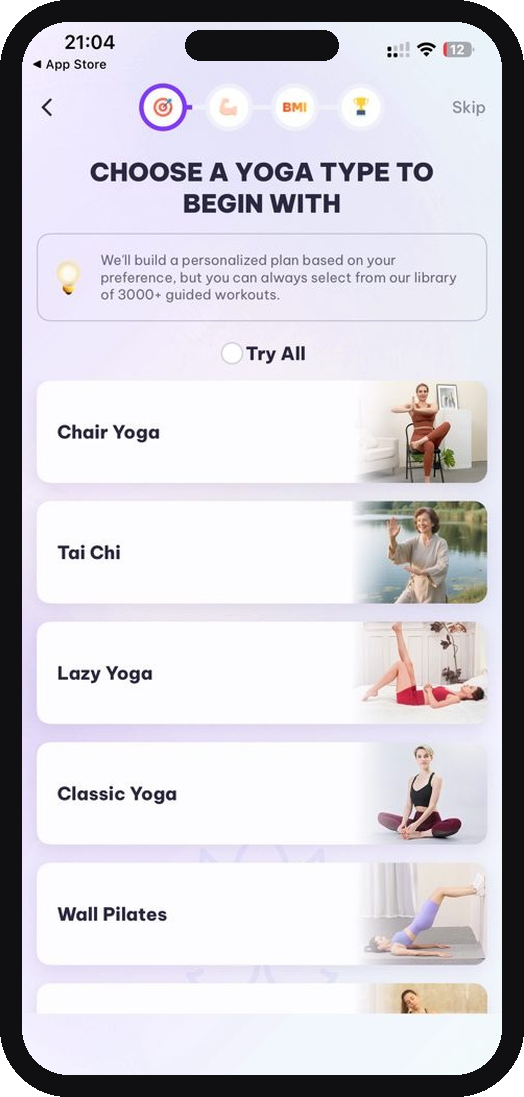
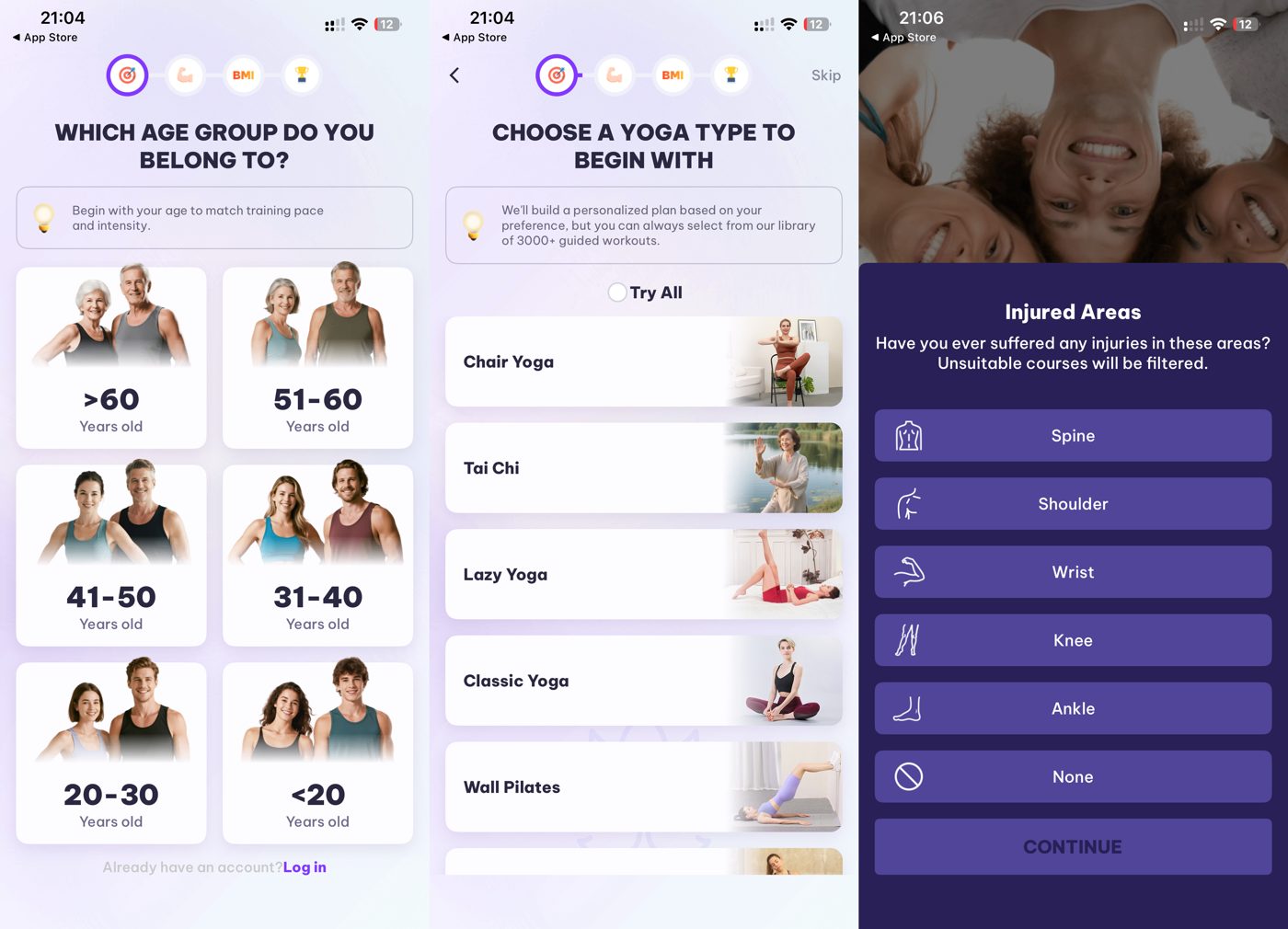
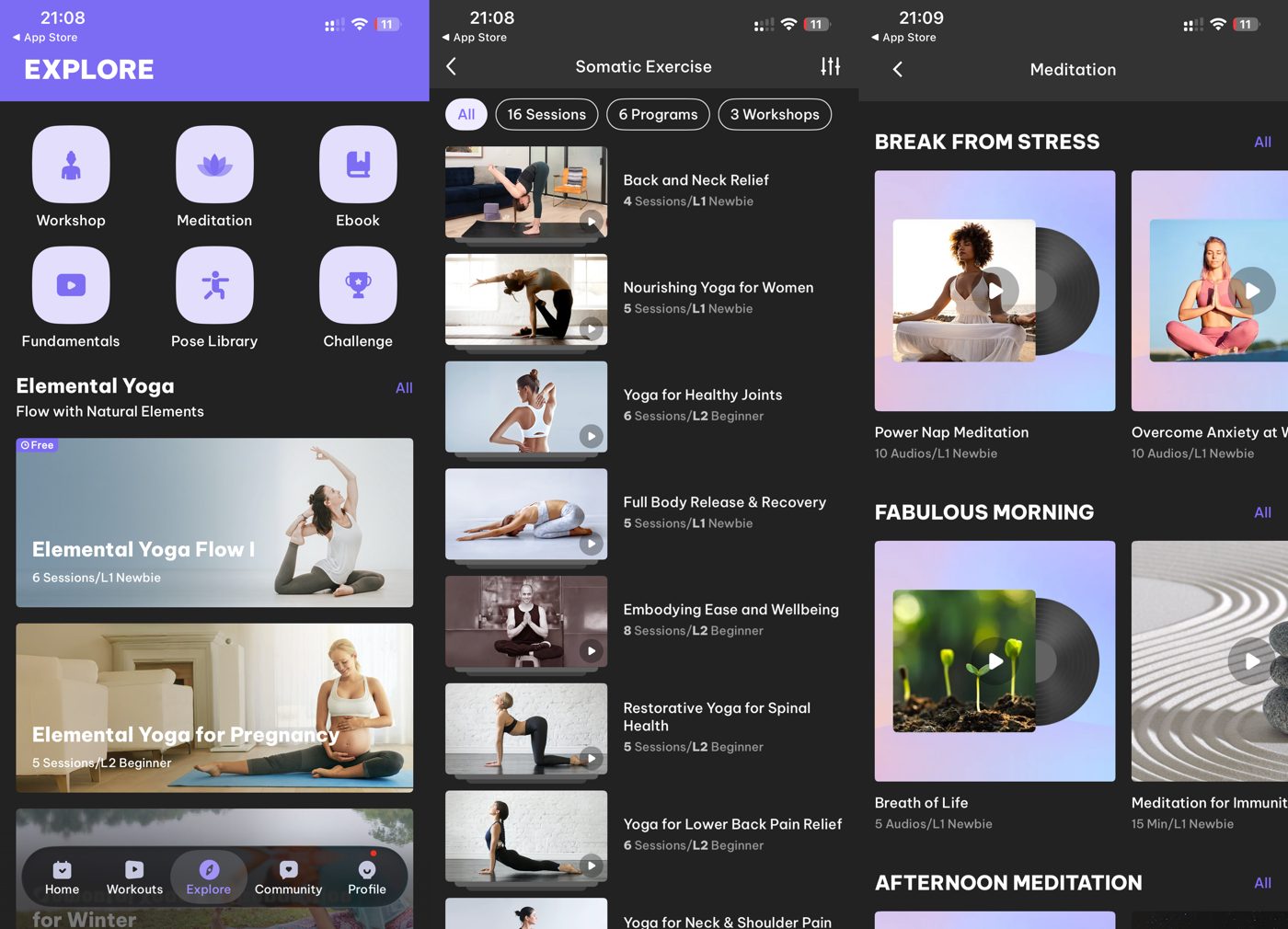
How this profile is different. We walked through the Daily Yoga onboarding and browsed the library ourselves, and the screenshots here are our own, but we could not complete a workout because there is no free trial, so this stays a research-based Data Profile rather than a hands-on review. It is built from the official pages, the app, aggregated user reviews and the science, scored only where the evidence reliably supports it, and where a rating genuinely needs completed workouts we say so. This is education, not medical advice; speak to your clinician, especially about HRT or existing conditions.
Daily Yoga Data Profile 2026: Quick Answer
Data profile: research-based, not personally tested. Hands-on score pending.
Women who want a big, affordable library of yoga, chair yoga, restorative and meditation with a guided plan to follow, and who like structure and variety
Your priority is progressive strength and bone loading or menopause-specific programming, or you dislike heavy in-app upselling; Daily Yoga has no menopause track and is known for frequent upsell pop-ups
A long-running yoga and meditation app with hundreds of pre-recorded classes, a 500-plus pose library, guided programs and a 28-day SmartCoach plan
About 5 to 45 minutes, with lots of short 7 to 15 minute options
A mat, plus optional blocks or a strap
Low, across yoga, chair yoga, Pilates and Tai Chi
Good low-impact and mind-body base with gentle and chair options, but no menopause programming, no pelvic-floor track, no hormone content and light on bone loading
None. All classes are pre-recorded and on demand
iOS, Android and an Apple Watch app; casts to a TV; offline downloads; syncs to Apple Health
Silver Pro about $12.99/month or $42.99/year; Gold Pro about $19.99/month, with annual plans that vary by promotion; discounted annuals come and go, so the price you see varies
A limited free tier plus a 7-day trial; the free tier is ad-supported with frequent upsell prompts
Cancel via the App Store or Google Play; users report frequent auto-renewal and cancellation complaints, so set a reminder before renewal
Neutral; makes no medical claims and is silent on menopause medicine
Active and frequently updated, with recent chair yoga, somatic and Tai Chi additions
5.9 / 10
Quick Verdict
Worth it for women over 40? Yes as an affordable, structured yoga and mind-body library, with a real caveat about billing, and no as a menopause tool.
Daily Yoga earns 5.9/10 on our research-based evaluation. Its strengths suit a midlife body and mind well: it is low-impact and joint-friendly across yoga, chair yoga, Pilates and Tai Chi, it has an unusually deep restorative and meditation library for recovery and a calmer nervous system, and, unlike a purely generative app, it gives you guided programs and a 28-day SmartCoach plan to follow, so there is real structure. The limits for our audience are real: it uses bodyweight and light work, so it under-delivers on the progressive strength and bone loading midlife guidance prioritises; beyond some menopause self-care mindfulness it has no menopause exercise programming or pelvic-floor work; and its biggest drawback is the experience around money, with well-documented complaints about relentless upsell pop-ups, even for paying members, and about auto-renewal and cancellation.
Start here: use the free tier and trial for the yoga, chair and meditation content, set a renewal reminder, and pair it with a heavier strength habit for bone and muscle.
Is Daily Yoga right for you?
Daily Yoga is strongest for training on low energy (8.0 out of 10, against a 5.7 average across the 77 programmes scored) and weakest for building bone density (2.5 against 5.1).
| Question | Verdict | Rating | Score |
|---|---|---|---|
| How it suits a perimenopausal body | |||
| Is Daily Yoga good for pelvic floor problems?Based on pelvic floor support and low-impact design | Moderate, about the same as mostmost score 4.6/10 | 5.0 / 10 | |
| Is Daily Yoga genuinely built for perimenopause and menopause?Based on menopause programming, hormone awareness, education and expert credibility | Low, and worse than mostmost score 3.3/10 | 2.0 / 10 | |
| Is Daily Yoga good for painful joints?Based on low-impact design and recovery provision | Strong, and better than mostmost score 6.2/10 | 8.0 / 10 | |
| Is Daily Yoga manageable when your energy is low?Based on recovery provision and mind-body support | Strong, and better than mostmost score 5.7/10 | 8.0 / 10 | |
| Is Daily Yoga good if you are new to strength training?Based on beginner on-ramp and mind-body support | Strong, and better than mostmost score 6.1/10 | 8.0 / 10 | |
| Is Daily Yoga good for building bone density?Based on bone loading and progressive strength | Low, and worse than mostmost score 5.1/10 | 2.5 / 10 | |
| Does Daily Yoga help with nutrition?Based on midlife nutrition support | Low, and worse than mostmost score 4.0/10 | 2.0 / 10 | |
| How it performs as a product | |||
| Can you fit Daily Yoga into a busy week?Based on time efficiency | Strong, about the same as mostmost score 7.6/10 | 8.0 / 10 | |
| Is Daily Yoga worth the money?Based on value for money | Moderate, and worse than mostmost score 6.9/10 | 6.0 / 10 | |
Jump to Section
What Daily Yoga Actually Is
Daily Yoga is one of the longest-running yoga apps, launched around 2012, and it has grown into a broad yoga, meditation and light-fitness library. Unlike a generative app that builds a fresh flow each time, Daily Yoga plays pre-recorded classes: hundreds of guided sessions, a pose library of more than 500 asanas with step-by-step instructions, structured multi-week programs, and a 28-day SmartCoach plan that sequences existing classes toward a goal you choose. Around the yoga sit meditation and yoga nidra, a large community feed with challenges and leaderboards, and, more recently, chair yoga, somatic yoga, Pilates, wall Pilates and Tai Chi. Sessions run from a few minutes to around 45, with plenty of short 7 to 15 minute options, and you can download classes for offline use.
For this audience it is worth being precise about what Daily Yoga is and is not. It is a genuinely deep, affordable low-impact and mind-body library, and its gentle, chair and restorative content makes it approachable for an older or stiffer body. What it does not have is any menopause-specific programming: there is no perimenopause or menopause track, no menopause education inside the app, and no dedicated pelvic-floor work. It is also worth naming the app’s most consistent drawback up front, because it shapes the whole experience: reviewers repeatedly describe frequent upsell pop-ups and ads, and a pattern of auto-renewal and cancellation complaints. Read Daily Yoga as a rich, structured yoga and mind-body library at a low headline price, with the billing experience as the thing to go in with your eyes open about.
Who Is Behind Daily Yoga? Credibility
Daily Yoga is published by Daily Yoga Culture Technology Co., a developer that launched the app around 2012, which makes it one of the oldest yoga apps on the market. Longevity and scale are real signals: the library is large, the app is actively updated, and it has tens of millions of downloads over the years. Its classes are produced by in-house professional yoga coaches. What it does not have is clinical authority for the menopause questions some readers will bring. The individual teacher profiles and credentials are thin and rarely surfaced, and there is no named physiotherapist, physician, women’s-health clinician or menopause specialist involved, and no medical advisory board. It is also worth noting that some of the app’s marketing and the SmartCoach onboarding lean toward weight-loss framing rather than a consistently weight-neutral approach. Read Daily Yoga as a competent, high-volume general-wellness yoga product with a credible operating history, rather than a source of menopause or medical guidance.
Content and Features
At a glance: a deep, structured yoga and mind-body library with strong recovery content, guided programs and a beginner-friendly plan, at a low headline price. It has no menopause track, is light on progressive strength, and the upsell-heavy experience is a real drawback.
| Format | Pre-recorded, on-demand classes and multi-week programs, plus a 28-day SmartCoach plan; no live classes. |
| Disciplines | Yoga (Vinyasa, Hatha, Yin, Restorative, Yoga Nidra and more), plus chair yoga, somatic yoga, Pilates, wall Pilates, Tai Chi and meditation. |
| Menopause / perimenopause | Limited. Some menopause self-care mindfulness content, but no menopause exercise programming or hormone content. |
| Prenatal and postnatal | Not confirmed as a dedicated program. |
| Pelvic floor | No standalone pelvic-floor program; only incidental core and breath work within general classes. |
| Recovery and mind | Strong. A large meditation and yoga nidra library, plus restorative and yin yoga, with a calm, self-paced feel. |
| Nutrition | Light only. Wellness and recipe e-books rather than a structured meal-plan or tracking system. |
| Strength | Bodyweight yoga plus light Pilates and HIIT; mobility and some tone rather than heavy progressive loading. |
| Structure | Guided programs, a 500-plus pose library with instructions, five difficulty levels and a 28-day SmartCoach plan; more structured than a generative app. |
| Community and coaching | A large community feed with challenges and leaderboards; no live coaching or form correction. |
What Equipment Do You Need for Daily Yoga?
Daily Yoga needs very little. For the yoga, chair, restorative and meditation work you really only need a mat, and, if you like, a couple of blocks and a strap to make poses more accessible, which is especially useful for a midlife body easing back into flexibility work. The Pilates and wall Pilates practices are mostly bodyweight, though a set of light hand weights adds a little resistance if you want it. If you want any of the work to keep challenging your strength over time, a slightly heavier adjustable pair is worth having, because bodyweight and light fixed weights stop providing a strength stimulus once you adapt.
Recommended spec examples. These picks are curated by specification and feature fit, not personally lab-tested for long-term durability. Prices are examples; verify before buying.
Exercise mat
~$20 to $40
The one essential. Every yoga, chair yoga, Pilates and Tai Chi class is mat-based; a half-inch mat is kinder to knees, hips and spine.
Yoga blocks
~$15 a pair
Optional but helps. Brings the floor closer so poses stay accessible for a midlife body; buy two.
Light dumbbells
from ~$9
Optional. A light 1 to 5 lb pair adds a little load to the Pilates work; the app itself stays bodyweight.
Bottom line on equipment: a mat covers the yoga, chair and meditation work; add blocks and a strap for accessibility, and light weights only if you want a little more resistance.
How We Scored Daily Yoga: the 5.9 / 10 Breakdown
Research-based scores on our 9 weighted criteria. Because this is a Data Profile rather than a hands-on test, each score carries a confidence level. Women Over 40 is our most heavily weighted menopause criterion, and its full 12-capability breakdown follows in the next section.
| Category | Weight | Score | Reasoning (confidence) |
|---|---|---|---|
| Time Efficiency | 15% | 8 | Plenty of short 7 to 15 minute sessions and adjustable lengths fit a busy schedule. (confidence: high) |
| Muscle Potential | 18% | 4 | Bodyweight yoga plus light Pilates and HIIT build some tone, but there is no progressive external loading. (confidence: high) |
| Women Over 40 Specificity | 10% | 4.1 | Strong low-impact and mind-body base with gentle and chair options, but no menopause layer and light bone loading; full breakdown below. (confidence: high) |
| Joint Friendliness | 12% | 7 | Low-impact across yoga, chair and Tai Chi, though there is no live form correction. (confidence: high) |
| Recovery Compatibility | 10% | 8 | A deep meditation, yoga nidra and restorative library makes recovery a genuine strength. (confidence: high) |
| Programme Structure | 12% | 7 | Guided programs and a 28-day SmartCoach plan give real structure, more than a generative app. (confidence: medium) |
| Value for Money | 8% | 6 | A deep library at a low headline price, but confusing rotating promotions and heavy upselling erode the value. (confidence: medium) |
| UX and Design | 8% | 6 | Polished content undermined by recurring upsell pop-ups and ads and by auto-renewal complaints. (confidence: high) |
| Nutrition Integration | 7% | 2 | Only light recipe e-books; no structured nutrition system. (confidence: high) |
| Total | 100% | 5.9 / 10 | Research Score; hands-on score pending. |
Is Daily Yoga Good for Women Over 40?
In many ways, yes. Daily Yoga is a low-impact, joint-friendly way to practise yoga and mind-body movement at home, and its gentle, chair, restorative and Tai Chi content is well suited to a body that is easing back into movement or managing stiffness. Older and returning users repeatedly report real benefit from exactly this content. It has an unusually deep meditation and yoga nidra library, which supports a calmer nervous system when stress sensitivity and sleep disruption rise in perimenopause. And unlike a purely generative app, it gives you guided programs, five difficulty levels and a 28-day SmartCoach plan, so a woman who wants a clear path to follow gets real structure rather than a blank page.
Who it suits, and what is missing. The gaps are specific and important for this site. First, strength and bone. Midlife guidance prioritises progressive resistance and heavier loading to protect muscle and bone, and Daily Yoga’s bodyweight and light work builds mobility and some tone but sits below the stimulus needed for real strength or bone-density gains. Second, menopause. There is no perimenopause or menopause programming, no menopause education and no dedicated pelvic-floor work, so it is a general wellness tool rather than a menopause solution. Third, the experience around money. The frequent upsell prompts and the auto-renewal and cancellation complaints are a genuine friction, and worth planning around before you subscribe. It suits a woman who wants an affordable, structured, low-impact practice; it is a weaker single choice for someone whose priority is bone, muscle or menopause-specific support.
What the wider picture shows. Reviewers and long-term users describe Daily Yoga the way we would: a deep, affordable, beginner and senior-friendly library that people genuinely stick with, alongside a steady drumbeat of complaints about the upselling and the billing. One caution that matters more for a 40-plus or injured body is that some users find the default beginner instruction does not always cue side changes or hold lengths clearly, and there is no live teacher to correct your form. Read Daily Yoga as a strong low-impact and mind-body foundation for a woman over 40, best paired with a dedicated heavier-strength habit and, if menopause support is the priority, with guidance from elsewhere.
This is the perimenopause and menopause assessment, and it is separate from the overall score. Twelve things a programme either does for a midlife body or does not, each scored out of 10 with my reasoning next to it. Together they produce a single menopause fit score, and that becomes one of the nine categories in the overall scoring below.
How Daily Yoga Fits Perimenopause, Menopause & Beyond
Women Over 40 is our most important criterion, and here's the full breakdown behind it.
Daily Yoga is strongest for low-impact, recovery & deload, mind-body support and beginner on-ramp, and weakest for menopause programming, hormone awareness, bone loading, pelvic floor, midlife nutrition, progressive strength, menopause education and expert credibility, in our menopause and midlife capability assessment for women over 40.
At a glance
| Capability | Score | Rating | Why |
|---|---|---|---|
| Right training for a midlife body | |||
| Low-impact | 8/10 | Strong | The whole library, from yoga to chair yoga, Pilates and Tai Chi, is low-impact and joint-sparing. |
| Progressive strength | 3/10 | Minimal | Bodyweight yoga and light Pilates only, with no external load or rep-and-set progression. |
| Bone loading | 2/10 | None | No weighted or high-impact loading; yoga sits below the threshold that drives bone-density gains. |
| Recovery & deload | 8/10 | Strong | A deep restorative, yin, yoga nidra and meditation library makes recovery a genuine strength. |
| Built for menopause | |||
| Menopause programming | 1/10 | None | No menopause or perimenopause programming; the content is general wellness only. |
| Pelvic floor | 2/10 | None | No dedicated pelvic-floor track; only incidental core and breath work within general classes. |
| Hormone awareness | 1/10 | None | No cycle or hormone-phase awareness anywhere in the content. |
| Menopause education | 3/10 | Minimal | Some menopause self-care mindfulness content, but no structured menopause education or symptom guidance. |
| Expert credibility | 3/10 | Minimal | In-house yoga coaches with thin named credentials; no clinician, pelvic PT or menopause specialist and no advisory board. |
| Whole-woman support | |||
| Mind-body support | 8/10 | Strong | A large meditation and yoga nidra library plus an active community and challenges. |
| Beginner on-ramp | 8/10 | Strong | Five levels, a SmartCoach plan and a famously beginner-friendly design, though the upsell friction dents it. |
| Midlife nutrition | 2/10 | None | Only light recipe e-books; no structured or midlife-specific nutrition guidance. |
ScaleBest-in-classStrongSomeMinimalNone
What the sources say: Research-based (no hands-on testing; browsed onboarding and library), derived from the official pages, the app store listings and aggregated user reviews.
These are evidence-informed suitability ratings, not clinical measurements. They combine exercise science with product-specific research and, where indicated, hands-on testing, alongside multi-source verification, and are approximate. Individual response varies. A starting point, not medical advice. How we score menopause fit
What the sources say: scores combine the official pages, the app store and user reviews. Low-impact, recovery, mind-body support and beginner on-ramp scored well because they are core, verifiable strengths and a good match for a midlife body. The built-for-menopause group scored low because, beyond some menopause self-care mindfulness content, there is no menopause exercise programming, hormone or standalone pelvic-floor content, and progressive strength and bone loading are limited by the bodyweight and light-weight format.
These are evidence-informed suitability ratings, not clinical measurements. They combine exercise science with published-feature analysis and multi-source verification, and are approximate. Individual response varies. A starting point, not medical advice. How we score menopause fit.
What the Research Says: Daily Yoga’s Approach Checked
Daily Yoga’s low-impact, mind-body approach is well matched to some midlife needs, with important caveats. Yoga has real, if modest, benefits for menopausal women: a systematic review and meta-analysis of 13 trials found yoga reduced menopausal symptoms, most consistently the psychological ones and comparable to other forms of exercise, though the evidence was rated low quality, so we would frame it as helpful for wellbeing rather than a treatment for hot flashes.[1] Its meditation content has a similar profile: a meta-analysis found mindfulness-based interventions improved quality of life and reduced stress in menopausal women, without strong evidence they reduce hot flashes.[2] A 2025 review of mind-body therapies also found benefits for menopausal mood and sleep, though these pool several practices rather than yoga alone.[3] In older adults, yoga improves balance, lower-body strength and flexibility, which are fall-risk factors, though the evidence does not show it prevents actual falls, so we do not claim that.[4] On sleep specifically, be cautious: a meta-analysis found yoga improved sleep in women overall while the peri and postmenopausal subgroup showed no significant benefit.[5]
The caveat that matters most for our audience is strength and bone. The biggest gains for midlife muscle and bone come from progressive resistance and heavier loading. In the LIFTMOR trial, brief high-intensity resistance and impact training improved bone density and function in postmenopausal women, whereas light, low-intensity exercise did not, and reviews confirm that bone responds to higher mechanical loads.[6][7] Daily Yoga’s bodyweight and light work sits well below that threshold, so treat it as excellent low-impact conditioning, mobility and mind-body practice rather than a strategy for building strength or bone. It can genuinely help with everyday aches too: a Cochrane review found yoga produced small to moderate improvements in back-related function and pain, comparable to other exercise.[8] Pair Daily Yoga with a dedicated heavier-strength routine to cover what it cannot.
What Users Report: Verified Sentiment
Rating snapshot: the content is widely liked and the billing is not, and that split is the story. On Google Play, the largest sample, Daily Yoga holds about 4.1 stars from roughly 150,000 to 162,000 reviews on more than 10 million installs. On the Apple App Store it sits higher at about 4.7, but on a much thinner United States sample of a few thousand ratings, and the app actively prompts ratings, so we treat that number with caution. On Trustpilot, a small and self-selected sample of around 99 reviews averages about 1.2, with roughly 96 percent one-star, almost entirely about billing. The most reliable single figure is the Google Play 4.1 on a large base.
Consistently praised
- A large, varied library with a fresh class to do each day.
- Beginner-friendly progression, five levels and the SmartCoach plan.
- A deep meditation library and an active community with challenges.
- Gentle, chair and restorative content that older users return to.
Consistently criticised
- Frequent upsell pop-ups and ads, reported even by paying members.
- Auto-renewal, refund and hard-to-cancel billing complaints.
- Confusing, rotating promotional pricing and tiers.
- Occasional bugs, and default instruction that can under-cue for beginners.
Source and credibility note: figures were read live from Google Play, the Apple App Store and Trustpilot (August 2026). The Google Play 4.1 on a large base is the population signal; the Apple 4.7 sits on a thin, prompt-lifted sample, so we weight it lightly; the Trustpilot 1.2 is a tiny, self-selected billing-complaint venue rather than a content verdict. Developer replies are largely templated. No women-40-plus breakdown exists in the review corpus, so that lens is inferred from features and older-user comments, not reviewer statements.
Devices, Platforms and App
Daily Yoga runs on iOS and Android, with an Apple Watch app, and you can cast classes to a television, download sessions for offline use and sync activity to Apple Health. That casting and Apple Watch support is a genuine convenience for practising in the living room and tracking a session. The practical catch, and the biggest theme in the reviews, is not the hardware but the experience: the free tier is ad-supported with frequent upsell prompts, and several members report the same pop-ups even after paying, so during the trial it is worth seeing how intrusive you find them before you commit. For a woman over 40 who wants a calm practice, that friction is the thing to weigh against the depth of the library.
Daily Yoga specifications
- Free trial
- Free tier + trial (multiple overlapping memberships)
- Cancellation
- cancel/turn off auto-renew via store/account
- Session length
- ~5 to 60+ min
- Who makes it
- Hong Kong Daily Yoga Culture Technology Co. (China); Apple listing now shows publisher PhoeniXcel Limited; certified yoga instructors; no clinician
- Still maintained
- Active; iOS v8.90.00 (2026-05-16)
- What is included
- On-demand classes: yesLive classes: partlyRecovery content: yesMenopause education: partlyStructured programmes: yesMeditation: yesNutrition guidance: no
- Women over 40
- Pelvic floor work: noMenopause clinician involved: noInjury modifications: partlyBone-health focus: noModified progressions: partlyCycle syncing: noPrenatal options: partly
- Devices and access
- Offline downloads: yesCasting to TV: noSubtitles: noWearable sync: partly
- Support
- Clinical advisory board: noCommunity: partlySupplement upsell: no
- Last verified
- 12 August 2026
Daily Yoga Price 2026: What You Actually Pay
| Plan | Cost | Includes |
|---|---|---|
| Free tier and trial | Free, plus a 7-day trial | A limited set of classes free, ad-supported with upsell prompts; the trial opens full access and requires a card. |
| Silver Pro | About $12.99/month or $42.99/year | The standard membership, unlocking the wider class and program library. |
| Gold Pro | About $19.99/month; annual varies by promotion | The higher tier, adding master classes and workshops. |
| Annual promotions | Roughly $49.99 to $69.99/year, varying | Discounted annual bundles that rotate by promotion, so the price you are shown varies. |
Cancellation and Billing
This is the part to plan around. Daily Yoga can be cancelled through your Apple App Store or Google Play subscriptions, with access continuing to the end of the billing period, but reviewers report a recurring pattern of auto-renewal at full price, difficulty cancelling and refused refunds, and a Trustpilot profile that is heavily weighted to billing complaints. The pricing itself rotates through many promotional offers, so two people can see different prices. Practical steps: prefer to subscribe through the App Store or Google Play so cancellation is in your own account settings, set a calendar reminder a day or two before any trial or renewal, and keep a confirmation. Prices were checked in August 2026; confirm the current figure at checkout.
Will You Actually Stick With It?
Five levels, a guided plan and gentle options make this an easy app to start and keep up.
The yoga, chair and meditation work is calm by design, so it rarely leaves you needing days to recover.
Bodyweight and light work mean strength gains stall unless you add heavier loading elsewhere.
Frequent pop-ups and billing complaints can wear on the experience; manage the subscription carefully.
Daily Yoga Pros and Cons
Pros
- A deep, affordable library of yoga, chair yoga, Pilates, Tai Chi and meditation
- Low-impact and joint-friendly across the whole catalogue
- Strong recovery content: restorative, yin, yoga nidra and meditation
- Real structure: guided programs, five levels and a 28-day SmartCoach plan
- Beginner and senior-friendly, with gentle and chair options
- A 500-plus pose library with step-by-step instructions
- An Apple Watch app, casting to a TV and offline downloads
- A large community feed with challenges
Cons
- Frequent upsell pop-ups and ads, reported even by paying members
- Auto-renewal, refund and hard-to-cancel billing complaints
- Confusing, rotating promotional pricing
- Bodyweight and light work under-deliver on progressive strength and bone loading
- No menopause programming, education or standalone pelvic-floor track
- No live teacher, and default instruction can under-cue for beginners
- No clinician or menopause specialist; thin named-teacher credentials
How Daily Yoga Compares to Similar Platforms
If you are deciding between low-impact, yoga-led home platforms, this is how Daily Yoga sits against the alternatives. Scores come from our independent reviews and update automatically as each is scored; Pvolve is included as the menopause-built contrast.
| Feature | Daily Yoga | Down Dog | FitOn | Peloton | Pvolve |
|---|---|---|---|---|---|
| Our score | 5.9 / 10 (research) | 6.0 / 10 | 7.3 / 10 | 7.3 / 10 | 8.3 / 10 |
| Monthly price | from ~$12.99/mo · ~$42.99/yr | $12.99/mo · ~$99.99/yr | Free tier · ~$29.99/yr Pro (verify) | ~$12.99 to $44/mo (verify) | $24.99/mo · equipment from $199 |
| Free trial | 7 days (plus limited free tier) | Yes (brief, card required) | Generous free tier | Yes (app tiers) | 14 days (card required) |
| Best for | Affordable, structured yoga and mind-body library | Flexible, generative yoga and mind-body practice | Free, varied at-home workouts | Studio-style cycling and classes | Low-impact functional strength, menopause, joints |
| Impact level | Low | Low (yoga); high in the HIIT app | Low to moderate | Moderate to high | Low by design |
| Progressive strength | Bodyweight and light weights | Bodyweight and light weights | Some, light weights | Yes | Yes, functional |
| Programme structure | Guided programs and SmartCoach plan | Generative, self-directed | Some programs | Structured classes and plans | Guided programs |
| Perimenopause content | None | None | Minimal | Some women’s-health content | Best in class: Menopause Strong, pelvic floor |
| Mind-body content | Strong, yoga and meditation | Strong, yoga and meditation | Good | Good | Some |
| App Store rating | 4.1 Android · 4.7 iOS (thin) | ~4.9 iOS · ~4.9 Android | 4.8 iOS | 4.9 iOS | ~4.9 (streaming app) |
| Best suited to | Women wanting an affordable, structured yoga and mind-body library | Women wanting flexible, customisable yoga practice | Women wanting free, varied home workouts | Cycling and studio-class fans | Women ~35+, perimenopause, joint issues |
Competitor prices are approximate; verify on each platform’s website. Scores reflect our independent reviews. See each full review for methodology.
Daily Yoga vs Down Dog: Which Is Better for Women Over 40?
This is the closest pairing for a woman who mainly wants yoga at home: both are affordable, deep and beginner-friendly, and both are low-impact and light on the progressive strength and bone loading a midlife body needs. Down Dog generates a fresh, non-repeating session each time and lets you set the level, length, pace and focus, which keeps practice from getting stale and makes it unusually easy to tailor to a stiff or tired body. It suits a woman who wants deep customisation and a calm, self-directed practice, and its store ratings and billing reputation are cleaner.
Daily Yoga is different in feel: instead of generating sessions, it gives you a large library of pre-recorded classes, guided multi-week programs and a 28-day SmartCoach plan, so it is the better pick if you want structure and a clear path to follow rather than a blank page, and it adds a big community, chair yoga and Tai Chi. The trade-off is the experience around money: Down Dog is the calmer, cleaner subscription, while Daily Yoga is cheaper at the headline level but comes with frequent upsell prompts and more billing complaints. Neither is a menopause tool. For a customisable, generative practice with a cleaner subscription, Down Dog; for a structured, affordable library with guided plans, Daily Yoga; and for genuine menopause programming and pelvic-floor work, a purpose-built option such as Pvolve goes further than either.
If Daily Yoga Is Not Right for You: Best Alternatives
Daily Yoga has a deep, affordable low-impact library, but it is light on strength, not menopause-built, and pushes heavy upsells. If that is your sticking point, here is where our other reviews point:
- Best generative yoga without the upsell: Down Dog builds a fresh session each time with far less sales friction.
- Best for menopause-specific design: Pvolve adds clinically informed, low-impact menopause programming.
- Best free filterable library: FitOn offers yoga, strength and Pilates you can sort by type and length, free.
Daily Yoga FAQ
Daily Yoga is one of the oldest yoga apps, launched around 2012, offering a large library of pre-recorded yoga, chair yoga, Pilates, Tai Chi and meditation classes. It includes guided multi-week programs, a 500-plus pose library with instructions, five difficulty levels, a 28-day SmartCoach plan and a community feed with challenges. Classes run from a few minutes to around 45, with many short options.
It is freemium. The Silver Pro membership is about $12.99 a month or $42.99 a year, and the higher Gold Pro tier is about $19.99 a month, with annual plans that vary by promotion, and discounted annual offers come and go, so the price you see varies. There is a limited free tier and a 7-day trial that requires a card. Prices rotate through many offers, so confirm the current figure at checkout.
As affordable, low-impact yoga and mind-body practice, yes: it is joint-friendly, calming and easy to start, with strong gentle, chair, restorative and meditation content that older users value. But it is not menopause-built. There is no menopause programming or education, no standalone pelvic-floor track, and its bodyweight and light work does not provide the progressive strength or bone loading a midlife body needs, so pair it with heavier strength work.
The most consistent complaints are about the experience around money: frequent upsell pop-ups and ads, reported even by paying members, and a pattern of auto-renewal at full price, difficulty cancelling and refused refunds, which is why its Trustpilot profile skews heavily to one-star reviews. The content itself is well liked. To avoid surprises, subscribe through the App Store or Google Play so cancellation is in your own settings, and set a reminder before any trial or renewal.
Only up to a point. Daily Yoga uses bodyweight yoga and light Pilates work, which build mobility and some tone but sit below the loading needed for meaningful strength or bone-density gains. The evidence is clear that bone and strength respond to heavier, progressive resistance. Treat Daily Yoga as excellent low-impact conditioning, mobility and mind-body practice, and add a dedicated heavier-strength routine for muscle and bone.
For a woman who wants an affordable, structured, low-impact yoga and mind-body library with a guided plan to follow, Daily Yoga offers a lot for a low headline price and is easy to stick with. The caveats are real: it is a weaker choice if your priority is progressive strength, bone or menopause-specific support, and the upsell and billing experience is a genuine drawback to manage. This is a research-based Data Profile; a hands-on test is still to come.
Final Verdict
Research Score: 5.9 / 10 · Hands-on Score: pending
Daily Yoga is a deep, affordable and genuinely structured yoga and mind-body library, and one of the more senior and beginner-friendly options we have profiled. It is low-impact and joint-friendly, its restorative and meditation content genuinely supports recovery and a calmer nervous system, and its guided programs and SmartCoach plan give real structure. That earns it a solid research-based score. The moderating factors for our audience are that its bodyweight and light work under-delivers on the progressive strength and bone loading that protect a midlife body, beyond some menopause self-care mindfulness it has no menopause exercise programming or pelvic-floor track, and its upsell-heavy experience and billing complaints are a real drag on the value and the day-to-day feel.
Daily Yoga is for women who want an affordable, structured, low-impact practice with a clear path to follow, and who are happy to manage the subscription carefully. Daily Yoga is not for women whose priority is progressive strength and bone, or menopause-specific programming, or who want a calm, upsell-free subscription, who would be better served by adding heavier strength work and, for menopause, a purpose-built option such as Pvolve.
Testing Status
Research profile complete (official site, App Store, Google Play and Trustpilot, user reviews, peer-reviewed exercise and menopause science). Hands-on testing: pending. When we test it, first-person notes, real screenshots, adherence and a Hands-on Score are added to this same page, moving it to Sample-tested then Fully tested. How we score and profile.
Sources and Further Reading
- Cramer, H., Peng, W., Lauche, R. (2018). Yoga for menopausal symptoms: a systematic review and meta-analysis. Maturitas. Available at: pubmed.ncbi.nlm.nih.gov. Yoga reduced menopausal symptoms, most consistently psychological ones, comparable to other exercise; evidence rated low quality.
- Chen, T.L. et al. (2021). Effectiveness of mindfulness-based interventions on quality of life and menopausal symptoms in menopausal women: a meta-analysis. Journal of Psychosomatic Research. Available at: sciencedirect.com. Mindfulness improved quality of life and reduced stress, with insufficient evidence it reduces hot flashes.
- Fan, Z. et al. (2025). Mind-body therapies for sleep disturbances, depression and anxiety in menopausal women: a systematic review and meta-analysis of RCTs. Frontiers in Public Health. Available at: pmc.ncbi.nlm.nih.gov. Mind-body therapies improved menopausal sleep, depression and anxiety; results pool several practices, not yoga alone.
- Sivaramakrishnan, D. et al. (2019). The effects of yoga compared to active and inactive controls on physical function and health-related quality of life in older adults: a systematic review and meta-analysis. International Journal of Behavioral Nutrition and Physical Activity. Available at: pmc.ncbi.nlm.nih.gov. Yoga improved balance, lower-limb strength and flexibility (fall-risk factors), not actual falls.
- Wang, W.L. et al. (2020). The effect of yoga on sleep quality and insomnia in women with sleep problems: a systematic review and meta-analysis. BMC Psychiatry. Available at: link.springer.com. Yoga improved sleep in women overall, but the peri and postmenopausal subgroup showed no significant benefit.
- Watson, S.L. et al. (2018). High-intensity resistance and impact training improves bone mineral density and physical function in postmenopausal women: the LIFTMOR randomized controlled trial. Journal of Bone and Mineral Research. Available at: pubmed.ncbi.nlm.nih.gov. Heavier, high-intensity loading improved bone density; light exercise did not.
- Kumar, S. et al. (2025). Exercise for postmenopausal bone health: can we raise the bar? Current Osteoporosis Reports. Available at: pmc.ncbi.nlm.nih.gov. Bone-building needs high-magnitude loading; low-to-moderate exercise yields minimal bone-density change.
- Wieland, L.S. et al. (2017). Yoga treatment for chronic non-specific low back pain. Cochrane Database of Systematic Reviews. Available at: cochranelibrary.com. Yoga gave small to moderate short-term improvements in back function and pain, comparable to other exercise.
This is a research-based Data Profile, not a hands-on review. Pricing and features were verified August 2026 and may have changed. Some affiliate links may be present. This site does not accept payment from platforms reviewed. Education, not medical advice; speak to your clinician, especially about HRT or existing conditions.
Related Guides
What To Do Next
- → Take our 2-minute quiz for a personalised recommendation.
- → See our best workouts for perimenopause rankings.
- → Compare with our Down Dog review and see how we score every programme.