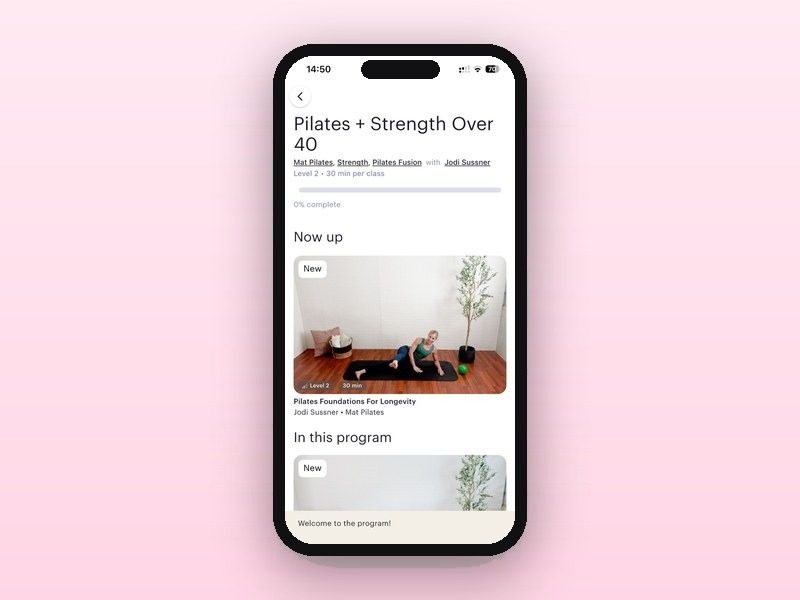
Menovation scores higher overall, 7.7 against 7.3, and is the stronger platform for joint-friendly training and app quality. Owning Your Menopause is the better pick if what you need most is value for money and menopause-stage suitability.
Quick answer
- Menovation 7.7 vs Owning Your Menopause 7.3
- Menovation wins three criteria, OYM two, four tied
- Muscle 8 vs 7
- Beginner on-ramp 6 vs 9
- Menovation $28.99/mo, OYM £16.99/mo
- Neither shows joint modifications
Menovation is the better platform if you want the training itself to move you forward. It wins Muscle Potential, 8 against 7, and progressive strength capability 8 out of 10 against 6. Over the five-week PowHERful programme she took her working weights from around 11 lb to 13 lb upper body and 17 lb to 20 lb lower body per hand. It also wins Joint Friendliness, 8 against 6.5, and UX and Design, 6.5 against 5.
Owning Your Menopause is the better platform if you are starting out or want the wider specialist library. Beginner on-ramp is 9 out of 10 against 6, the widest capability gap here. It wins Women Over 40 Specificity, 7.7 against 7.6, Value for Money, 7.5 against 6.5, hormone awareness 9 against 8 and pelvic floor 8 against 7. It also costs less.


The two tests were not equivalent, and the difference matters for one score in particular. Menovation was tested for six to eight weeks on iOS, including the five-week PowHERful programme completed in full, with the tester training at her normal load of 11 to 20 lb dumbbells per hand. Owning Your Menopause was tested across two separate periods totalling about eight weeks, and the first of those began shortly after she had recovered from a meniscus injury, so she deliberately trained light on 4 to 9 lb and 13 lb dumbbells. Read the Muscle Potential gap with that in mind. She also increased her protein intake and reduced sugary food during the Menovation period, which she states herself when reporting her results, so the body-composition change on that platform is not attributable to the training alone.
Menovation if you already train and want a programme that adds load, and if you can accept working from a phone. Owning Your Menopause if you are newer to strength, want the broadest menopause library on either platform, and want to pay less. The complication worth stating plainly is that Katy Cole left both. She moved on from Menovation’s MAM30 format and was frustrated by its interface, and she stepped away from Owning Your Menopause because the workouts alone did not hold her, while planning to return for its education. Both earn the trial. Neither earned a year.
Menovation vs Owning Your Menopause: the two platforms
Same nine weighted criteria, same twelve capability scores, and two different answers to what a menopause platform should be.

Menovation
Winner
A perimenopause and menopause platform built around named strength programmes, with roughly 30 nutrition lessons and a library of short expert-led health tips covering hormones, mental health, intimacy and pelvic health.
- 20 to 30 min
- Progressive strength 8/10
- Expert credibility 9/10
- 8-day trial
- iOS in practice
Choose Menovation if you:
- Already train and want the load to go up rather than hold steady
- Want a fixed-length programme you can actually finish
- Want deep, practical nutrition education for this life stage
- Prefer a coach leading you through a session in one continuous flow
- Can accept training from a phone screen

Owning Your Menopause
Runner-up
A menopause-specialist platform pairing graded strength courses with specialist GP discussions, nutritionist and psychologist content, pelvic floor guidance, meditation and face yoga.
- 10 to 30 min
- Beginner on-ramp 9/10
- Hormone awareness 9/10
- 14-day trial
- Basic video production
Choose Owning Your Menopause if you:
- Are new to structured strength training
- Want to understand why each movement matters, not just copy it
- Want the widest menopause library on either platform
- Need sessions that can drop to 10 or 15 minutes on a bad day
- Want to pay less per month
How we scored this, and how both were tested
Both platforms were paid for and used for weeks, and both were scored on the same nine weighted criteria and the same twelve capability scores. The weighting puts Muscle Potential highest at 18%, then Time Efficiency at 15%, Joint Friendliness and Programme Structure at 12% each, Women Over 40 Specificity and Recovery Compatibility at 10%, Value for Money and UX and Design at 8%, and Nutrition Integration at 7%.
Same tester, same stage, same knee. Katy is in her mid-forties, in perimenopause, a working mum who has tested close to fifty fitness platforms, with a meniscus injury history. That last detail is not incidental here: her first period on Owning Your Menopause began shortly after she had fully recovered from that injury, which is why she trained deliberately light on it and why the Muscle Potential comparison needs the caveat we give it above.
Owning Your Menopause was also the only platform here tested twice. She used it for an initial stint of several weeks shortly after the injury, then logged back in more recently on the trial to reassess it with fresh eyes, which is a better test of whether a platform holds up than a single unbroken run.
She came to Menovation because a friend mentioned it and she was curious enough to sign up for the trial, mainly because she had never seen a platform built so explicitly for this life stage. She came to Owning Your Menopause looking for something that would meet her where she was physically while also addressing the perimenopause symptoms she was navigating. Two different entry points, and both are worth knowing when you read what each platform did for her.
Muscle potential: Menovation wins, and it is the clearest result on this page
Menovation wins, 8 against 7, with progressive strength capability 8 out of 10 against 6. Muscle Potential carries the heaviest weight in our model at 18%, because Maltais and colleagues document accelerated loss of muscle mass and strength through the menopause transition.2
What happened on Menovation
The five-week PowHERful programme with Kaitlin Heaney was the main test and the one she completed fully. Her weights moved: from around 11 lb to 13 lb for upper body exercises and from 17 lb to 20 lb for lower body exercises per hand. Her upper body muscle tone improved visibly. She also dropped from 141 lb to 136 lb, which she attributes to the combination of consistent training, increased protein intake and reducing sugary food during the same period. That attribution is hers, it is stated in the review, and we repeat it here rather than presenting the number as a training result.
The reason she finished it is worth as much as the numbers. In her words, she has abandoned more 12-week programmes than she cares to admit, and knowing this one was only five weeks made it easy to commit from the start. A programme you complete beats a better programme you quit in week three, and five weeks is a length that survives a normal life.
What happened on Owning Your Menopause
She completed both the Beginner and the Intermediate Strength courses with Kate Rowe-Ham, using 4 to 9 lb and 13 lb dumbbells, deliberately lighter than her usual training weight because she was recovering from a meniscus injury at the time of the first testing period. Her result was maintenance rather than gain: she maintained her existing muscle tone and noticed some definition returning around her core and belly area, which surprised her because she had been neglecting abdominal work entirely.
Two things follow. First, this is not a fair strength head-to-head, and the score gap partly reflects a lighter test rather than a weaker platform. Second, the ceiling is real regardless: the strength programming tops out at intermediate, so a woman already training hard will run out of platform. Her own read on what the coaching delivers is more positive than the score suggests. She believes these workouts will deliver real, visible results because the form coaching means you are actually recruiting the right muscles rather than compensating through momentum.
Bone loading
Menovation takes bone loading 7 out of 10 against 6, and neither is a bone programme. Mohebbi and colleagues identify progressive resistance training as the primary non-hormonal intervention for bone mineral density after menopause,4 and a further review reports improvements in menopause symptoms and functional capacity with resistance training, on evidence its own authors rate as very low to low certainty.5 Menovation edges this because the load actually progressed. If bone is your specific reason for training, our best workouts to build muscle after 50 ranking covers platforms built around it.
Perimenopause and menopause fit: a genuine tie on programming, and Owning Your Menopause takes the specificity score
Owning Your Menopause wins Women Over 40 Specificity, 7.7 against 7.6, and the capability scores show why the gap is narrow. Menopause programming ties at 9 out of 10 and menopause education ties at 9 out of 10, which are the two highest scores of their kind we have recorded. Owning Your Menopause pulls ahead on hormone awareness, 9 against 8, and pelvic floor, 8 against 7.
This is the part of the page where both platforms are unusually strong, and the comparison is about shape rather than quality. Menovation goes deep. Its roughly 30 nutrition lessons on perimenopause are, in Katy Cole’s words, some of the most complete, practical information she has found on this topic, and she has spent a lot of time looking. The health tips, covering hormones, mental health, intimacy and pelvic health, are short and expert-led. Her reaction to the whole package was that she felt understood and recognised in a way that most fitness platforms never manage.
She also found the community welcoming and active, which on a platform aimed at a life stage people often navigate without much company is not a small thing.
Owning Your Menopause goes wide. Specialist GP discussions, nutritionist advice, psychologist content, pelvic floor guidance, meditation and face yoga. Her description of the educational resources is that they are outstanding, and she specifically notes the face yoga content as genuinely unique among platforms she has reviewed. Her plan after stepping away from the platform was to return specifically for the menopause education and nutrition content, which tells you which half of the product earned its keep.
Pelvic floor
Owning Your Menopause wins at 8 out of 10 against 7, and it is one of the few platforms either of us has seen treat pelvic floor as its own subject with dedicated guidance rather than a passing mention. Teixeira and colleagues report a 36% prevalence of urinary incontinence across female athletes in a systematic review with meta-analysis,3 a figure worth knowing before assuming this is a niche concern. That review did not separate high-impact from low-impact sport, so we do not claim it did.

Joint friendliness: Menovation wins the score, and neither platform will help you modify
Menovation wins, 8 against 6.5, and this is the score to read most carefully on the whole page, because the thing that would actually help a woman with a joint history is missing from both.
On Menovation she noted that no injury modifications were shown during the workouts, and put the consequence plainly: if you have a dodgy shoulder or a knee that complains on certain movements, you are on your own. On Owning Your Menopause she noticed the same absence of alternative exercises displayed for joint issues or similar conditions, and added the part that matters most. She already knew some alternatives from her own experience and applied them, but a woman dealing with knee, hip or shoulder issues for the first time would need to source modifications elsewhere.
Why this matters more now. Wright and colleagues describe the musculoskeletal syndrome of menopause, covering oestrogen decline’s effect on tendon and ligament integrity and increased injury risk in midlife.1 A platform aimed at exactly this audience that shows no modifications is a real gap, and both have it. Menovation’s higher score reflects the lower-impact shape of its programming rather than any support for working around an injury.
Time efficiency: tied on the score, and Owning Your Menopause has the lower floor
Tied at 8 each. Menovation runs 20 to 30 minutes for most strength programmes. Owning Your Menopause runs about 30 minutes for most workouts, with shorter 10 to 15 minute options available.
That 10 to 15 minute floor is the practical difference. Her own stated pattern is that she is more likely to stick with short, regular workouts than long sessions, and a platform with a genuine quarter-hour option survives the days when the alternative is nothing. Neither platform demands the 45 to 50 minute commitment that ended her run on other platforms, so both are realistic for a compressed week. If short sessions are the whole constraint, our 20-minute workouts for perimenopause guide is the better starting point than either.
Coaching and format: Menovation when it works, and a format inside it that did not
Menovation wins expert credibility, 9 out of 10 against 8, and Programme Structure ties at 7.5. The interesting comparison is not between the platforms but between two formats inside Menovation itself.
PowHERful with Kaitlin Heaney was, in her words, exactly what she wants from a workout. She liked the energy, the approach, and the way every session connected back to why this training matters for a body in perimenopause. She prefers total body, and explains why in a line that is useful for anyone choosing a split: total body means every session feels complete, and she never has to worry about whether she is neglecting a muscle group if she misses a day.
MAM30 was the opposite. The format, with separate videos per exercise and minimal coaching, did not work for her at all. Moving between separate video clips for each exercise broke the momentum of the session, and she likes having a coach guide her through the full workout in one continuous flow. After trying several sessions she decided to explore other programmes instead. That is a format problem rather than a content problem, and it is worth knowing that one of the platform’s named programmes runs on a structure she abandoned.
The barre workouts with Liz Cuttica were the surprise. She had not done much barre before, and they challenged her in ways she did not expect. Her legs and glutes were sore for two days after her first session, in a way they had not been from any recent strength workout. Owning Your Menopause’s equivalent strength is consistency of teaching rather than variety: with Kate Rowe-Ham she learned not just what to do but why she was doing it and how to position her body correctly.
Starting from scratch: Owning Your Menopause wins, 9 out of 10 against 6
Owning Your Menopause wins, and this is the widest capability gap on the page. It is built as a course you progress through, Beginner then Intermediate, rather than a library you have to navigate. For a woman who has never followed a structured strength programme, being told what the sequence is matters more than having more to choose from.
Menovation is harder on a beginner for a specific and fixable reason: there is no way to browse a simple list of all available workouts and filter by type, duration, or difficulty. If you want a 20-minute full-body strength workout, you cannot simply search for one. Someone who already knows what she wants can work around that. Someone who does not is being asked to make choices without the information to make them.
One caveat on the evidence, which Katy Cole states herself: she came to both platforms as someone who has tested close to fifty fitness apps and trains regularly with 11 to 20 lb dumbbells. Her account of a beginner on-ramp is an experienced woman’s assessment of how a beginner would fare, not a beginner’s own experience.
UX and design: Menovation wins the score, and both have a real problem
Menovation wins, 6.5 against 5, and 5 is the lowest UX score of any platform in this comparison set. Neither platform is pleasant to use, and they are unpleasant in different ways.
Menovation’s problem is where you have to use it. The web version could not play workouts during testing. She started on the website, tried to access and play the actual workouts and could not, and that pushed her to download the iOS app, which is where she spent the rest of the testing period. She prefers working out with a laptop or TV screen rather than a phone, so having to switch was a genuine downside. Holding a phone or propping it at the right angle while following strength exercises with dumbbells is a compromise she accepts but does not enjoy. For women who feel the same way, that is worth knowing before you subscribe.
Owning Your Menopause’s problem is how it looks. The video production is basic: no on-screen timers, limited lighting, framing issues. The app loads slowly. Educational videos lack transcriptions. The calorie calculator worked the first time she tested it and produced repeated errors the second, when she wanted to double-check her targets after adjusting her activity level, and she was unable to get it to recalculate, which she found frustrating. Her summary of the cumulative effect is the plainest version of what a low UX score means in practice: she found it harder to sustain the kind of visual energy that keeps you coming back day after day, and suspects she is not alone in that.
Unusually for her, she found the Owning Your Menopause app a better experience than its website, despite normally preferring a large laptop screen. So both platforms pushed her onto a phone, one by breaking and one by being better there.
Nutrition: tied, and these are the two strongest nutrition scores in the set
Tied at 8 each, with midlife nutrition capability 8 out of 10 on both. Nutrition carries the smallest weight in our model at 7%, so this does not move the overall scores much, but it is the area where menopause-specialist platforms most clearly earn their premium over general fitness apps.
Menovation’s roughly 30 perimenopause nutrition lessons are the deeper resource of the two. She described them as some of the most complete, practical information she has found on this topic, and noted that she barely got through a tenth of them during her testing period. The gap she identified is specific: no macronutrient data on the recipes, which creates a distance between the education and the practical application. On a lighter note, the banana breakfast cookies became a personal favourite and she made them regularly.
Owning Your Menopause brings nutritionist content as one strand of a wider specialist library, alongside GP and psychologist material. Its calorie calculator is the weak point, for the reason described above. Neither platform’s nutrition content is a diet plan, and neither should be read as one.
Equipment and space needed at home
Both need dumbbells and a mat, and the useful difference is what weight range each platform will actually take you through.
On Menovation she trained at 11 to 20 lb per hand, arriving from Burn360 and Fit with Coco, and moved up to 13 lb upper body and 20 lb lower body during PowHERful. On Owning Your Menopause she used 4 to 9 lb and 13 lb dumbbells, lighter by choice because of the injury recovery. If you own one pair of light dumbbells, Owning Your Menopause has the gentler entry. If you own a range and expect to move up it, Menovation is the platform built to take you there.
Neither needs machines, a bike, a rower or a treadmill, and neither offers classes for them. Both work in the space a mat occupies.
Menovation pros and cons
Menovation scores 7.7. It is strongest on building and keeping muscle and weakest on the app experience.
Pros
- Muscle Potential 8 and progressive strength 8 out of 10, with weights that actually moved during testing.
- Expert credibility 9 out of 10.
- Roughly 30 perimenopause nutrition lessons described as some of the most complete found anywhere.
- Fixed-length programmes that are realistic to finish.
- Joint Friendliness 8, the higher of the two.
- Barre that produces soreness in muscles regular strength work misses.
Cons
- The web version could not play workouts during testing, forcing a move to the phone.
- No way to browse and filter workouts by type, duration or difficulty.
- No injury modifications shown.
- The MAM30 format, with separate videos per exercise and minimal coaching, did not work for her at all.
- No macronutrient data on the recipes.
- Value for Money 6.5, the lower of the two.
- Beginner on-ramp 6 out of 10.
Owning Your Menopause pros and cons
Owning Your Menopause scores 7.3. It leads on short sessions and trails on the app experience.
Pros
- Beginner on-ramp 9 out of 10, the widest capability gap here.
- Women Over 40 Specificity 7.7.
- Hormone awareness 9 and pelvic floor 8.
- An education library spanning specialist GP, nutritionist, psychologist, pelvic floor, meditation and face yoga that she had not seen elsewhere.
- Form coaching that explains why, not just what.
- Shorter 10 to 15 minute options.
- Value for Money 7.5, and the cheaper subscription.
Cons
- UX and Design 5, the lowest score on this page, with basic video production, no on-screen timers, limited lighting and framing issues.
- Slow app loading.
- A calorie calculator that produced repeated errors.
- No transcriptions on educational videos.
- Strength programming tops out at intermediate.
- No alternative exercises shown for joint issues.
- She stepped away.
Quick yes/no comparison
| Feature | Menovation | Owning Your Menopause |
|---|---|---|
| Built specifically for menopause | Yes | Yes |
| Structured strength course for beginners | No | Yes |
| Progresses past intermediate strength | Yes | No |
| Injury modifications shown in class | No | No |
| Filter workouts by type, duration or difficulty | No | Partly |
| Workouts play reliably on desktop web | No, not during testing | Yes |
| Sessions under 20 minutes | No, 20 to 30 | Yes, 10 to 15 options |
| Specialist GP or clinician education | Partly, short expert tips | Yes |
| Pelvic floor guidance | Partly | Yes |
| Dedicated nutrition lessons | Yes, around 30 | Yes |
| Macronutrient data on recipes | No | Not assessed |
| Free trial | Yes, 8 days | Yes, 14 days |
Menovation vs Owning Your Menopause at a glance
| Menovation | Owning Your Menopause | |
|---|---|---|
| Overall score | 7.7 | 7.3 |
| How it was assessed | Fully tested, six to eight weeks on iOS | Fully tested, about eight weeks across two separate periods |
| Cost | $28.99/month, $69.99/quarter or $199.99/year | £16.99/month or £80 for six months |
| Free trial | 8 days | 14 days |
| Session length | 20 to 30 minutes | About 30 minutes, with 10 to 15 minute options |
| Where it runs in practice | iOS app, the web player would not play workouts during testing | Web and app, the app was the better experience |
| Approach | Named strength programmes plus nutrition lessons and short health tips | Graded strength courses plus a wide specialist education library |
| Named instructors | Kaitlin Heaney for strength, Liz Cuttica for barre | Kate Rowe-Ham for the strength courses |
| Equipment | Dumbbells and a mat, 11 to 20 lb range used | Dumbbells and a mat, 4 to 13 lb range used |
| Strength ceiling | Progressed during testing | Tops out at intermediate |
Menovation vs Owning Your Menopause: the full scoring breakdown
Menovation wins three of the nine weighted criteria and owning your menopause wins two, with four tied. The overall gap is 7.7 against 7.3, which is narrower than a criterion-by-criterion read suggests, because four of the nine are tied outright.
| Criterion | Weight | Menovation | Owning Your Menopause | Winner |
|---|---|---|---|---|
| Muscle Potential | 18% | 8 | 7 | Menovation |
| Time Efficiency | 15% | 8 | 8 | Tied |
| Joint Friendliness | 12% | 8 | 6.5 | Menovation |
| Programme Structure | 12% | 7.5 | 7.5 | Tied |
| Women Over 40 Specificity | 10% | 7.6 | 7.7 | Owning Your Menopause |
| Recovery Compatibility | 10% | 8 | 8 | Tied |
| Value for Money | 8% | 6.5 | 7.5 | Owning Your Menopause |
| UX and Design | 8% | 6.5 | 5 | Menovation |
| Nutrition Integration | 7% | 8 | 8 | Tied |
| Overall | 100% | 7.7 | 7.3 | Menovation |
The twelve capability scores
Owning your menopause wins four of the twelve capability scores and menovation wins three, with five tied. This is the reverse of the criteria result and the most useful thing on the page: the platform that loses the overall score wins the capability count, because capability measures what a platform is built to do rather than how well it does it.
| Capability | Menovation | Owning Your Menopause | Winner |
|---|---|---|---|
| Low-impact | 7 | 7 | Tied |
| Progressive strength | 8 | 6 | Menovation |
| Bone loading | 7 | 6 | Menovation |
| Recovery & deload | 6 | 7 | Owning Your Menopause |
| Menopause programming | 9 | 9 | Tied |
| Pelvic floor | 7 | 8 | Owning Your Menopause |
| Hormone awareness | 8 | 9 | Owning Your Menopause |
| Menopause education | 9 | 9 | Tied |
| Expert credibility | 9 | 8 | Menovation |
| Mind-body support | 8 | 8 | Tied |
| Beginner on-ramp | 6 | 9 | Owning Your Menopause |
| Midlife nutrition | 8 | 8 | Tied |
Value for money: Owning Your Menopause wins, and the currencies are not comparable
Owning Your Menopause wins, 7.5 against 6.5. It is cheaper in absolute terms and it gives you more library for the money.
| Plan | Menovation | Owning Your Menopause |
|---|---|---|
| Monthly | $28.99 | £16.99 |
| Longer plan | $69.99/quarter or $199.99/year | £80 for six months |
| Free trial | 8 days | 14 days |
| What the money buys | Named strength programmes that progress, plus deep nutrition education | A wide specialist library, plus graded strength courses that stop at intermediate |
One is priced in dollars and the other in pounds, so the two figures are not a like-for-like currency comparison and we are not going to present them as one. What is comparable is the trial: 14 days against 8, and Owning Your Menopause gives you nearly twice as long to decide.
What this means for your decision. If money is the binding constraint, Owning Your Menopause wins twice over, on price and on the score. If you already own the training habit and want the load to progress, Menovation’s higher price buys the thing Owning Your Menopause does not have. Our best free and budget workout apps ranking covers what is available if neither price works.
Who wins for…
Who wins for building muscle after 40
Menovation. Muscle Potential 8 against 7 and progressive strength 8 out of 10 against 6, with weights that moved up during a completed five-week programme.
Who wins for a complete beginner
Owning Your Menopause. Beginner on-ramp 9 out of 10 against 6, and a graded course structure rather than a library to navigate.
Who wins for menopause education
A tie, 9 out of 10 each. Menovation goes deeper on nutrition, Owning Your Menopause goes wider across GP, psychologist, pelvic floor and face yoga.
Who wins for pelvic floor
Owning Your Menopause. 8 out of 10 against 7, with dedicated guidance rather than a passing mention.
Who wins on price
Owning Your Menopause. Value for Money 7.5 against 6.5, a cheaper subscription and a longer trial.
Who wins for a joint history
Neither, really. Menovation takes the score, 8 against 6.5, but neither platform shows modifications, and that is what a woman with a joint history actually needs.
Who wins for training on a big screen
Owning Your Menopause, by default. Menovation’s web player would not play workouts during testing. Neither is a good television experience.
Who wins for finishing what you start
Menovation. Its five-week programme length is the reason she completed it, having abandoned longer programmes repeatedly.
Who wins for a 15-minute window
Owning Your Menopause. It has 10 to 15 minute options. Menovation starts at 20.
Who wins for understanding your own body
Owning Your Menopause. Hormone awareness 9 against 8, and form coaching that explains why a movement matters rather than only how to do it.
Who wins for nutrition
A tie on the score, Menovation on depth. Both take 8, but Menovation’s roughly 30 perimenopause lessons are the more substantial resource.
Who wins for staying subscribed
Neither held Katy Cole. She left both, for different and specific reasons, and both reasons are stated on this page.
Decision tree for women over 40
You have never followed a structured strength programme. Owning Your Menopause, on a beginner on-ramp of 9 against 6.
You already train with dumbbells and want to go heavier. Menovation, and be aware Owning Your Menopause tops out at intermediate.
Price is the constraint. Owning Your Menopause, cheaper and with a longer trial.
You want to train on a laptop or TV. Owning Your Menopause, though neither is good, and Menovation’s web player would not play workouts during our testing.
You have a knee, hip or shoulder that needs modifications. Neither shows them. Budget for getting that guidance elsewhere before you subscribe to either.
Some days you only have 15 minutes. Owning Your Menopause.
You want the deepest nutrition education for this life stage. Menovation.
You abandon long programmes. Menovation, for the five-week format specifically.
What we did not test
The limits of a test are part of the test, so here is what this comparison does not cover.
On Owning Your Menopause Katy Cole browsed but did not work through the dance classes, yoga sessions, rebound classes, HIIT workouts or Pilates, and she says plainly that she cannot speak to the quality of those specific workout types from personal experience. If one of those is your main reason for considering the platform, this page will not settle it for you.
On Menovation she did not get through the full education library, barely a tenth of it during her testing period, and she has not watched all of the health tips. Her assessment of that content is based on the lessons most relevant to where she is right now.
Neither platform was tested by a beginner. Both assessments of the beginner experience come from a woman who has tested close to fifty platforms, which is a useful expert judgement and not the same thing as a first-timer’s account.
The two testing periods were not equivalent in training load, for the injury reason set out above, and we have flagged that wherever the Muscle Potential gap is discussed rather than only once.
Which is better for women over 50?
Owning Your Menopause, for most women, and more clearly than at 40
The beginner on-ramp gap widens in relevance for a woman starting or restarting strength training later, and the education library covers postmenopausal questions that a purely programme-led platform does not touch. Its lighter default loading is a gentler entry, and the 10 to 15 minute options fit around a day with less predictable energy.
Menovation, if you are already training
The case flips entirely if you already lift. Progressive strength 8 out of 10 against 6 is the thing that matters most for maintaining muscle after menopause, and the intermediate ceiling on Owning Your Menopause arrives sooner for a woman who has been training for years. Our best low-impact workouts for women over 50 and best workouts for postmenopause rankings cover the wider field, and our 30-minute workouts for women over 40 guide is relevant to both, since both sit in that band.
Frequently asked questions
Is Menovation or Owning Your Menopause better for perimenopause?
Both are built for it, which is rare, and they are strong in different halves of the problem. Menovation scores 7.7 overall against 7.3 and wins on progressive strength, 8 out of 10 against 6. Owning Your Menopause wins Women Over 40 Specificity, 7.7 against 7.6, and takes hormone awareness 9 against 8 and pelvic floor 8 against 7. If you want the training to move you forward, Menovation. If you want the fuller specialist library around the training, Owning Your Menopause.
Which has better menopause education, Menovation or Owning Your Menopause?
They tie on the capability score, 9 out of 10 each, and they are strong in different ways. Menovation’s roughly 30 nutrition lessons on perimenopause were described in our review as some of the most complete and practical information found on the topic. Owning Your Menopause runs wider, with specialist GP discussions, nutritionist advice, psychologist content, pelvic floor guidance, meditation and face yoga, a spread she had not seen on any other platform. Menovation goes deeper on nutrition. Owning Your Menopause covers more of the rest of the experience.
Which builds more strength for women over 40?
Menovation. Muscle Potential is 8 against 7, and progressive strength capability is 8 out of 10 against 6. On Menovation she took her working weights from around 11 lb to 13 lb for upper body and from 17 lb to 20 lb for lower body per hand across the five-week PowHERful programme. On Owning Your Menopause she deliberately trained light, 4 to 9 lb and 13 lb dumbbells, because she was recovering from a meniscus injury, and her own summary is that she maintained her existing tone rather than adding to it. Those are not equivalent tests, and we say so rather than reading the gap as purely a platform difference.
Do Menovation or Owning Your Menopause show modifications for joint problems?
Neither does, and this is the clearest shared weakness on this page. On Menovation no injury modifications were shown during the workouts, so if you have a dodgy shoulder or a knee that complains on certain movements, you are on your own. On Owning Your Menopause she noticed the same absence of alternative exercises for joint issues, and added that she already knew some alternatives from her own experience and applied them, but that a woman dealing with knee, hip or shoulder issues for the first time would need to source modifications elsewhere. Joint Friendliness is 8 against 6.5.
How do Menovation and Owning Your Menopause compare on price?
Owning Your Menopause is cheaper and wins Value for Money, 7.5 against 6.5. It is £16.99 a month or £80 for six months. Menovation is $28.99 a month, $69.99 a quarter or $199.99 a year. One is priced in pounds and the other in dollars, so this is not a like-for-like currency comparison and we are not going to pretend it is. Both offer a free trial: 14 days on Owning Your Menopause, 8 days on Menovation.
Which is better for a complete beginner?
Owning Your Menopause, and by the widest capability margin on this page. Beginner on-ramp is 9 out of 10 against 6. It runs a Beginner Strength course as a structured course rather than a library to navigate, and she completed both the Beginner and Intermediate courses with Kate Rowe-Ham. Her comment on the coaching is the reason for the score: she learned not just what to do but why you are doing it and how to position your body correctly. Menovation assumes more. It has no way to browse all workouts and filter by type, duration or difficulty, which is harder on someone who does not yet know what to pick.
What are the differences in strength programme structure between Menovation and Owning Your Menopause?
Programme Structure ties at 7.5. The difference is shape, not quality. Menovation runs named programmes of fixed length, and she completed the five-week PowHERful programme in full, noting that she has abandoned more 12-week programmes than she cares to admit and that knowing it was only five weeks made it easy to commit. Owning Your Menopause runs graded courses, Beginner then Intermediate, and tops out at intermediate, so there is a ceiling if you are already training hard. Menovation also runs MAM30, a format with separate videos per exercise and minimal coaching, which did not work for her at all.
Which app works better on a laptop or TV?
Neither is good here, and this is where Menovation lost the most ground despite winning the UX score, 6.5 against 5. The Menovation web version could not play workouts during testing, which forced a move to the iOS app and the loss of her preferred big-screen setup. She prefers a laptop or TV and called the switch to a phone a genuine downside. On Owning Your Menopause she tested both and, unusually for her, found the app the better experience, but the video production itself is basic, with no on-screen timers and limited lighting, which is why its UX score is the lowest on this page.
Which has better nutrition guidance?
They tie on both measures, Nutrition Integration at 8 and midlife nutrition capability at 8 out of 10 each, and they are the two strongest nutrition scores among the platforms we have compared. Menovation’s roughly 30 perimenopause nutrition lessons are the deeper resource, though she wanted macronutrient data on the recipes and did not find it. Owning Your Menopause brings nutritionist content as part of a wider specialist library, and its calorie calculator produced repeated errors on the second attempt.
What is the time commitment and typical session length for each?
They tie on Time Efficiency at 8. Menovation runs 20 to 30 minutes for most strength programmes. Owning Your Menopause runs about 30 minutes for most workouts with shorter 10 to 15 minute options, so it has the lower floor if some days you only have a quarter of an hour. Her stated preference is relevant to reading both scores: she is more likely to stick with short, regular workouts than long ones.
Did the tester stay with either platform?
No, and that is the most useful thing on this page. She stepped away from Owning Your Menopause and says plainly that the workouts alone did not hold her long-term in the way that platforms with more polished production have, while planning to return for the education and nutrition content. On Menovation she moved on from MAM30 to other programmes after several sessions, and the UX limitations frustrated her. Both are worth the trial. Neither held her, for reasons that are specific and stated.
Research citations
- Wright VJ, Schwartzman JD, Itinoche R, Wittstein J. The musculoskeletal syndrome of menopause. Climacteric. 2024;27(5):466–472. menopause MSK study. (Cited for: oestrogen decline’s effect on tendon and ligament integrity, and increased injury risk in midlife.)
- Maltais ML, Desroches J, Dionne IJ. Changes in muscle mass and strength after menopause. Journal of Musculoskeletal and Neuronal Interactions. 2009;9(4):186–197. PubMed. (Cited for: accelerated loss of muscle mass and strength through the menopause transition.)
- Teixeira RV, Colla C, Sbruzzi G, Mallmann A, Paiva LL. Prevalence of urinary incontinence in female athletes: a systematic review with meta-analysis. International Urogynecology Journal. 2018;29(12):1717–1725. urinary incontinence meta-analysis. (Cited for: 36% prevalence of urinary incontinence across female athletes in a range of sports. Note: this review did not separate high-impact from low-impact sport, so we do not claim it did.)
- Mohebbi R, Shojaa M, Kohl M, et al. Exercise training and bone mineral density in postmenopausal women: an updated systematic review and meta-analysis. Osteoporosis International. 2023;34:1145–1178. bone density meta-analysis. (Cited for: progressive resistance training as the primary non-hormonal intervention for bone density after menopause.)
- Sá KMM, et al. Resistance training for postmenopausal women: systematic review and meta-analysis. Menopause. 2022. PubMed. (Cited for: improvements in menopause symptoms and functional capacity with resistance training. Note: this review did not measure strength or lean mass as primary outcomes, and its authors rate the certainty of evidence as very low to low, so we report it on that basis.)
This page compares fitness platforms. It is not medical advice. Katy is a woman who has trained through perimenopause, not a clinician. Any strength or body-composition observations described are one person’s recorded experience, not an expected result or a general pattern. If you have a diagnosed condition, an injury, or symptoms that concern you, speak to a qualified healthcare professional before changing how you train.
About this comparison
Compiled by Katy Cole for Her Daily Fit. Both platforms were paid for and used. Menovation was tested for approximately six to eight weeks on iOS, starting on the 8-day free trial and continuing on a paid subscription, including the five-week PowHERful programme completed in full, MAM30, and barre. Owning Your Menopause was tested across two separate periods totalling about eight weeks, including the Beginner and Intermediate Strength courses both completed. Both were scored on the same nine weighted criteria and the same twelve capability scores. Maltais and colleagues document accelerated loss of muscle mass and strength through the menopause transition,2 which is why Muscle Potential carries the most weight in that model. Prices were verified against official sources in 2026 and may differ if there has been a recent change. Menovation is priced in USD and Owning Your Menopause in GBP, so the two figures are not a like-for-like currency comparison. Scores are pulled live from each programme’s own assessment. Her Daily Fit earns nothing from either platform.
Compared with
Featured in