Owning Your Menopause scores higher overall, 7.3 against 6.7, and is the stronger platform for nutrition guidance and menopause-stage suitability. Moves App is the better pick if what you need most is joint-friendly training and building muscle.
Quick answer
- Owning Your Menopause 7.3 vs Moves App 6.7
- Menopause programming 9 vs 2
- Beginner on-ramp 9 vs 6
- Muscle 7 vs 8
- £16.99/mo vs $20/mo
- No voiceover coaching on Moves App
Owning Your Menopause is the better platform for almost any woman over 40 who wants training that fits this life stage. Women Over 40 Specificity is 7.7 against 5.1, the widest criterion gap on this page, with menopause programming 9 out of 10 against 2 and hormone awareness 9 against 2. It also wins Time Efficiency, 8 against 7, Nutrition Integration 8 against 3.5, Value for Money 7.5 against 6.5, and beginner on-ramp 9 out of 10 against 6.
Moves App is the better structure for progressive dumbbell strength, and it has no coach. It wins Muscle Potential, 8 against 7, Joint Friendliness 8 against 6.5, UX and Design 6 against 5 and bone loading 7 out of 10 against 6. Our tester trained on it at 11 to 20 lb per hand and found the Strength workouts genuinely demanding. She still stopped, because the sessions are read rather than led.
The strength comparison is not a fair fight, and we would rather say so than let the score speak for itself. Owning Your Menopause was tested across two separate periods totalling about eight weeks, the first of which began shortly after she had recovered from a meniscus injury, so she deliberately trained light on 4 to 9 lb and 13 lb dumbbells. Moves App was tested for about a month at her normal load of 11 to 20 lb per hand. The Muscle Potential gap partly reflects that difference in load rather than purely a difference in platform. What is not a testing artefact is Owning Your Menopause’s stated ceiling: its strength programming tops out at intermediate.
Owning Your Menopause for most women here, because it is coached, it is built for this life stage, it starts a beginner properly and it costs less. Moves App only if you specifically want a structured progressive dumbbell plan and you are genuinely content to read your workout rather than be led through it. She was not, and she is careful to say that is a preference rather than a defect. The complication is that neither platform held her: she stepped away from Owning Your Menopause because the workouts alone did not keep her, and from Moves App because the format did not suit her. She plans to go back to one of them for the education.
Owning Your Menopause vs Moves App: the two platforms
Same nine weighted criteria, same twelve capability scores, and two completely different ideas of what a woman needs from an app.

Owning Your Menopause
Winner
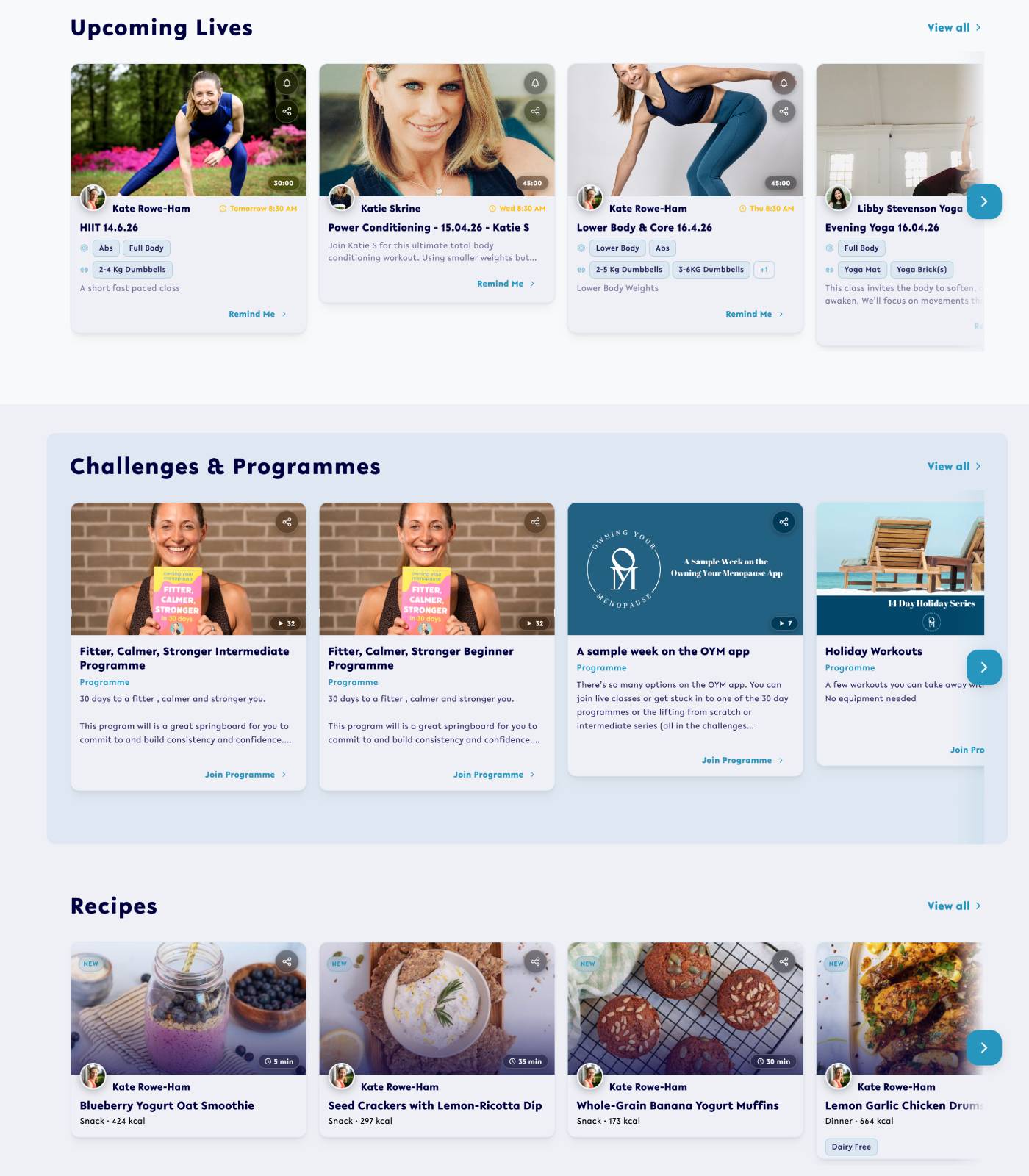
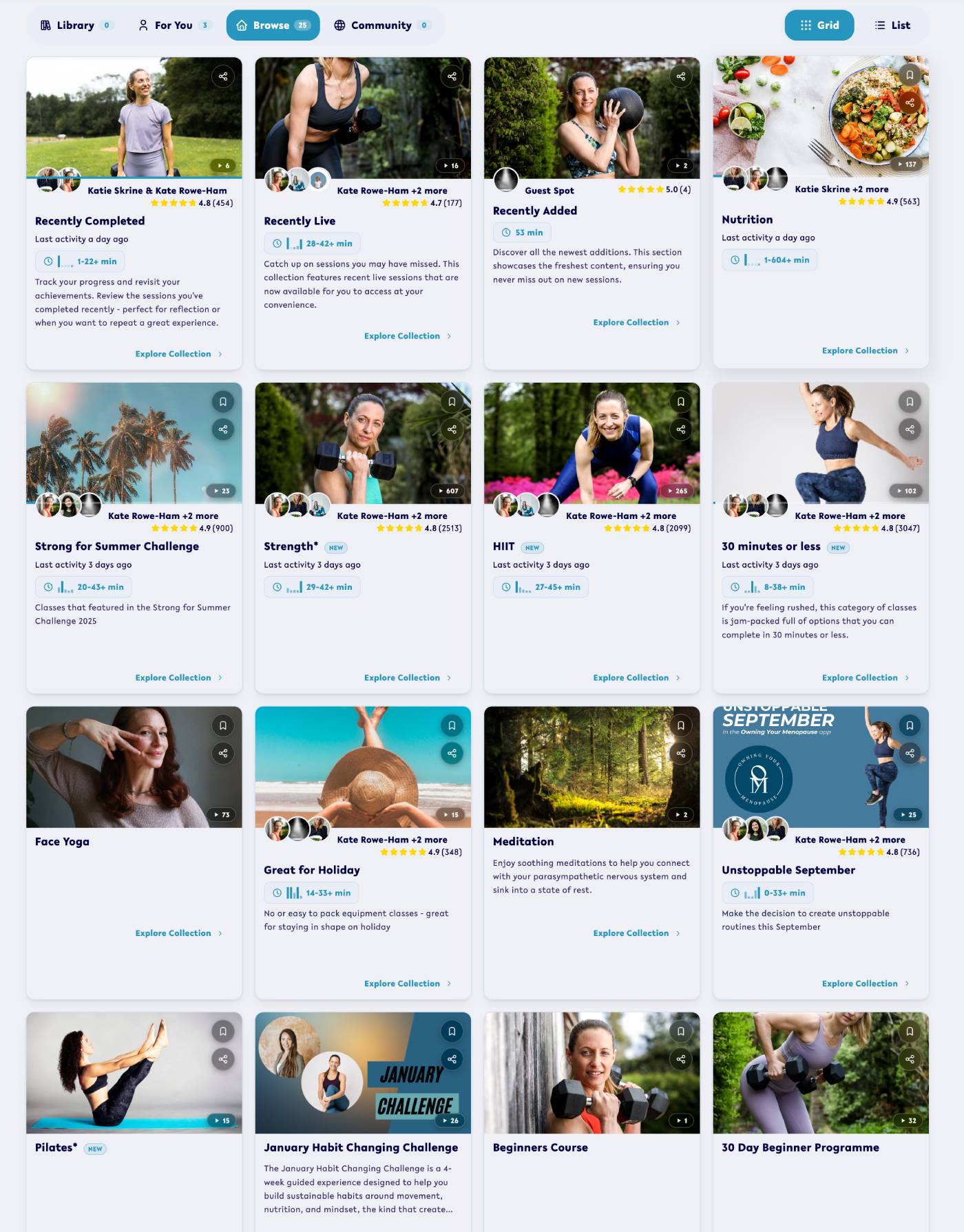
A menopause-specialist platform pairing graded strength courses with specialist GP discussions, nutritionist and psychologist content, pelvic floor guidance, meditation and face yoga.
- 10 to 30 min
- Menopause programming 9/10
- Beginner on-ramp 9/10
- 14-day trial
- Basic video production
Choose Owning Your Menopause if you:
- Want training and education built around perimenopause and menopause
- Are new to structured strength training
- Want to understand why a movement matters, not just copy it
- Need sessions that can drop to 10 or 15 minutes on a bad day
- Want a longer trial before you commit
Moves App
Runner-up
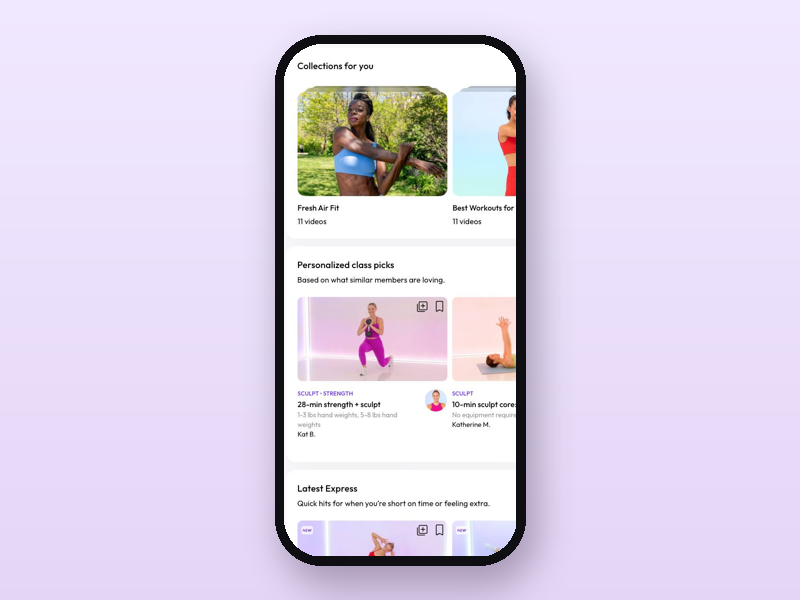
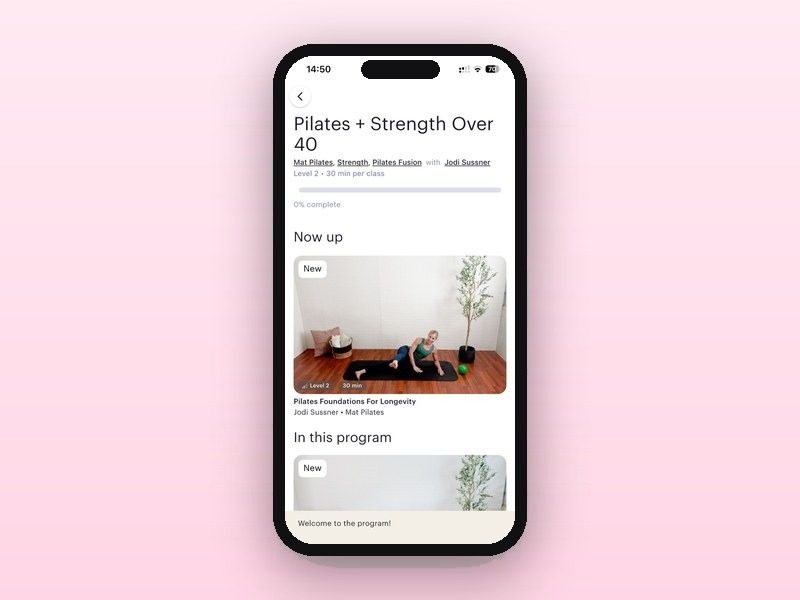
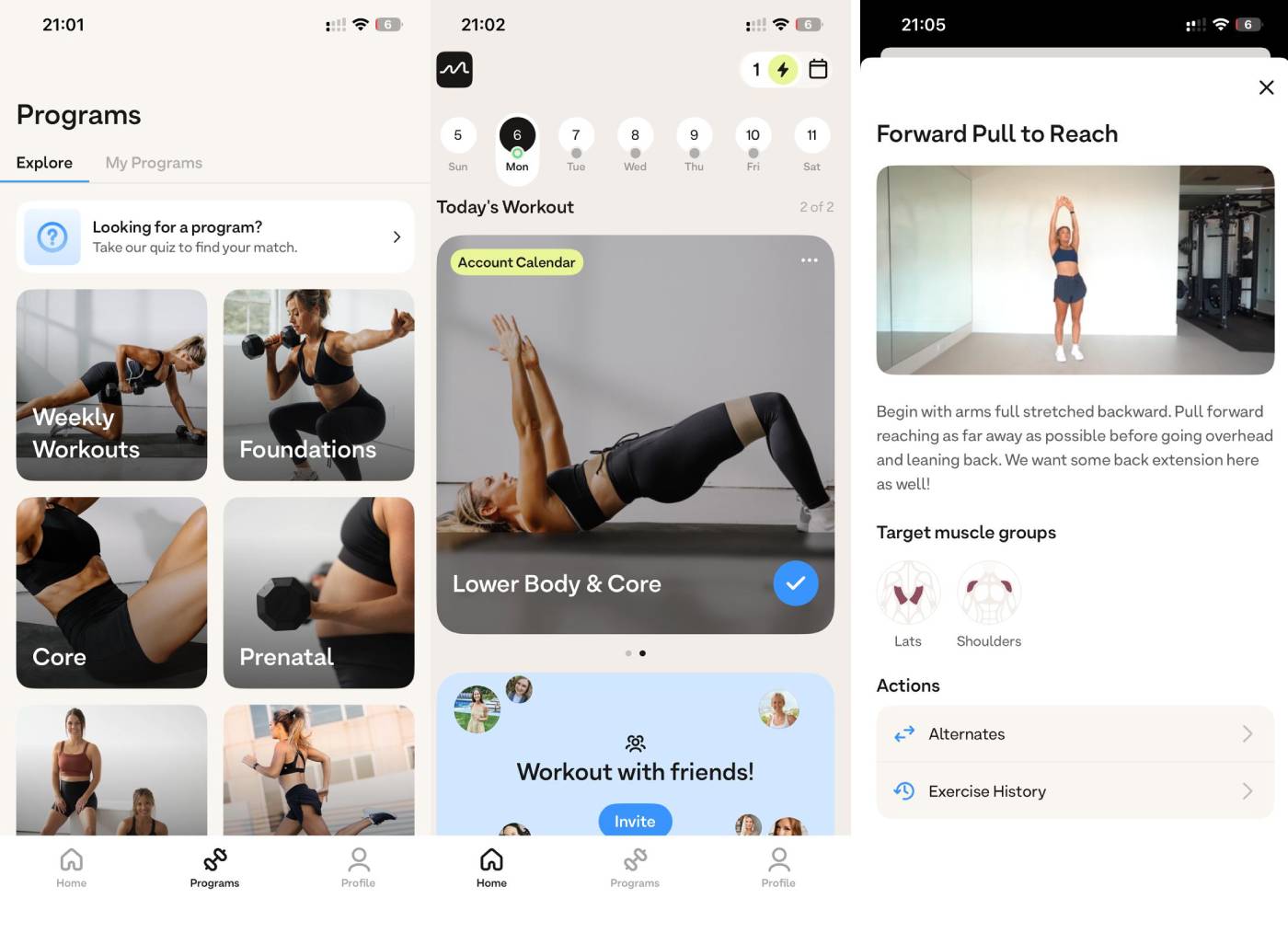
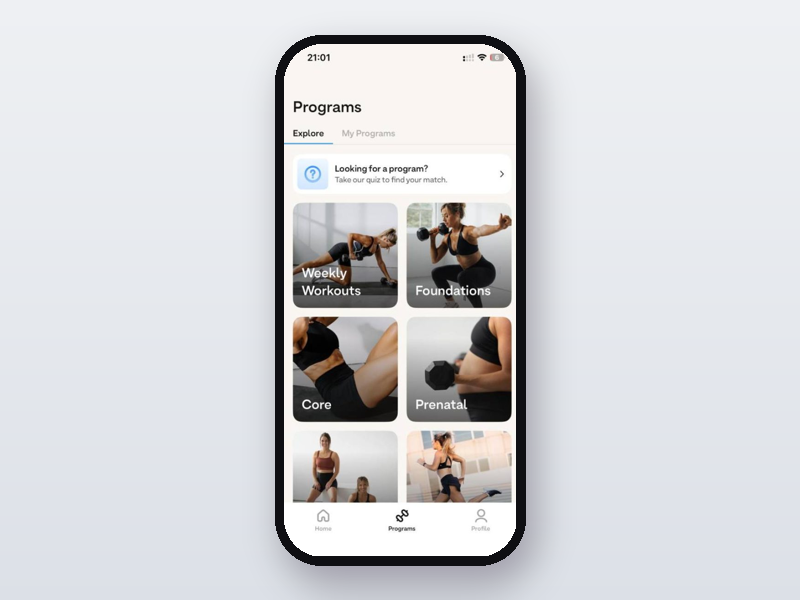
A self-paced strength platform built on written instructions rather than follow-along video, with muscle group images before each session, created by Madeline Custer with Brandon Moss.
- 30 or 60 min
- Muscle 8
- No voiceover
- 7-day trial
- $20/month
Choose Moves App if you:
- Want a structured progressive dumbbell plan running 18 weeks
- Are happy reading a workout rather than being talked through it
- Own a range of dumbbells and expect to move up it
- Like knowing which muscle group a session targets before you start
- Have already outgrown intermediate strength programming
How we scored this, and how both were tested
Both platforms were used and scored on the same nine weighted criteria and the same twelve capability scores. Muscle Potential carries 18%, Time Efficiency 15%, Joint Friendliness and Programme Structure 12% each, Women Over 40 Specificity and Recovery Compatibility 10%, Value for Money and UX and Design 8%, and Nutrition Integration 7%.
Same tester, same knee, same stage. Katy is in her mid-forties, in perimenopause, with a meniscus injury history. On Owning Your Menopause that history is central: she came to the platform shortly after fully recovering from the injury, looking for something that would meet her where she was physically while also addressing the perimenopause symptoms she was navigating. On Moves App, the knee history shows up differently, in her appreciation of a feature that tells her what a session is about to load.
Owning Your Menopause was also the only platform here tested twice: an initial stint of several weeks post-injury, then a later return on the trial to reassess with fresh eyes. That is a better test of whether a platform holds up than one unbroken run, and it is why her verdict on it carries more weight than the eight-week total suggests. She came to Moves App while researching strength-based programmes and signed up through the website, which she found refreshingly simple, and her first impression was that it reminded her of EvolveYou with a narrower focus and a slightly different approach.
Perimenopause and menopause fit: Owning Your Menopause wins, and it is the widest gap on the page
Owning Your Menopause wins Women Over 40 Specificity, 7.7 against 5.1, and the capability rows underneath show a gap that a single criterion cannot express: menopause programming 9 out of 10 against 2, menopause education 9 against 2, hormone awareness 9 against 2, midlife nutrition 8 against 3, mind-body support 8 against 2.
This is the section that decides the page for most readers. Our tester’s description of the Owning Your Menopause education library is that it is outstanding: specialist GP discussions, nutritionist advice, psychologist content, pelvic floor guidance, meditation, and even face yoga. She singles out the face yoga content as genuinely unique among platforms she has reviewed. She also found the community welcoming and active, which on a platform aimed at a life stage many women navigate without much company is worth more than it sounds.
Moves App has no perimenopause content at all. That is not a criticism of what it set out to do, and it is a complete answer to whether it suits a woman looking for menopause-aware training. If that is your filter, our low-cortisol workouts for perimenopause guide covers the ground Moves App does not.
Pelvic floor
Owning Your Menopause wins, 8 out of 10 against 7, with dedicated guidance rather than a passing mention. Teixeira and colleagues report a 36% prevalence of urinary incontinence across female athletes in a systematic review with meta-analysis,3 which is reason enough to want the subject addressed directly. That review did not separate high-impact from low-impact sport, so we do not claim it did. Moves App’s score of 7 is unexpectedly high for a platform with no women’s-health positioning and reflects the core and stability work in its programming rather than any dedicated content.
Coaching and progression: Owning Your Menopause wins, and this is the deciding section
Owning Your Menopause wins on coaching, and Moves App wins Programme Structure, 7 against 7.5. Those two facts together are the whole comparison: one platform has a better plan, the other has someone in the room.
Moves App has no voiceover coaching. The workouts are written instructions you read and then perform. Our tester’s verdict is the plainest sentence in her review: the format did not work for her. She wants a coach showing her the movement and talking her through it as she does it, and to hear cues about form, tempo and breathing while she is mid-set. Without that, the sessions felt like work rather than training. She found herself stopping to re-read instructions and losing momentum, and she is explicit that this is personal preference and wants to be clear about that.
That caveat deserves respect. Some people genuinely prefer to work at their own pace with no voice in their ear. But two consequences of the format are not preference at all: sessions ran longer than planned because she had to read descriptions and adjust, and the platform gives no way to filter workouts by duration, difficulty, equipment required or body area, which is the discoverability problem the UX section covers below.
On Owning Your Menopause the coaching is the strongest part of the product. With Kate Rowe-Ham she learned not just what to do but why she was doing it and how to position her body correctly, and her forecast follows from that: she believes these workouts will deliver real, visible results because the form coaching means you are actually recruiting the right muscles rather than compensating through momentum.
Moves App’s structural advantage is real and should not be dismissed. She dipped into the Weekly Moves schedule to see how the daily programming worked on its own and said she could see the programme producing genuine results for someone who commits to the full 18 weeks. Owning Your Menopause has no equivalent runway, because its strength programming tops out at intermediate.
Muscle potential: Moves App wins, with a caveat we will keep repeating
Moves App wins, 8 against 7, though progressive strength capability runs the other way at 6 out of 10 for Owning Your Menopause against 7. Muscle Potential carries the heaviest weight in our model at 18%, because Maltais and colleagues document accelerated loss of muscle mass and strength through the menopause transition.2
What happened on Moves App
She was training with 11 to 20 lb per hand across most exercises and found the Strength workouts genuinely demanding at that load, which is the case for the platform in one line. She gravitates towards full-body sessions rather than upper or lower body splits and tended to stick with the full-body options. She started with Foundation Moves and moved on after about two weeks, dipped in and out of Strength Moves between programme testing and found them solid, straightforward strength sessions, and tried the programme combining strength training with running, which she enjoyed as a concept but modified significantly, going much slower than prescribed.
What happened on Owning Your Menopause
She completed both the Beginner and Intermediate Strength courses with Kate Rowe-Ham using 4 to 9 lb and 13 lb dumbbells, deliberately lighter than her usual training weight because of the injury recovery. The result was maintenance with a surprise: she maintained her existing tone throughout both testing periods and noticed some new definition around her core and belly area, which surprised her because she had been neglecting abdominal work entirely. She appreciated that belly-targeted workouts in the programming addressed a gap in her training that she had not been motivated to fix on her own.
That last point is a real argument for a programmed platform over a self-directed one: it makes you do the thing you would otherwise skip.
Bone loading
Moves App wins, 7 out of 10 against 6. Mohebbi and colleagues identify progressive resistance training as the primary non-hormonal intervention for bone mineral density after menopause,4 with a further review reporting improvements in menopause symptoms and functional capacity from resistance training, on evidence its own authors rate as very low to low certainty.5 Loaded progressive dumbbell work is closer to what that evidence points at, and the intermediate ceiling on Owning Your Menopause is a genuine limit here. Our best workouts to build muscle after 50 ranking covers platforms built specifically around it.
Joint friendliness: Moves App wins, and it does one thing unusually well
Moves App wins, 8 against 6.5, despite Owning Your Menopause taking low-impact capability 7 out of 10 against 6.
The reason is a specific feature. Moves App shows muscle group images before each workout, which she found genuinely useful for understanding the purpose of each session, and having had knee issues herself she called this one of the most practical features she has encountered on any platform. Knowing what a session is about to load, before you start it, is a real and unusual form of joint protection.
Owning Your Menopause’s weakness is the more conventional one. She noticed the absence of alternative exercises displayed for joint issues or similar conditions, and made the consequence explicit: she already knew some alternatives from her own experience and applied them, but a woman dealing with knee, hip or shoulder issues for the first time would need to source modifications elsewhere. Neither platform offers in-class modifications, so on both you are responsible for your own substitutions.
Why this matters more now. Wright and colleagues describe the musculoskeletal syndrome of menopause, covering oestrogen decline’s effect on tendon and ligament integrity and increased injury risk in midlife.1 For a menopause-specialist platform, the absence of modifications is a sharper omission than it is on a general strength app, and we score it that way.
Time efficiency: Owning Your Menopause wins, and the gap is that its durations are reliable
Owning Your Menopause wins, 8 against 7. It runs about 30 minutes for most workouts, with shorter 10 to 15 minute options. Moves App offers 30 or 60 minute options.
On paper those look similar. In practice they are not, for two reasons. Owning Your Menopause has a genuine short option for a day with fifteen minutes in it, and Moves App does not. And Moves App’s stated durations are unreliable: the self-paced format meant workout durations got longer than they are planned for, because she had to read the descriptions and often adjust, and no duration is displayed before you start.
For a woman fitting training around work and family, being able to answer whether this fits in the time I have is the first question, and only one of these platforms lets you answer it. Our 30-minute workouts for women over 40 guide covers the band both occupy, and 20-minute workouts for perimenopause covers the shorter end only Owning Your Menopause reaches.
Recovery: Owning Your Menopause wins, and both are thin
Owning Your Menopause wins, 8 against 7, though recovery and deload capability runs the other way at 7 out of 10 against 8.
Owning Your Menopause’s advantage is content rather than structure: meditation, psychologist material and the shorter session options give you somewhere to go on a day when training hard is the wrong choice. Its mind-body support score of 8 out of 10 against 2 is the practical measure of that.
Moves App’s higher deload capability reflects the fact that its 18-week programme is properly periodised, which is a real strength. What it does not have is anything to do on a recovery day. It is a strength platform, and rest is arranged elsewhere.
Neither platform is a recovery product, and if downregulation is a priority, our low-cortisol workouts for perimenopause guide is the better place to start.
UX and design: Moves App wins, and both have real problems
Moves App wins, 6 against 5, and 5 is the lowest UX score in this comparison set. Neither platform is pleasant to use.
Owning Your Menopause looks basic and it costs it users. The video production has no on-screen timers, limited lighting and framing issues. The app loads slowly. Educational videos lack transcriptions. The calorie calculator worked the first time she used it and gave a reasonable calorie target with a recommended increase, then produced repeated errors on the second attempt when she wanted to double-check her targets after adjusting her activity level, and she was unable to get it to recalculate, which she found frustrating. Her summary of the cumulative effect is the clearest statement of what a low UX score means in practice: she found it harder to sustain the kind of visual energy that keeps you coming back day after day, and suspects she is not alone in that. Unusually for her, since she normally prefers a laptop with a large screen, she found the app the better experience of the two.
Moves App cannot tell you how long a workout is. In testing she wanted to filter workouts by duration, by difficulty, by equipment required, or by body area, and often had to start a session to understand how long it would actually take. That is a narrower problem than Owning Your Menopause’s, which is why Moves App takes the score, and it compounds badly with the self-paced format.
Nutrition: Owning Your Menopause wins, and it is not close
Owning Your Menopause wins, 8 against 3.5, with midlife nutrition capability 8 out of 10 against 3. Nutrition carries the smallest weight in our model at 7%, and this is still one of the widest content gaps on the page.
Owning Your Menopause brings nutritionist content as one strand of a specialist library that also covers GP and psychologist material, which is the kind of provision a general strength app has no reason to build. Its calorie calculator is the weak point, for the reason set out above, and her plan after stepping away from the platform was to return specifically for the menopause education and nutrition content, which tells you which half of the product earned its keep.
Moves App has limited nutrition tools and a basic community. It is a strength platform and nutrition is not what it is for, which is a fair position for it to take and a real gap if you wanted both in one subscription.
Equipment and space needed at home
Both work in a small space with a mat and dumbbells, and only one of them will ask you for heavier ones.
Moves App is built for progressive dumbbell work, and she trained at 11 to 20 lb per hand, so a range of weights matters and the platform is designed to take you up it. On Owning Your Menopause she used 4 to 9 lb and 13 lb dumbbells, lighter by choice during injury recovery, and the intermediate ceiling means most women will not outgrow a moderate set.
Neither platform needs machines, a bike, a rower or a treadmill, and neither offers classes for them. On screens, she found the Owning Your Menopause app better than its website, which is unusual for her.
Starting from scratch: Owning Your Menopause wins, 9 out of 10 against 6
Owning Your Menopause wins, and this is the widest capability gap on the page. It is built as a course you progress through, Beginner then Intermediate, and she completed both. For a woman who has never followed a structured strength programme, being told the sequence matters more than having more to choose from.
Moves App asks a beginner to read a written description and judge her own form, with nobody telling her how it should feel. She trains regularly and has tested dozens of platforms, and the format still cost her momentum in the way the coaching section describes. A beginner does that more, not less, and has no basis for knowing whether what she is doing is correct. The muscle group images help with intent, not with execution.
One caveat on the evidence, which she states herself about her own account: she came to both platforms as an experienced trainee. Her assessment of the beginner experience is an expert’s judgement of how a beginner would fare rather than a beginner’s own report.
Owning Your Menopause pros and cons
Owning Your Menopause scores 7.3. It is strongest on short sessions and weakest on the app experience.
Pros
- Women Over 40 Specificity 7.7 against 5.1, with menopause programming, menopause education and hormone awareness all 9 out of 10 against 2.
- Beginner on-ramp 9 against 6.
- An education library spanning specialist GP, nutritionist, psychologist, pelvic floor, meditation and face yoga that she had not seen elsewhere.
- Form coaching that explains why, not just what.
- Nutrition Integration 8.
- Time Efficiency 8 with 10 to 15 minute options.
- A welcoming, active community.
- Value for Money 7.5 and a 14-day trial.
Cons
- UX and Design 5, the lowest here, with basic video production, no on-screen timers, limited lighting and framing issues.
- Slow app loading.
- A calorie calculator that produced repeated errors.
- No transcriptions on educational videos.
- Strength programming tops out at intermediate.
- No alternative exercises shown for joint issues.
- She stepped away because the workouts alone did not hold her.
Moves App pros and cons
Moves App scores 6.7. It leads on building and keeping muscle and trails on nutrition guidance.
Pros
- Muscle Potential 8 against 7, with Strength workouts she found genuinely demanding at 11 to 20 lb per hand.
- Bone loading 7 out of 10 against 6.
- Joint Friendliness 8, helped by muscle group images before each workout that she rates among the most practical anywhere.
- Programme Structure 7, with an 18-week progression she believed could produce genuine results.
- UX and Design 6.
- A refreshingly simple sign-up.
Cons
- No voiceover coaching, so sessions are read rather than led, which is why she stopped.
- Sessions ran longer than planned because of the self-paced format.
- No workout duration displayed before you start.
- No filtering by duration, difficulty, equipment or body area.
- No perimenopause content at all, with menopause programming, education and hormone awareness all 2 out of 10.
- Mind-body support 2 against 8.
- Nutrition Integration 3.5.
- Limited nutrition tools.
Quick yes/no comparison
| Feature | Owning Your Menopause | Moves App |
|---|---|---|
| Built specifically for menopause | Yes | No |
| Voiceover coaching during the workout | Yes | No |
| Structured beginner strength course | Yes | No |
| Progresses past intermediate strength | No | Yes |
| Multi-week progressive plan | Yes, graded courses | Yes, 18 weeks |
| Shows workout duration before you start | Yes | No |
| Filter by duration, difficulty or body area | Partly | No |
| Muscle group shown before the session | No | Yes |
| Injury modifications shown in class | No | No |
| Sessions under 20 minutes | Yes, 10 to 15 options | No |
| Specialist GP or clinician education | Yes | No |
| Pelvic floor guidance | Yes | No |
| Free trial | Yes, 14 days | Yes, 7 days |
Owning Your Menopause vs Moves App at a glance
| Owning Your Menopause | Moves App | |
|---|---|---|
| Overall score | 7.3 | 6.7 |
| How it was assessed | Fully tested, about eight weeks across two separate periods | Fully tested, approximately one month |
| Cost | £16.99/month or £80 for six months | $20/month or $200/year |
| Free trial | 14 days | 7 days |
| Session length | About 30 minutes, with 10 to 15 minute options | 30 or 60 minutes, self-paced so it varies |
| Coaching format | Coached video with form explanation | Written instructions, no voiceover |
| Approach | Graded strength courses plus a wide specialist menopause library | Self-paced progressive dumbbell strength |
| Named instructors | Kate Rowe-Ham for the strength courses | None, the format is self-paced |
| Equipment | Dumbbells and a mat, 4 to 13 lb range used | Dumbbells and a mat, 11 to 20 lb range used |
| Strength ceiling | Tops out at intermediate | 18-week progression |
| Menopause content | Extensive, GP, nutritionist, psychologist, pelvic floor, face yoga | None |
Owning Your Menopause vs Moves App: the full scoring breakdown
Owning your menopause wins six of the nine weighted criteria and moves app wins three. The overall gap is 7.3 against 6.7.
| Criterion | Weight | Owning Your Menopause | Moves App | Winner |
|---|---|---|---|---|
| Muscle Potential | 18% | 7 | 8 | Moves App |
| Time Efficiency | 15% | 8 | 7 | Owning Your Menopause |
| Joint Friendliness | 12% | 6.5 | 8 | Moves App |
| Programme Structure | 12% | 7.5 | 7 | Owning Your Menopause |
| Women Over 40 Specificity | 10% | 7.7 | 5.1 | Owning Your Menopause |
| Recovery Compatibility | 10% | 8 | 7 | Owning Your Menopause |
| Value for Money | 8% | 7.5 | 6.5 | Owning Your Menopause |
| UX and Design | 8% | 5 | 6 | Moves App |
| Nutrition Integration | 7% | 8 | 3.5 | Owning Your Menopause |
| Overall | 100% | 7.3 | 6.7 | Owning Your Menopause |
The twelve capability scores
Owning your menopause wins nine of the twelve capability scores and moves app wins three. The menopause programming, menopause education and hormone awareness rows, 9 against 2 in each case, are the widest gaps here and the clearest statement of who each platform was built for.
| Capability | Owning Your Menopause | Moves App | Winner |
|---|---|---|---|
| Low-impact | 7 | 6 | Owning Your Menopause |
| Progressive strength | 6 | 7 | Moves App |
| Bone loading | 6 | 7 | Moves App |
| Recovery & deload | 7 | 8 | Moves App |
| Menopause programming | 9 | 2 | Owning Your Menopause |
| Pelvic floor | 8 | 7 | Owning Your Menopause |
| Hormone awareness | 9 | 2 | Owning Your Menopause |
| Menopause education | 9 | 2 | Owning Your Menopause |
| Expert credibility | 8 | 7 | Owning Your Menopause |
| Mind-body support | 8 | 2 | Owning Your Menopause |
| Beginner on-ramp | 9 | 6 | Owning Your Menopause |
| Midlife nutrition | 8 | 3 | Owning Your Menopause |
Value for money: Owning Your Menopause wins, and the currencies are not comparable
Owning Your Menopause wins, 7.5 against 6.5.
| Plan | Owning Your Menopause | Moves App |
|---|---|---|
| Monthly | £16.99 | $20 |
| Longer plan | £80 for six months | $200/year |
| Free trial | 14 days | 7 days |
| What the money buys | A specialist menopause library plus graded strength courses that stop at intermediate | An 18-week progressive dumbbell plan, read rather than coached |
One is priced in pounds and the other in dollars, so the two figures are not a like-for-like currency comparison and we are not going to present them as one. What is directly comparable is the trial: 14 days against 7, and Owning Your Menopause gives you twice as long to find out whether the basic video production is something you can live with, which on the evidence of our own testing is the thing most likely to make you cancel.
What this means for your decision. Owning Your Menopause gives you far more content for a similar monthly outlay, and the content is specialist rather than generic. Moves App’s narrower offer is only better value if progressive dumbbell programming is specifically the thing you want and the coaching gap does not bother you. Our best free and budget workout apps ranking covers what is available if neither price appeals.
Who wins for…
Who wins for perimenopause and menopause
Owning Your Menopause, overwhelmingly. Menopause programming 9 out of 10 against 2, and Moves App has no perimenopause content at all.
Who wins for building muscle after 40
Moves App. Muscle Potential 8 against 7 and bone loading 7 against 6, with the caveat that the two platforms were tested at different loads.
Who wins for a complete beginner
Owning Your Menopause. Beginner on-ramp 9 out of 10 against 6, with graded courses and coaching that explains form.
Who wins for being coached
Owning Your Menopause, without qualification. Moves App has no voiceover coaching at all.
Who wins on price
Owning Your Menopause. Value for Money 7.5 against 6.5, with twice the trial length.
Who wins for a joint history
Moves App, narrowly. 8 against 6.5, on the strength of showing you what a session will load. Neither offers in-class modifications.
Who wins for a 15-minute window
Owning Your Menopause. It has 10 to 15 minute options. Moves App starts at 30 and overruns.
Who wins for knowing how long a workout takes
Owning Your Menopause. Moves App does not display duration, and its self-paced format makes the nominal number unreliable anyway.
Who wins for following a long progression
Moves App. An 18-week plan against a course that stops at intermediate.
Who wins for nutrition
Owning Your Menopause. Nutrition Integration 8 against 3.5 and midlife nutrition 8 out of 10 against 3.
Who wins for pelvic floor
Owning Your Menopause. 8 out of 10 against 7, with dedicated guidance rather than incidental core work.
Who wins for staying subscribed
Neither held Katy Cole. She left both, and she plans to return to Owning Your Menopause for the education rather than the workouts.
Decision tree for women over 40
Perimenopause is why you are looking. Owning Your Menopause. Moves App has no content for it.
You have never followed a structured strength programme. Owning Your Menopause, on a beginner on-ramp of 9 against 6.
You want a coach talking you through the movement. Owning Your Menopause. This is the single biggest difference between them.
You already lift and want a long progression. Moves App, and accept that you will be reading it.
Some days you only have 15 minutes. Owning Your Menopause.
You need to know a session fits the time you have. Owning Your Menopause.
Basic video production would make you cancel. Moves App, or neither. This is the most common reason she expects women to leave Owning Your Menopause.
You have a knee, hip or shoulder that needs modifications. Neither shows them. Budget for getting that guidance elsewhere.
What we did not test
Here is what this comparison does not cover.
On Owning Your Menopause she browsed but did not work through the dance classes, yoga sessions, rebound classes, HIIT workouts or Pilates, and she says plainly that she cannot speak to the quality of those specific workout types from personal experience. If one of those is your main reason for considering it, this page will not settle it.
On Moves App we did not test prenatal training, the Move Anywhere travel programme, or the Move Together challenge, which carries a separate cost. She started Foundation Moves and moved on after about two weeks rather than completing it, and dipped into rather than completed the Weekly Moves schedule, so her judgement of the 18-week progression assesses its design rather than reporting on finishing it.
The two strength tests were run at different loads for the injury reason set out above, and we have flagged that wherever the Muscle Potential comparison appears rather than only once.
Neither platform was tested by a beginner, and both beginner assessments are an experienced tester’s judgement.
Which is better for women over 50?
Owning Your Menopause, and the case strengthens
The education library covers postmenopausal questions a strength app does not touch, the beginner on-ramp gap of 9 against 6 matters more for a woman starting or restarting later, and the 10 to 15 minute options fit a day with less predictable energy. Our best low-impact workouts for women over 50 and best workouts for postmenopause rankings cover the wider field.
Moves App, only if you already lift and want more runway
Progressive loading remains the intervention with the best evidence behind it for muscle and bone after menopause,4 and the intermediate ceiling on Owning Your Menopause arrives sooner for a woman who has trained for years. If you know your form, want a plan rather than a class, and are content to read it, Moves App gives you somewhere to keep going. If any of those three is untrue, the coaching gap outweighs the runway.
Frequently asked questions
Is Owning Your Menopause or Moves App better for women over 40?
Owning Your Menopause, on 7.3 against 6.7, and the gap is almost entirely about who the platform is for. Women Over 40 Specificity is 7.7 against 5.1, the widest criterion gap on this page. Menopause programming is 9 out of 10 against 2, menopause education 9 against 2, hormone awareness 9 against 2 and midlife nutrition 8 against 3. Moves App is a competent strength platform with no perimenopause content at all. If this life stage is why you are looking, the comparison is not close.
Which builds more strength for women in their 40s?
Moves App, on Muscle Potential 8 against 7 and bone loading 7 out of 10 against 6, though progressive strength capability runs the other way at 6 against 7. Moves App is built for progressive dumbbell work and Katy Cole found the Strength workouts genuinely demanding at 11 to 20 lb per hand. On Owning Your Menopause she trained deliberately light, 4 to 9 lb and 13 lb, because she was recovering from a meniscus injury, and she maintained her existing tone rather than adding to it. That is a lighter test rather than purely a weaker platform, and Owning Your Menopause does have a real ceiling: its strength programming tops out at intermediate.
Which offers better coaching and progression?
Owning Your Menopause, and it is the largest practical difference between them. Moves App has no voiceover coaching at all: the workouts are written instructions you read and then perform. Her verdict was that the format did not work for her, that she wants a coach showing her the movement and talking her through it as she does it with cues about form, tempo and breathing while she is mid-set, and that without that the sessions felt like work rather than training. On Owning Your Menopause with Kate Rowe-Ham she learned not just what to do but why she was doing it and how to position her body correctly. Programme Structure is 7.5 against 7.
Do either platform show modifications for joint problems?
Neither shows in-class modifications. On Owning Your Menopause she noticed the absence of alternative exercises for joint issues, and added that she already knew some alternatives from her own experience and applied them, but a woman dealing with knee, hip or shoulder issues for the first time would need to source them elsewhere. Moves App does something different and genuinely useful instead: it shows muscle group images before each workout, which she rates among the most practical things on any platform, for the reasons the joints section sets out. Joint Friendliness is 6.5 against 8, and Moves App wins it.
How do Owning Your Menopause and Moves App compare on price and value?
Owning Your Menopause wins Value for Money, 7.5 against 6.5. It is £16.99 a month or £80 for six months, with a 14-day free trial. Moves App is $20 a month or $200 a year with a 7-day trial. One is priced in pounds and the other in dollars, so these are not a like-for-like currency comparison and we are not going to present them as one. What is comparable is the trial: 14 days against 7.
Which is better for a complete beginner?
Owning Your Menopause, by the widest capability margin on this page. Beginner on-ramp is 9 out of 10 against 6. It is built as a course you progress through, Beginner then Intermediate, and she completed both. Moves App asks a beginner to read a written description and judge her own form with no one telling her how it should feel. She trains regularly and has tested dozens of platforms, and still found herself stopping to re-read instructions and losing momentum. A beginner does that more, not less.
What are the differences in strength programme structure?
Programme Structure is 7.5 against 7, and the shapes are different rather than one being better. Owning Your Menopause runs graded courses with a ceiling at intermediate. Moves App runs an 18-week progression, and she said she could see it producing genuine results for someone who commits to the full course, though she moved on from Foundation Moves after about two weeks and was never going to stick with it long-term. One has a plan you would want to finish and no voice to carry you through it. The other has the coaching and a shorter runway.
What is the time commitment and typical session length for each?
Owning Your Menopause wins Time Efficiency, 8 against 7. It runs about 30 minutes for most workouts with shorter 10 to 15 minute options. Moves App offers 30 or 60 minute options, but they are self-paced, so the real duration is longer and unpredictable: she found that durations got longer than planned because she had to read the descriptions and often adjust, and no duration is displayed before you start. One platform tells you what you are committing to. The other does not.
Which has better nutrition guidance?
Owning Your Menopause, by a wide margin. Nutrition Integration is 8 against 3.5, and midlife nutrition capability 8 out of 10 against 3. It brings nutritionist content as part of a specialist library alongside GP and psychologist material. Its weak point is the calorie calculator: she tested it twice, it worked the first time and produced repeated errors the second when she wanted to double-check her targets after adjusting her activity level, and she was unable to get it to recalculate. Moves App has limited nutrition tools and nutrition is not what it is for.
What equipment and space do you need at home for each?
Both work in a small space with a mat and dumbbells, and the useful weight range differs. Moves App is built for progressive dumbbell work and she trained at 11 to 20 lb per hand across most exercises, so a range matters. On Owning Your Menopause she used 4 to 9 lb and 13 lb dumbbells, lighter by choice during injury recovery, and the platform’s intermediate ceiling means you are unlikely to outgrow a moderate set. Neither needs machines.
Did the tester stay with either platform?
No, and the reasons are different and specific. She stepped away from Owning Your Menopause and says plainly that the workouts alone did not hold her long-term in the way that platforms with more polished production have, while planning to return for the menopause education and nutrition content. She tested Moves App for about a month, moved on from Foundation Moves after two weeks, and concluded she was never going to stick with it long-term because the format did not work for her. Both are worth a trial. Neither earned a year.
Research citations
- Wright VJ, Schwartzman JD, Itinoche R, Wittstein J. The musculoskeletal syndrome of menopause. Climacteric. 2024;27(5):466–472. menopause MSK study. (Cited for: oestrogen decline’s effect on tendon and ligament integrity, and increased injury risk in midlife.)
- Maltais ML, Desroches J, Dionne IJ. Changes in muscle mass and strength after menopause. Journal of Musculoskeletal and Neuronal Interactions. 2009;9(4):186–197. PubMed. (Cited for: accelerated loss of muscle mass and strength through the menopause transition.)
- Teixeira RV, Colla C, Sbruzzi G, Mallmann A, Paiva LL. Prevalence of urinary incontinence in female athletes: a systematic review with meta-analysis. International Urogynecology Journal. 2018;29(12):1717–1725. urinary incontinence meta-analysis. (Cited for: 36% prevalence of urinary incontinence across female athletes in a range of sports. Note: this review did not separate high-impact from low-impact sport, so we do not claim it did.)
- Mohebbi R, Shojaa M, Kohl M, et al. Exercise training and bone mineral density in postmenopausal women: an updated systematic review and meta-analysis. Osteoporosis International. 2023;34:1145–1178. bone density meta-analysis. (Cited for: progressive resistance training as the primary non-hormonal intervention for bone density after menopause.)
- Sá KMM, et al. Resistance training for postmenopausal women: systematic review and meta-analysis. Menopause. 2022. PubMed. (Cited for: improvements in menopause symptoms and functional capacity with resistance training. Note: this review did not measure strength or lean mass as primary outcomes, and its authors rate the certainty of evidence as very low to low, so we report it on that basis.)
This page compares fitness platforms. It is not medical advice. Katy is a woman who has trained through perimenopause, not a clinician. Any strength or body-composition observations described are one person’s recorded experience, not an expected result or a general pattern. If you have a diagnosed condition, an injury, or symptoms that concern you, speak to a qualified healthcare professional before changing how you train.
About this comparison
Compiled by Katy Cole for Her Daily Fit. Both platforms were used and assessed firsthand. Owning Your Menopause was tested across two separate periods totalling about eight weeks, including the Beginner and Intermediate Strength courses with Kate Rowe-Ham both completed, using 4 to 9 lb and 13 lb dumbbells, deliberately lighter than usual because of a meniscus injury recovery during the first period. Moves App was tested for approximately one month, starting with Foundation Moves and moving on after about two weeks, then dipping into Strength Moves, Endurance Moves and Weekly Moves, training at 11 to 20 lb per hand. Both were scored on the same nine weighted criteria and the same twelve capability scores. Maltais and colleagues document accelerated loss of muscle mass and strength through the menopause transition,2 which is why Muscle Potential carries the most weight in that model, and the difference in training load between the two tests is flagged wherever that criterion is discussed. Prices were verified against official sources in 2026 and may differ if there has been a recent change. Owning Your Menopause is priced in GBP and Moves App in USD, so the two figures are not a like-for-like currency comparison. Scores are pulled live from each programme’s own assessment. Her Daily Fit earns nothing from either platform.
Compared with
Featured in