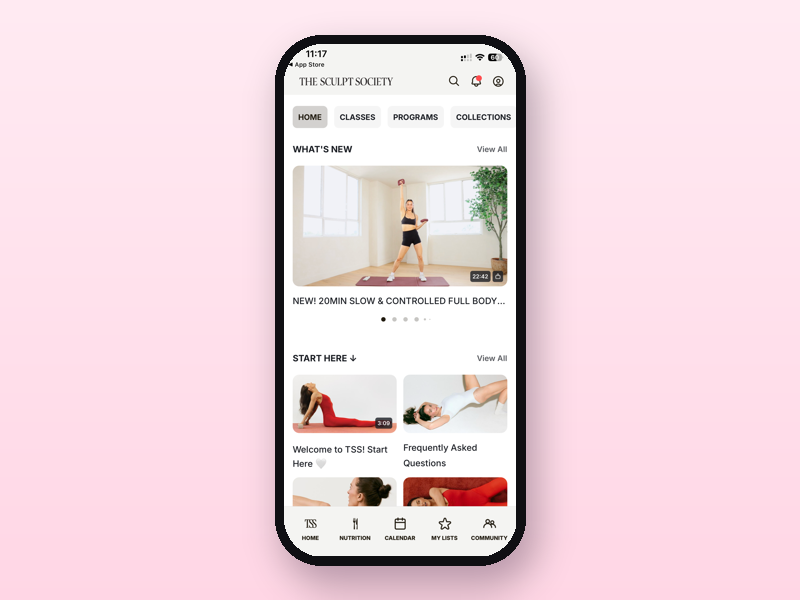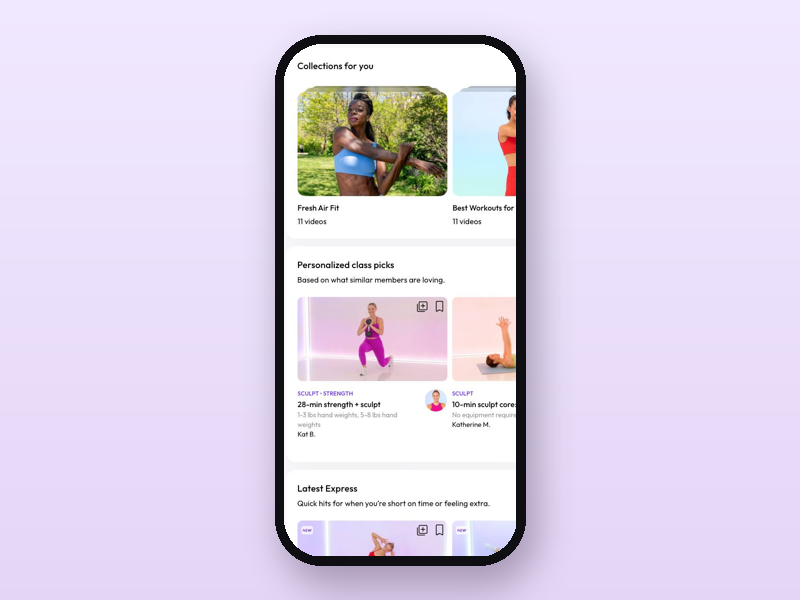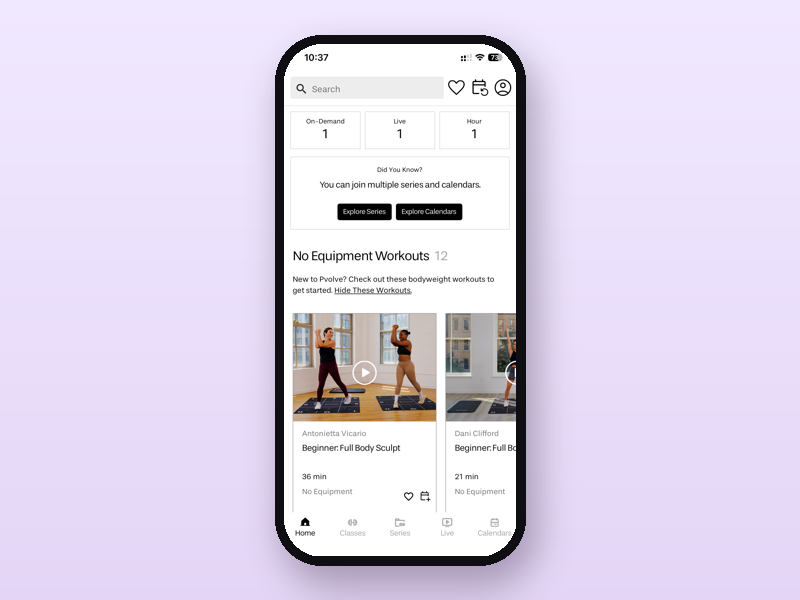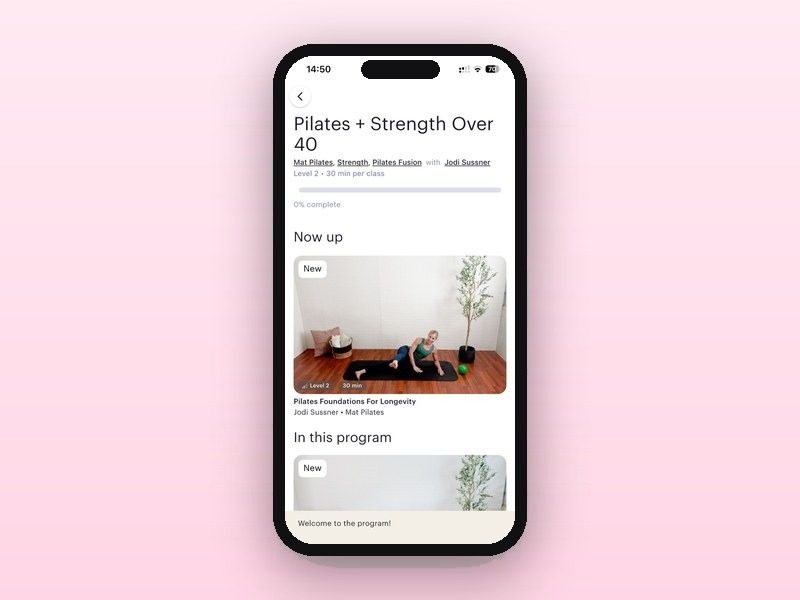
Apple Fitness+ scores higher overall, 6.9 against 6.6, and is the stronger platform for building muscle and fitting training into a busy week. Nike Training Club is the better pick if what you need most is value for money and a free app with nothing to cancel.
Quick answer
- Apple Fitness+ 6.9 vs Nike Training Club 6.6
- Free vs $9.99 a month
- Value 10 vs 7, Nike Training Club
- Muscle 7.5 vs 6, Apple Fitness+
- Capability scores six each
- Menopause programming 1 vs 2
Apple Fitness+ is the better trainer and Nike Training Club is the better bargain, and the score gap is narrow enough that the decision is not really about the number. Apple Fitness+ wins Time Efficiency 9 against 8, Muscle Potential 7.5 against 6, Joint Friendliness 8 against 7, Programme Structure 7.5 against 7, Recovery Compatibility 7 against 6 and UX and Design 7.5 against 7.
Nike Training Club wins the three criteria that decide whether a platform is worth paying for at all. Value for Money is 10 against 7, the widest gap on the page, because it costs nothing. Women Over 40 Specificity is 4.5 against 4.3, and Nutrition Integration goes the same way, 3 against 0. On the twelve capability scores the pair split evenly, and the split is informative: Apple Fitness+ takes the training-quality rows, Nike Training Club takes the rows that touch women’s health.
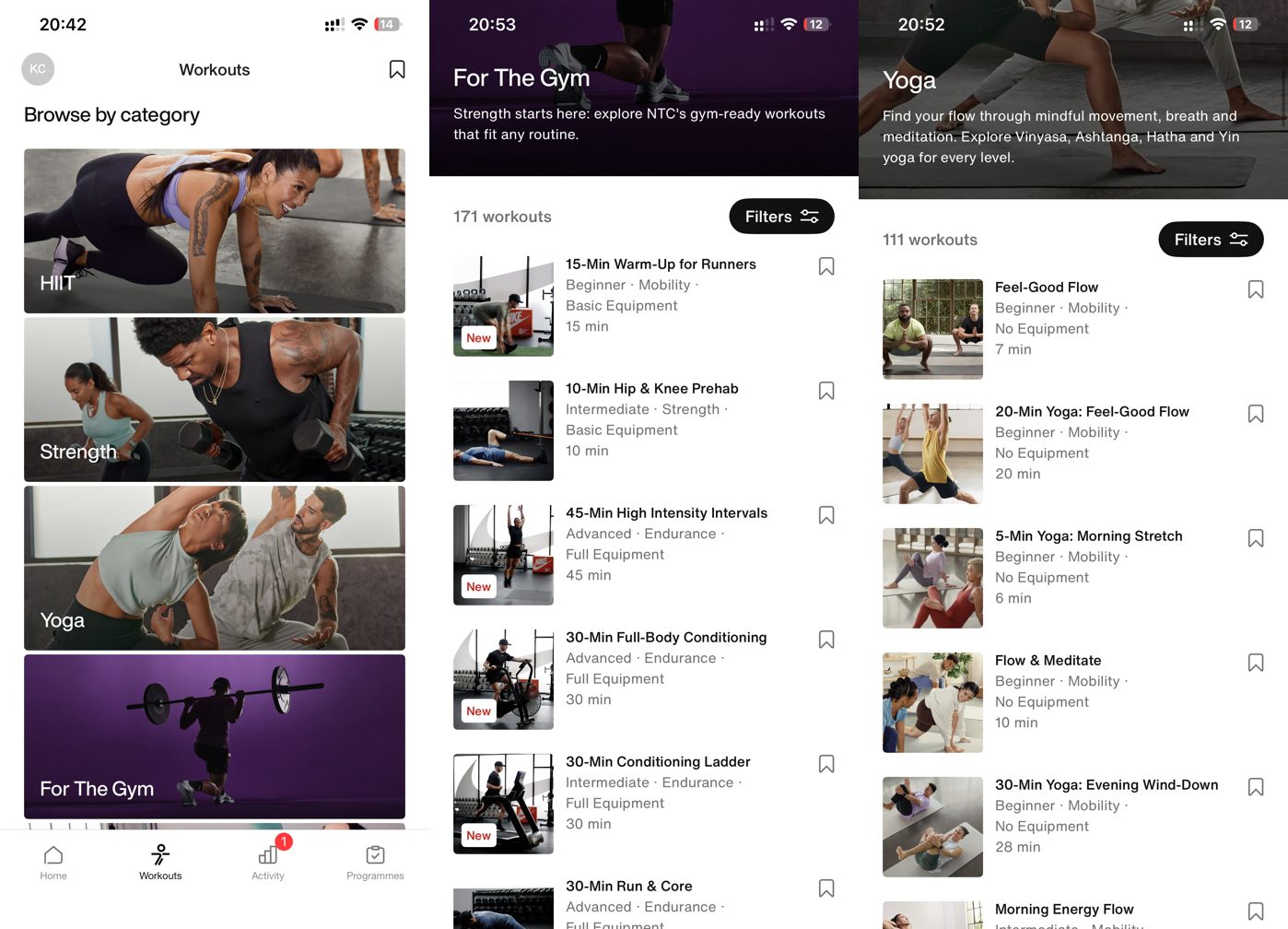
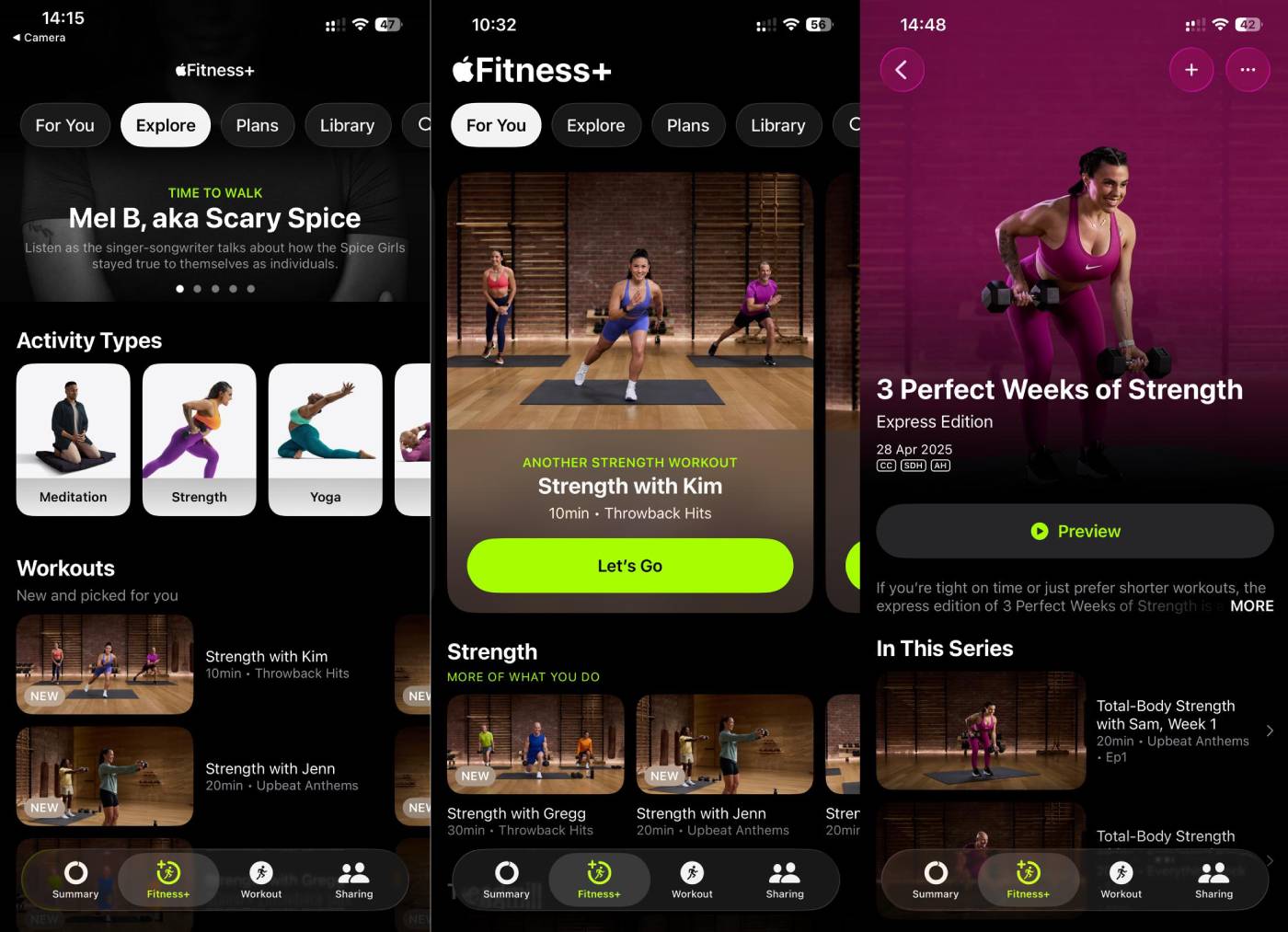
The evidence behind these two columns is not the same depth, and it runs the opposite way to the price. Apple Fitness+ was used daily for five weeks, on a custom plan and then a full progressive strength programme, so its scores rest on how it actually behaved over more than a month. Nike Training Club was sample tested. That means signing up, browsing the whole free library, completing one workout and working through the filters, which is enough to describe what the library holds and not enough to say how well its programmes progress across two months. Where a Nike Training Club score depends on staying power, treat it as provisional and we say so in the section rather than only here.
Nike Training Club if you want quality movement at no cash cost, are content to assemble your own week, and would rather add load on your own terms than be charged for the reminder. Apple Fitness+ if you own Apple hardware, want to be handed a short session and a visible modification every day, and know from experience that structure is what keeps you turning up. The reason the recommendation is not simply the higher number is that one of these platforms is free, and free changes what a small scoring gap is worth.
Nike Training Club vs Apple Fitness+: the two platforms
Same nine weighted criteria, same twelve capability scores, one paid and locked to a hardware ecosystem, one free and open to anyone with a phone.
Nike Training Club
Runner-up
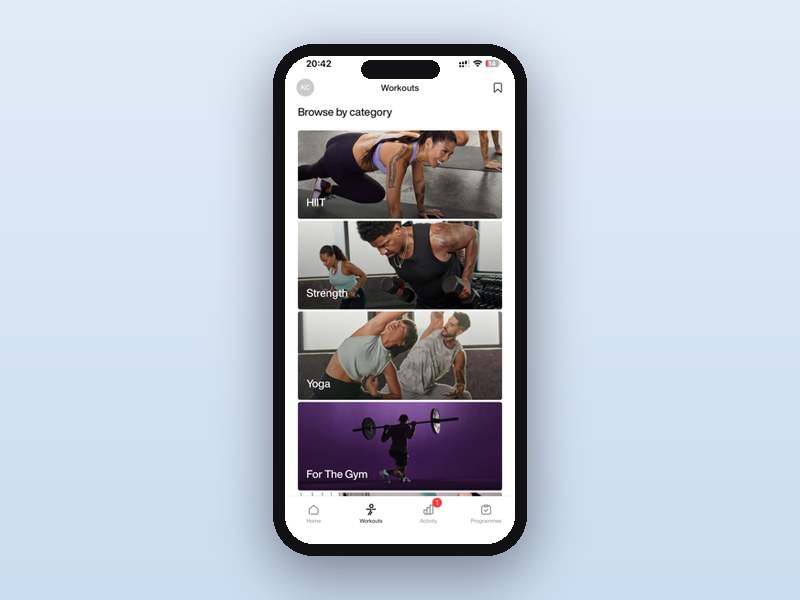
Nike’s free workout app: a large library of trainer-led workouts and multi-week programs across strength, conditioning and HIIT, core, yoga, Pilates, mobility, recovery and mindfulness, led by Nike Master Trainers.
- A few min to 45
- Free
- No ads
- Pelvic floor 4/10
- Sample tested
Choose Nike Training Club if you:
- Want a serious library at no cash cost
- Use Android, or move between platforms
- Are happy to build your own training week
- Want yoga, Pilates and mobility alongside strength
- Do not want another subscription to manage
Apple Fitness+
Winner
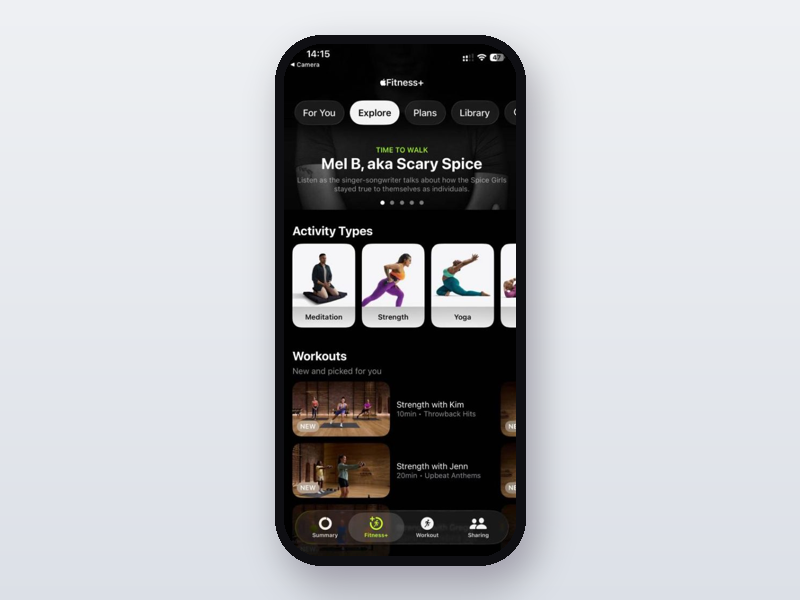
A streaming library of trainer-led strength, HIIT, Pilates, yoga, dance, treadmill, cycling, rowing, meditation and recovery sessions, with custom plans and multi-week programmes, built inside the Apple ecosystem.
- 10 to 30 min
- Three trainers per session
- Low-impact 7/10
- 1 month free
- Fully tested
Choose Apple Fitness+ if you:
- Already live inside the Apple ecosystem
- Want short sessions you can stack back to back
- Need the modified version shown, not described
- Want a progressive strength programme built for you
- Share a household plan through Family Sharing
How we scored this, and how deeply each one was used
Both platforms were scored on the same nine weighted criteria and the same twelve capability scores. Muscle Potential carries 18%, Time Efficiency 15%, Joint Friendliness and Programme Structure 12% each, Women Over 40 Specificity and Recovery Compatibility 10%, Value for Money and UX and Design 8%, and Nutrition Integration 7%.
One tester, two very different amounts of use. Katy is a woman in her mid-forties, perimenopausal, working full-time with two school-aged children, and carrying an old meniscus injury. She is not a clinician.
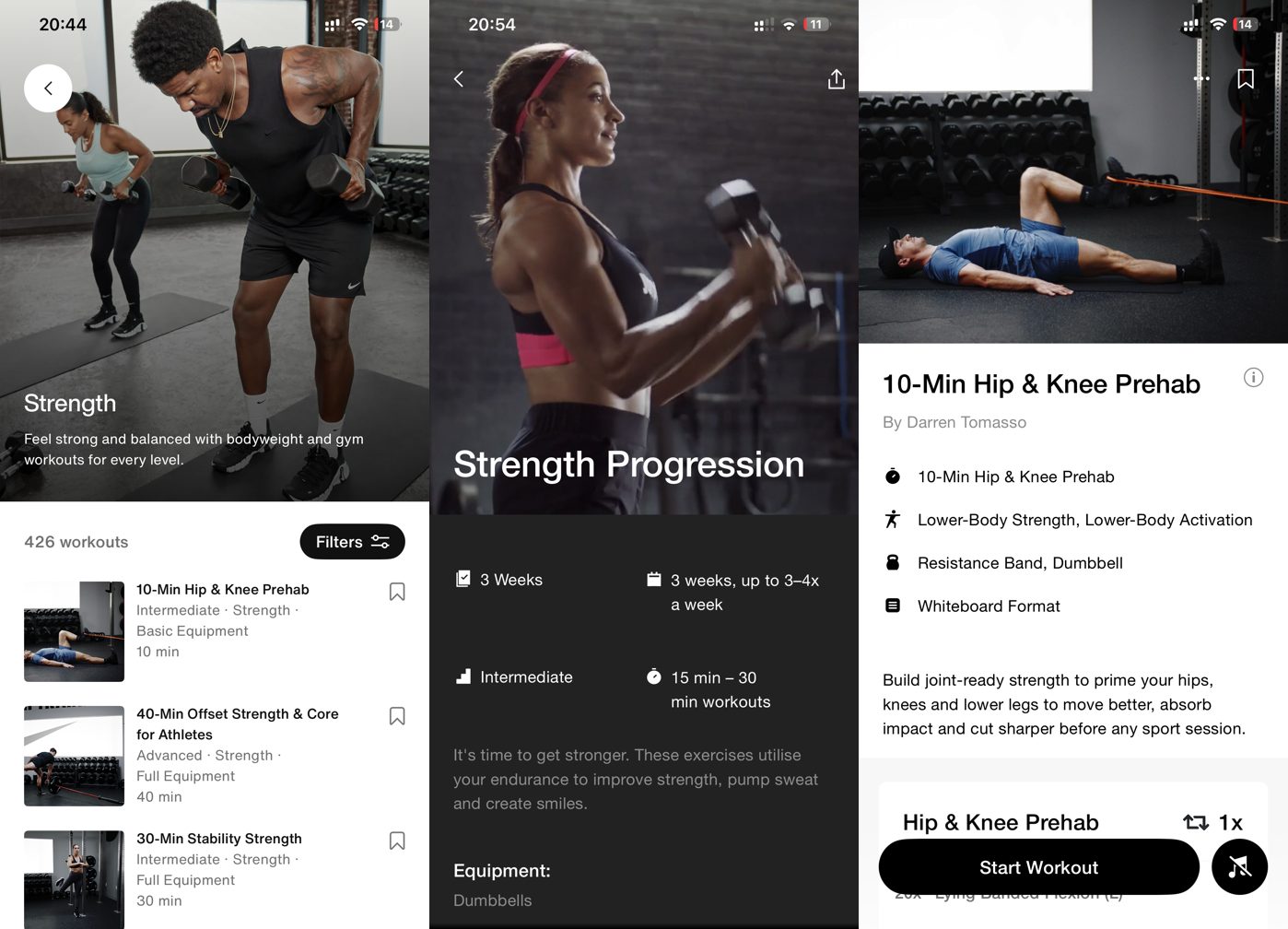
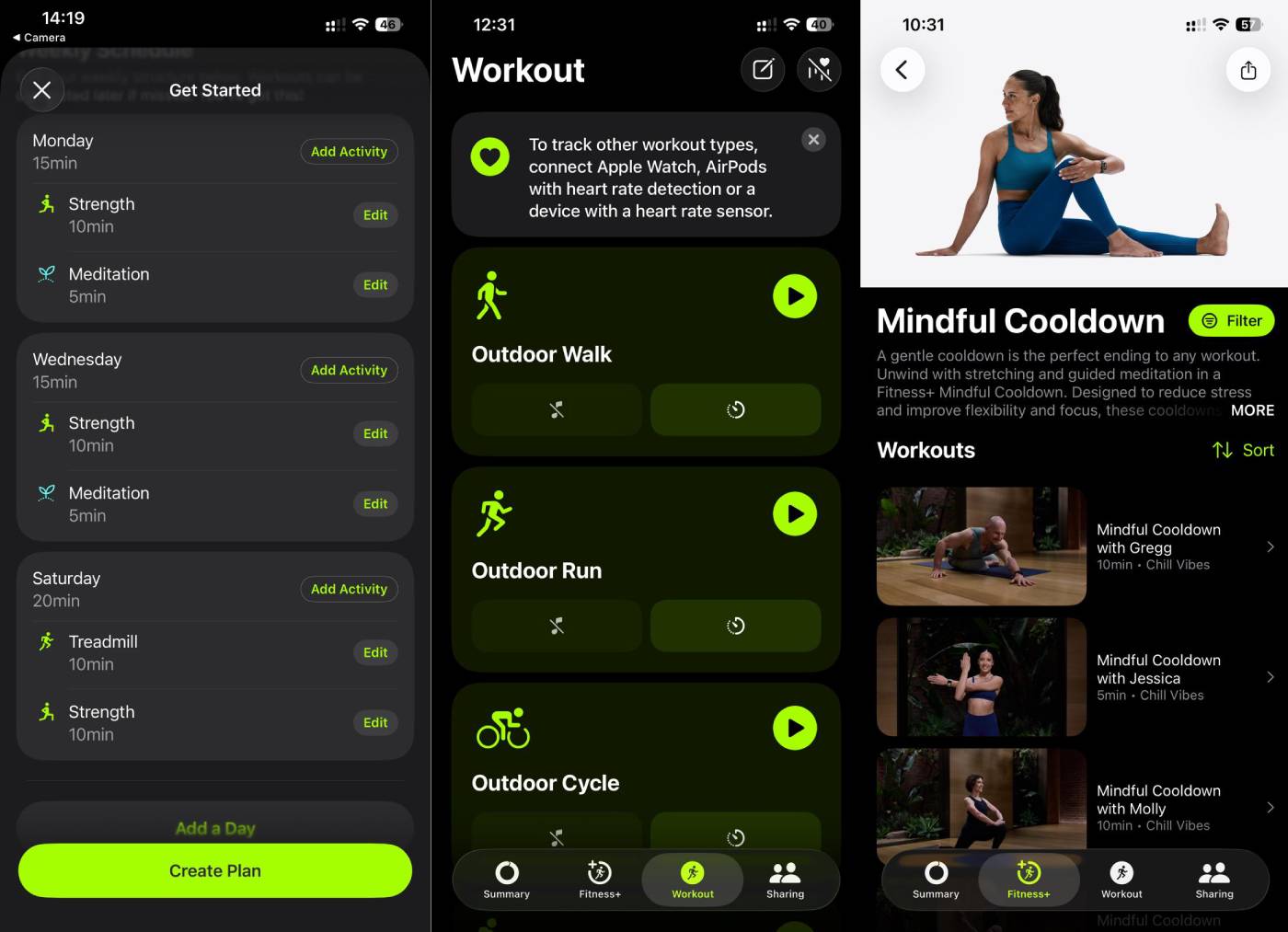
On Apple Fitness+ she trained for five weeks of structured daily use, first on a custom plan of her own design and then on the 3 Weeks of Strength programme, which she repeated after a month of inactivity, with dance classes, Pilates with resistance bands, treadmill sessions and the Mindful Cooldowns around it. She used dumbbells from 9 lb to 20 lb, resistance bands, ankle weights, a kettlebell and a mat, on iPhone and iPad projected to a TV and a monitor. On Nike Training Club she signed up, browsed the whole free library, completed a Hip and Knee Prehab joint workout in the Whiteboard follow-along format, and worked through the library filters.
That difference matters in one direction only. Where a criterion depends on what a platform contains, price, library breadth, whether menopause programming exists, the two columns sit on the same evidence. Where a criterion depends on how a platform behaves over weeks, progression, variety, whether you keep opening it, the Apple Fitness+ number rests on five weeks of daily use and the Nike Training Club number rests on a single session and a thorough look around.
There is one further limit worth stating at the top. Apple Fitness+ was tested without an Apple Watch, which is the platform’s headline feature. Everything below describes the app as it works on its own.
Value for money: the widest gap on the page, and the reason this is not a simple win
Nike Training Club wins, 10 against 7, and 10 is the highest Value for Money score we have published.
| Plan | Nike Training Club | Apple Fitness+ |
|---|---|---|
| Monthly | No paid tier exists | $9.99, or £9.99 in the UK |
| Annual | Nothing to bill | $79.99, or £79.99 in the UK |
| Free tier | Everything, the whole library and all programmes | None beyond the trial |
| Trial | Nothing to trial | One month free, or three months free with a new Apple device purchase |
| Household | Each person makes a free account | Family Sharing included, and bundled in Apple One Premier |
| What you pay with | A free Nike account and extensive data collection | Money, and owning Apple hardware |
Nike Training Club is free with no subscription and no ads, and Nike made its former Premium tier free in 2020. The cost is not literally zero. A free Nike account is required and the app collects a broad set of information linked to you, so the transaction is data for software rather than money for software. For most readers that is a reasonable trade, and it should be one you make deliberately.
Apple Fitness+ is priced sensibly for what it is, and its trial is one of the more generous in this category. Where the value case wobbles is the hardware condition underneath it. The subscription only works if you already own an iPhone, iPad or Apple TV, so the true price for a woman outside that ecosystem is the price of a device. And for a subscriber without an Apple Watch, the headline metrics feature is missing. She reached that conclusion herself after five weeks: the ongoing $9.99 per month is harder to justify when she can get similar workout quality from Alo Wellness Club for free.
What this means for your decision. A paid platform has to be better than the free one by enough to be worth the money, not merely better. Apple Fitness+ is better on six of the nine criteria, and none of those margins is large. Our best free and budget workout apps ranking covers the rest of the no-cost field.
Time efficiency: Apple Fitness+ wins, and stacking is why
Apple Fitness+ wins, 9 against 8, and these are two of the strongest Time Efficiency scores in our comparison set, so this is a gap between good and very good rather than between good and bad.
Most Apple Fitness+ sessions run 10 to 30 minutes, and the platform is designed for you to put two of them together. In testing she almost always stacked: a 20-minute strength followed by a 10-minute cooldown. That is a different proposition from a library of 20-minute classes, because it lets you assemble the length you have today out of parts rather than hunting for a class that happens to be the right size.
She is explicit about why that mattered more than anything else on the platform. Working full time with two school-aged children, pickups, after-school clubs, friends and driving around, fitting in a 20-minute workout is genuinely achievable in a way that a 45 to 60-minute commitment every day simply is not, and she names it as the single biggest reason she kept coming back. The result was adherence: she showed up nearly every day for five weeks.
Nike Training Club runs from a few minutes to around 45 minutes and you filter by duration yourself. That is a perfectly good answer and the reason it scores 8 rather than lower. What it does not have is the stacking design, or a plan that decides for you what today looks like. Our 30-minute workouts for women over 40 and 20-minute workouts for perimenopause guides cover the wider field in both bands.
Muscle and bone: Apple Fitness+ wins, and one platform actually progresses you
Apple Fitness+ wins Muscle Potential, 7.5 against 6, with progressive strength capability 7 out of 10 against 6 and bone loading 5 against 4. Muscle Potential carries the heaviest weight in our model at 18%, so this criterion moves the overall result more than any other.
The difference is progression, not volume of content. The 3 Weeks of Strength programme is built to escalate: week one runs at a faster pace with lighter weights, week two slows the tempo and adds load, and week three adds complexity. That is a written progression rather than a suggestion, and in testing it worked. The progressive overload was real, moving from 9 to 13 lb dumbbells up to 11 to 17 lb over five weeks, with improved form on several movements. She ended up repeating the programme, running it for five weeks total because she had been inactive for about a month beforehand, which is a fair description of how most people restart.
Nike Training Club’s strength library is deeper than its reputation suggests, hundreds of workouts including progressive dumbbell programmes with moderate-to-heavy cues, and she was positively surprised by how much real strength content is free. What it will not do is push you. Nothing in the app tells you when to add weight, so the loading decision sits with you every single session.
The evidence is specific about why that decision matters. Khalafi and colleagues found in a systematic review and meta-analysis that exercise increased muscle and reduced fat mass, waist circumference and visceral fat in postmenopausal women, with resistance work the most effective modality for muscle.1 Watson and colleagues found in the LIFTMOR trial that heavier, high-intensity resistance and impact training improved bone mineral density and physical function in postmenopausal women, where light exercise did not to the same degree.2 Both platforms can carry that kind of training. Only one of them will steer you into it.
There is a further wrinkle that neither platform addresses, and it is worth knowing before you judge either by results. Isenmann and colleagues ran a 20-week controlled trial of free-weight resistance training in women aged 40 to 60 and found that maximal strength rose in every group, while increases in muscle mass appeared only in the premenopausal participants; the authors conclude that larger training volumes than six to eight sets per muscle per week are likely to be needed for the postmenopausal group.3 Read against that, a three-week programme of short sessions is a good start and not a complete answer, and the same is true of a free library you steer yourself.
Our best workouts to build muscle after 50 ranking covers platforms that programme progression explicitly rather than leaving it to the user.
Joint friendliness: Apple Fitness+ wins on a design decision
Apple Fitness+ wins, 8 against 7, with low-impact capability 7 out of 10 against 6. The margin is small and the mechanism behind it is not.
Every Apple Fitness+ session is filmed with three trainers, and one of them is always demonstrating a modification. That means the easier option is visible for the whole session rather than mentioned once at the start, which is the difference between a modification you can copy and a modification you have to remember. For a woman working around a joint, that is a practical feature rather than a marketing line. With an old meniscus injury in the picture, she was able to follow every strength and Pilates session without knee pain by watching the modifier.
Nike Training Club has no equivalent system, and it earns 7 on content instead. There is genuine yoga, Pilates, mobility and recovery material to mix in on a day when loading is wrong, and there is specific joint work in the free library. She went looking for exactly that, because she knows how much it matters to build the muscles around a joint she has injured, and a Hip and Knee Prehab session turned up as she signed up. Finding that in a free general-fitness app is not nothing.
Neither platform has a low-impact filter, so on both you are steering yourself away from the jumping. HIIT is prominent in both libraries, and that is not a fault: Cai and colleagues found in a systematic review and meta-analysis that high-intensity interval training significantly improved cardiorespiratory fitness in middle-aged and older women.5 The point is that on both platforms the choice of intensity is yours to make on the day, and only one of them puts the gentler version on screen while you make it.
Our best low-impact workouts for women over 50 ranking covers platforms where low impact is the design rather than a category.
Perimenopause and menopause fit: Nike Training Club edges it, and neither is built for this
Nike Training Club wins Women Over 40 Specificity, 4.5 against 4.3, and both numbers belong in the lower half of everything we score. Menopause programming is 1 out of 10 for Nike Training Club and 2 for Apple Fitness+.
Nike Training Club has two pieces of adjacent content and it is worth describing them precisely, because they are easy to overstate. The first is a four-week, four-phase programme called Harness the Power of Your Menstrual Cycle, which syncs training to the cycle. That is relevant to a still-cycling perimenopausal woman and it is not menopause support. The second is the pelvic-floor block inside its maternity programme. Together they are why hormone awareness is 3 out of 10 against 1 and menopause education 2 against 1.
Apple Fitness+ has nothing labelled for this life stage anywhere in the library, which is why its menopause education score is the lower of the two despite the platform being better in most other respects. What it does have is content that happens to fit: short sessions, visible modifications, progressive strength and a large recovery library. The review puts it exactly that way, that the workouts suit perimenopause and menopause well, Apple just hasn’t branded them that way. That is a real observation and it is not the same thing as programming, because an unlabelled library still leaves the woman to work out what her body needs this week.
The research is clear enough about why the strength side of both libraries is the part that matters here. Capel-Alcaraz and colleagues reviewed randomised trials of strength exercise during the menopausal transition and reported improvements in leg and pelvic-floor strength, physical activity, bone density and hormonal and metabolic measures, while noting that the evidence does not yet single out one type of strength training as superior.4 On either platform, the strength content is the part to prioritise, and on neither of them will anything tell you that.
Pelvic floor
Nike Training Club wins, 4 out of 10 against 2. Its pelvic-floor work exists inside the postpartum maternity programme, Nike (M)ove Like a Mother, whose deep-core and pelvic-floor recovery block was designed by a pelvic-health physical therapist and vetted by an obstetrician. That is genuine clinical input, scoped to pregnancy and postpartum rather than to midlife. Apple Fitness+ has no dedicated pelvic-floor track, and 2 out of 10 reflects core work that touches the area rather than any content aimed at it.
Expert credibility
Nike Training Club wins, 6 out of 10 against 5. Nike Master Trainers are an established coaching roster and the maternity module carries named clinical input. Apple Fitness+ trainers are Apple employees filmed in a purpose-built Apple studio rather than independent creators with their own followings, which produces consistency and a house style, and it also means the platform has no outside specialist attached to it. Neither company has a menopause clinician or an advisory board.
Structure: Apple Fitness+ builds the week, Nike Training Club hands you the shelves
Apple Fitness+ wins Programme Structure, 7.5 against 7, and the margin is narrower than the experience of using the two suggests.
Apple Fitness+ lets you build a custom plan by choosing activity types, session lengths and training days, and it then holds you to it. Alongside that sit multi-week programmes with a written arc, of which 3 Weeks of Strength is the clearest example. She used both: a custom plan of two to three strength sessions, one or two cardio or dance sessions, one HIIT day and recovery, and then the strength programme on top.
Nike Training Club has multi-week programs too, and they give real structure once you are inside one. What it lacks is anything that turns a library into a week. The consequence is named plainly in the Nike Training Club testing: if you are a beginner and do not know how to structure your workout week, you might feel lost. The experienced-user version of the same gap is the filters, which cover duration, level, intensity, equipment and format, but not body target, so on strength days when she wanted a full-body session she had to hunt for it manually.
Apple Fitness+ has its own version of the same limitation, and it is fair to hold both to it. The summary from five weeks of use is that if you know what your body needs, the library delivers, and if you do not, you are on your own. Custom plans choose the shape of your week; they do not choose the right shape for a midlife body. Neither platform will tell you that you should be lifting heavier or resting more this week.
Recovery: Apple Fitness+ wins the criterion, Nike Training Club wins the deload row
Apple Fitness+ wins Recovery Compatibility, 7 against 6, and this is the one place where the criterion and the capability point in opposite directions: recovery and deload capability runs 6 out of 10 to Nike Training Club against 5.
Apple Fitness+ has the better recovery habit built into it. The Mindful Cooldowns are 5 to 10 minutes long and designed to be stacked onto the end of a session, and she used them almost daily after strength sessions. Making the cooldown a separate short class you attach rather than a two-minute stretch tacked onto a video is a small design decision that changes how often people actually do it. There is also meditation and yoga in the library for the days when training is the wrong answer.
Nike Training Club has recovery, mobility, yoga, breathwork and mindfulness content, with mind and sleep material alongside it, and its higher deload capability reflects a library that is easier to drop down into without paying for anything. What neither platform has is adaptive logic. Neither one notices that you are tired, neither one schedules a rest week, and on both of them a deload is a decision you make and then have to keep.
Our low-cortisol workouts for perimenopause guide covers the platforms that treat recovery as a programming problem rather than a content category.
UX and design: Apple Fitness+ wins, with a specific fault on each side
Apple Fitness+ wins UX and Design, 7.5 against 7, and both platforms have exactly one irritation that a reader should know about before subscribing or downloading.
Apple Fitness+ is clean, well built and pleasant to use, and the production quality is high without being distracting. Two things hold it below an 8. The first is filtering. She wanted to filter simultaneously by time, coach and body area, the way she can on some other platforms, and could not always do that cleanly, because the filters are inconsistent across activity types. The second is a projection bug: she had an intermittent issue where the screen would go black while the audio continued, and the only fix was to stop the workout and restart it, which is mildly infuriating mid-session. It happened a handful of times across five weeks.
The larger design constraint is not a bug at all. Apple Fitness+ runs on iPhone, iPad and Apple TV only, with no Android and no web app, so a woman without Apple hardware is simply outside the product.
Nike Training Club is a well-built app with an Apple Watch app of its own, health sync and casting to a television, and it scores 7 on that basis. Its two frictions both came out of the session. Whiteboard-format workouts carry no voiceover coaching, and the one she picked happened to be exactly that, a follow-along session with no voiceover; she could still follow the video reasonably well, but it would be nice to have someone explain and remind you of the correct posture. The fix is to choose the instructor-led Class format instead. The other is the missing body-target filter described above.
Nutrition: a win for Nike Training Club that neither platform has earned
Nike Training Club wins Nutrition Integration, 3 against 0, and this is the least useful win on the page.
Apple Fitness+ has no nutrition of any kind. No meal planning, no macro guidance, no food education, nothing. That is why it takes the lowest Nutrition Integration score we have published, and why midlife nutrition capability is 1 out of 10 against 3.
Nike Training Club has no structured nutrition programme either. It is a workout app and it does not pretend otherwise. Nutrition carries the smallest weight in our model at 7%, so this criterion moves almost nothing, and the practical answer for either platform is that food is a problem you are solving somewhere else. Our best workout apps with meal plans ranking covers the platforms that do handle both.
Equipment and space needed at home
Nearly identical, and the purchase that changes your results is the same on both.
Both platforms have large bodyweight libraries that need nothing but a mat and enough floor space. Apple Fitness+ adds a little more kit at the margins: she used dumbbells, resistance bands, ankle weights, a kettlebell and a mat across five weeks, with the bands mainly for Pilates, and a treadmill is useful but optional for the walking and running sessions. Nike Training Club’s strength library runs on dumbbells and a mat.
On either platform the item worth buying is a pair of adjustable dumbbells, because a fixed light pair stops providing a stimulus once your body has adapted to it, which is the mechanism behind the loading evidence cited above. Neither platform requires proprietary hardware, a machine or a dedicated room. The one hardware condition on this page is the Apple device itself.
Starting from scratch, or starting again
Apple Fitness+ wins beginner on-ramp, 7 out of 10 against 6, and the fair framing is that both are usable and neither is designed for a complete beginner.
Apple Fitness+ has the better on-ramp because of three things working together: a plan it builds for you, sessions short enough that starting does not feel like a commitment, and the modifier on screen in every session. Its Strength Basics programme exists for exactly this, and she sampled five of those sessions to assess them and corrected her own form on a couple of movements afterwards, which is a fair signal of how well they explain.
Nike Training Club has the better price for finding out, which for a genuine beginner is a serious argument, and it has beginner workouts and starter programmes. Its weakness is the one already named: a library does not tell you what to do on Tuesday.
There is one more data point worth reporting, because it is rare to have any. She asked her mum, 68, a regular walker who does Pilates, to test the older-adults category on Apple Fitness+. Her verdict was mixed. She enjoyed the Strength for Older Adults sessions with Molly but found the difficulty level too low overall, and preferred dipping into the regular library with light or no weights. Two useful things follow: the beginner content is genuinely gentle, and a fit older woman may find it too gentle.
Nike Training Club pros and cons
Nike Training Club scores 6.6. It is strongest on value for money and weakest on nutrition guidance.
Pros
- Value for Money 10 against 7, the highest we have published, because it is free with no subscription and no ads.
- Women Over 40 Specificity 4.5 against 4.3.
- Nutrition Integration 3 against 0, on a low bar.
- Pelvic floor 4 out of 10 against 2, hormone awareness 3 against 1, menopause education 2 against 1 and expert credibility 6 against 5.
- Recovery and deload 6 against 5.
- Real yoga, Pilates, mobility and joint content.
- It works on any phone.
Cons
- Muscle Potential 6 against 7.5, with nothing prompting you to add load.
- Programme Structure 7 against 7.5: a library, not a plan.
- Time Efficiency 8 against 9 and Joint Friendliness 7 against 8.
- No body-target filter.
- Whiteboard-format workouts carry no voiceover coaching.
- A free Nike account is required, with extensive data collection.
- And it was sampled rather than lived with.
Apple Fitness+ pros and cons
Apple Fitness+ scores 6.9. It leads on short sessions and trails on nutrition guidance.
Pros
- Time Efficiency 9 against 8, on 10 to 30 minute sessions that stack.
- Muscle Potential 7.5 against 6, with progressive strength 7 out of 10 against 6 and a programme that actually escalates.
- Joint Friendliness 8 against 7, because a modifier is on screen in every session.
- Recovery Compatibility 7 against 6, UX and Design 7.5 against 7 and Programme Structure 7.5 against 7.
- Beginner on-ramp 7 against 6.
- Family Sharing included.
Cons
- Value for Money 7 against 10, against a free competitor.
- Nutrition Integration 0, the lowest we have published.
- Pelvic floor 2 out of 10, hormone awareness 1, menopause education 1. iPhone, iPad and Apple TV only, with no Android and no web app.
- Filters that will not combine time, coach and body area.
- An intermittent screen blackout when projecting.
- The metrics layer needs a watch we did not test.
Quick yes/no comparison
| Feature | Nike Training Club | Apple Fitness+ |
|---|---|---|
| Free to use | Yes, entirely | No |
| Free trial | Nothing to trial | Yes, one month, or three with a device |
| Works on Android | Yes | No |
| Works in a browser | Yes | No |
| A plan built for you | No, multi-week programmes only | Yes, custom plans |
| A progressive strength programme | Dumbbell programmes, progression left to you | Yes, 3 Weeks of Strength |
| Modification shown throughout the session | No | Yes, a dedicated modifier trainer |
| Menopause or perimenopause programming | No | No |
| Any hormone or cycle content | Yes, one cycle-syncing programme | No |
| Pelvic floor content | Yes, within the postpartum programme | No |
| Nutrition guidance | No | No |
| Filter by body target | No | Sometimes, not across all activity types |
| Dedicated cooldown sessions | Recovery and mobility content | Yes, 5 to 10 minute Mindful Cooldowns |
| Apple Watch app | Yes | Yes, and it adds the metrics layer |
| Cast to a television | Yes | Yes, and Apple TV is supported directly |
| How deeply was it tested | Sample tested, one workout | Fully tested, five weeks |
Nike Training Club vs Apple Fitness+ at a glance
| Nike Training Club | Apple Fitness+ | |
|---|---|---|
| Overall score | 6.6 | 6.9 |
| How it was assessed | Sample tested, signed up, browsed the whole free library and completed a workout | Fully tested, five weeks of structured daily use without an Apple Watch |
| Cost | Free | $9.99 a month or $79.99 a year, and £9.99 or £79.99 in the UK |
| Trial | Nothing to trial, a free Nike account is required | One month free, or three months free with a new Apple device purchase |
| Session length | A few minutes to around 45 minutes | Most sessions run 10 to 30 minutes, with 5 to 10 minute cooldowns |
| Approach | A large self-directed library plus multi-week programs | A streaming library plus custom plans and multi-week programmes |
| Devices | iOS, Android and the web | iPhone, iPad and Apple TV only |
| Modifications | Filter by duration, level, intensity, equipment and format, but not by body target | Three trainers per session, one always demonstrating a modification |
| Who is behind it | Nike Master Trainers, plus clinical input on the maternity module | Apple employees filmed in a purpose-built Apple studio |
| Menopause content | None, one cycle-syncing programme and a postpartum pelvic-floor block | None at all |
| Equipment | A mat to start, dumbbells for the strength library | A mat and dumbbells, with bands, ankle weights and a kettlebell useful |
| Known live issue | No body-target filter, Whiteboard-format workouts carry no voiceover coaching | An intermittent screen blackout when projecting, and inconsistent filters |
| How we assessed it | Sample tested, library browsed and one workout completed | Fully tested across five weeks of structured daily use |
The full scoring breakdown
Apple fitness+ wins six of the nine weighted criteria and nike training club wins three. The overall margin is narrow, and every criterion Apple Fitness+ wins it wins by a small amount, while the one criterion Nike Training Club wins decisively is the one about money.
| Criterion | Weight | Nike Training Club | Apple Fitness+ | Winner |
|---|---|---|---|---|
| Muscle Potential | 18% | 6 | 7.5 | Apple Fitness+ |
| Time Efficiency | 15% | 8 | 9 | Apple Fitness+ |
| Joint Friendliness | 12% | 7 | 8 | Apple Fitness+ |
| Programme Structure | 12% | 7 | 7.5 | Apple Fitness+ |
| Women Over 40 Specificity | 10% | 4.5 | 4.3 | Nike Training Club |
| Recovery Compatibility | 10% | 6 | 7 | Apple Fitness+ |
| Value for Money | 8% | 10 | 7 | Nike Training Club |
| UX and Design | 8% | 7 | 7.5 | Apple Fitness+ |
| Nutrition Integration | 7% | 3 | 0 | Nike Training Club |
| Overall | 100% | 6.6 | 6.9 | Apple Fitness+ |
The twelve capability scores
Nike training club wins six of the twelve capability scores and apple fitness+ wins six, which is the most evenly divided capability table we have published. The division is not random. Apple Fitness+ takes low-impact, progressive strength, bone loading, mind-body support, beginner on-ramp and menopause programming, all of which are about how well the training is built. Nike Training Club takes pelvic floor, hormone awareness, menopause education, expert credibility, midlife nutrition and recovery and deload, which are the rows that touch women’s health specifically. A better-built platform and a platform that has thought slightly harder about women is not the same thing.
| Capability | Nike Training Club | Apple Fitness+ | Winner |
|---|---|---|---|
| Low-impact | 6 | 7 | Apple Fitness+ |
| Progressive strength | 6 | 7 | Apple Fitness+ |
| Bone loading | 4 | 5 | Apple Fitness+ |
| Recovery & deload | 6 | 5 | Nike Training Club |
| Menopause programming | 1 | 2 | Apple Fitness+ |
| Pelvic floor | 4 | 2 | Nike Training Club |
| Hormone awareness | 3 | 1 | Nike Training Club |
| Menopause education | 2 | 1 | Nike Training Club |
| Expert credibility | 6 | 5 | Nike Training Club |
| Mind-body support | 6 | 7 | Apple Fitness+ |
| Beginner on-ramp | 6 | 7 | Apple Fitness+ |
| Midlife nutrition | 3 | 1 | Nike Training Club |
Who wins for…
Who wins on price
Nike Training Club, and it is not close. Value for Money 10 against 7, because there is nothing to pay.
Who wins for building muscle
Apple Fitness+. Muscle Potential 7.5 against 6, on a programme that escalates load week by week.
Who wins for bone
Apple Fitness+, narrowly. It leads the bone loading row 5 out of 10 against 4, and on both platforms the heavier work is a choice you make.2
Who wins for a joint that sets the terms
Apple Fitness+. Joint Friendliness 8 against 7, because the modified version is on screen rather than described.
Who wins for a fifteen-minute window
Apple Fitness+. Time Efficiency 9 against 8, and the stacking design is what earns it.
Who wins for being told what to do
Apple Fitness+. Programme Structure 7.5 against 7: it builds a week, Nike Training Club offers a library.
Who wins for perimenopause and menopause
Neither, and Nike Training Club by a hair. Women Over 40 Specificity 4.5 against 4.3, on cycle content that is adjacent rather than an answer.
Who wins for pelvic floor
Nike Training Club, on a low bar. 4 out of 10 against 2, and its content is postpartum rather than menopause-stage.
Who wins for an Android phone
Nike Training Club, by default. Apple Fitness+ does not run on Android or in a browser, so there is no comparison to make.
Who wins for a beginner
Apple Fitness+ to train with, Nike Training Club to start with. Beginner on-ramp 7 out of 10 against 6, against a price of nothing.
Who wins for nutrition
Nike Training Club, and only technically. 3 against 0, because one of them has none at all.
Who wins on evidence
Apple Fitness+, because it was lived with. Five weeks of daily use against one session and a browse.
Decision tree for women over 40
You do not use Apple devices. Nike Training Club. Apple Fitness+ is not available to you, and this is the only question on the page with a hard answer.
You want to spend nothing. Nike Training Club, and it is a genuinely good app rather than a consolation prize.
You know structure is what you lack. Apple Fitness+, for the custom plan plus a strength programme that escalates.
You have twenty minutes and no more. Apple Fitness+, for the stacking model. Nike Training Club will also do it and you will do the choosing.
A knee or a hip decides your week. Apple Fitness+, for the on-screen modifier. Nike Training Club if the price matters more, and use its joint and mobility content deliberately.
Your priority is muscle and bone. Apple Fitness+ first, then heavier work than either platform programmes, because a three-week arc of short sessions is a start rather than a finish.
Perimenopause is why you are looking. Neither. Menopause programming is 1 out of 10 and 2 out of 10, and there are platforms built for this.
You want one subscription to cover training and food. Neither, and Apple Fitness+ least of all.
What we did not test
The gaps are on both sides and they are different in kind.
On Apple Fitness+ we did not use the Apple Watch metrics layer, because she does not own one, so nothing on this page describes real-time heart rate, Activity Rings on screen or the Burn Bar. That is the platform’s headline differentiator and it sits outside this assessment entirely. We also did not assess Time to Walk or Time to Run as a reason to subscribe.
On Nike Training Club we did not run a full multi-week programme, the cycle-syncing programme, the maternity programme or the Apple Watch app. One completed workout and a thorough browse establish what the library holds and how one workout format feels. They do not establish whether its dumbbell programmes progress well across two months, and that limit sits underneath its Muscle Potential and Programme Structure scores.
Neither platform was assessed for how it handles an injury or a symptom flare, and nothing here should be read as a claim about long-term results on either.
Which is better for women over 50?
Apple Fitness+, for the way it is built
The three-trainer format is worth more at 55 than at 40, because the modified version being permanently on screen removes the guesswork on the days when a joint is unhappy. The short sessions matter for the same reason they matter at any age. And the strength programming, while modest, escalates, which is the property that counts.3
Nike Training Club, for the way it costs nothing
If you are not sure whether you will stay with an app, paying to find out is the wrong order of operations. Nike Training Club lets you test your own consistency for free, with real yoga, Pilates and mobility content for the gentler days. Our best workouts for postmenopause and best Pilates programmes for women over 40 rankings cover the wider field.
What we would actually suggest
Try Nike Training Club first for a month, because it costs nothing and it will tell you whether a self-directed library is a thing you use or a thing you download. If the answer is that you need to be told what to do, take the Apple Fitness+ free month next and follow a programme rather than browsing. Whichever you land on, add load deliberately and treat the menopause gap as something you are solving elsewhere.
Frequently asked questions
Is Nike Training Club or Apple Fitness+ better for women over 40?
Apple Fitness+ takes the overall score, 6.9 against 6.6, and Nike Training Club takes the money. Apple Fitness+ wins Time Efficiency 9 against 8, Muscle Potential 7.5 against 6, Joint Friendliness 8 against 7, Recovery Compatibility 7 against 6, Programme Structure 7.5 against 7 and UX and Design 7.5 against 7. Nike Training Club wins Value for Money 10 against 7, Women Over 40 Specificity 4.5 against 4.3 and Nutrition Integration 3 against 0. On the twelve midlife capability scores they split six and six, which almost never happens.
Is Nike Training Club really free, with no catch?
It is free of charge. There is no subscription, no paid tier and no ads, and the whole library including the multi-week programmes is included. What it costs instead is a free Nike account, which is required and comes with extensive data collection, so you are trading information rather than money. That is why Value for Money is 10 out of 10, the highest score of its kind we have published, and why the trade is worth understanding before you make it rather than after.
Do you need an Apple Watch for Apple Fitness+?
No, and this comparison was carried out without one. Since late 2022 the platform runs on iPhone, iPad and Apple TV without a watch. What a watch adds is the metrics layer: real-time heart rate on screen, Activity Ring progress and the Burn Bar. Our tester does not own an Apple Watch, so the testing here reflects the platform experience without the metrics layer, and every score on this page describes the app as it behaves on its own. If you do own a watch, the value side of the argument improves and we cannot tell you by how much.
Which one builds more muscle?
Apple Fitness+, 7.5 against 6, with progressive strength 7 out of 10 against 6 and bone loading 5 against 4. Muscle Potential carries the heaviest weight in our model at 18%, so this is the single largest reason the score lands where it does. The 3 Weeks of Strength programme moves you deliberately from lighter, faster work to heavier, slower work, and in testing the progressive overload was real, moving from 9 to 13 lb dumbbells up to 11 to 17 lb over five weeks with improved form on several movements. Nike Training Club has hundreds of strength workouts and dumbbell programmes, and nothing in it tells you when to add weight.
Which is gentler on joints?
Apple Fitness+, 8 against 7, and the reason is structural rather than a matter of content. Every session carries three trainers, one of whom is always demonstrating a modification, so the easier version is on screen in front of you rather than described. Our tester has a meniscus history and followed every strength and Pilates session without knee pain by watching the modifier. Nike Training Club scores 7 on the strength of real yoga, Pilates, mobility and recovery content plus specific joint work, including a Hip and Knee Prehab session in the free library. Low-impact capability is 7 out of 10 against 6, which is close.
Does either one have menopause or perimenopause programming?
No. Menopause programming is 2 out of 10 for Apple Fitness+ and 1 for Nike Training Club, which are two of the lowest scores we publish. Nike Training Club has the more relevant adjacent content: a four-week cycle-syncing programme called Harness the Power of Your Menstrual Cycle, and a postpartum pelvic-floor block inside its maternity programme. That is why hormone awareness runs 3 against 1 in its favour. Apple Fitness+ has nothing labelled for this stage at all, and Katy Cole’s summary of it is that the workouts suit perimenopause and menopause well, Apple just hasn’t branded them that way.
Which has better pelvic floor content?
Nike Training Club, 4 out of 10 against 2, and both numbers are low for a reason. Its pelvic-floor work sits inside the postpartum maternity programme, Nike (M)ove Like a Mother, whose recovery block was designed by a pelvic-health physical therapist and vetted by an obstetrician. That is genuine clinical input and it is scoped to pregnancy and postpartum rather than to a woman in her fifties. Apple Fitness+ has no dedicated pelvic-floor track anywhere in the library.
Which suits a beginner better?
Apple Fitness+, on a beginner on-ramp of 7 out of 10 against 6. It builds you a custom plan, the sessions are short enough not to intimidate, and the three-trainer format means the modified version is always visible. Nike Training Club is free, which removes the cost of finding out, and it has beginner workouts and starter programmes, but it is a library rather than a coach. The verdict from the Nike Training Club testing is blunt: if you are a beginner and do not know how to structure your workout week, you might feel lost.
How much did each platform actually get tested?
Unequally, and the asymmetry runs the opposite way to the price. Apple Fitness+ was fully tested across five weeks of structured daily use, on a custom plan and then the 3 Weeks of Strength programme, with dance, Pilates and treadmill sessions alongside. Nike Training Club was sample tested: signed up, the whole free library browsed, one workout completed and the filters worked through. So the free platform carries the lighter evidence, and any Nike Training Club score that depends on how a platform behaves across months should be read as provisional.
Which is better value?
Nike Training Club, 10 against 7, and it is the widest gap on the page. Nike Training Club costs nothing. Apple Fitness+ is $9.99 a month or $79.99 a year in the US, and £9.99 a month or £79.99 a year in the UK, with Family Sharing included, so a household can share one subscription. It is also bundled into Apple One Premier. The trial is generous: one month free for any new subscriber, or three months free with a new Apple device purchase. Our tester’s own conclusion after five weeks was that the ongoing $9.99 per month is harder to justify when she can get similar workout quality from Alo Wellness Club for free.
Which one has nutrition guidance?
Neither, and Nike Training Club wins Nutrition Integration 3 against 0 only because Apple Fitness+ has literally none. There is no meal planning, no macro guidance and no food education inside Apple Fitness+, which is why it takes the lowest Nutrition Integration score we have published. Nike Training Club has no structured nutrition programme either; midlife nutrition capability is 3 out of 10 against 1. Nutrition carries the smallest weight in our model at 7%, so it barely moves either total, and if you want training and eating handled in one place, neither of these is the answer.
Which one would you actually recommend?
Start with Nike Training Club, because it costs nothing to find out whether a self-directed library suits you, and add load deliberately since nothing in it will prompt you. Move to Apple Fitness+ if you own Apple hardware and you already know that being told exactly what to do is what keeps you consistent: the short stacked sessions and the dedicated modifier are the two things it does better than almost anything else. If you use Android, or any device outside the Apple ecosystem, the decision is made for you. And if perimenopause is the reason you are looking, neither of these platforms is built for it.
Research citations
- Khalafi M, Habibi Maleki A, Sakhaei MH, et al. The effects of exercise training on body composition in postmenopausal women: a systematic review and meta-analysis. Frontiers in Endocrinology. 2023. PMC. (Cited for: exercise increased muscle and reduced fat mass, waist circumference and visceral fat in postmenopausal women, with resistance training the most effective modality for muscle.)
- Watson SL, Weeks BK, Weis LJ, Harding AT, Horan SA, Beck BR. High-intensity resistance and impact training improves bone mineral density and physical function in postmenopausal women: the LIFTMOR randomized controlled trial. Journal of Bone and Mineral Research. 2018;33(2):211–220. PubMed. (Cited for: heavier, high-intensity resistance and impact training improved bone density and physical function, where light exercise did not to the same degree.)
- Isenmann E, Kaluza D, Havers T, et al. Resistance training alters body composition in middle-aged women depending on menopause: a 20-week control trial. BMC Women’s Health. 2023;23:526. PMC. (Cited for: maximal strength rose in every group on free-weight resistance training, while increases in muscle mass appeared only in the premenopausal participants, with the authors concluding that volumes above six to eight sets per muscle per week are likely to be needed after menopause. Note: 31 women completed the study, so we report it as a small trial.)
- Capel-Alcaraz AM, García-López H, Castro-Sánchez AM, Fernández-Sánchez M, Lara-Palomo IC. The efficacy of strength exercises for reducing the symptoms of menopause: a systematic review. Journal of Clinical Medicine. 2023;12(2):548. PMC. (Cited for: improvements in leg and pelvic-floor strength, physical activity, bone density and hormonal and metabolic measures, with the review noting that no one type of strength training is yet shown to be superior. Note: the Apple Fitness+ reference list attributes this paper to a different journal; the record on PubMed Central is the Journal of Clinical Medicine.)
- Cai L, et al. Effects of high-intensity interval training on cardiopulmonary fitness and physical function in middle-aged and elderly women: a systematic review and meta-analysis. Frontiers in Physiology. 2026. PMC. (Cited for: high-intensity interval training significantly improved cardiorespiratory fitness in middle-aged and older women.)
This page compares fitness platforms. It is not medical advice. Katy is a woman who has trained through perimenopause, not a clinician. Any training observations described are one person’s recorded experience, not an expected result or a general pattern. If you have a diagnosed condition, an injury, or symptoms that concern you, speak to a qualified healthcare professional before changing how you train.
About this comparison
Compiled by Katy Cole for Her Daily Fit. The two platforms were assessed to different depths and the difference is worth carrying into how you read the table. Apple Fitness+ was used for five weeks of structured daily use, so its column reflects behaviour over time. Nike Training Club was sample tested, so its column reflects what the library contains and how one session felt. Both were scored on the same nine weighted criteria and the same twelve capability scores, and the capability table came out level, six rows each.
Khalafi and colleagues found that resistance work is the modality that best protects muscle across the menopause transition,1 which is why Muscle Potential carries the most weight in that model. The Apple Fitness+ testing was done without an Apple Watch, so the metrics layer is not represented anywhere on this page. Prices were checked against official sources in 2026 and may differ if there has been a recent change. Scores are pulled live from each programme’s own assessment, so they update when a platform is rescored. Her Daily Fit earns nothing from either platform, and neither company was contacted before publication.
Compared with
Featured in
Best workouts to build muscle after 50
Best low-impact workouts, women over 50
20-minute workouts for perimenopause
30-minute workouts, women over 40
Low-cortisol workouts for perimenopause
Best workouts for postmenopause
Best Pilates programmes, women over 40
Best workout apps with meal plans