
Evlo scores higher overall, 8.0 against 6.2, and is the stronger platform for nutrition guidance and joint-friendly training. FIIT is the better pick if what you need most is fitting training into a busy week.
Quick answer
- Evlo 8.0 vs FIIT 6.2
- Evlo wins 7 of 9 criteria
- Muscle 9 vs 8, joints 9.5 vs 6
- Evlo $55.99/mo, FIIT £19.99/mo
- Evlo 45 to 50 min, FIIT 25 min
- Progressive strength 9 vs 6
Evlo is the better platform for building muscle after 40 without wrecking your joints, and it is expensive and long. It wins seven of the nine weighted criteria, including the two that matter most here: Muscle Potential at 18% weight, 9 against 8, and Joint Friendliness, 9.5 against 6. Progressive strength capability is 9 out of 10 against 6, and expert credibility 9 against 4.
FIIT wins on session length and price, and it is the more realistic option for a compressed week. Sessions run 10, 25, 40 or 60 minutes against Evlo’s realistic 45 to 50, and it costs £19.99 a month against $55.99. Evlo’s own weakest criterion is Value for Money at 6. If you cannot reliably find 50 minutes, the better platform is the one you will actually open.
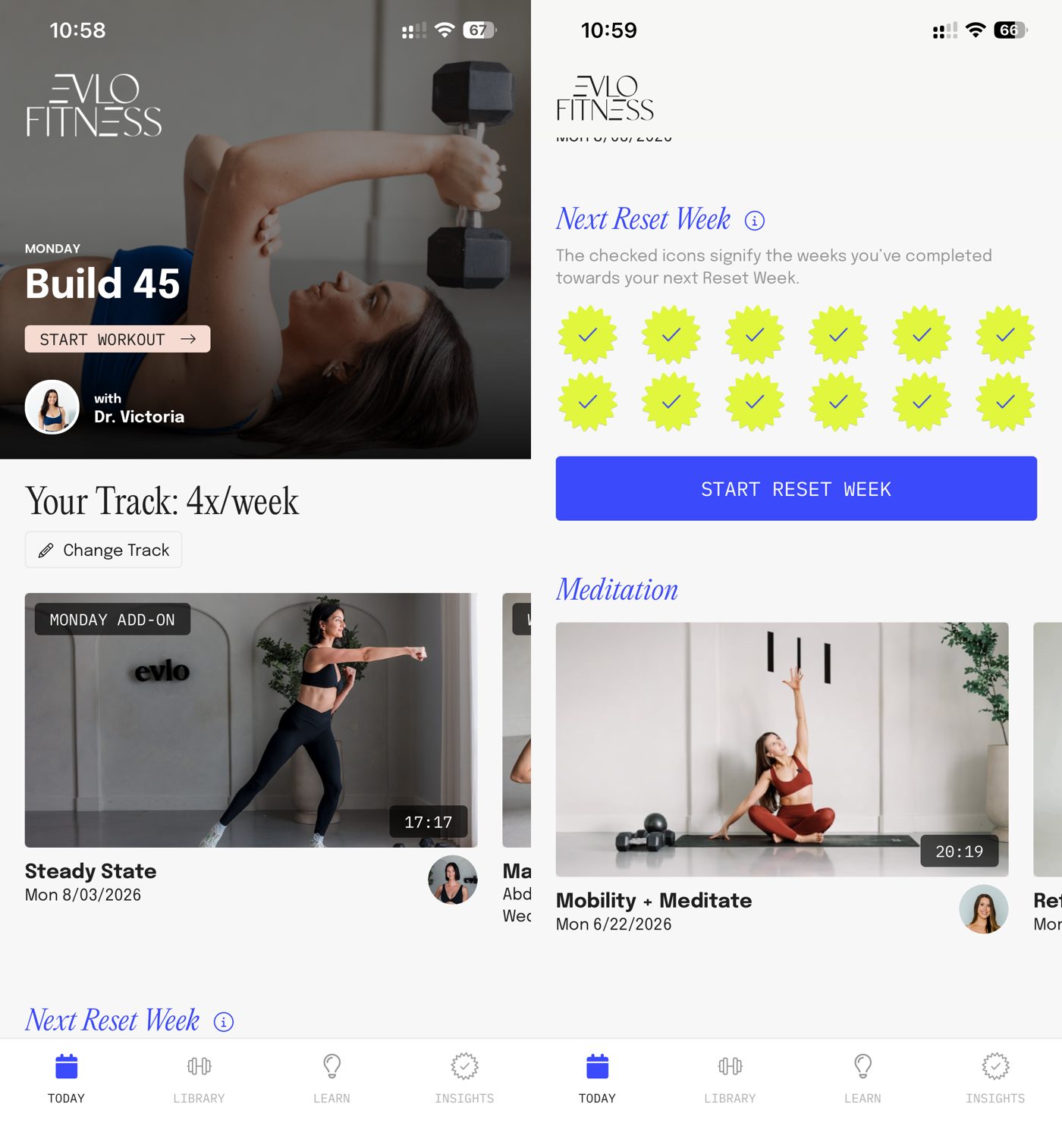
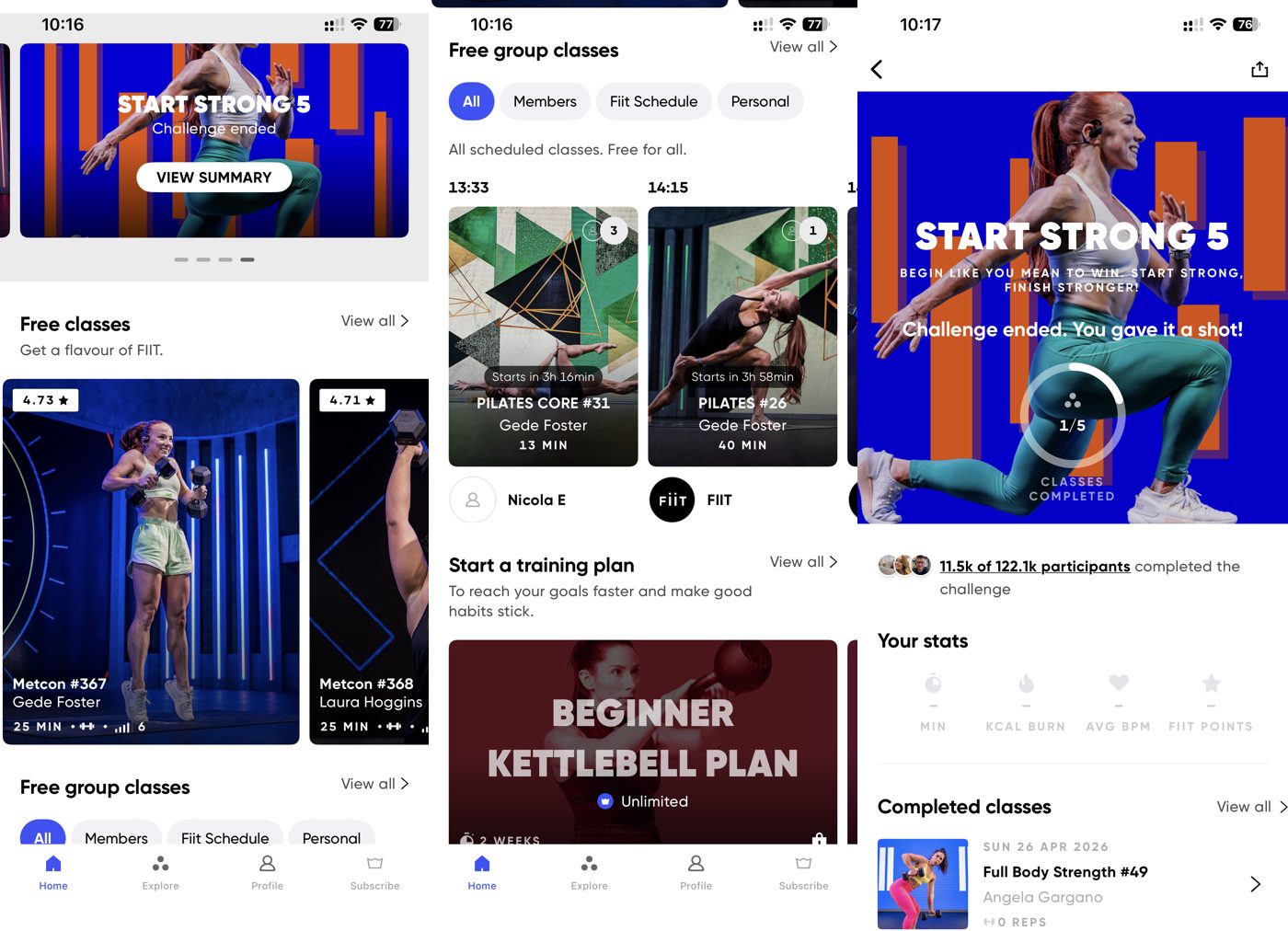
The two were not tested for the same length of time, and one test ended early for a specific reason. Evlo was used for eight weeks, including the Foundations programme and a full Reset Week. FIIT was used on a 14-day free trial that was abandoned before it ended, after being interrupted mid-workout three times and discovering that the video player cannot be rewound: the session simply continues without you and there is no way back. That is a real, checkable product decision rather than an opinion, but a fortnight is a lighter test than eight weeks, so read the FIIT scores as an assessment of what the platform contains and how two weeks of it felt. One thing does carry over from before that fortnight: FIIT is a platform Katy had used previously and returned to deliberately, to see whether it still worked for her at this life stage. Her summary of what she found is that the workouts have not changed, her needs have.
Evlo if you have reached the point where higher-intensity training has stopped producing results and you want the load to be precise rather than large, and if you can find 50 minutes. FIIT if 25 minutes is what you have, you want to pay a third as much, and you are happy to build your own week. The complication worth stating plainly is that Katy left Evlo for shorter sessions elsewhere and then came back, because nothing else did the same thing.
Evlo vs FIIT: the two platforms
Same nine weighted criteria, same twelve capability scores, and two opposite answers to what a midlife body needs.
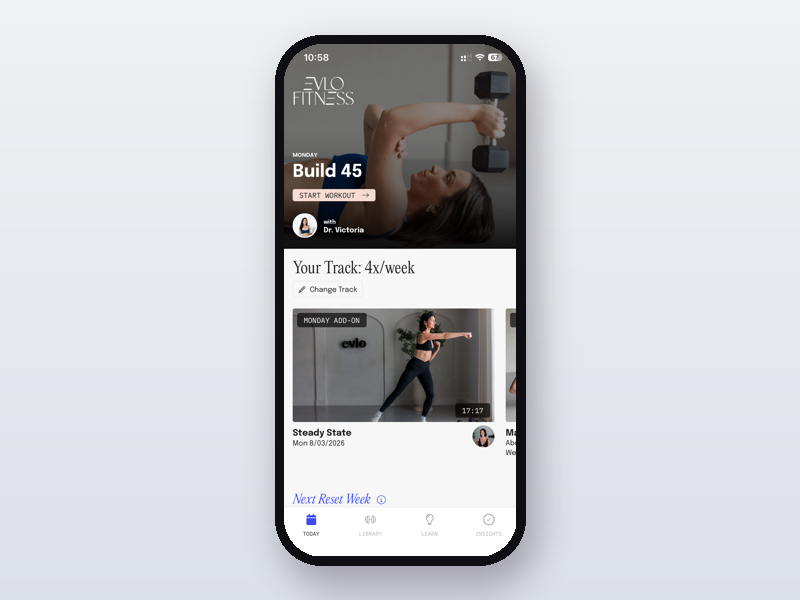
Evlo
Winner
Physiotherapist-led strength built on lower volume and higher precision, with assigned daily workouts, a Foundations on-ramp and a full Reset Week built into the programming.
- 45 to 50 min
- Progressive strength 9/10
- Joints 9.5
- 14-day trial
- Reset Week built in
Choose Evlo if you:
- Have found that higher-intensity training stopped producing what it used to
- Want to finish a session tired but not emptied for the rest of the day
- Have a joint history and want targeted work rather than avoidance
- Want deload structured for you instead of guessing at it
- Can find 50 minutes, and will pay for precision

FIIT
Runner-up
A UK studio-style platform with strong filtering, 25-minute strength sessions that end on a finisher, Pilates with Lottie Murphy, and equipment classes for bike, rower and tread.
- 10 to 60 min
- £19.99/month
- Mid to high impact
- 14-day trial
- No rewind
Choose FIIT if you:
- Have 25 minutes rather than 50, most days
- Want to pay considerably less per month
- Are happy building your own week from a filter system
- Like a session that ramps up at the end rather than winding down
- Have a bike, rower or treadmill you want classes for
Affiliate link, at no extra cost to you. Full disclosure.
How we scored this, and how both were tested
Evlo got eight weeks, FIIT got a fortnight, and that gap matters before any score. Evlo was tested from the Foundations on-ramp through weekly programming, including Build, Burn, Barre, nutrition and a full Reset Week. FIIT was tested on its 14-day trial across functional strength, full-body strength, Pilates basics and one treadmill workout; the AirBike, rower, kettlebell and 60-minute classes were not.
Same tester, same knee, same stage. Katy Cole is in her forties, perimenopausal, with a meniscus injury history, and came to Evlo already fit, so her account reflects an existing base rather than a beginner encounter.
Muscle Potential carries the most weight of the nine at 18%, because preserving lean mass through menopause is the highest-value thing a programme can do at this age. Time Efficiency is 15%, and here the two pull in opposite directions.
Muscle potential: Evlo wins, and it is the highest score on this page
Evlo wins, 9 against 8. On progressive strength capability the gap is 9 out of 10 against 6, and a 9 is the highest we have recorded on that capability.
What happened on Evlo
The first surprise was downward. Katy came in regularly using 15 lb and heavier dumbbells and had to drop to 11 lb to complete the sets properly. Within the first week of Foundations she was sore in places her usual training had stopped reaching: core, inner thighs, glutes. Her summary of that week is precise about what it meant. The first feeling was surprise, the second was that she was clearly doing something different, and the specific, deep soreness was direct evidence of it.
After eight weeks she was 3 lb lighter without any dietary change, visibly more toned, and stronger in her lower body than in a long time, coming back stronger in her core and glutes than she had been in years. The targeting is unusually clean: after a lower body Build session she was cooked in her glutes and hamstrings while feeling perfectly fine everywhere else.
What happened on FIIT
FIIT is not weak here. Muscle Potential is 8, and her verdict on the sessions themselves is that she felt them, her muscles were challenged, and the workouts delivered. She chose the 25-minute strength sessions with finishers, where the last few minutes ramp up, and the finishers were the part she looked forward to most: something about the quick ramp at the end of a strength session lands as a treat rather than a punishment.
What it lacks is progression that is managed for you. Progressive strength scores 6, and the platform gives you a library and a filter rather than a plan that adds load.
Bone density
Bone loading is 6 out of 10 for Evlo and 5 for FIIT, which is modest on both. Mohebbi and colleagues identify progressive resistance training as the primary non-hormonal intervention for bone mineral density after menopause,4 and a separate systematic review and meta-analysis reports improvements in menopause symptoms and functional capacity with resistance training, on evidence its own authors rate as very low to low certainty.5 Evlo is the closer of the two to that description, but neither is a bone-density programme, and our best workouts to build muscle after 50 ranking covers what is.
Joint friendliness: Evlo wins by the widest margin on the page
Evlo wins, 9.5 against 6, and that is the highest Joint Friendliness score we have recorded anywhere on this site. On low-impact capability it is 9 out of 10 against 5.
The same meniscus history was carried into both. On Evlo it was managed by design: the loading is targeted rather than large, and her reason for returning to the platform after leaving it is precisely this, that nothing else produces the same targeted effect on joints.
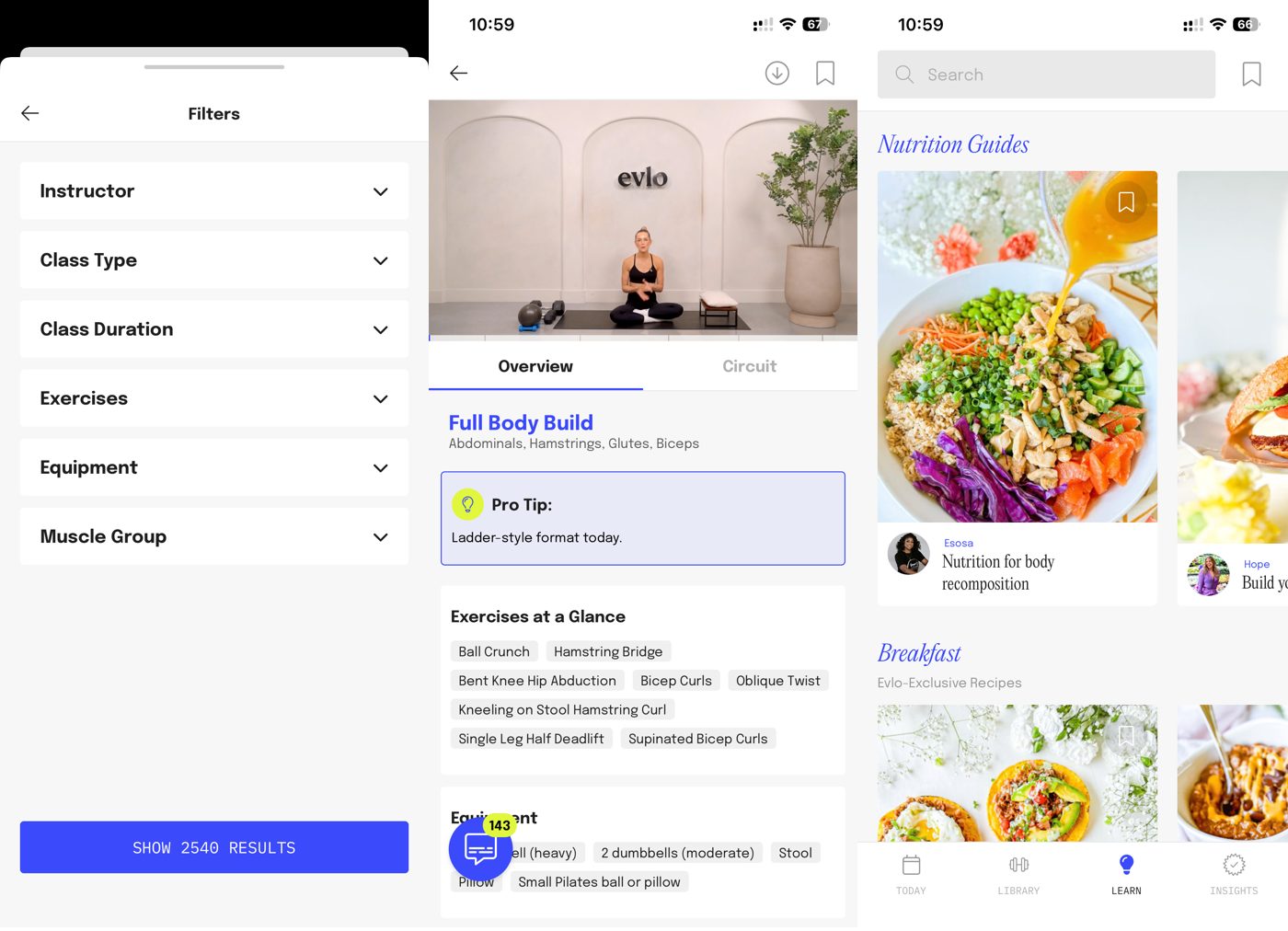
On FIIT the knee still tells her when it disapproves, and the platform is mostly mid to high impact. Two things separate them. FIIT’s filtering is genuinely good, and she was able to find a class matching exactly what she wanted, including filtering specifically for low-impact options when her knee was complaining. But FIIT does not show mid-class modifications, and she says plainly that she needed them. A filter helps you choose a class. A modification helps you finish one.
Why this matters more now. Wright and colleagues describe a cluster of musculoskeletal changes associated with the menopause transition, including effects on tendon and ligament integrity and a raised injury risk.1 That is an argument for the modification being on screen, not for training less.
Time efficiency: FIIT wins, and this is the reason Evlo lost a user
FIIT wins, 7.5 against 6.5. It is one of only two criteria FIIT takes, and on this pair it is the one most likely to decide what you actually do.
Evlo lists its sessions at 35 minutes. The realistic figure is 45 to 50. That gap is the single most practical fact on this page, and it is what ended her run: she moved to Burn360 25-minute sessions combined with Caroline Girvan short workouts, not because Evlo stopped working but because consistent 50-minute slots were what she was most short of.
FIIT runs 10, 25, 40 or 60 minutes, and the 25-minute slot fits a perimenopausal training schedule where energy fluctuates. She also noticed her brain fog improved on the days she did those short, finisher-led sessions.
Then she went back. She returned to Evlo because nothing else produces the same targeted effect on joints, and describes coming back feeling fresher and more motivated. Her own summary is the most useful sentence in either review: that leave-and-return is probably the most candid endorsement she can write, because Evlo is hard to stay with consistently and hard to stay away from. Our 20-minute workouts for perimenopause ranking covers the short end of the field properly.
Recovery: Evlo wins, and the difference is what the rest of your day looks like
Evlo wins, 9 against 6.5, with recovery and deload capability 9 out of 10 against 3, the widest capability gap in this comparison.
A 9 on deload reflects something structural: Evlo builds a full Reset Week into the programming rather than leaving you to decide when to back off. Her account of the difference is about the hours after the session, not the session itself. Coming from HIIT-based training she was used to finishing workouts depleted. With Evlo she finished tired but not emptied, and the rest of the day was normal, productive, not dragged through.
FIIT scores 3 on recovery and deload, and this produced the most useful physiological observation across either review. The same fast-paced sessions felt good in the days after her period, leaving her sore in a way she actually enjoyed, and left her flu-like, overly sore and unable to sleep in the week before it. That is one person’s experience across a fortnight rather than a general claim about cycles, and we are not going to tell you what your own pattern is. What it illustrates is the gap FIIT has: it offers no guidance to help a perimenopausal user know when to push and when to pull back.
She resolved it herself, and the protocol she landed on is worth stating because it is what the platform will not give you. Two to three 25-minute strength sessions with finishers in the post-period and follicular window, scaled back to mat Pilates and mobility in the late luteal phase. FIIT supports that if you build it yourself. It does not coach you into it. Evlo makes the equivalent decision for you by scheduling a Reset Week, which is the practical difference between a 9 and a 3 on this row.
Perimenopause and menopause fit: Evlo wins, and neither is menopause-built
Evlo wins, 6.6 on Women Over 40 Specificity against 3.2. The capability scores are the more useful read, and they are low on both: menopause programming 3 out of 10 against 1, menopause education 4 against 1, hormone awareness 3 against 1.
So Evlo wins this criterion despite having no menopause programme, which is worth being clear about. What it has is a training philosophy that happens to suit a midlife body, plus expert credibility of 9 out of 10 and recovery and deload of 9. FIIT has none of that and no menopause content either.
Her conditional on FIIT is the sharpest version of what is missing: if FIIT had a perimenopause or menopause programme led by Lottie Murphy, she would probably still be subscribed. The Pilates was already there and she loved it. The framing was not.
Pelvic floor
Evlo scores 5 out of 10 and FIIT 2. Neither has a dedicated pelvic floor programme. Teixeira and colleagues report a 36% prevalence of urinary incontinence across female athletes in a systematic review and meta-analysis.3 That review did not separate high-impact from low-impact sport, so we do not claim that it did, and we are not going to tell you what your symptoms are. If this is a concern, a dedicated app alongside either platform is the answer.
Coaching and progression: Evlo wins, 9 out of 10 against 4 on expert credibility
Evlo wins on coaching, and the mechanism is that it decides for you. Programme Structure is 8.5 against 6.5. Evlo assigns the day’s workout, runs a Foundations on-ramp and schedules the Reset Week. Expert credibility is 9 out of 10, the highest on this page, reflecting the physiotherapist-led design.
FIIT’s coaching is good in the room and absent at the plan level. She is warm about the trainers: it is a pleasure to work out with Gede Foster, whose Functional Strength sessions have a clear structure, and the Pilates classes with Lottie Murphy are super pleasant, the relaxing atmosphere making them her favourite sessions of the trial. What did not work was the plan. The recommended plan did not appeal, so she used the filter system to build her own week of two strength sessions, two Pilates and one cardio, and her conclusion is blunt: she does not need to pay for an app where she has to design her own workouts, and programme structure matters more in midlife, not less.
UX and design: Evlo wins, and one FIIT flaw ended a trial
Evlo wins, 8.5 against 6.5. The gap is caused by one specific, checkable product decision rather than a general impression.
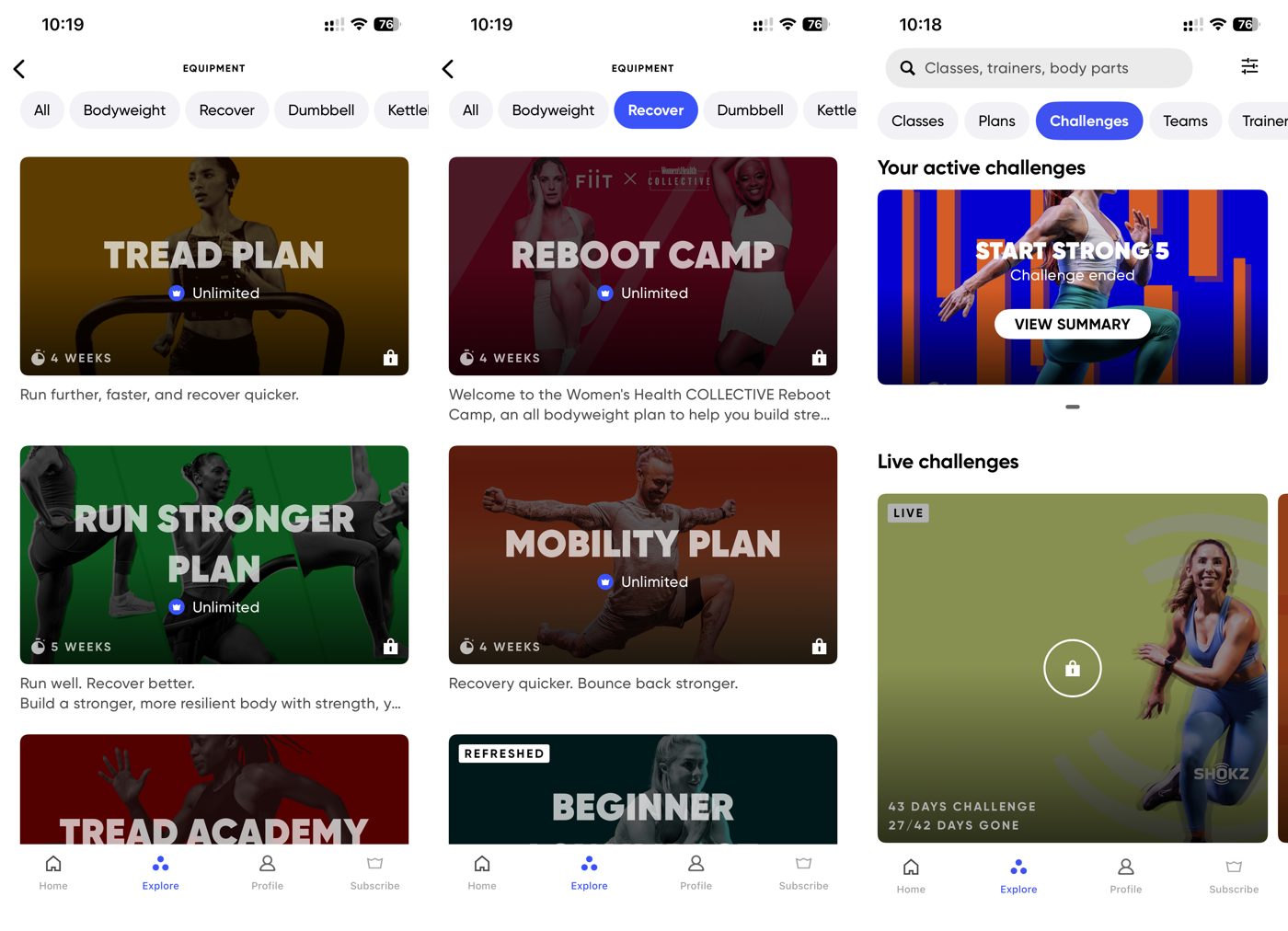
FIIT’s video player cannot be rewound. On three separate occasions during the trial Katy was interrupted mid-workout: once a delivery arrived, once her phone rang and she answered, once there was a technical issue. Each time she forgot to pause first, and each time she came back to find the workout had progressed past where she had stopped with no way to move back. After the third occasion she gave up on the platform. The same limitation applies within a session: if she missed a cue or wanted to re-check her form, she could not.
There is a second friction. Without a video preview she would commit to a class and realise within five minutes that it was either too slow or too intense, and she quit mid-workout or after a quarter of the video on more than one occasion.
Against that, FIIT’s filtering is a genuine strength, good enough to find exactly the class she wanted including a low-impact filter when her knee was complaining. The interface is not bad. One decision inside it made the platform unusable for her.
Nutrition: Evlo wins, and FIIT barely competes on this one
Evlo wins, 7 on Nutrition Integration against 2. On midlife nutrition capability it is 5 out of 10 against 1. Nutrition carries the smallest weight in our model at 7%, so this gap moves the overall scores least, but it is the widest proportional gap on the page.
Evlo includes a nutrition section, which she went through as part of the eight weeks. It is a supporting component rather than a coached plan, which is why it scores in the middle rather than the top. FIIT is a workout platform and does not pretend otherwise. If nutrition guidance is part of what you want from a subscription, neither of these is the reason to pick it, and Evlo is the only one of the two that offers anything at all.
One point of context on why the weight is low. The eight-week body-composition change recorded on Evlo happened without any dietary change, which she states explicitly. That is one person’s result over eight weeks rather than an expected outcome, and it is not a claim about what either platform’s nutrition content does.
Equipment and space needed at home
Both work in a small space with dumbbells, and only FIIT has classes for machines.
Her FIIT setup is a useful benchmark for either: a mat, dumbbells in heavy and medium, a 2 by 2 metre space, a phone casting to a TV, a treadmill in the room and no fitness tracker. One treadmill workout was fun, with the trainer’s voice and on-screen pace cues keeping her moving. She did not test the AirBike, rower or stationary bike classes, because she does not own any of that equipment, so this page does not assess them.
On Evlo the requirement is dumbbells and a mat, and the notable equipment fact is the direction of travel: she went down from 15 lb and heavier to 11 lb to complete the sets properly, so you may need less weight than you expect rather than more.
Starting from scratch: Evlo wins, 8 out of 10 against 4
Evlo takes the beginner on-ramp by the second widest capability margin here, largely because it assigns a Foundations programme after onboarding rather than dropping you into a library.
One caveat on the evidence, which Katy states herself: she came to Evlo already fit, so her account reflects someone with an existing base rather than a beginner encounter. The score reflects the platform’s structure rather than a tested beginner experience.
FIIT scores 4. The filtering is excellent for someone who knows what she is looking for, and it is exactly the wrong shape for someone who does not, because the recommended plan may not fit and the alternative is designing your own week.
Evlo pros and cons
Evlo scores 8.0. It is strongest on joint-friendly training and weakest on value for money.
Pros
- Muscle Potential 9 and Joint Friendliness 9.5, the highest joint score we have recorded.
- Progressive strength 9 out of 10, recovery and deload 9, expert credibility 9.
- A Reset Week built into the programming.
- Assigned daily workouts and a Foundations on-ramp, with beginner on-ramp 8.
- Eight weeks of testing produced a measured result and a return after leaving.
Cons
- $55.99 a month or $599 a year, and Value for Money is its weakest criterion at 6.
- Sessions are listed at 35 minutes and realistically run 45 to 50, which is what caused a user to leave.
- Menopause programming 3 out of 10 and hormone awareness 3, so it is not menopause-built.
- Time Efficiency 6.5 is the lower of the two.
FIIT pros and cons
FIIT scores 6.2. It leads on building and keeping muscle and trails on nutrition guidance.
Pros
- Time Efficiency 7.5 with 10, 25, 40 and 60 minute options, and £19.99 a month against $55.99.
- Muscle Potential 8 is genuinely respectable.
- Excellent filtering, including a low-impact filter.
- Strong trainers in Gede Foster and Lottie Murphy.
- Equipment classes for bike, rower and tread.
- 25-minute strength sessions with finishers that were a highlight.
Cons
- The video player cannot be rewound, which ended the trial after three interruptions.
- No mid-class modifications shown.
- No video preview before committing to a class.
- Recovery and deload 3 out of 10.
- Menopause programming, hormone awareness and menopause education all 1.
- Nutrition Integration 2, the lowest score on this page.
- The cancellation cutoff before trial end catches people.
Quick yes/no comparison
| Feature | Evlo | FIIT |
|---|---|---|
| Assigns you a daily workout | Yes | No |
| Structured deload or reset week | Yes | No |
| Mid-class modifications shown | Yes | No |
| Can rewind the video | Yes | No |
| Video preview before you commit | Yes | No |
| Low-impact filter | Yes | Yes |
| Sessions under 30 minutes | No, 45 to 50 realistic | Yes |
| Menopause-specific programming | No | No |
| Classes for bike, rower or treadmill | No | Yes |
| Nutrition guidance | Partly | No |
| Physiotherapist-led design | Yes | No |
| Free trial | Yes, 14 days | Yes, 14 days |
Evlo vs FIIT at a glance
| Evlo | FIIT | |
|---|---|---|
| Overall score | 8.0 | 6.2 |
| How it was assessed | Tested, eight weeks including a full Reset Week | Tested, 14-day trial abandoned before it ended |
| Cost | $55.99/month or $599/year | £19.99/month or £119.99/year |
| Free trial | 14 days | 14 days, with a cancellation cutoff before the end |
| Session length | 35 min listed, 45 to 50 min realistic | 10, 25, 40 or 60 min |
| Impact level | Low | Mostly mid to high |
| Approach | Physiotherapist-led, lower volume, higher precision | Studio-style classes, HIIT-leaning, build your own week |
| Equipment | Dumbbells and a mat | Dumbbells and a mat, plus optional bike, rower and tread classes |
| Menopause content | None branded, but the training philosophy suits midlife | None |
Evlo vs FIIT: the full scoring breakdown
Evlo wins seven of the nine weighted criteria and FIIT wins two. Scores are pulled live from each programme’s own assessment, so this table updates when the assessment does.
| Criterion | Weight | Evlo | FIIT | Winner |
|---|---|---|---|---|
| Muscle Potential | 18% | 9 | 8 | Evlo |
| Time Efficiency | 15% | 6.5 | 7.5 | FIIT |
| Joint Friendliness | 12% | 9.5 | 6 | Evlo |
| Programme Structure | 12% | 8.5 | 6.5 | Evlo |
| Women Over 40 Specificity | 10% | 6.6 | 3.2 | Evlo |
| Recovery Compatibility | 10% | 9 | 6.5 | Evlo |
| Value for Money | 8% | 6 | 6 | Tied |
| UX and Design | 8% | 8.5 | 6.5 | Evlo |
| Nutrition Integration | 7% | 7 | 2 | Evlo |
| Overall | 100% | 8.0 | 6.2 | Evlo |
The twelve capability scores
Evlo wins all twelve capability rows and FIIT wins none. The recovery and deload row, 9 against 3, is the widest gap and the one that explains what the rest of your day feels like.
| Capability | Evlo | FIIT | Winner |
|---|---|---|---|
| Low-impact | 9 | 5 | Evlo |
| Progressive strength | 9 | 6 | Evlo |
| Bone loading | 6 | 5 | Evlo |
| Recovery & deload | 9 | 3 | Evlo |
| Menopause programming | 3 | 1 | Evlo |
| Pelvic floor | 5 | 2 | Evlo |
| Hormone awareness | 3 | 1 | Evlo |
| Menopause education | 4 | 1 | Evlo |
| Expert credibility | 9 | 4 | Evlo |
| Mind-body support | 7 | 4 | Evlo |
| Beginner on-ramp | 8 | 4 | Evlo |
| Midlife nutrition | 5 | 1 | Evlo |
Value for money: tied on the score, and nearly three times apart on price
Tied at 6 each, and this is the tie that needs the most explaining on any page in this series.
| Plan | Evlo | FIIT |
|---|---|---|
| Monthly | $55.99 | £19.99 |
| Annual | $599 | £119.99 |
| Free trial | 14 days | 14 days, cancel before the cutoff |
| What the money buys | Physiotherapist-led programming, assigned daily workouts, Reset Weeks | A large studio-style library, strong filtering, equipment classes |
Evlo is one of the most expensive subscriptions on this site, and Value for Money is its own weakest criterion at 6, so the review is not pretending otherwise. It ties because it delivers the most targeted training we have assessed. FIIT ties from the other direction: it costs a third as much and the score reflects a platform that lost a user to a fixable interface decision.
What this means for your decision. Both trials are 14 days, so the trial is not the tiebreaker. Note that FIIT’s cancellation cutoff falls before the trial ends, which catches people. If price is the deciding factor, our best free and budget workout apps for women over 40 ranking covers cheaper options than either.
Who wins for…
Who wins for building muscle after 40
Evlo. 9 against 8, progressive strength 9 out of 10 against 6, and eight weeks of testing that ended 3 lb lighter and stronger in the core and glutes.
Who wins for a joint history
Evlo. 9.5 against 6, the highest joint score we have recorded, and it shows modifications where FIIT does not.
Who wins for a 25-minute slot
FIIT. 7.5 against 6.5. Evlo lists 35 minutes and realistically runs 45 to 50.
Who wins on price
FIIT. £19.99 a month against $55.99, and £119.99 a year against $599.
Who wins for rest weeks and recovery
Evlo. 9 against 6.5, with recovery and deload 9 out of 10 against 3 and a Reset Week built in.
Who wins for being told what to do
Evlo. Programme Structure 8.5 against 6.5. Evlo assigns the day’s workout, FIIT hands you a filter.
Who wins if you get interrupted mid-workout
Evlo. FIIT’s player cannot be rewound, and three interruptions in a fortnight ended the trial.
Who wins for finishing with energy left
Evlo. Tired but not emptied, with the rest of the day normal, against HIIT-leaning sessions that produced a flu-like week.
Who wins for starting from scratch
Evlo. Beginner on-ramp 8 out of 10 against 4, with a Foundations programme assigned at onboarding.
Who wins for bike, rower or treadmill classes
FIIT. It has them and Evlo does not, though we tested only the treadmill content.
Who wins for anything menopause-specific
Neither, really. Evlo leads on the criterion at 6.6 against 3.2, but menopause programming is 3 out of 10 against 1 and neither platform has a menopause programme.
Who wins for nutrition
Evlo. 7 against 2, the lowest single score on this page.
Decision tree for women over 40
Higher-intensity training has stopped working for you. Evlo. That is exactly the moment it was tested at.
You can find 25 minutes but not 50. FIIT, or Evlo accepting you will do it less often.
You have a joint history. Evlo, at 9.5 against 6.
You want to be told what to do each day. Evlo.
Price is the constraint. FIIT, at roughly a third of the monthly cost.
You train at home with a bike, rower or treadmill. FIIT, for the machine classes.
You get interrupted a lot. Evlo, without hesitation.
What we did not test
The testing was uneven and the gaps are worth naming.
FIIT was assessed on a 14-day trial that was abandoned before it ended. The AirBike, rower and stationary bike classes were not tested because that equipment was not available, and the kettlebell classes, the Fiit Mum postnatal content, the 60-minute sessions and the live leaderboard classes were not tested either. Its scores describe what the platform contains and how a fortnight of it felt.
On Evlo the eight weeks covered the whole programme list named in the scoring section above. The limitation there is the tester rather than the coverage: she came to it already fit, so the beginner on-ramp number is a read on how the platform is built, not on how a beginner would actually find it.
We do not publish calorie-burn comparisons. The strength and body-composition figures on this page are one person’s record over eight weeks, not a promised result, and the cycle-phase observation on FIIT is one person’s experience rather than a general pattern.
Which is better for women over 50?
Evlo, and more clearly than at 40
Every advantage sharpens: joint friendliness 9.5 against 6, recovery and deload 9 against 3, progressive strength 9 against 6, and a Reset Week you do not have to remember to take. The impact profile matters more too, since FIIT is mostly mid to high.
The obstacle is time and money, not suitability
$55.99 a month and a realistic 45 to 50 minutes is a genuine barrier, and it is the barrier that moved our own tester off the platform for a while. If that rules it out, our best low-impact workouts for women over 50 and best workouts for postmenopause rankings cover platforms that get closer to the same job for less.
- Price
- $55.99/mo
- Free trial
- 14 days (App Store still shows legacy 7-day copy, flag)
- Price
- Unlimited £19.99/$19.99/mo (Essential £7.99 may be phasing out)
- Free trial
- 14 days (Play still says 30 day, stale; use 14)
The FIIT button is an affiliate link, at no extra cost to you. Full disclosure.
Frequently asked questions
Is Evlo or FIIT safer for women over 40 with joint pain?
Evlo, 9.5 against 6 on Joint Friendliness and 9 out of 10 against 5 on low-impact capability. Both were used by the same tester with a meniscus injury history. FIIT has a good low-impact filter but does not show mid-class modifications, which she says she needed. Neither is a rehabilitation programme, and a diagnosed joint problem is a question for a physiotherapist.
Which program builds muscle better for women in their 40s, Evlo or FIIT?
Evlo, 9 against 8, with progressive strength capability 9 out of 10 against 6. Across eight weeks of testing she dropped from 15 lb dumbbells to 11 lb to complete the sets properly, and finished 3 lb lighter with no dietary change and stronger in her core and glutes than she had been in years.
Do Evlo and FIIT offer menopause-friendly or hormone-aware plans?
Neither has a menopause programme. Evlo scores 3 out of 10 for menopause programming and 3 for hormone awareness, FIIT scores 1 for both. Evlo wins the Women Over 40 criterion at 6.6 against 3.2 because its low-volume, high-precision, deload-structured approach happens to suit a midlife body, not because it is labelled for one.
How do Evlo and FIIT compare on price and value for a woman over 40?
Evlo is $55.99 a month or $599 a year. FIIT is £19.99 a month or £119.99 a year, roughly a third of the cost. They tie on Value for Money at 6 each, which is Evlo’s weakest criterion and reflects that it delivers the most targeted training we have assessed at a price to match. Both offer a 14-day free trial, and FIIT’s cancellation cutoff falls before the trial ends.
Can a woman over 40 start Evlo or FIIT with no prior gym experience?
Evlo is the better starting point, with a beginner on-ramp of 8 out of 10 against 4 and a Foundations programme assigned after onboarding. One caveat on our evidence, set out in full further up the page: she came to Evlo already fit and says so, so that score describes how the on-ramp is designed rather than how a beginner found it. FIIT expects you to build your own week from a filter system, which suits someone who already knows what she wants.
What are the differences in strength training programmes between Evlo and FIIT?
Evlo is physiotherapist-led, lower volume and higher precision, with the day’s workout assigned to you and a Reset Week scheduled into the programming. FIIT is studio-style and HIIT-leaning, and the sessions she chose were 25-minute strength classes ending in a finisher, which she describes as landing like a treat rather than a punishment. Evlo progresses the load for you. FIIT gives you a library and a filter.
Which offers better coaching and progression for midlife women?
Evlo, on expert credibility 9 out of 10 against 4 and Programme Structure 8.5 against 6.5. FIIT’s trainers were a highlight in the room, particularly Gede Foster for functional strength and Lottie Murphy for Pilates. The gap is at plan level: the recommended plan did not fit, and building your own week is not what most people want to pay for.
What equipment and space do you need at home for Evlo or FIIT?
Both work with dumbbells and a mat in a small space. The tested FIIT setup was a mat, heavy and medium dumbbells, a 2 by 2 metre space, a phone casting to a TV and a treadmill, with no fitness tracker. FIIT additionally offers bike, rower and tread classes, though only the treadmill content was tested. On Evlo you may need lighter dumbbells than you expect: she went down from 15 lb to 11 lb to complete the sets properly.
Which is better for preserving bone density and muscle mass after 40?
Evlo, on bone loading 6 out of 10 against 5 and Muscle Potential 9 against 8. Mohebbi and colleagues identify progressive resistance training as the primary non-hormonal intervention for bone mineral density after menopause.4 Evlo is the closer of the two to that description, but neither is primarily a bone-density programme.
What is the time commitment and typical session length for each?
FIIT runs 10, 25, 40 or 60 minutes. Evlo lists 35 minutes but realistically runs 45 to 50, and that gap is the most practical fact on this page. It is why she moved away to shorter sessions elsewhere and then returned, because nothing else produced the same targeted effect on her joints.
Why did the reviewer stop the FIIT trial?
The video player cannot be rewound. On three separate occasions she was interrupted mid-workout, forgot to pause, and came back to find the session had moved on with no way to go back. After the third she gave up. She is clear that this was not about the training: the workouts delivered, the trainers were good, and she says she is a bit sad she did not continue.
Research citations
- Wright VJ, Schwartzman JD, Itinoche R, Wittstein J. The musculoskeletal syndrome of menopause. Climacteric. 2024;27(5):466–472. menopause MSK study. (Cited for: oestrogen decline’s effect on tendon and ligament integrity, and increased injury risk in midlife.)
- Maltais ML, Desroches J, Dionne IJ. Changes in muscle mass and strength after menopause. Journal of Musculoskeletal and Neuronal Interactions. 2009;9(4):186–197. PubMed. (Cited for: accelerated loss of muscle mass and strength through the menopause transition.)
- Teixeira RV, Colla C, Sbruzzi G, Mallmann A, Paiva LL. Prevalence of urinary incontinence in female athletes: a systematic review with meta-analysis. International Urogynecology Journal. 2018;29(12):1717–1725. urinary incontinence meta-analysis. (Cited for: 36% prevalence of urinary incontinence across female athletes in a range of sports. Note: this review did not separate high-impact from low-impact sport, so we do not claim it did.)
- Mohebbi R, Shojaa M, Kohl M, et al. Exercise training and bone mineral density in postmenopausal women: an updated systematic review and meta-analysis. Osteoporosis International. 2023;34:1145–1178. bone density meta-analysis. (Cited for: progressive resistance training as the primary non-hormonal intervention for bone density after menopause.)
- Sá KMM, et al. Resistance training for postmenopausal women: systematic review and meta-analysis. Menopause. 2022. PubMed. (Cited for: improvements in menopause symptoms and functional capacity with resistance training. Note: this review did not measure strength or lean mass as primary outcomes, and its authors rate the certainty of evidence as very low to low, so we report it on that basis.)
This page compares fitness platforms. It is not medical advice. Katy is a woman who has trained through perimenopause, not a clinician. Any strength, body-composition or cycle-related observations described are one person’s recorded experience, not an expected result or a general pattern. If you have a diagnosed condition, an injury, or symptoms that concern you, speak to a qualified healthcare professional before changing how you train.
About this comparison
Compiled by Katy Cole for Her Daily Fit. Both platforms were paid for and used. Evlo was tested across eight weeks from the Foundations programme through regular weekly programming including a full Reset Week. FIIT was tested on a 14-day Unlimited free trial that was abandoned before it ended, for the reason set out in the UX section and again in the limitations. Both were scored on the same nine weighted criteria and the same twelve capability scores. Maltais and colleagues document accelerated loss of muscle mass and strength through the menopause transition,2 which is why Muscle Potential carries the most weight in that model. Prices were verified against official sources in 2026 and may differ if there has been a recent change. Evlo is priced in USD and FIIT in GBP, so the two figures are not a like-for-like currency comparison. Scores are pulled live from each programme’s own assessment. Her Daily Fit earns nothing from either platform.
Compared with
Where these brands appear in our “Best for” rankings